What Is Data Enrichment And How Does It Work

By Mriganka Bhuyan
•Founder at Munch
Your sales data is probably a mess. We’ve all seen it: a CRM filled with half-complete contacts, bounced emails, and job titles from five years ago. It’s like trying to navigate Los Angeles using a map from 1995. This is the exact headache that data enrichment was born to solve.
It’s the process of taking that skeletal record, say, a name and a company, and fleshing it out with crucial details from other sources. It transforms a partial lead into a rich, complete profile that your sales team can actually use.
From Blurry Snapshot to HD Portrait
Imagine your current contact data is a blurry, low-resolution photo. You can sort of make out the person, but you're missing the details that matter. Data enrichment is like hitting the "enhance" button and watching that grainy image sharpen into a crystal-clear, high-definition portrait.
So, what does that look like in practice? It's the automated process of layering in third-party data to your existing customer records. For example, you start with "Jane Doe at Acme Corp." and the enrichment process adds her job title (VP of Marketing), her direct phone number, the company's annual revenue, and the fact they use HubSpot for their marketing automation.
This new, richer profile often includes game-changing details like:
-
Firmographics: Key company stats like size, annual revenue, and industry.
-
Technographics: The tech stack they're using (are they a Salesforce shop? Do they use Marketo?).
-
Verified Contact Info: Accurate, up-to-date email addresses and direct-dial phone numbers that don't bounce.
Suddenly, you’re not just guessing. You're equipped to have a genuinely relevant conversation with a prospect who is far more likely to be the right fit. This is the foundational first step, and getting a solid grip on lead enrichment is a must for any sales team trying to compete today.
Data enrichment turns your outreach from a wild shot in the dark into a precision-guided mission. It's the difference between cold calling a random directory and starting a warm, informed conversation with exactly the right person.
No Longer a Luxury, It's a Necessity
This isn't just some fancy "nice-to-have" anymore. Shifting from tedious manual research to automated data enhancement is fast becoming the standard for B2B teams that want to win. The market trends tell the same story.
The global data enrichment solutions market was valued at USD 2.37 billion in 2023 and is on track to hit USD 4.58 billion by 2030. This explosive growth is why nearly 68% of enterprises are making data-driven sales a top priority. As you can see on Grand View Research, ignoring this trend is like choosing to bring a knife to a gunfight.
How Data Enrichment Works (Spoiler: It’s Not Magic)
So, what’s really going on behind the curtain? While data enrichment can feel like a bit of magic, there’s no sorting hat or secret spell involved. It's a surprisingly straightforward process that takes your basic, bare-bones data and turns it into a goldmine of insights.
The whole thing kicks off with a single piece of information: a "matcher." An enrichment platform grabs one data point you already have, like a prospect's email address or their name and company. That little tidbit acts as the key to unlock a vast vault of related information.
Where Does All This Extra Data Come From?
Think of it like a detective's investigation. Once the tool has its key (the email address), it starts scouring a massive network of data sources to find a match. This isn’t one giant, dusty phonebook; it’s a dynamic web of constantly updated information.
These sources usually fall into a few key buckets:
-
Public Records: Think government filings, official business registrations, and other publicly accessible company details. It's all out there if you know where to look.
-
The Open Web: This includes public information scraped from professional networks like LinkedIn, company "About Us" pages, press releases, and industry news.
-
Third-Party Data Providers: These are the big guns. Specialized B2B data companies that live and breathe data aggregation, verification, and validation on a massive scale.
By cross-referencing information across all these databases, the tool can confidently pinpoint the right person at the right company. Then, it starts layering on all that juicy, new information, transforming a simple contact record into a rich, detailed profile.
The whole process turns a skeletal record into a fully fleshed-out, sales-ready asset.
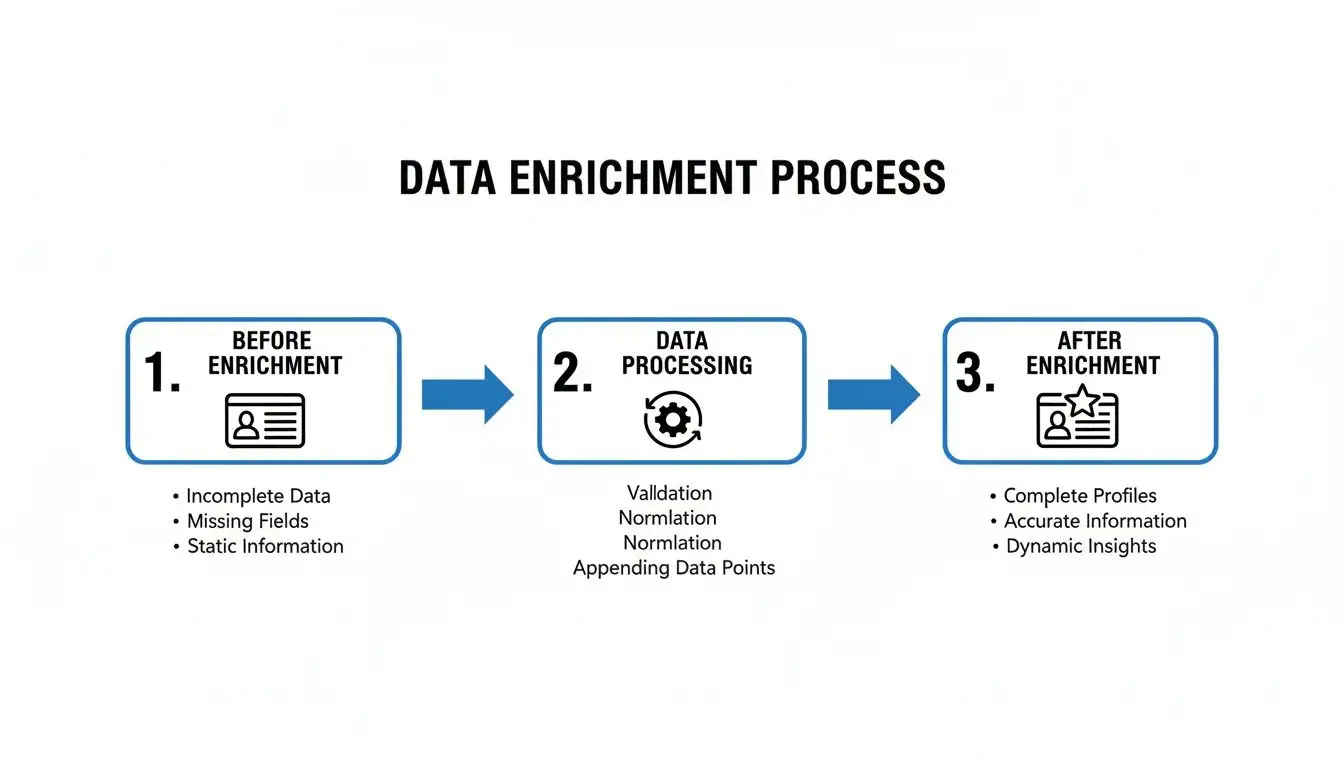
This simple visual nails the transformation: an incomplete lead becomes a complete, accurate profile that your sales team can actually use.
Choosing Your Speed: Batch vs. Real-Time
Data enrichment isn't a one-size-fits-all process, especially when it comes to timing. You have two main options, and the right choice depends entirely on what you're trying to accomplish.
1. Batch Enrichment
This is your "all-at-once" approach. You take a big list of contacts, maybe a CSV file with 50,000 leads, and upload it for a massive, one-time update. It’s the perfect solution for doing a major database cleanup or refreshing your entire CRM. Think of it like taking your car in for a full detailing; you drop it off and come back later to find it sparkling clean.
Batch enrichment is the go-to for large-scale data hygiene projects. It ensures your entire database is accurate and up-to-date, giving you a solid foundation for all your sales and marketing campaigns.
2. Real-Time Enrichment
This method is all about instant gratification. Real-time enrichment works on the fly, updating a single record the moment it hits your system. When someone fills out a "Contact Us" form on your website with just their name and email, an API call is made, and their profile is fleshed out with their company, job title, and industry in seconds. It’s like using Shazam to identify a song playing in a coffee shop: you get the info you need, right when you need it. This ensures every new lead is immediately qualified and ready for action.
Most businesses end up using a combination of both. You might run a batch process every quarter to keep your core database fresh, while using real-time enrichment to handle the daily stream of new leads. If you're curious about which platforms offer these capabilities, checking out different lead enrichment tools is a great way to see what fits your workflow.
Turning Enriched Data Into More Revenue
Alright, let's get to the part everyone actually cares about: How does all this fancy data stuff make you more money? Having clean, complete data is nice, but it’s the tangible sales outcomes that really matter. Data enrichment is what directly connects better information to bigger paychecks for your team.
It’s all about turning raw data into revenue by working smarter, not harder. This isn't just about making tiny improvements here and there; it’s about fundamentally changing how your sales team operates for the better. Let's break down three game-changing benefits that turn enriched data into a serious competitive advantage.
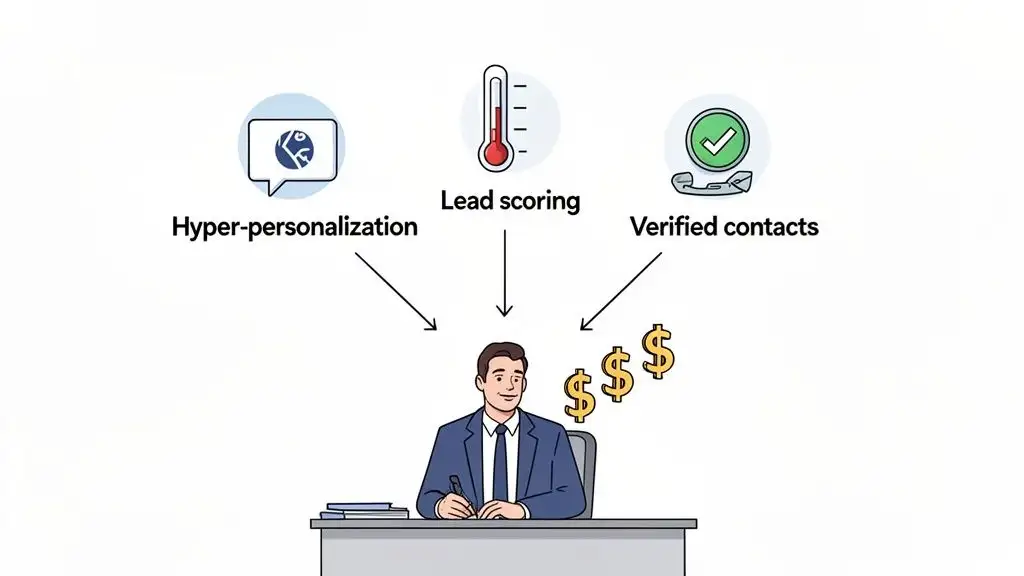
Think of these three pillars: personalization, smarter targeting, and verified contacts, as the engine that drives sales success.
Supercharge Your Personalization Efforts
Let's be honest, generic, one-size-fits-all outreach is dead. Prospects today can spot a lazy, templated email from a mile away, and it usually gets deleted faster than a bad Netflix recommendation. Data enrichment lets you move beyond the tired "Hi {first_name}" and craft messages that show you’ve actually done your homework.
Imagine this: instead of a generic pitch, your email opens with, "Saw your company just raised a Series B and adopted HubSpot. Congrats on the growth!" Suddenly, you're not just another salesperson; you're a well-informed advisor who gets their specific situation. This level of personalization is only possible with enriched firmographic and technographic data.
This isn't about being creepy; it's about being relevant. When your outreach reflects a genuine understanding of a prospect's business, they're far more likely to see you as a valuable partner, not just another vendor.
Pro Tip: You can use Munch to build sharp and targetted prospecting lists, enrich their data in waterfall motions and even craft personalized outreach messages - all in one platform!
Get Smarter With Lead Scoring
Newsflash: not all leads are created equal. Your sales team’s time is their most valuable asset, and wasting it on tire-kickers is a recipe for missed quotas. Data enrichment powers a much more intelligent lead scoring model, letting you prioritize the leads that are actually likely to close.
Instead of just guessing, you can automatically score leads based on critical data points like:
-
Company Size: Is this a one-person startup or a 500-employee enterprise ready to buy?
-
Annual Revenue: Do they actually have the budget for your solution?
-
Tech Stack: Are they already using complementary (or competitor) technologies?
-
Recent Funding: A fresh round of funding often signals a company is ready to invest in growth.
With this intel, your team can focus their energy on the red-hot opportunities, hitting them with the right message at exactly the right time. This targeted approach is a cornerstone of any effective strategy to build a sales pipeline that consistently delivers results. You stop chasing ghosts and start closing deals with prospects who are genuinely a good fit.
Dramatically Improve Connection Rates
What's the point of crafting the perfect message if it never even reaches the right person? Bounced emails and dead-end phone numbers are the bane of every sales rep's existence. It's the modern-day equivalent of screaming into the void.
Data enrichment solves this by providing verified, direct-dial phone numbers and accurate email addresses. This seemingly simple fix has a massive impact on your team's efficiency and morale. Some reports suggest sales reps can waste over 20 hours per month on manual data entry and fixing bad data. That's insane.
By arming your team with correct contact information, you slash that wasted effort. More of their time is spent having meaningful conversations and less of it is spent listening to a dial tone or getting bounce-back notifications. This isn't just an efficiency gain; it's a direct path to more meetings booked and more deals closed.
Picking Your Data Enrichment Playbook
Alright, you're on board. You see the power, you can practically smell the revenue. So, what's the next move? How do you actually get this data enrichment engine up and running?
When it comes down to it, you're standing at a fork in the road. You can either roll up your sleeves and build a system from the ground up, or you can partner with a specialized vendor who’s already mastered the game.
Let’s break down what each path looks like, starting with the ambitious DIY route.
The DIY Approach: Building In-House
Building your own data enrichment solution is kind of like deciding to build your own custom-fit race car. Sure, it's possible if you happen to have a team of elite engineers, a bottomless budget, and more time than you know what to do with. For most companies, though, it's a monumental project that spirals out of control fast.
Think about what it takes. You’d need to hunt down and license data from dozens of different providers, then build custom APIs to stitch them all together, not to mention managing rate limits and security. After that comes the really fun part: developing the mind-bending logic to clean, match, and merge all that information without creating a Frankenstein's monster of a database.
And it doesn't stop there. You're also on the hook for constant maintenance, navigating the murky waters of data compliance, and making sure everything stays current. It’s a full-time job for an entire department. Unless your company’s mission is to become a data aggregator, this path is usually a costly detour from what you’re actually good at.
Partnering with a Pro
This is the path most businesses take, and for good reason. Partnering with a third-party data enrichment vendor is the pragmatic, efficient, and sane choice. Take Munch for example - we have already done all the grueling work for you. We’ve built the infrastructure, forged the relationships with data sources, and fine-tuned the algorithms to match and append data with surgical precision.
Think of it as leasing that high-performance race car instead of building it. You get to feel the G-force and zip around the track immediately, without ever having to worry about engineering specs or engine maintenance. It lets you plug into a powerful, ready-made system and see results in days, not years.
Choosing a vendor lets your sales and marketing teams do what they do best: drive revenue. It prevents them from getting bogged down in a complex data engineering project. It's the fast track to getting high-quality, actionable data flowing right into your CRM.
In-House vs Third-Party Data Enrichment
So, how do you decide? This head-to-head comparison should make it crystal clear which data enrichment model is the right fit for your business.
| Factor | Building In-House | Using a Third-Party Vendor |
|---|---|---|
| Initial Cost | Extremely High: Requires massive investment in engineering talent, infrastructure, and data licensing. | Low: Typically a predictable subscription fee with minimal setup costs. |
| Time to Value | Long: Months, or even years, to build, test, and deploy a functional system. | Fast: Can be up and running in days or weeks, delivering immediate ROI. |
| Maintenance | Continuous & Complex: Requires a dedicated team for updates, bug fixes, and compliance. | Zero: The vendor handles all maintenance, updates, and infrastructure management. |
| Data Quality | Variable: Quality depends entirely on your team's ability to source and integrate data. | High & Consistent: Vendors specialize in data quality and have multi-source validation. |
| Flexibility | Total Customization: You can build it exactly to your unique (and often complex) specs. | Configurable: Offers strong flexibility through APIs and integrations but within a set framework. |
| Core Focus | Distraction: Pulls resources and attention away from your primary business goals. | Focused: Allows your team to concentrate on sales, marketing, and customer success. |
For the vast majority of businesses, the choice is obvious. Unless data enrichment is your product, partnering with a vendor delivers superior results with a fraction of the cost and headache.
Unlocking a Smarter Strategy: Waterfall Enrichment
Now, even after you choose a vendor, there’s a pro-level technique that separates the good from the great. It’s a clever strategy called waterfall enrichment, and it’s one of the most cost-effective ways to get the data you need.
Imagine you need a specific, hard-to-find piece of info about a lead. You could blast a message to all your contacts at once, but that's noisy and inefficient. A smarter way would be to ask your most reliable friend first. If they know, you're done. If not, you move on to the next person, and so on. You only expand your search when you have to.
That’s exactly how waterfall enrichment works with data providers. It pings them one by one, in a specific order, based on their accuracy and cost.
-
First Stop: The system starts by querying the best and most affordable provider for a specific data point, like a direct-dial phone number.
-
Got a Match? Stop. If it finds a high-confidence result, the process ends right there. You get exactly what you need for the lowest possible price.
-
No Luck? Keep Going. If the first source comes back empty, the system automatically moves to the second-best provider in the sequence, and continues down the line.
This sequential method guarantees you’re not paying multiple providers for the same piece of data. It’s an intelligent system that maximizes your fill rates without lighting your budget on fire, and it's a core feature in top-tier B2B lead generation software. This tiered approach is the secret sauce for getting the best possible data at the best possible price.
Common Data Enrichment Mistakes to Avoid
Data enrichment is a game-changer, but it's not a magic bullet for your sales pipeline. Treating it like one is the fastest way to turn your sparkling clean data project into an even bigger mess than what you started with. It's like getting a brand-new sports car but skipping the driving lessons: you’re more likely to hit a wall than the open road.
To keep your data sharp and your outreach on point, you need to steer clear of a few common traps. Think of this as the "read the instructions before you assemble the IKEA furniture" part of the guide. It’ll save you a ton of headaches, we promise.
The Single Source of Truth Fallacy
Putting all your faith in one data provider is a classic rookie mistake. It’s like getting all your news from a single source or only listening to one band your entire life. You end up with a very narrow, and likely skewed, view of the world. No single vendor has a monopoly on perfect, all-encompassing information.
Some providers are wizards at digging up direct-dial phone numbers, while others are masters of uncovering a company's tech stack. Relying on just one means you're inheriting all their blind spots. This inevitably leads to half-baked profiles and missed opportunities, completely defeating the purpose of enriching your data in the first place.
The Fix: Don’t put all your eggs in one basket. Embrace a multi-provider strategy, like waterfall enrichment, which pings several sources in a logical sequence. This approach seriously boosts your chances of finding accurate data without paying for the same info over and over again. Munch taps into more than 50+ providers to give you the most accurate data available.
Ignoring the Inevitable Data Decay
Here’s a cold, hard fact: your data has a shelf life, and it goes stale faster than a carton of milk left on the counter. People switch jobs, companies get acquired, and technology evolves. In fact, B2B data decays at a staggering rate of about 30% per year. That means nearly a third of your database could be totally useless in just twelve months.
Failing to account for this decay is like taking a "set it and forget it" approach to a garden. You might get a great crop the first season, but if you don't keep tending to it, you'll be left with a patch of weeds. An enrichment project you ran last year is now just a fossilized snapshot of a business reality that no longer exists.
The Fix: Data enrichment isn't a one-and-done task; it's a continuous part of your operations. Schedule regular data refreshes for your entire database, at least quarterly. For new leads and active accounts, use real-time enrichment to make sure you're always working with the freshest information available.
Forgetting About Privacy and Compliance
In the mad dash for more data, it's dangerously easy to brush past privacy regulations like GDPR and CCPA. Using data from sketchy, non-compliant sources isn't just bad form; it can land your company in a world of hurt with massive fines and a PR nightmare. It’s the business equivalent of downloading a movie from a dodgy website in the early 2000s: you never know what kind of trouble you're inviting.
One of the biggest compliance risks is adding contact details to records for people who never gave you permission. For example, if someone gives you their name but not their email, enriching that record with an email and then blasting them with marketing messages can be a direct violation. You have to be sure your data partners obtained their information legally. Good data governance isn't just a friendly suggestion; it's essential for staying in business. To learn more, check out our guide on how to verify email addresses the right way.
A Practical Guide to Using Enriched Data
Enough with the theory. Let's see what this looks like in the real world.
Picture a sales rep named Alex. In the old days, Alex’s morning started with a soul-crushing spreadsheet and a bottomless cup of coffee. It was a digital scavenger hunt, clicking through endless LinkedIn profiles and company websites, with no real prize at the end. That entire workflow is now dead.
Today, Alex's day starts with a unified sales intelligence platform. Instead of drowning in tabs, the system flags companies that just closed a new funding round or started using a new piece of tech that plays nicely with Alex's product. These aren't just leads; they're buying signals practically screaming, "We have money and a problem to solve!"
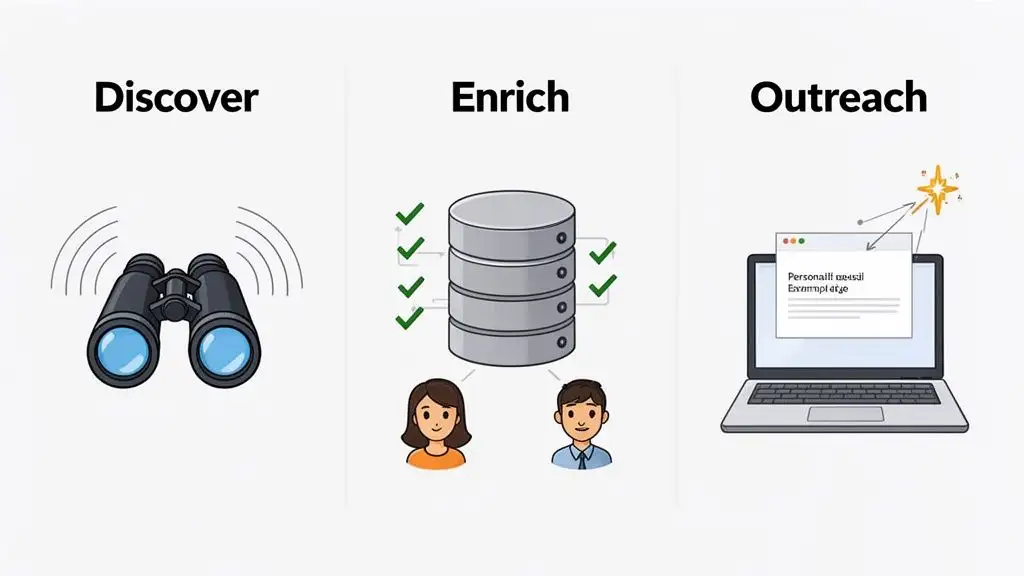
From Discovery to an Automated Deep Dive
The moment Alex spots a promising company, the magic kicks in. There's no frantic Googling or digging for a contact. Behind the scenes, a waterfall enrichment process instantly pings multiple data sources to pull in everything Alex needs to know.
Before Alex can even finish that first sip of coffee, the bare-bones lead record is transformed into a complete profile with:
-
Verified Contact Info: A direct-dial phone number and an email address with over 95% accuracy. Say goodbye to bounced emails.
-
Firmographics: Company size, industry, and annual revenue pop up, confirming it’s an ideal customer.
-
Technographics: The system flags that the prospect uses a specific CRM, handing Alex the perfect icebreaker on a silver platter.
This isn't about filling in empty boxes. It's about building a 360-degree view of the prospect automatically. The platform does all the grunt work, saving hours Alex used to burn on mind-numbing manual tasks.
The old way was like trying to build a puzzle with half the pieces missing. A unified platform gives you the finished picture, so you can focus on strategy, not searching.
Crafting Outreach That Actually Gets a Reply
Now, the fun part: turning all that rich data into a message that someone will actually read. The platform’s AI doesn’t just recycle some tired, generic template. It scans the enriched data points to draft a hyper-personalized email and LinkedIn message.
For instance, the AI might generate an opening line like: “Saw your team just adopted Salesforce and closed a Series B. Huge congrats! Companies in your industry often tell us that getting their new tech stack under control is a top priority after a big funding round.”
This message is timely, relevant, and makes it look like Alex spent an hour doing research, even though the AI did the heavy lifting. This is where it all comes together. By merging discovery, enrichment, and outreach into one fluid motion, Alex stops being a data janitor and becomes a strategic seller: someone who starts meaningful conversations that actually close deals.
Got Questions? We've Got Answers.
Alright, let's tackle some of the common questions that pop up when teams first dip their toes into the world of data enrichment.
How Often Should I Refresh My Sales Data?
Think of your data like fresh produce: it doesn't stay good forever. Data enrichment isn't a "set it and forget it" task. People switch jobs, companies get bought, and entire tech stacks change overnight. B2B data has a surprisingly short shelf life.
For the hot leads you're actively working, you need real-time enrichment. This ensures you’re always operating with the latest, most accurate info right when it matters most. For the rest of your database, running a big batch update every three months or so is a great rule of thumb to keep things from getting stale.
Is Data Enrichment Actually Useful for ABM?
Useful? It's essential. Trying to run an Account-Based Marketing (ABM) campaign without data enrichment is like trying to navigate a new city without a map. You might get somewhere eventually, but it's going to be a messy, inefficient trip.
Enrichment is what gives you the rock-solid firmographic and technographic details you need to pinpoint your ideal target accounts. It doesn't just tell you which companies to go after; it gives you the contact info for the key players on the buying committee. This lets you tailor your message to everyone involved, not just a single contact you happened to find.
Simply put, ABM without enrichment is a guessing game. With enrichment, it’s a surgical strike.
Is This Stuff Even Legal?
Yes, as long as you're smart about where you get your data. If you're buying lists from some shady corner of the internet, you're asking for trouble. But working with a reputable vendor is a completely different story.
Legit providers pull their information from public sources, like company websites, press releases, and public filings, or they work with partners who have already secured the proper consent. A good platform will be totally upfront about its data sources and will be fully compliant with major privacy laws like GDPR. This means you can build your pipeline without worrying about legal headaches.
Ready to stop guessing and start selling with data that actually works? Munch unifies lead discovery, waterfall enrichment, and AI-powered personalization into one seamless workflow. Find high-intent prospects and launch outreach that gets replies. Discover your next customer with Munch today.