Unlocking Sales Intelligence To Find And Close High Intent Deals

By Mriganka Bhuyan
•Founder at Munch

Ever feel like your sales team is playing Battleship in the dark? You call out 'B4,' hoping to hit a prospect, but mostly you just hear 'miss.' Sales intelligence is the cheat code that turns on the lights and reveals the entire board. It’s all about gathering and making sense of data to find the right companies, figure out when they're ready to buy, and know exactly what to say when you reach out.
It's the difference between fumbling around and striking with precision.
Why Sales Intelligence Is Your New Secret Weapon
Old-school prospecting is a grind. You buy a stale list, make a hundred cold calls, and cross your fingers for one decent conversation. It's draining, inefficient, and about as fun as watching paint dry. Sales intelligence completely flips the script, swapping out blind guesswork for a data-backed strategy.
Instead of just getting a name and a company, you're handed a full dossier on your prospects. Think of it like this: would you rather show up to a party knowing no one, or arrive with a friend who gives you the full rundown on every guest? You’d know exactly who to talk to, what they're into, and how to kick off a great conversation.
Going Beyond The Basic Contact List
At its heart, sales intelligence gives you the critical context that turns a cold, awkward outreach into a warm, relevant one. This isn't just about snagging an email address; it’s about understanding the "why" behind your call or email.
This powerful approach is built on a few key types of data:
-
Firmographics: The company vitals like size, industry, revenue, and location. This is how you define your ideal customer profile (ICP).
-
Technographics: The specific tech stack a company uses. For example, knowing they use a competitor or a complementary tool is your perfect way in.
-
Buying Signals: This is the secret sauce. These are real-time events that scream "opportunity!" Think of a new funding round, a key executive hire, or a surge in hiring for a specific department.
This shift from "who" to "when" and "why" is exactly why the sales intelligence market is set to explode, projected to jump from USD 4.42 billion in 2025 to a massive USD 9.15 billion by 2031. AI is the engine behind this growth, cutting down prospect research time from hours to minutes by instantly spotting those crucial buying signals. You can read the full research on this market growth to see the trends for yourself.
Sales intelligence isn't just a luxury for massive enterprise teams anymore. It's a must-have for any B2B company that wants to build a predictable, scalable revenue engine and let reps focus on what they do best: closing deals.
To really grasp the difference, let's put the old way and the new way side-by-side.
Traditional Prospecting vs Sales Intelligence
| Activity | Traditional Prospecting (The Guessing Game) | With Sales Intelligence (The Winning Strategy) |
|---|---|---|
| Finding Leads | Buying stale lists or manual web scraping. | Getting real-time alerts on companies that fit your ICP and are showing buying intent. |
| Outreach | Generic, one-size-fits-all email blasts. | Hyper-personalized messages based on recent company events or tech stack needs. |
| Timing | A shot in the dark, hoping you catch them at the right moment. | Engaging prospects at the exact moment they need a solution like yours. |
| Efficiency | High volume, low conversion. Reps spend 80% of their time prospecting. | Low volume, high conversion. Reps spend 80% of their time selling. |
| Result | Frustrated reps, annoyed prospects, and a leaky sales funnel. | A predictable pipeline, happy reps, and delighted customers. |
See the difference? One is a numbers game based on luck; the other is a strategy game based on insight.
Exploring the best sales intelligence software can give you a feel for the tools that make this possible. These platforms are the engines that turn raw data into real opportunities. A great first step is simply understanding who is already checking you out. In our guide, we explain how to track website visitors and turn that anonymous traffic into your next big deal.
Pro Tip: Platforms like Munch helps you build your prospect list, enrich their contact information in a waterfall motion and crafts personalized outreach messages by researching your lead's Linkedin posts and their company's news and announcements.
The Four Pillars of Actionable Sales Data
So, how does all this sales intelligence magic actually happen? It's not sorcery, but it is incredibly smart data. Think of it like a killer recipe for outreach. You have four key ingredients that, when mixed just right, create something amazing. You can't just use one; you need the full set, like the four original members of Destiny's Child or the wheels on a car.
This simple flowchart breaks down how these pieces fit together, moving from raw data collection all the way to a perfectly tailored message for your prospect.
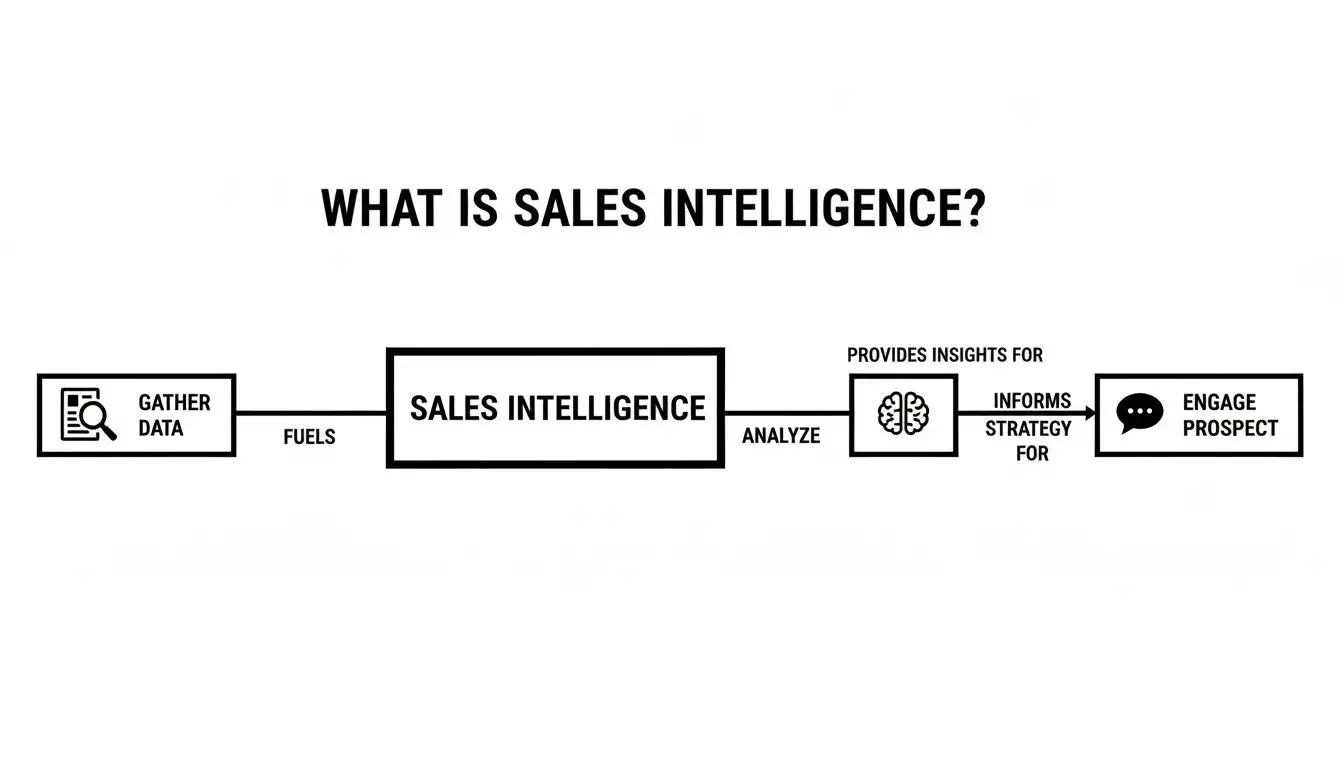
At its heart, the process is simple: gather, analyze, and engage. This is the foundation of any sales intelligence strategy that actually works.
Buying Signals: The When
Think of buying signals as the Bat-Signal for sales reps. They’re real-time events that scream, "This company isn't just a good fit, they're a good fit right now." These signals slice through the endless noise and tell you exactly when to make your move.
But not all signals are created equal. A generic one is totally useless. What you need is an actionable buying signal, something so specific it points to an immediate need.
-
Weak Signal: "Company shows interest in marketing automation." (Yawn. So what?)
-
Strong Signal: "Company just posted three new job openings for 'Marketing Automation Specialist' and their Head of Marketing recently followed HubSpot on LinkedIn."
See the difference? The second one gives you a person to contact, a clear reason to reach out, and even a specific technology to reference. You're no longer shooting in the dark; you're responding to a flashing neon sign.
Data Enrichment: The What
Okay, so a buying signal just lit up your dashboard. Awesome! But who do you call? This is where data enrichment swoops in to fill in the blanks. It takes a basic lead like a name and a company and layers on all the juicy details you need. It’s like turning a blurry, pixelated photo into a crystal-clear 4K image.
We're not talking about finding a generic info@company.com email address. Real enrichment uncovers verified, direct-dial phone numbers, accurate personal emails, and detailed firmographic data.
A lead without enriched data is just a name on a list. A lead with enriched data is a person with a problem you can solve, a direct line you can call, and a tech stack you can integrate with.
For a deeper dive into this, check out our full guide on what is data enrichment and see how it fuels winning sales campaigns.
Lead Scoring: The Who
With a flood of timely signals and richly detailed data, you could easily have hundreds of potential leads. Now what? Lead scoring is the sorting hat that tells you which prospects belong at the very top of your call list. It automatically ranks every lead based on how well they match your Ideal Customer Profile (ICP) and the strength of their recent buying signals.
A good scoring model does the prioritizing for you. For example, a 500-person tech company that just landed Series B funding and is hiring new sales reps might get a score of 95/100. Meanwhile, a 10-person agency with zero recent signals might score a measly 30/100.
This ensures your reps spend their precious time on the accounts most likely to close, not chasing leads that are colder than a polar bear's toenails.
AI Personalization: The How
This is where it all comes together in a beautiful symphony. AI personalization takes all the intel you’ve gathered, including the signals, the enriched data, and the lead scores, and helps you write the perfect outreach message. It goes way beyond "Hi {first_name}" and generates hyper-relevant conversation starters based on what’s happening right now.
The growth here is absolutely staggering. Modern AI can digest signals from over 100,000 sources to obliterate research time. This is a huge reason why the sales intelligence market is projected to rocket from $8.519 billion in 2025 to $29.13 billion by 2035. The whole push is about making every single conversation feel warm, relevant, and human.
These four pillars are a team. A signal without enrichment is just an alert with no one to contact. A lead with great data but no scoring is a needle in a haystack. And the perfect lead without personalized outreach is a golden opportunity, completely wasted.
Putting Sales Intelligence Into Action
Alright, enough theory. Knowing the "what" and "why" is great, but the real fun begins when you see sales intelligence work its magic in the wild. It’s like knowing all the cheat codes for a video game but never actually playing. Let's look at how savvy B2B teams are using these insights to run circles around their competitors.
This isn’t about abstract ideas; it’s about concrete sales plays that generate real revenue. These examples show how tracking the right signals turns your sales team from hopeful guessers into strategic sharpshooters who always seem to be in the right place at the right time.
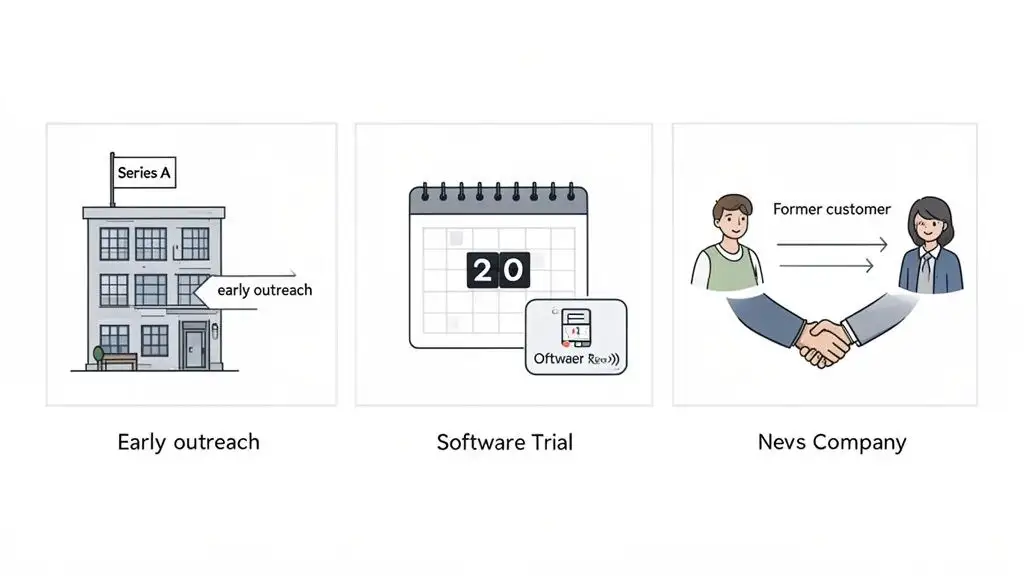
The Early Bird Play: Capitalizing on Funding News
Imagine you sell a premium SaaS product that helps startups scale their operations. Your Ideal Customer Profile (ICP) is a tech company that just secured a significant funding round, because you know they’re about to go on a hiring and spending spree.
Without sales intelligence, you’d probably find out about their $20 million Series A a week later from a tech blog. By then, your competitors have already flooded the founder’s inbox. But with a sales intelligence platform, you get an automated alert the moment the funding is announced.
Your rep immediately reaches out with a hyper-relevant message:
"Congrats on the Series A, Jane! Scaling after a big raise is both exciting and chaotic. We helped [Similar Company] streamline their onboarding process when they were at your exact stage. Worth a quick chat next week?"
This isn't a cold email; it's a timely, informed conversation starter. You’re not just another vendor. You’re the first one to the party, and you came bearing gifts.
The Competitor Swoop: Identifying Expiring Trials
Here's another killer move. Let's say your agency builds high-converting landing pages. You know that many of your potential clients use a popular, but often clunky, DIY landing page tool. A key buying signal for you is when a company’s free trial for that rival software is about to end.
A good sales intelligence tool can track technographic data, including trial versions of software. Your system flags a company that fits your ICP whose 14-day trial with "LandingPageBuilder 5000" ends this Friday.
Your team swoops in on Thursday with a perfectly timed offer:
"Hey Mark, saw you might be testing out new landing page solutions. If you're not 100% sold on the results, we can build a custom, high-performance page that's proven to double conversion rates for B2B tech. Can I send over a few examples?"
You’ve just intercepted a prospect at their exact moment of need, right when they’re evaluating their options. It’s the sales equivalent of a perfectly executed alley-oop. Understanding effective prospecting and sales techniques like this can dramatically shorten your sales cycle.
The Champion Tracker: Following Past Customers
One of the easiest sales you'll ever make is to a happy former customer. The problem is, people change jobs all the time. Tracking job changes is one of the most powerful yet underutilized buying signals in B2B sales.
Think about it. You had a fantastic relationship with Sarah, the VP of Marketing at an old client. She loved your product and was your internal champion. Last week, she quietly updated her LinkedIn profile; she just started a new role at a bigger company.
Your sales intelligence platform pings you instantly. Before her new chair is even warm, you send her a congratulatory note.
"Sarah, this is amazing news! Huge congrats on the new role at InnovateCorp. They’re lucky to have you. Once you’re settled, I’d love to show you how our latest features could help you make a huge impact in your first 90 days."
You’ve just turned a past success into a warm lead at a new enterprise account. You get to skip the gatekeepers and go straight to a decision-maker who already knows, likes, and trusts you. That's not just smart selling; it's a guaranteed pipeline booster.
Top Buying Signals And How To Use Them
To really drive this home, let’s break down some of the most valuable buying signals you can track. Think of this table as a playbook for turning data points into dollars. Each signal is a green light, an open door to a highly relevant conversation.
| Buying Signal | What It Means | Your Sales Play |
|---|---|---|
| New Executive Hire | The new leader is looking to make an impact in their first 90 days and has a fresh budget. | Reach out with a "congrats" message and offer insights or tools to help them achieve a quick win in their new role. |
| Company Expansion | They are opening a new office or entering a new market, which means new operational needs. | Offer solutions that support growth, from logistics and hiring to new marketing and sales tech stacks for that region. |
| Negative Competitor Mention | A prospect publicly complains about their current vendor on social media or a review site. | Jump in with a helpful, empathetic comment. Follow up privately to offer a better, pain-free alternative. |
| High Web Intent | A target account has multiple employees visiting your pricing page or case studies. | Trigger an alert for your sales rep to prioritize this account. Send a personalized email referencing the content they viewed. |
| Technology Change | They've just dropped a competitor's software or added a complementary tool from your ecosystem. | If they dropped a rival, reach out. If they added a complementary tech, propose an integrated solution. |
These are just a few examples, but you can see the pattern: a signal happens, and you respond with a perfectly tailored, timely, and relevant action. That's the core of modern, intelligent selling. And by the way, integrating lead scoring into a business intelligence dashboard can help you automate and prioritize these signals at scale.
How to Build a Sales Intelligence Strategy
Alright, let's get down to business. Having a powerful sales intelligence tool without a strategy is like handing the keys to a spaceship to someone who can't drive a car. It's cool, but you’re not going anywhere. Building a real strategy is how you stop flying blind and start hitting your targets with precision.
This isn’t just about buying software; it's about building a smarter workflow. As Morpheus told Neo in The Matrix, you have to free your mind. Your tools are only as good as the strategy you build around them.
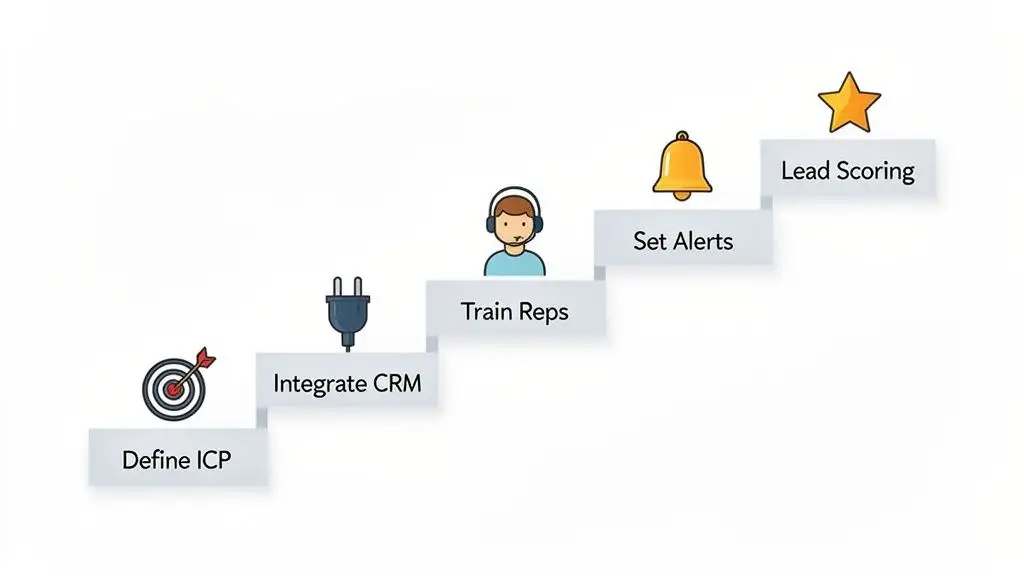
Nail Your Ideal Customer Profile
Everything starts here. If you don't know exactly who you're selling to, the best data in the world is useless. Your Ideal Customer Profile (ICP) is your North Star, guiding every single decision you make. Don't settle for vague descriptions like "mid-sized tech companies."
Get specific. What’s their employee count? What’s their annual revenue? What specific technologies are already in their stack? Define the exact pain points you solve for them. A sharp ICP ensures your sales intelligence platform isn't just finding leads, but finding the right leads. You can explore our guide for an ideal customer profile template to get started.
Integrate and Automate Your Workflow
Once you know who you’re looking for, it's time to wire everything together. A standalone sales intelligence tool creates more work, not less. The real magic comes from integrating it directly into your existing CRM and sales platforms.
This creates a seamless flow of information. When a new high-intent lead is identified, it should automatically pop up in your CRM, already enriched with contact data and buying signals. This move alone eliminates mind-numbing manual data entry and lets your reps focus on one thing: selling.
Your sales intelligence platform should feel like a native part of your CRM, not another tab you have to remember to check. The goal is to reduce clicks and increase conversations.
Set Up Your Buying Signal Alerts
This is where the fun really begins. You need to configure your platform to listen for the specific events that matter to your business. These automated alerts are your early warning system for hot opportunities.
Start by defining your top 3-5 buying signals. These could be:
-
Funding Events: A company in your ICP just landed a new round of funding.
-
Key Hires: A target account just hired a new VP of Sales.
-
Technology Changes: A prospect started a free trial of a competitor's product.
Set up real-time alerts for these triggers. When a signal fires, your reps should be the first to know, allowing them to craft timely, hyper-relevant outreach before anyone else even knows what's happening.
This global focus is becoming more important. North America currently leads the sales intelligence market, commanding over 35% of the global share. However, with the Asia Pacific region showing the fastest growth, your strategy must be ready to scale internationally.
Arm Your Reps with Smart Templates
Finally, you need to empower your team to act on this newfound intelligence. Rich data is great, but it needs to translate into compelling outreach that actually gets replies. Create a library of outreach templates designed to be personalized with the juicy data you now have.
Don't just use {first_name}. Build templates around specific buying signals. For example, have a "New Funding" template or a "Competitor Mention" template. These semi-automated but highly personal messages give your reps a massive head start, combining the speed of automation with the touch of human insight.
Alright, let's take that section and give it a real human touch, making it sound like it's coming straight from a seasoned sales pro who's seen it all.
3 Sales Intelligence Traps That'll Sabotage Your Success
So, you’ve just rolled out a shiny new sales intelligence platform. High fives all around! But before you start printing those oversized commission checks, let's talk about the banana peels on the floor. It's easy to get so excited about the new tech that you stumble right into some classic, face-palm-worthy mistakes.
Think of it like getting a top-of-the-line kitchen. You have the best knives and the fanciest stove, but if you don't know how to cook, you're still just going to burn the toast. Let's make sure you're cooking up five-star deals, not setting off the smoke alarm.
Mistake #1: Drinking from the Data Firehose
The most common trap is getting completely buried in data. Your new platform is a firehose of buying signals, enriched contacts, and market insights, and your team is standing there with a thimble. It's overwhelming. Suddenly, your reps are spending more time scrolling through notifications than actually talking to prospects.
Having a million data points doesn't mean you have a million opportunities. Most of the time, it just means you have a million distractions. Reps get paralyzed by choice, unsure which of the thousand "signals" is the one that actually matters.
The fix? Get ruthless with your filters.
-
The goal isn't to see everything. The goal is to see only what's important.
-
Tune your platform to surface only the top 5-10% of leads that are a perfect fit for your Ideal Customer Profile (ICP).
-
Focus on high-intent signals that scream "buy now!", like a company announcing a Series B funding round, not just a whisper like a random social media mention.
Mistake #2: The "Set It and Forget It" Sinkhole
This one's a classic. You and your team spend a solid week getting everything dialed in. Your ICP is perfect, the buying signals are on point, the templates are golden. Then you dust off your hands, walk away, and never look back. Big mistake.
Markets don't stand still. Your competitors are changing their tactics, new challenges are emerging for your customers, and the ICP you defined six months ago might as well be a historical artifact. That "golden" buying signal you found? Everyone knows about it now, and you're just another latecomer to the party.
Your sales intelligence strategy needs regular check-ups. Schedule a quarterly review to see what's actually working. Which signals lead to the most booked meetings? Which outreach templates are getting replies? Your strategy should be a living, breathing thing, not a dusty instruction manual on a shelf.
Treat it like a garden. You can’t just throw some seeds on the ground and expect a harvest. You have to keep weeding, watering, and pruning to get results.
Mistake #3: Letting the Robots Take the Wheel
Look, the AI behind these platforms is incredible. It can dig up the perfect lead and even draft a killer opening line based on a recent company news bite. But don't make the mistake of thinking it can do everything. Relying too heavily on automation is a surefire way to sound like... well, a robot.
Prospects can smell a generic, automated email from a mile away. It has all the personality of a self-checkout machine. It might be efficient, but it creates zero connection.
The secret is to strike the right balance.
-
Let the tech do 80% of the grunt work which includes research, data entry, and initial drafting.
-
This frees up your reps to focus on the crucial final 20%: adding that human touch. A clever observation, a personal anecdote, or a genuine question that shows they've actually done their homework and aren't just hitting "send" on a template.
Sales intelligence tees up the perfect shot, but a human still has to be the one to kick the ball into the net.
So, Is Your Sales Team Ready to Level Up?
Alright, let's bring it all home. We've toured the entire world of sales intelligence, from sniffing out buying signals to sidestepping the classic implementation traps. Now we get to the big question: how do you really know if it’s time for your team to make the jump?
Forget the crystal ball. The answer is staring you right in the face in your team's daily grind and your weekly results.
Are your reps drowning in a sea of manual research, spending more time on LinkedIn than on the phone? Does your pipeline look less like a steady climb and more like a Six Flags rollercoaster? If your outreach emails are met with the sound of crickets, it’s a sign. It’s time for a change.
Sales intelligence isn't just another shiny object to add to your tech stack. It’s a complete upgrade to your team's operating system, a fundamental shift from guessing to knowing. It’s the difference between showing up to the party an hour late and being the one who knew the host’s favorite drink before you even walked in.
What the Winning Workflow Actually Looks Like
The real magic happens when you bring all this power under one roof. We’re not talking about juggling three different tools and a Frankenstein's monster of spreadsheets. A true sales intelligence platform creates a seamless, repeatable workflow that turns every rep into an expert on every single account.
It breaks down like this:
-
Spot the Signal: It all begins with automatically flagging companies that are not only a perfect fit but are actively showing they’re ready to buy right now. Say goodbye to stale lists and shots in the dark.
-
Get the Goods: With a single click, your team gets the direct dials, verified emails, and deep-dive company insights they need to start a meaningful conversation. This step alone can hand reps back 3 to 5 hours a week.
-
Go in Warm: Finally, the platform helps you craft outreach that’s timely, relevant, and sounds like it came from a real person, not a robot. That’s how you make a killer first impression every time.
This unified approach is how you unlock all the massive benefits we've been talking about. You can dig deeper into supercharging your process with our guide to top-tier sales AI tools.
In today’s market, selling smarter isn't just an option, it's the only way to win. Your competition is already using this data to get in the door faster and build stronger relationships. The real question is, can you afford not to?
The goal here is simple: get your sellers out of the data mines and back to doing what they do best which is building relationships and closing deals. It’s about swapping rep burnout and inconsistent quarters for a predictable, scalable revenue machine.
If you're tired of doing things the old way, a smarter path is waiting for you.
Still Got Questions? We've Got Answers
Alright, let's tackle some of those lingering questions you might have. Think of this as the after-party conversation where we get into the nitty-gritty. Here are a few of the most common things people ask when they're ready to dive into sales intelligence.
How Is Sales Intelligence Different from a CRM?
Great question. Think of your CRM like a meticulously organized address book. It’s brilliant for keeping track of everyone you already know. All your past conversations, notes, and history are right there. It’s your system of record, your source of truth for existing relationships.
Sales intelligence, though, is more like having a well-connected friend who’s always out and about, hearing the latest town gossip. It doesn't just manage your current contacts; it actively finds new people you need to meet. It tells you who’s new in town, who’s looking to make a big purchase, and what they care about right now.
Your CRM is your history book, managing the who. Sales intelligence is your crystal ball, revealing the why now and what's next.
Essentially, your CRM holds your past and present, while sales intelligence uncovers your future opportunities.
Can a Small Startup Really Benefit from This?
Not only can they, but they arguably need it more than the big guys. When you're a small team with a brand that isn't a household name, every single sales interaction has to count. You simply don't have the resources to waste on leads that go nowhere.
Sales intelligence is the great equalizer. It’s the slingshot in a David-and-Goliath fight. It lets a nimble startup be smarter, faster, and more relevant than a lumbering corporate giant. Instead of blasting out a generic email to 1,000 cold contacts and hoping for the best, a founder can zero in on 20 ideal prospects who are already showing signs they're ready to buy.
And don't assume this is just for enterprises with deep pockets. Modern tools are surprisingly accessible, giving you the same kind of data horsepower that used to be locked away in Fortune 500 companies. It's the difference between fumbling in the dark for product-market fit and strategically finding your first true fans from day one.
How Quickly Will I Actually See Results?
You’ll see the first impact almost immediately, just maybe not where you expect. The very first win is time. Right out of the gate, your reps get back 3 to 5 hours a week that they used to spend digging for contact info and researching prospects. That's time they can now spend, you know, actually selling.
As for pipeline, you can be engaging with hot leads within the first week of turning on your buying signal alerts. Building a truly robust, predictable pipeline might take a full quarter, but you should absolutely see a bump in positive replies and meetings booked within the first 30 to 60 days. That’s typically how long it takes for the team to find their groove and start weaving those data-driven insights into their outreach.
Ready to stop guessing and start selling with surgical precision? Munch brings lead discovery, data enrichment, and AI personalization together in one place. Find prospects who are ready to buy and craft outreach they’ll actually want to read. Start building your predictable pipeline today.