Mastering Prospecting In Sales: A Guide to Better Leads

By Mriganka Bhuyan
•Founder at Munch
Let's be honest, sales prospecting is the engine room of any successful sales operation. It's the art and science of finding potential customers, your future raving fans, and starting a conversation that leads to a sale. It’s the very first, and arguably most important, step in the sales dance. The goal? To sift through the noise and find the people or businesses who are a perfect fit for what you're selling.
What Is Sales Prospecting and Why Does It Feel So Hard?

If you've ever felt like you're just shouting into the void, hoping a customer shouts back, you're not alone. Prospecting often gets a bad rap as a soul-crushing grind of cold calls and robotic emails. But that’s the old way of thinking. True prospecting isn't about just jamming your calendar with meetings; it’s about building a reliable, predictable pipeline filled with people who are actually glad you called.
The days of a rep smiling and dialing their way through the phonebook are long gone. Today's buyers are incredibly savvy. They do their own homework and can sniff out a generic, copy-pasted email from a mile away. Using those outdated tactics is like showing up to a lightsaber fight with a pool noodle. It's just not going to connect.
The Modern Prospecting Challenge
The real game today is about finding the right people, at the right time, with a message that actually resonates. It's shifted from a game of volume to a game of precision. In the hyper-competitive world of B2B sales, just getting a foot in the door requires some serious grit. It takes reps, on average, a staggering 18 dials just to connect with a single buyer. To beat those odds, high-growth companies are now using an average of 16 touchpoints per prospect over just a couple of weeks to break through.
This means we have to be smarter, not just louder. Think less shotgun blast, more sniper shot, perfectly aimed and timed. Effective prospecting is built on a foundation of deep research and a genuine curiosity about a prospect's business and their unique challenges. For a solid game plan, checking out a proven playbook on how to generate leads for B2B can make all the difference.
The secret to great prospecting is relevance. If your message isn't relevant to what's happening in their world right now, you're just another notification to be swiped away. Your job is to cut through that noise with a message that screams, "I see you, I get your problem, and I might just have the answer."
So, what makes it feel like such an uphill battle? The bar for earning someone's attention has never been higher. Buyers are drowning in information and interruptions. They're not looking for another vendor; they're looking for a partner who brings value from the very first conversation.
Your success boils down to a few key ingredients:
-
Pinpoint Targeting: Are you zeroing in on the companies and people who are a dead-on match for your Ideal Customer Profile?
-
Irresistible Messaging: Is your outreach personalized and crafted to speak directly to their pain points, not your product features?
-
Strategic Timing: Are you reaching out when they're most likely to be thinking about the exact problem you solve?
Nail these, and prospecting transforms from a frustrating numbers game into a repeatable system for generating fantastic leads. To really sharpen your edge, diving into the world of sales intelligence is a non-negotiable.
Stop Selling to Everyone and Build Your Ideal Customer Profile
Let's be honest. Trying to sell to every business with a pulse is a classic rookie mistake. It’s the sales equivalent of swiping right on every single person on Tinder. Sure, you'll get a lot of matches, but the quality will be questionable, and you'll burn a ton of energy on dead ends.
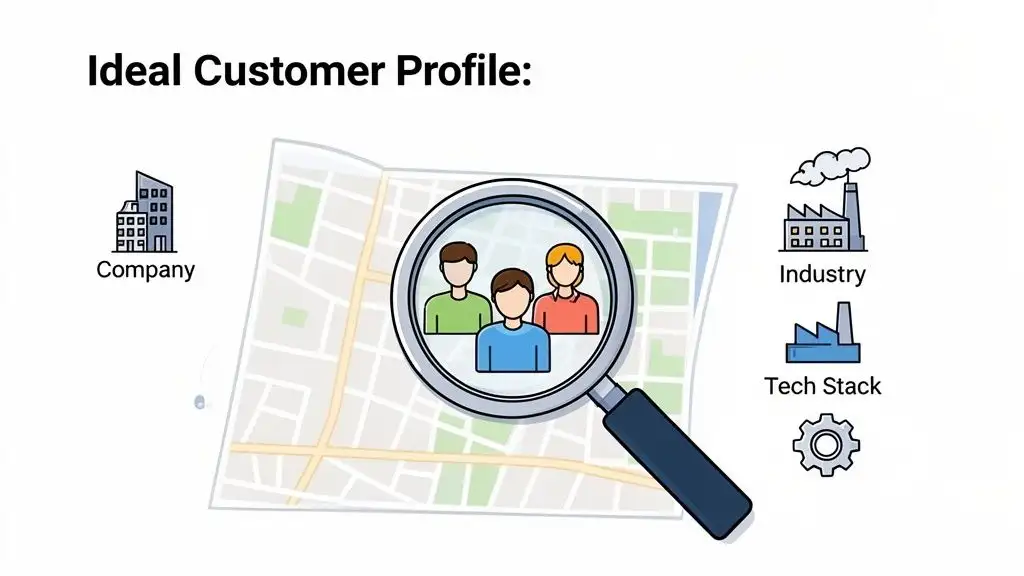
A well-defined Ideal Customer Profile (ICP) is your sales GPS. It’s a crystal-clear description of the company that gets the absolute most value from what you offer. This isn't just some feel-good marketing exercise; it's a strategic filter that stops you from chasing prospects who were never going to buy anyway.
Think of your ICP like Netflix's recommendation algorithm. Netflix doesn't just throw random movies at you. It analyzes what you've watched, what you’ve rated, and who you are to predict what you’ll love next. A solid ICP does the same for your sales efforts, pointing you directly to the companies that are practically lining up to become your next raving fans.
Decoding Your Best Customers
The secret to building a killer ICP is to look backward before you look forward. Your happiest, most successful current customers are holding all the cheat codes. They’ve already proven they need your solution, so your job is to find more companies just like them.
Start by digging into your top 10 customers. Don’t just ask if they're happy; find the common threads that tie them all together.
-
Firmographics: What's their size (both employee count and revenue)? What industry are they in? Where are they located? For example, you might discover your sweet spot is B2B SaaS companies in North America with 50-250 employees.
-
Technographics: What tools are they already using? Do they all use HubSpot for marketing, Slack for communication, and AWS for hosting? Knowing their tech stack can reveal integration opportunities or signal their tech-savviness.
-
Behavioral Traits: How did they find you? What was the "aha!" moment that made them sign on the dotted line? What specific, nagging problem did your solution make disappear? For instance, maybe they all signed up after a major funding round because their old systems couldn't keep up with the new growth. This is where you uncover the pain points that actually drive action.
Here’s a look at the data points you’ll want to gather to build out a truly useful ICP.
Ideal Customer Profile (ICP) Components
This table breaks down the essential data points needed to build a robust and actionable Ideal Customer Profile for targeted sales prospecting.
| Data Category | Key Metrics | Example (for a B2B SaaS company) |
|---|---|---|
| Firmographics | Industry, Company Size (Employees & Revenue), Geography | B2B Technology, 50-250 employees, $10M-$50M ARR, North America |
| Technographics | CRM, Marketing Automation, Cloud Provider, Project Management Tools | Salesforce, HubSpot, AWS, Jira |
| Pain Points | Business Challenges, Inefficiencies, Missed Opportunities | Inefficient lead follow-up, poor sales-marketing alignment, difficulty tracking ROI |
| Buying Triggers | Recent Funding, New Executive Hires (VP Sales/Marketing), Expansion | Just raised a Series B round, Hired a new CRO, Expanding into the EMEA market |
| Success Metrics | Key business outcomes they achieve with your product | Increased lead conversion rate by 20%, Shortened sales cycle by 15%, Improved team productivity |
Once you identify these patterns, you’ve basically built the blueprint for your perfect-fit customer. This isn't theory; it's a data-backed profile that makes prospecting infinitely easier. If you need a hand organizing your findings, our guide provides a fantastic ideal customer profile template to get you started.
From Company Profiles to Human Personas
Okay, so the ICP tells you which companies to target. But you don't sell to a building or a logo; you sell to a person inside that company. This is where the buyer persona comes into play. A buyer persona is a semi-fictional character representing the actual human you need to get in front of.
An Ideal Customer Profile gets you to the right building. A Buyer Persona gets you past security and into the right office.
While your ICP might be "Mid-Market Tech Companies," your buyer persona could be "Sarah, the VP of Marketing."
To build a truly useful persona, you need to get inside Sarah's head and understand her day-to-day reality:
-
Her Role: What are her key responsibilities? What metrics does her boss hold her accountable for? (e.g., Lead generation, MQL to SQL conversion rates).
-
Her Pains: What keeps her up at night? Is she drowning in spreadsheets trying to prove marketing ROI? Is her team bogged down by manual, repetitive tasks?
-
Her Goals: What does professional success look like for her? Is she trying to get that next promotion? Is she on a mission to finally implement a new marketing automation platform that actually works?
This level of detail completely transforms your outreach. Instead of sending a generic email about your "amazing features," you can send a hyper-relevant message to Sarah about how you can solve her specific ROI reporting headache. That’s how you make your prospecting brutally effective.
Find Prospects Who Actually Want to Hear From You
Let's be honest, most prospecting feels like digging through a digital dumpster for leads. It’s a grind. But what if you could stop searching for a needle in a haystack and instead find haystacks made entirely of red-hot, ready-to-buy needles?
The secret is shifting your focus. Stop asking "who fits my ideal customer profile?" and start asking, "who fits my ICP and is practically waving a flag that says they need me right now?"
These flags are what we call buying signals. They’re your new secret weapon. When you spot one, your outreach isn't some cold, annoying interruption. It's a timely, relevant, and often welcome conversation. It’s the difference between crashing a party and being the guest of honor.
Tune Into Key Buying Signals
Your mission, should you choose to accept it, is to become a master at spotting these triggers. Instead of just mindlessly scrolling through LinkedIn, you'll be on a hunt for specific events that scream "opportunity." Think of yourself as a detective, piecing together clues that lead you straight to a perfect prospect who's already looking for help.
Here are the big ones I always look for:
-
New Executive Hires: A new CMO, CRO, or VP of Sales is a goldmine. Seriously. They have a fresh budget, a mandate to make a splash in their first 90 days, and they're almost always looking to rip and replace old tech. A quick congrats message offering a killer insight for their new role is a fantastic way in.
-
Recent Funding Announcements: A company just landed a Series A or B round? You know what they have? Cash. And a ton of pressure to spend it on growth. That almost always means investing in new software, services, and people.
-
Company Growth and Hiring Sprees: If a target account suddenly posts dozens of new jobs for their sales team, that's a massive tell. They're scaling fast, which means they're feeling the growing pains your solution can solve. A bigger team needs better tools.
-
Adopting Complementary Technology: If you see a company just brought on Salesforce, they're now a perfect prospect for any tool that plays nicely with it. Keep an eye on their tech stack. When they adopt a platform that makes your product the logical next step, you pounce.
Timing is everything. When you reach out right after one of these triggers, you stop sounding like a salesperson and start looking like a mind-reading consultant who showed up with the perfect solution at the perfect time.
Master Social Listening and Niche Communities
So where do you find these signals? You go where your prospects live online. Social listening isn't just for the marketing department anymore; it's a core prospecting skill.
Set up alerts on LinkedIn Sales Navigator for keywords tied to your triggers. For example, create saved searches for things like "promoted to VP of Sales," "joined as CMO," or "secured Series B funding" within your target accounts. Your feed will instantly transform into a curated list of high-intent leads. To really take this to the next level, check out our deep-dive guide on LinkedIn prospecting for some more advanced plays.
And don't sleep on niche online communities. I’ve found some of my best opportunities by just hanging out in Slack channels, industry forums, and Reddit threads like r/sales. People go there to vent about their problems and ask for advice. If you show up, offer genuine help, and establish yourself as an expert, prospects will literally come to you.
The Power of Intent Data
Ready for the ultimate cheat code? It’s intent data.
This stuff flips the entire outbound model on its head. Instead of you guessing who might be interested, intent data tools tell you exactly which companies are actively researching solutions like yours right now.
They track digital footprints, showing you who's binging your competitor's blog, reading G2 reviews in your category, or downloading whitepapers on the exact problems you solve. The insight is incredible. Recent B2B sales benchmarks show that using intent data can lead to 30% higher conversion rates and 40% shorter sales cycles.
With the average B2B purchase now involving 13 different people, as highlighted in a full analysis of B2B sales trends, knowing precisely who on the buying committee is engaged is a game-changer. You can hit them with precise, multi-threaded outreach that actually lands.
Combine a rock-solid ICP with a sharp eye for these buying signals, and you stop chasing cold leads for good. You start engaging warm prospects who are already halfway across the finish line, turning prospecting from a dreaded chore into your most predictable source of pipeline.
Craft an Outreach Plan That Actually Gets Replies
So you’ve got a killer list of prospects. Fantastic. But a list by itself is like having a map to buried treasure with no shovel. It’s just a piece of paper until you start digging. Now, we need to build an outreach plan that doesn't just get you noticed but actually gets you replies.
The goal is to stop sounding like a spambot and start acting like a helpful human being. Think about it: a bad outreach plan is like that guy at a party who corners you to talk about his "disruptive new paradigm." A great outreach plan makes you the person who shows up with a solution to a problem someone didn't even know they could solve. It's about earning the right to their time.
This means ditching the copy-paste templates for good and getting smart about how and where you show up.
Pro Tip: Use Munch 's AI agents to research each of your leads by reading their LinkedIn posts and company news and announcements and craft personalized outreach messages in minutes!
The Multi-Channel Cadence: Don't Put All Your Eggs in One Basket
Relying solely on email is a one-way ticket to the "ignore" pile. Your prospects are juggling emails, Slacks, and a dozen other things. A modern outreach strategy meets them where they actually hang out, blending email, LinkedIn, and yes, even the phone, into a cohesive sequence.
The whole point is to create a series of thoughtful touchpoints that build on one another. A single email is easy to miss. But a personalized email, followed by a relevant comment on their LinkedIn post, and then a quick, context-aware phone call? That’s hard to ignore. It shows you’re persistent and genuinely interested, not just running an automated script.
It's about creating a whisper of familiarity before you ever shout for a meeting.
Ditch Generic Templates, Embrace AI Personalization
Let’s be honest. No one has ever been thrilled to receive an email starting with, "I came across your impressive profile." It’s the sales equivalent of a limp handshake. To stand out, your message needs to feel like it was crafted specifically for them, because it was.
This is where AI becomes your secret weapon. Instead of spending 20 minutes digging through a prospect’s history, AI tools can instantly scan their LinkedIn activity, company announcements, or recent interviews to find a golden nugget for your opening line.
Suddenly, your outreach can reference things like:
-
A killer point they made on a recent podcast.
-
A new feature their company just launched.
-
A recent award or recognition they received.
This isn’t just personalization; it's proof you’ve done your homework. It shows you value their time enough to invest your own. For a deeper dive into crafting messages that hit the mark, check out our guide on how to write cold emails that people actually want to read.
Things like a new hire, a funding round, or a new tech investment are flashing green lights telling you to reach out. These buying signals are the perfect triggers for highly relevant, personalized messages.
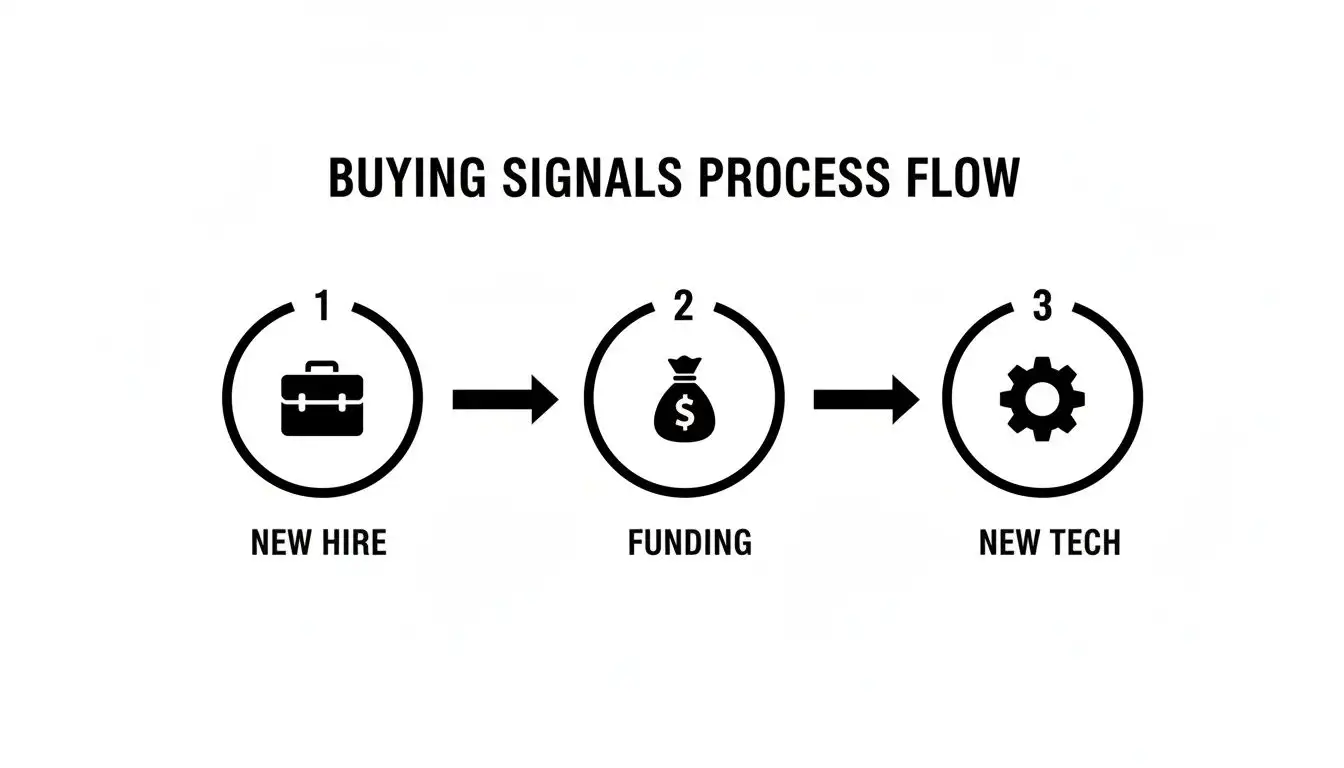
This is how you turn a cold outreach into a warm conversation: by starting with something you already know they care about.
Building Your Outreach Workflow
A structured cadence is your playbook. It’s what separates disciplined, consistent outreach from just randomly sending messages when you feel like it. It ensures no one slips through the cracks and helps you be persistent without becoming a pest.
Your outreach cadence should be a conversation, not a monologue. Each touchpoint should add new value or offer a different perspective, not just say "checking in" on a loop.
Here’s a sample sequence to get you started. This is a framework, not a rigid script. The most important step is always listening for a reply so you can jump in and have a real conversation.
Sample 10-Day Multi-Channel Outreach Cadence
This table lays out a simple but powerful sequence that combines email, LinkedIn, and a phone call to create multiple, non-intrusive touchpoints.
| Day | Channel | Action & Personalization Tip |
|---|---|---|
| 1 | Email & LinkedIn | Send a hyper-personalized email based on a specific trigger (news, post, etc.). Then, simply view their LinkedIn profile. That’s it. |
| 3 | Follow up with a different angle. Don't just "bump" the first email. Share a short, valuable resource, like a relevant article or tip. | |
| 5 | Find a recent post they shared and leave a thoughtful comment. No pitching, just add to the conversation. | |
| 7 | Send a short, pattern-interrupt email. Think one or two sentences, maybe a direct question related to their role or a recent project. | |
| 10 | Phone Call | Make a warm call. You have context now! For example, "Hi [Name], I'm the one who sent you the article on X. Just wanted to follow up briefly." |
This balanced approach ensures you’re showing up in different ways, adding value at each step before you ever ask for anything in return.
One last thing: none of this matters if your emails land in spam. Your sender reputation is everything. Following a proper guide to cold email warmup is mission-critical to make sure your perfectly crafted messages are actually seen.
Measure What Matters to Turn Data Into Pipeline
If you're not measuring your prospecting, you're just winging it. Flying blind in sales is like trying to find your way through the Upside Down without a compass. It’s dark, confusing, and you’re probably going to run into a Demogorgon.
Data is your flashlight. It turns guesswork into a clear, predictable process for building a fat pipeline.
But let's be real, not all metrics are created equal. Some are just vanity numbers, like obsessing over LinkedIn post likes. They feel good, but they don't pay the bills. We're going to focus on the key performance indicators (KPIs) that actually translate your hard work into booked meetings and closed deals.
Key Prospecting KPIs You Can't Ignore
To figure out what’s really working, you need to be a little obsessive about a few core metrics. These numbers are the vital signs of your prospecting health, telling you exactly where things are humming along and where they’re falling apart.
For every outreach campaign, you should have these on a dashboard somewhere:
-
Total Prospects Contacted: Your baseline activity level. How many shots did you take?
-
Email Open Rate: The first hurdle. Is your subject line good enough to even get a look?
-
Reply Rate: The big one. Did your message actually spark a conversation?
-
Meetings Booked: The ultimate prize. How many chats turned into a real meeting on the calendar?
-
Prospect-to-Qualified-Lead Conversion Rate: What percentage of people you talk to are actually a good fit?
Tracking these numbers gives you a diagnostic toolkit. If you’re struggling to generate pipeline, you can pinpoint the exact stage where your process is breaking down. For a deeper dive, check out our guide on essential lead generation KPIs.
Diagnosing Your Funnel Like a Pro
Once you have the data, it's time to play detective. Think of yourself as a mechanic popping the hood on your sales engine.
Is your open rate high but your reply rate is in the gutter? Congrats, your subject line is a certified banger. But the body of your email is probably falling flat. Maybe it's too long, too "me, me, me," or the call-to-action is weak.
What if your reply rate is solid but you're booking zero meetings? This usually means people are interested enough to engage, but the conversation dies. You might be failing to create urgency, or your value prop isn't compelling enough to justify a 30-minute call.
A low conversion rate isn't a failure. It's just data telling you where to get better. Treat your metrics as feedback, not a report card.
The numbers don't lie. Data from across the B2B world shows that the median conversion rate from prospect to meeting is around 2.9%. The top reps? They consistently hit 5% or more. What separates them is often a mix of sharp strategy and the right tech; AI adopters, for instance, see 50% more qualified leads and spend 60-70% less time on manual prep.
A/B Testing Your Way to the Top
The best reps are never satisfied. They're always tinkering. A/B testing is your secret weapon for making small, data-driven tweaks that snowball into massive results. The concept is simple: test version A against version B and see which one wins.
You can A/B test pretty much anything in your outreach:
-
Subject Lines: Test a straightforward subject like "Quick question about [Company]" versus something more intriguing like "Your recent article on X."
-
Opening Lines: Does referencing a LinkedIn post get more replies than mentioning a recent company announcement? Find out.
-
Calls to Action (CTAs): Compare a "hard" ask like "Are you free for a 15-minute call next week?" with a "soft" one like "Is this a priority for you right now?".
-
Email Length: Does a short, punchy email outperform a more detailed one that's packed with social proof?
The golden rule is to only change one thing at a time. If you change the subject line and the CTA, you won’t know which change actually made the difference. By systematically testing and adopting the winners, you turn prospecting from an art into a science, steadily cranking up your metrics and filling your pipeline with quality opportunities.
Your Top Sales Prospecting Questions, Answered
Look, even the grizzled veterans of sales have questions about prospecting. The game changes fast. What crushed your quota last year might get you crickets today. So, let’s dive into the questions I hear all the time and give you some straight, no-BS answers.
This is the rapid-fire round. We'll settle the big debates and clear up the confusion so you can get back to what matters: filling that pipeline.
What’s the Single Biggest Mistake Reps Make in Prospecting?
Hands down, the number one, undisputed champion of prospecting screw-ups is launching into outreach without a shred of research. Firing off a generic, one-size-fits-all message is the fastest way to get your email dragged to the trash folder. It’s lazy, and believe me, your prospects can smell it a mile away.
You don't need to write a biography on them, either. Just spend five minutes. For example, check their LinkedIn profile for a recent post, see if their company was mentioned in the news, or find a blog they shared. Mentioning one tiny, relevant detail shows you actually did your homework.
A single, well-researched email to the right person will always, always outperform one hundred generic blasts to the wrong ones. This is a game of precision, not just volume.
This simple act completely changes the dynamic. You're no longer just another SDR hawking software; you're a curious professional who spotted something interesting and decided to start a relevant conversation.
How Long Should a Sales Prospecting Cadence Actually Be?
There’s no magic number here, but if you're looking for a solid starting point in B2B, aim for a 10 to 14-day cadence with about 8 to 12 touchpoints. The secret sauce is mixing it up. Spread those touches across different channels like email, phone, and LinkedIn to create a surround-sound effect.
The goal is to be persistent without being a total pest. Keep these tips in your back pocket:
-
Vary your value: Don't just send another "just checking in" email. That’s a waste of everyone’s time. For example, share a relevant article, ask a killer question, or send a quick personalized video.
-
Give them space: Let your prospect breathe between touches. Hitting them up back-to-back just screams desperation.
-
Match the account value: If you're chasing a massive enterprise deal, your cadence should probably be longer, slower, and way more personalized than one for a smaller SMB account.
And for goodness' sake, track your results. Your data will tell you if your cadence is too short, too long, or hitting the sweet spot.
How Can I Actually Use AI in My Prospecting (Without Sounding Like a Robot)?
Think of AI as your ultimate sidekick, the Robin to your Batman. It’s there to handle the mind-numbing grunt work so you can swoop in and be the hero. AI shouldn't replace your personality; it should supercharge your ability to use it.
Here’s how to put it to work right now:
-
Find the right people: Use AI-powered tools to scan the web for buying signals and score leads against your Ideal Customer Profile. This keeps you focused on the prospects who are actually ready to talk.
-
Get the right info: Let AI handle the data enrichment. It can find accurate contact info and company details, saving you from the soul-crushing black hole of manual research.
-
Personalize at scale: The best AI writers can draft unique, relevant first-touch messages and follow-ups based on a prospect's real-time activity. The AI does the heavy lifting, and you add the final human touch.
Is Cold Calling Officially Dead?
Yes, but with a massive asterisk. The old-school, smile-and-dial approach of hammering a random list is dead, buried, and we should all be glad it's gone.
But a strategic, well-researched warm call? That’s still one of the most powerful weapons in your sales arsenal. This is when you call a prospect after you’ve already connected with them on another channel, like email or LinkedIn. You're no longer a complete stranger intruding on their day.
The goal of this call isn't to steamroll them with a pitch. It’s to build on that first touchpoint. And considering that 57% of C-level executives still prefer to be contacted by phone, it’s a critical part of any multi-channel strategy, as long as you use it smartly and respect their time.
Ready to stop guessing and start building a predictable pipeline? Munch is the all-in-one sales intelligence platform that helps you find high-intent prospects, enrich their data with 95%+ accuracy, and launch AI-powered outreach that actually gets replies. See how much faster you can grow by signing up on Munch!.