How To Write Cold Emails That Actually Get Read

By Mriganka Bhuyan
•Founder at Munch
Crafting a B2B cold email that actually gets a reply is an art. It’s a delicate dance of in-depth research, a dash of genuine personality, and a rock-solid value proposition. Forget just being loud; the real key is being undeniably relevant.
Escaping the Cold Email Black Hole
Let’s be real for a second. Most cold emails are dead on arrival. They get sent with high hopes and land with a thud in a digital graveyard, right next to that newsletter you subscribed to in 2012 and forgot about. It feels like you're shouting into the void, but the void has a really aggressive spam filter.
This isn’t just a feeling, your emails are fighting an uphill battle. But this is where we turn things around. Think of this as your Rocky training montage where we break down the cringey, predictable mistakes that get your emails sent straight to the trash.
The Most Common Cold Email Crimes
So, why do so many emails end up in digital purgatory? The problem is almost always the same: the email is completely selfish. It's a broadcast all about "me, me, me" when it should be focused entirely on "you, you, you." Your prospect couldn't care less about your quarterly quota or your company’s latest funding round. They have exactly one question: "What's in it for me?"
Too many sales reps are still blasting out emails using templates from a bygone era, with personalization so thin it's just, "Hi {first_name}." That low-effort approach is DOA in today’s world. Your prospect's inbox is a fortress, and a generic message is like trying to storm the castle with a plastic spoon.
The numbers tell a brutal story. Cold email response rates have plummeted to an average of just 5.1% across all industries. Even worse, sophisticated spam filters are now blocking a whopping 17% of emails before a human ever lays eyes on them. Ouch.
The Cold Email Autopsy Report
Let’s perform a quick post-mortem on the emails that never make it. Understanding what not to do is the first step to crafting outreach that actually works. It's less about a secret formula and more about dodging the obvious landmines that sabotage your entire outbound sales effort.
Here’s a breakdown of the usual suspects that get emails ignored or deleted on sight.
| The Mistake (Why It Failed) | The Fix (What to Do Instead) |
|---|---|
| The "Quick Question" Subject Line: It’s lazy, screams "sales pitch," and is completely forgettable. | Write a Hyper-Specific Subject: Mention a trigger event, a shared connection, or a recent company announcement. Make it intriguing. |
| The Wall of Text: Your email looks like a novel. No one has the time or energy to read your life story. | Keep It Scannable: Use short sentences, punchy paragraphs (2-3 lines max), and bullet points to break up the text. |
| "Hi {first_name}" Personalization: Using just a name and company is the bare minimum. It shows zero real effort. | Reference Something Real: Mention a recent LinkedIn post they wrote, a podcast they were on, or a new initiative their company launched. |
Once you see the patterns, it’s hard to unsee them. These aren't just bad habits; they're deal-killers.
The goal isn’t to trick someone into a conversation. It's to earn their attention by demonstrating you've done your homework and have something genuinely valuable to offer.
By facing these harsh realities head-on, you can completely change your approach. The new game plan is simple: send fewer, smarter emails that people actually want to open.
Become a Digital Detective Before You Write
Writing a cold email without doing any research is like showing up to a potluck with only a fork. You’re completely unprepared, hoping someone else did the work to make it worthwhile. Let’s not do that.
Before you even think about typing a subject line, you need to put on your digital detective hat.
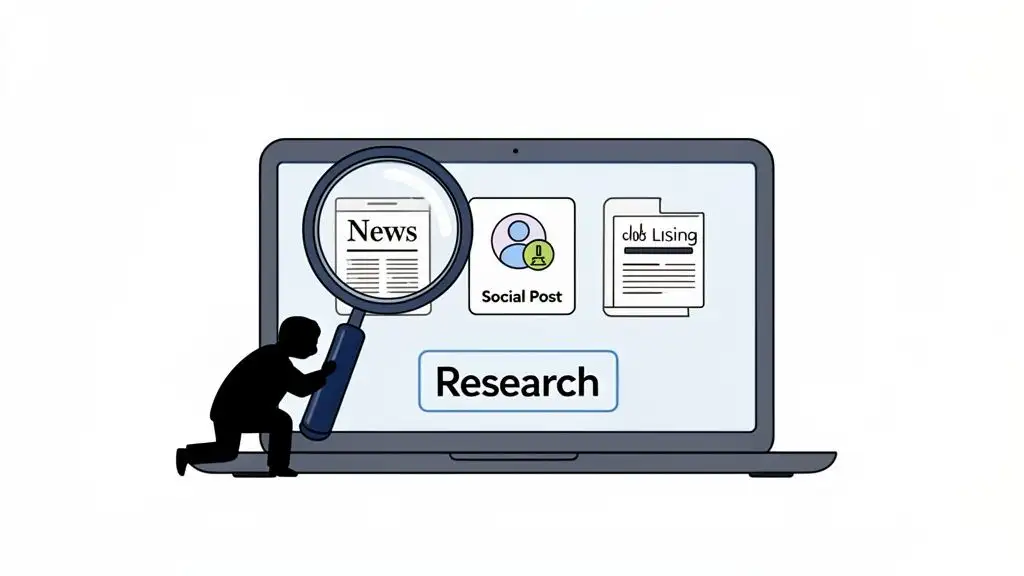
I'm not talking about a five-minute glance at their LinkedIn profile. I'm talking about some serious digital sleuthing to uncover “buying signals,” the breadcrumbs your best prospects leave all over the internet. These clues tell you what they’re dealing with right now, making your email feel less like a random interruption and more like a perfectly timed solution.
Uncovering High-Intent Buying Signals
Buying signals are just events or actions that scream, "We have a problem you can solve!" Finding them is what turns a generic, delete-worthy pitch into a relevant, can't-ignore conversation starter. Think of yourself as a modern-day Sherlock Holmes, but your magnifying glass is Google and LinkedIn.
Your mission, should you choose to accept it, is to find the perfect trigger that justifies your outreach. These aren’t just random factoids; they are specific, timely events that crack open a window of opportunity.
Here’s where to look for the good stuff:
-
Company News & Press Releases: Did they just announce a major partnership or land a fat new round of funding? A big partnership means new integration headaches, and fresh funding means they have cash to burn on tools that fuel growth. For example: "Saw you just integrated with Salesforce. Congrats! We help companies avoid the data sync nightmares that usually follow."
-
Job Boards (LinkedIn, Indeed): Are they hiring for a bunch of roles in the same department? A Director of Sales hiring 5 new reps probably has a serious problem with their onboarding process or sales enablement tools. That's your cue. For example: "Noticed you're hiring a new SDR team. Scaling from 2 to 7 is tough without a consistent playbook."
-
Social Media & Blogs: Did a key decision-maker just publish a post complaining about a specific industry challenge? That’s literally a direct window into their brain. Use it! For example: "Loved your post on the headache of marketing attribution. We help solve that by..."
These signals give you a powerful "why you, why now" hook. Suddenly, you're not just another random salesperson. You're a sharp, informed professional who has spotted a real, timely need.
Building Your Ideal Customer Profile
Once you get good at spotting these signals, you can build an Ideal Customer Profile (ICP) that’s less of a stale demographic report and more of a character bio for the hero of your favorite show. A truly great ICP goes way beyond just a job title and industry. You need to get inside their world.
A hyper-specific ICP feels like you actually know the person. It’s the difference between targeting "VPs of Marketing at SaaS companies" and targeting "VPs of Marketing at Series B fintech SaaS companies who are hiring content managers and just complained on Twitter about their marketing attribution." See the difference? One is a category; the other is a person with a problem.
Your goal is to know your prospect's situation so well that your email feels like it was written exclusively for them, because it was. This is the ultimate antidote to the generic, easily ignored sales pitch.
This deep research pays off, big time. Instead of blasting out a hundred generic emails and praying for a single reply, you can send ten hyper-targeted messages and get 3 or 4 genuine conversations started. It’s all about precision, not just volume.
Of course, all this recon is useless if you don't have the right email address. If you're struggling to find contact info, check out our guide on how to find business emails for your prospects.
Armed with this level of insight, your emails will land with the accuracy of a heat-seeking missile, not the random spray of a fire hose. Now you're ready to start writing.
Write Emails So Personal They Feel Psychic
If you’re still starting emails with Hi {first_name} and calling it a day, you’re basically bringing a flip phone to an iPhone fight. Sure, it technically works, but you’re going to get absolutely smoked.
What we’re really after is that "Wait, how did they know that?" reaction. That’s the moment they stop mindlessly scrolling through their inbox and actually read your email.
Let's break down how to turn your digital detective work into an email that feels less like a pitch and more like a perfectly timed conversation.
Pro Tip: Munch automatically does the boring research (scanning their Linkedin profiles and posts, researching company news and announcements) and crafts personalized outreach messages.
First Impressions Matter: Your Subject Line
Think of your subject line as the bouncer at an exclusive club. Its only job is to get your email past the velvet rope. The problem is, most subject lines, like "Quick Question," "Following Up," and "Intro," are the email equivalent of wearing socks with sandals. They guarantee you're not getting in.
The trick is to be intriguing without veering into cringey clickbait. You want to sound like a real person, not a marketing bot that just chugged three espressos. The best subject lines are specific and drop a hint about the valuable insight you uncovered during your research.
It’s the difference between spammy and spicy.
Subject Line Grader From Spammy to Spicy
Here’s a quick look at what separates the subject lines that get deleted on sight from the ones that get an immediate click.
| The Bad (Delete Immediately) | The Good (Click-Worthy) | Why It Works |
|---|---|---|
| "Quick Question" | "Idea for your new SDR hires" | It's specific, tied to a recent event (new hires), and promises immediate value. |
| "Intro: [Your Company] <> [Their Company]" | "Loved your podcast on marketing attribution" | A genuine, specific compliment shows you've done your homework and aren't just spamming. |
| "Available for a meeting?" | "That recent partnership with Acme Corp" | Referencing a big company announcement makes you look informed and relevant right now. |
See the pattern? Great subject lines aren't pulled out of thin air. They’re a direct result of solid research and a nod to a buying signal you spotted.
The Opener Is Your Make-or-Break Moment
You have about three seconds. That’s it. Three seconds to prove your email isn't a total waste of time, and the opening line is where you win or lose that battle.
Whatever you do, don't waste this precious real estate on fluff like, "Hope you're having a great week!" It’s a dead giveaway that you have nothing important to say. Your opener has to instantly connect to why you're reaching out, paying off the promise you made in your subject line.
Weak, Forgettable Opening:
"My name is Alex, and I work at XYZ Corp. We help companies increase their revenue."
Psychic, Can't-Ignore-It Opening:
"Saw your LinkedIn post about the challenge of scaling your outbound team. That problem is a beast to solve."
The second one just hits different, right? It immediately proves you're paying attention. It’s not about you; it's about them and their world. This builds instant credibility. Getting a clear picture of your customer by building an Ideal Customer Profile is your secret weapon for finding these specific pain points.
Give the Body a Simple, Punchy Structure
Okay, you've hooked them. Now what? Get straight to the point. Nobody has time to read a novel in their inbox. The goal is to connect their problem to your solution in under 150 words.
A battle-tested framework for this is PAS (Problem, Agitate, Solve). It's simple, it's powerful, and it just works.
-
Problem: Start by stating the problem you know they have (thanks, research!).
-
Agitate: Gently twist the knife. Remind them why this problem is so frustrating or expensive.
-
Solve: Introduce your solution as the obvious, logical way to make the pain go away.
Let's put it into practice. Say you're reaching out to a VP of Sales who's on a hiring spree.
Problem:
"Scaling an SDR team from 5 to 15 in a single quarter almost always leads to messy messaging and ramp times that crush your pipeline goals."
Agitate:
"That usually means your best reps are stuck playing babysitter to rookies instead of closing deals, while your new hires take months to actually hit their numbers."
Solve:
"Our platform hands new SDRs the exact playbooks and content they need from day one, which cuts their ramp time in half."
This little framework tells a tight, compelling story that hits them right where they live. You’re not just another vendor; you’re a problem-solver.
Key Insight: Personalization is everything. Campaigns that go beyond just the first name see reply rates jump as high as 18%. And yet, a shocking 5% of salespeople actually personalize every single message. Also, keep it short. Emails under 200 words consistently get higher open and reply rates. You can find more data on the impact of personalization and email length here.
End With a Low-Friction Call to Action
The final piece of the puzzle is your Call to Action (CTA), and this is where so many otherwise great emails go to die.
Asking for a "30-minute demo" is like proposing marriage on a first date. It’s way too much, way too soon. The goal of a cold email isn't to book a meeting; it's simply to start a conversation. To do that, you need a low-friction, interest-based CTA.
Don't ask for their time. Ask for their interest.
High-Friction CTA (Please Don't Do This):
"Are you free for a 30-minute demo on Tuesday at 2 PM?"
Low-Friction CTA (This is the move):
"Worth taking a closer look?"
This approach makes it incredibly easy for them to say "yes" without feeling like they’ve just committed to a huge chunk of their calendar. It’s a simple question that gauges their interest and opens the door. Even a one-word reply is a massive win. You've officially escaped the cold email black hole and started a real conversation.
The Follow-Up Is Your Secret Weapon
Sending one email and hoping for the best is like walking into a final boss battle with a wooden sword. Sure, you might get lucky with a critical hit, but chances are you’re going to get absolutely torched. The cold, hard truth of B2B sales is that most conversations don't spark on the first try. They ignite in the follow-up.
Quitting after a single attempt is leaving a massive pile of money on the table. Just think about it from your prospect's perspective. Your perfectly crafted email probably landed while they were in a back-to-back meeting, putting out a fire with their dev team, or just trying to remember where they parked.
A follow-up isn't nagging. It's a professional, necessary nudge that cuts through the chaos of a busy inbox.
The Art of the Persistent, Not-Annoying Cadence
So, how do you stay top of mind without becoming the human equivalent of a pop-up ad they can't close? The secret lies in a multi-touch cadence where every single message brings something new to the party.
If your follow-up is just, "Hey, bumping this to the top of your inbox," you're just training them to delete your emails faster. A killer follow-up sequence is all about strategic persistence, not brute-force pressure.
Here are the golden rules for a follow-up that actually gets replies:
-
Space It Out: For the love of all that is holy, do not follow up the next day. A good rule of thumb is to wait 2-3 business days for your first nudge, then add another day or two between any others. Let them breathe.
-
Always Add New Value: This one is non-negotiable. Every message needs to offer a fresh insight, a relevant resource, or a new angle. Don't just rehash your first pitch.
-
Keep Getting Shorter: Your follow-ups should be progressively shorter than the last. By the end of your sequence, you might be down to just two punchy sentences.
Think of it like a great TV series. Each episode (or email) gives you a bit more of the plot, building momentum and keeping you hooked without giving it all away at once.
Building a Simple, High-Impact Follow-Up Sequence
Let's cook up a simple 3-touch sequence you can steal and tweak. We'll pretend you're reaching out to a Head of Marketing whose company just launched a new podcast.
Email 1 (The Opener): You’ve already sent your initial personalized email congratulating them on the podcast and connecting it to a pain point you solve (like turning those new listeners into actual leads). They haven't replied.
Email 2 (The Value-Add):
Subject: Thought on the [Podcast Name] podcast
"Hi [Name],
Stumbled across this case study on how [Competitor] grew their podcast audience by 30% using interactive transcripts. Thought it might be interesting given your recent launch.
Cheers,
[Your Name]"
Boom. This email adds immediate, relevant value and asks for absolutely nothing in return. It's pure helpfulness.
Email 3 (The Gentle Nudge):
Subject: One last thing
"Hi [Name],
Noticed your team is hiring for a new Content Strategist. Scaling content production alongside a new podcast is a massive lift.
Is turning that new audience into a reliable lead channel on your radar right now?
Best,
[Your Name]"
This final email smartly ties in another buying signal (the job posting) to their likely priorities, showing you're still paying close attention. If you want to dive deeper into more advanced plays, check out these sales cadence best practices.
This whole process is about building a compelling case, one email at a time.
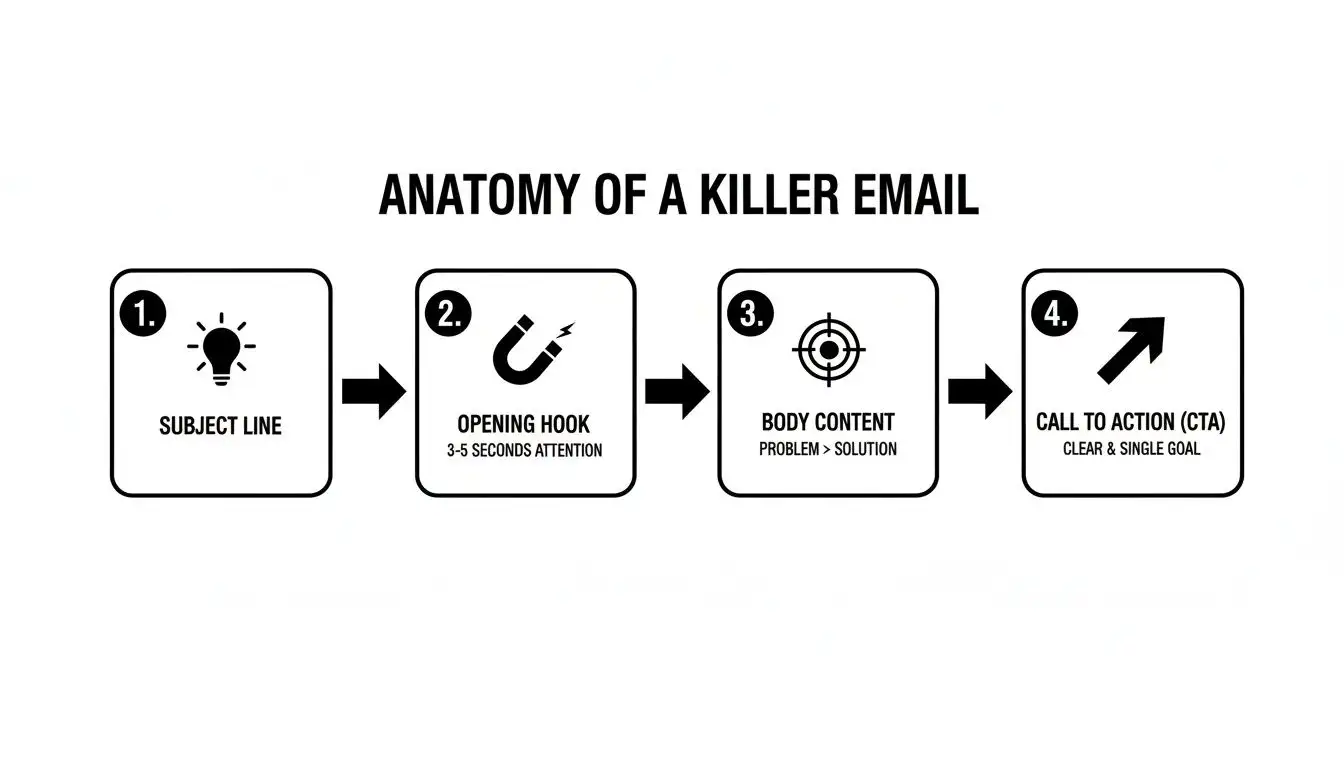
From that killer subject line to the clear CTA, each piece works together to guide your prospect toward hitting "reply."
Why Following Up Is Not Optional
Honestly, the data on follow-ups is so strong it should be illegal not to do it. Follow-up sequences are the unsung heroes of cold outreach. They can take a sad 3.0% reply rate from a single email and boost it to 5.8% with just three touches.
That's a 93% lift. You're practically doubling your conversations by sending two more short emails. By not following up, you're willingly ghosting almost half of your potential deals.
The takeaway is simple: sending one email isn't a strategy, it's a lottery ticket. A well-executed follow-up sequence is where the real money is made, turning a chilly outreach into a genuinely warm conversation.
Remember, the goal isn't to annoy someone into a meeting. It's to prove that you are a helpful, persistent, and valuable expert. When you add value at every step, you stop being just another name in their inbox and start becoming a resource they actually remember.
Stay Out of the Dreaded Spam Folder
You’ve done it. You’ve crafted an email so personal and compelling it could bring a tear to a CFO's eye. You hit send, lean back in your chair, and... it lands right next to a message about a surprise inheritance from a long-lost Nigerian prince.
All that hard work, completely wasted in the spam folder.
This isn’t the sexiest part of cold emailing, I'll admit. But ignoring deliverability is like building a Ferrari and forgetting to put gas in it. It looks fantastic, but it's going absolutely nowhere. Let's make sure your emails actually get seen.
The Technical Trio: SPF, DKIM, and DMARC
Think of your email domain as a passport. When you send an email, the receiving server (like Google or Microsoft) acts like a border agent, checking your credentials to make sure you are who you say you are. SPF, DKIM, and DMARC are the official stamps in that passport that prove you're legit.
-
SPF (Sender Policy Framework): This is basically a list of all the mail servers authorized to send emails for your domain. It’s like telling the bouncer at a club, "Yeah, they're with me."
-
DKIM (DomainKeys Identified Mail): This adds a digital signature to your messages, proving the email hasn’t been tampered with on its journey. Think of it as the unbroken wax seal on a royal decree.
-
DMARC (Domain-based Message Authentication, Reporting & Conformance): This is the final checkpoint. It tells receiving servers what to do if an email fails the SPF or DKIM checks, like quarantine it or just reject it outright.
Setting these up isn't nearly as scary as the acronyms make it sound. Most domain providers have simple, step-by-step guides. Getting it right is a massive signal to the email giants that you're one of the good guys.
Pro Tip: Don’t skip the technical setup. It’s a one-time chore that builds the entire foundation for your outreach. Sending emails without it is like showing up to the airport with no ID; you are not getting on that flight.
Warming Up Your Email Account
If you register a brand-new email address and immediately blast out 200 emails, you don't look like a savvy salesperson. You look like a spam bot having a very productive morning. To email providers like Google, that sudden spike in activity is a massive red flag.
You have to warm up the account first.
This just means you gradually increase your sending volume over a few weeks. It’s like training for a marathon; you don’t just show up and run 26.2 miles on day one. You start small, build your endurance, and prove to the system that you have legitimate intentions.
Start by sending 10-20 emails a day, then slowly ramp it up to 30, then 50, and so on. This process builds a positive sender reputation from the ground up. If you want to dive deeper, you can learn more about how to improve email deliverability and why a solid warm-up strategy is non-negotiable.
Keeping Your Sender Reputation Squeaky Clean
Once your account is warmed up, the game becomes about maintenance. Your sender reputation is an invisible score that email providers assign to your domain based on your sending habits. A high score gets you a ticket to the primary inbox; a low one sends you straight to spam jail.
Here are the non-negotiables for staying in their good graces:
-
Keep Your Bounce Rate Low: An email "bounces" when it can't be delivered to an invalid address. A high bounce rate tells providers your list is old or low-quality. Always aim for a bounce rate below 5%.
-
Clean Your Lists Religiously: People change jobs. Emails go defunct. Use a list-cleaning service to scrub your contacts before every single campaign to get rid of the duds.
-
Make Unsubscribing Easy: Hiding the unsubscribe link is a rookie move and a surefire way to get your emails marked as spam. It’s also required by laws like CAN-SPAM. A spam complaint is far, far worse for your reputation than a simple opt-out.
Think of your sender reputation like a credit score. Every good action builds it up, and every lazy mistake tears it down. Protect it at all costs.
A Few Lingering Questions Answered
Alright, you've got the playbook. You're ready to start sending emails that feel less like a shot in the dark and more like a perfectly timed assist. But even the best players have a few questions before the big game.
Let's run through the most common ones that pop up when you're in the trenches. Think of this as the final huddle before you hit send and start turning cold leads into warm conversations.
How Many Follow-Ups Is Too Many?
This is a classic. The sweet spot is usually 2-3 follow-ups after your initial email, for a total of 3-4 messages. Any more than that, and you start looking like that person who just doesn't get the hint at a party. The returns diminish fast, and your odds of annoying someone skyrocket.
But honestly, it's less about the number and more about the value you bring with each touchpoint.
-
Just "bumping this up"? Don't. Seriously. Stop after one. It adds zero value and just screams desperation.
-
Bringing a new insight each time? A 4-step sequence spread over two weeks can work wonders. Your first follow-up could point to a relevant case study, and the next could reference a new company announcement you spotted.
The goal is persistent, valuable contact, not just relentless noise. Once you've run your sequence without a nibble, it's time to let it go. Move that prospect to a long-term nurture list and try again in a few months with a fresh angle.
The rule is simple: never send a follow-up without a new reason to be in their inbox. Each message should be a fresh, self-contained piece of value.
What Are the Best Days and Times to Send?
Ah, the million-dollar question. The old-school wisdom always points to Tuesday, Wednesday, and Thursday mornings as the golden window. But the real answer? It completely depends on your audience. A startup founder's inbox habits are worlds apart from a Fortune 500 executive's.
Don't just pick one time slot and stick with it. Get strategic and vary your send times throughout your sequence.
Here's a cadence I've seen work well:
-
Email 1: Go for Tuesday at 10 AM. You'll hit that prime-time inbox rush.
-
Email 2: Schedule the first follow-up for Thursday at 3 PM, catching them as their day is winding down.
-
Email 3: Try something a bit unconventional, like Sunday evening around 8 PM. You’d be surprised how many leaders use the weekend to clear their inbox and prep for the week ahead.
The only way to know for sure what works for your ideal customer is to test it. Stop guessing and let the data tell you the story.
Should I Include Links and Images in My First Email?
Tread very, very carefully here. For that first email to a brand new contact, the best practice is to avoid attachments and keep links to a bare minimum.
Why? Spam filters are like an overprotective parent dropping their kid off at college. They are incredibly suspicious of strangers, especially those bearing "gifts" like attachments and a dozen links.
Multiple links, flashy images, or heavy files are massive red flags for a new sender. They can torpedo your deliverability before you ever get a chance to start a conversation.
-
The Safe Bet: A single, clean link to your LinkedIn profile in your signature is generally fine.
-
Asking for Trouble: Attaching a PDF or embedding a big company logo is just asking to get flagged.
The goal of that first email is beautifully simple: land in the primary inbox and get a reply. Once you've gotten that initial handshake in the form of a response, you're in a much safer position to send over your calendar link or other resources.
How Do I Actually Measure Success?
Not long ago, the open rate was king. But with privacy updates like Apple's Mail Privacy Protection, open rates have become about as reliable as a chocolate teapot. It's now a vanity metric that can be wildly misleading.
It's time to focus on metrics that track actual human engagement.
-
Reply Rate: This is your new North Star. What percentage of people are actually hitting reply? A strong campaign should hit at least 5-10%.
-
Positive Reply Rate: This one is even better. It filters out the "no thanks" and "unsubscribe" messages to show you who is genuinely interested.
-
Meeting Booked Rate: This is the bottom line. How many conversations are turning into qualified meetings? This is what really matters.
-
Bounce Rate: Keep a close eye on this. If it starts creeping above 5%, you've got a serious problem with your list quality or your technical setup.
Tracking these metrics gives you a clear, honest picture of what’s working and what isn't. It's how you stop guessing and start refining a cold email strategy that drives real results.
Ready to stop guessing and start winning? Munch is your all-in-one platform to find high-intent prospects, enrich their data, and launch personalized outreach that gets replies. Stop the manual research and start booking more meetings with Munch!