LinkedIn Prospecting Mastery: The Complete Guide To LinkedIn Prospecting

By Mriganka Bhuyan
•Founder at Munch
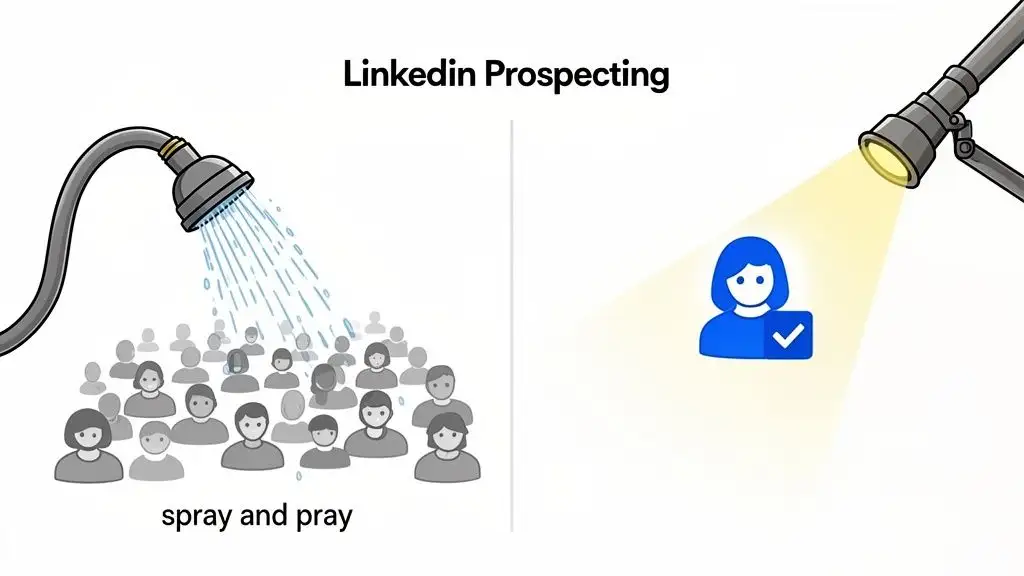
Welcome to the new era of B2B sales. Let's ditch the cringey, spammy "spray and pray" connection requests that feel more like digital junk mail than genuine outreach.
LinkedIn prospecting is the art and science of finding, connecting with, and actually engaging potential customers on the platform. It's about transforming the world's biggest professional network from a chaotic digital Rolodex into your most predictable pipeline.
Your LinkedIn Prospecting Revolution Starts Now
Old-school cold calling feels like showing up to a dinner party uninvited and trying to sell knives. It's just plain awkward for everyone involved. The modern B2B sales party has moved online, and LinkedIn is the venue. It’s no longer just a place to park your résumé; it's the definitive arena for building relationships and, more importantly, driving revenue.
The game has completely changed. We've shifted from a numbers game to a precision game. Think of it as trading a fire hose for a sniper rifle. Instead of blasting a generic pitch at anyone with a pulse, we're now zeroing in on the right people, at the right time, with a message they actually care about.
Why This Approach Wins, Hands Down
The numbers speak for themselves. According to LinkedIn's own research, a staggering 78% of social sellers hit their quota. Compare that to the paltry 38% of salespeople sticking to traditional methods. That's a 40-point gap, proving just how powerful this platform is for B2B sales. You can dive deeper into the data with this breakdown of LinkedIn statistics.
This wild success boils down to one simple idea: relevance. Effective LinkedIn prospecting isn't about you or your amazing product. It’s about deeply understanding your prospect’s world.
The goal is to stop shouting into the void and start having meaningful conversations with people who are actually in a position to buy. This requires a deep understanding of who you're selling to, a concept we call the Ideal Customer Profile.
Building Your Foundation: The ICP
Before you even think about sending a single connection request, you need a crystal-clear picture of who you're after. This whole playbook is designed to give you actionable steps, but it all starts with your Ideal Customer Profile (ICP). This isn't just about a job title and industry. A truly powerful ICP gets into the nitty-gritty:
-
Pain Points: What specific business challenges are keeping them up at night? For example, are they drowning in manual data entry because their current system is about as efficient as a dial-up modem? Is their lead quality so low they're getting more bots than buyers?
-
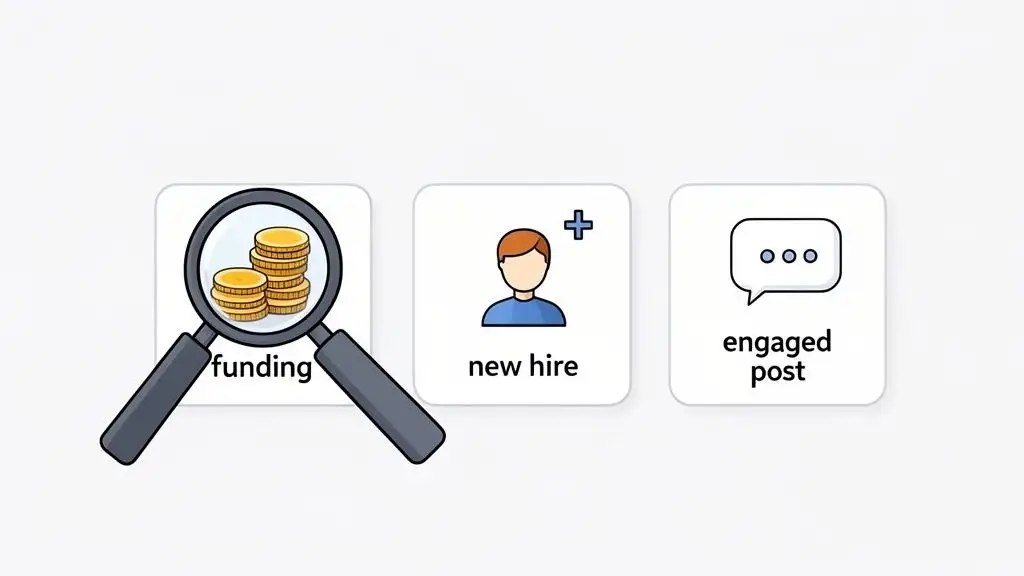
Buying Triggers: What events signal they might suddenly need you? A practical example is a new executive hire who wants to make their mark, a fresh round of funding that needs to be spent, or a major company expansion that creates new operational headaches.
-
Goals: What does "winning" look like for them? Are they trying to boost team efficiency by 20% or desperately trying to crack into a new market? Their goals are your roadmap for a relevant pitch.
Nailing this down is the absolute first step toward building a killer prospecting strategy. If you're staring at a blank page, you might be interested in our guide on how to build your ideal customer profile. It’ll help you stop guessing and start targeting with surgical precision.
Finding Your Ideal Customers Before They Know You Exist
Trying to sell to everyone on LinkedIn is a one-way ticket to burnout. It's like trying to get a cat to enjoy a bath; it’s messy, you’ll probably get scratched, and nobody ends up happy.
The first rule of effective LinkedIn prospecting is knowing exactly who you’re looking for. This means going way beyond basic filters like job title and company size. That's table stakes. The real magic happens when you start spotting high-intent buying signals.
These are the digital breadcrumbs people and companies leave behind that scream, "We have a problem and we're ready to spend money to fix it!" Think of yourself as the Sherlock Holmes of sales, but instead of a magnifying glass, your best tool is LinkedIn Sales Navigator.
Uncovering High-Intent Buying Signals
Your Ideal Customer Profile (ICP) tells you who to look for. But buying signals? They tell you when to reach out. Nailing both is like knowing exactly what you want for your birthday and then finding it on sale. It's the perfect intersection of preparation and opportunity.
Let’s hunt for some clues. The most powerful signals point to a major change happening within a company, which almost always creates new needs and opens up budgets.
Here are the top signals to track:
-
Recent Funding Announcements: A company that just closed a Series B round has cash to burn. They're actively looking to invest in growth, efficiency, and new tools to help them scale.
-
New Executive Hires: A new VP of Sales or CMO isn't hired to sit still. They’re brought in to shake things up, launch new strategies, and are often handed a budget to make their mark within the first 90 days.
-
Rapid Company Growth: Keep an eye out for companies with a major spike in headcount over the last six months. This usually signals growing pains, making it the perfect time to pitch solutions that build efficiency.
-
Job Postings for Key Roles: Is a company hiring a whole team of SDRs? They probably need sales enablement or data tools. Are they hiring their first Head of Marketing? They’ll need a marketing automation platform. Job descriptions are a goldmine of intel on a company's current tech stack and challenges.
A buying signal is an event that turns a cold prospect into a warm lead. It transforms your outreach from an interruption into a timely, relevant solution to a problem they are actively trying to solve.
To help you get started, here's a quick cheat sheet of signals to look for and what to do when you spot one.
Table: High-Intent Buying Signals on LinkedIn
| Buying Signal | What It Means | Example Action |
|---|---|---|
| New Funding Round | The company has fresh capital and is under pressure to grow. | Reach out to department heads with a solution that helps them hit their new, ambitious targets. |
| Hired a New C-Suite Exec | A new leader is looking to make a quick impact and will be evaluating their team’s entire tech stack. | Congratulate them on the new role and offer insights relevant to their first 90-day plan. |
| Multiple Job Postings in One Department | They are scaling a specific team and will face new operational challenges. | Connect with the department head and offer a tool or service that solves a known scaling problem. |
| Mentioning a Competitor | They are actively evaluating solutions in your category. | Position your solution as a superior alternative by highlighting your key differentiators. |
| Company Expansion (New Office) | The business is growing, and new locations often need their own tools and processes. | Target the leader of the new office with a customized offer for their team. |
These are just a handful of examples, but you can see how each one gives you a powerful, relevant reason to start a conversation.
Putting It All Together in Sales Navigator
Sales Navigator is your command center for hunting down these signals. Don't just plug in "Director of Marketing." You need to layer filters like a master chef layers flavors. For a primer on the basics, check out this guide on how to find connections on LinkedIn.
For instance, you could create a lead list with these filters:
-
Job Title: "VP of Sales" OR "Head of Sales"
-
Industry: "Computer Software"
-
Company Headcount: "51-200 employees"
-
Spotlights Filter: "Changed jobs in the last 90 days"
Boom. You now have a hyper-targeted list of new sales leaders at tech companies who are almost certainly re-evaluating their entire sales process and toolkit. This isn't a shot in the dark; it's a calculated, strategic strike.
Automating Your Signal Detection
Manually searching for these signals every single day is about as efficient as sending a raven instead of an email. This is where modern sales intelligence platforms come into play. These tools act as your 24/7 watchtower, constantly scanning for buying signals across your target accounts.
Instead of you hunting for clues, the leads come directly to you. A platform like Munch can monitor for funding events, job changes, and technology adoption in real time. It turns hours of grunt work into a prioritized feed of warm leads ready to talk. This frees you up to do what you do best: selling.
Mastering the Art of the First Message
Let’s get one thing straight: your connection request is your digital handshake. If it’s limp and generic, you’re getting ignored. It’s that simple.
Sending a boilerplate, self-serving pitch is the online equivalent of walking up to a stranger at a party and immediately asking them to help you move a couch. It's weird, it's pushy, and it’s a one-way ticket to being ghosted.
The whole point of your first message isn't to make a sale. It's just to start a real conversation. And to do that, your note has to be about them, not you. It needs to be personal and relevant. That’s the entire game of LinkedIn prospecting.
The Anatomy of a Perfect Connection Request
Think of your 300-character connection note like a movie trailer. It needs to be short, punchy, and make the other person genuinely curious about what comes next. A killer note really only has three parts.
-
The Hook: A killer opening line that proves you’re not just another bot. For instance, mention something specific that shows you’ve actually looked at their profile, like, "Saw your recent post on scaling sales teams..."
-
The Context: A quick sentence that bridges the gap. "Why me? Why now?" This is where you answer that. A simple example is, "...since I also work with SaaS leaders on that exact challenge, I thought I'd connect."
-
The Call-to-Action (CTA): This is NOT a "book a demo" link. It’s a super soft, no-pressure invitation to connect, usually phrased as a simple question, such as, "Mind if I join your network?"
The golden rule here is simple: give before you ask. Your first touchpoint should offer something like a compliment, a useful insight, or a genuine point of connection. Never, ever lead with your pitch.
This isn't just fluffy advice; it's backed by data. It’s not a numbers game, it's a quality game. In fact, research shows that sales reps who send fewer than 25 connection requests a week are almost twice as likely to hit a 40%+ acceptance rate. This proves that a thoughtful, targeted approach crushes a spray-and-pray strategy every single time. You can learn more about how LinkedIn prospecting is changing.
Copy-Paste-And-Tweak Message Templates
Alright, here are a few practical, non-cringey templates you can grab and adapt. Think of these as a starting point, not a script. The more you twist them to fit the person, the better your results will be.
1. The "Congrats on the Promotion" Message
-
When to use it: When someone on your target list lands a new job or gets a promotion. This is a massive buying signal!
-
Template: "Hi [First Name], congrats on the new role as [Job Title] at [Company Name]! The first 90 days are always a whirlwind. Given my work with other VPs of Sales, I'd be curious to hear what your top priority is. Happy to connect and share any insights if helpful."
2. The "I Loved Your Post" Message
-
When to use it: Right after a prospect posts something insightful that actually relates to the problem you help solve.
-
Template: "Hi [First Name], really enjoyed your post on [Topic]. Your point about [Specific Insight] was spot on. It's a challenge I see often. I share a lot of content on this subject and would love to connect."
3. The "Mutual Connection" Message
-
When to use it: When you share a strong, relevant connection with someone. This acts like a mini-referral.
-
Template: "Hi [First Name], I see we're both connected to [Mutual Connection's Name]. I've always been impressed with their work at [Their Company]. Seeing that you're also in the [Industry] space, it felt right to connect."
If you're looking for more inspiration, you might like our deep dive on LinkedIn connection message templates.
Using AI To Personalize At Scale
Let's be real for a second. Manually digging through every single prospect's profile to find that perfect, golden nugget of an icebreaker takes forever. It's the sales equivalent of trying to binge-watch a show from the 90s on a dial-up modem. Painfully slow.
This is where AI-powered sales tools completely change the game. Platforms like Munch can scan a prospect's profile, recent posts, and company news in seconds to spit out relevant, context-aware messages. It does the grunt work for you, suggesting personalized opening lines that reference specific projects or accomplishments.
This frees up hours for your reps to actually talk to people instead of being buried in research. And the best part? It sends your reply rates through the roof because every single message feels like it was written just for them.
Crafting an Outreach Cadence That Actually Gets Replies
Relying only on LinkedIn for prospecting is like showing up to a potluck with just a bag of chips. Sure, it's a start, but you're missing out on the whole feast. The real magic happens when you orchestrate a multi-channel attack that keeps you on your prospect's radar without driving them crazy.
The goal is to be professionally persistent, not a pest. A killer outreach cadence is like a great movie trailer because it drops just enough information at each step to build intrigue. You want to spark curiosity, not bury them under a wall of text in your first message.
This means weaving together LinkedIn messages, profile views, smart content engagement, and good old-fashioned email into one seamless sequence. It’s all about showing up in different places, in different ways, over a strategic period of time.
Designing Your Outreach Blueprint
A truly effective cadence isn't just a series of random pokes and prods; it's a carefully choreographed dance. Every single step has a purpose, a channel, and specific timing. The secret sauce is varying your touchpoints to create a sense of professional omnipresence. You're everywhere, but in a helpful, non-creepy way.
Your cadence should map out the entire prospect journey over a set timeframe, usually about two weeks. This simple plan stops you from sending those desperate, last-minute follow-ups and ensures every lead gets the same consistent, polished experience.
Think of it like this: A single message is a whisper in a crowded room. A multi-step, multi-channel cadence is a full-blown conversation. It builds familiarity and trust over time, which dramatically increases your chances of getting a reply.
The structure should escalate gently. You kick things off with low-effort touchpoints (like a simple profile view) and slowly build toward higher-effort asks (like a direct email). This approach warms up your prospect, so by the time your email lands in their inbox, they already have a flicker of recognition. "Oh yeah, that's the person from LinkedIn."
A Sample 14-Day Prospecting Cadence
Alright, let's get tactical. Here’s a sample playbook you can steal and adapt for your own LinkedIn prospecting game. Pay attention to how it blends passive "nudges" with active engagement across both LinkedIn and email. This is just a starting point, and you can dive deeper into building your own by checking out these sales cadence best practices.
This table lays out a tactical outreach sequence that combines LinkedIn and email touches for maximum impact.
| Day | Channel | Action |
|---|---|---|
| Day 1 | View the prospect's profile. That's it. This silent, non-intrusive action is often enough to pique their curiosity and get them to check out your profile in return. | |
| Day 2 | Send a personalized connection request. Reference a specific post they wrote, a mutual connection, or recent company news. Keep it short, sweet, and focused on them. | |
| Day 4 | Once they accept, like or comment on one of their recent posts. Your comment needs to add value, not just be "Great post!" Ask a thoughtful question to get a real conversation started. | |
| Day 5 | Time for the first email. A subject line like "Quick question" often works wonders. Keep the email body tight, mention your new LinkedIn connection, and get straight to your value prop. | |
| Day 8 | Slide into their DMs with a direct message. This could be a quick follow-up to your email or a message sharing a genuinely useful article that relates to their industry. No sales pitch here. | |
| Day 11 | Send a follow-up email, but come at it from a different angle. Maybe share a mini case study or a specific insight you noticed about one of their competitors (in a helpful, not aggressive, way). | |
| Day 14 | Circle back one last time. View their profile again and like another piece of their content. If you're still hearing crickets, send a final, gentle break-up email and move them to a long-term nurture list. |
This multi-touch approach ensures you’re thoughtfully engaging with prospects across the platforms they use most, building familiarity with every step.
Using Data To Measure And Scale Your Success
If you’re not measuring your LinkedIn prospecting, you’re flying blind. It’s like trying to cook a five-star meal by just chucking ingredients into a pan and hoping for the best. Sure, you might get lucky once, but you’ll have zero clue how to do it again. Data is what turns your outreach from a chaotic art project into a repeatable science.
The trick is to stop obsessing over vanity metrics and start tracking the numbers that actually grow your pipeline. Who cares about profile views? They don't pay the bills. We need to get laser-focused on the data that leads directly to closed deals.
The Metrics That Truly Matter
If you want to build a predictable revenue machine, there are only three core metrics you need to live and breathe. Together, they tell the whole story of your prospecting game, from the initial connection request to a signed contract.
-
Connection Acceptance Rate: This is your first big hurdle. A low rate (anything under 20%) is a giant red flag that your targeting is off or your connection message is falling flat. For example, if you send 100 requests and only 15 accept, something is wrong with your initial approach.
-
Reply Rate (to First Message): Okay, so they accepted. Now what? This metric tells you how many people actually respond to your first real message. It’s a direct grade on the quality of your outreach. If your acceptance rate is solid but your reply rate is in the gutter, your follow-up is almost certainly too generic or pushy.
-
Meetings Booked Rate: This is the one. The grand finale. Out of all the conversations you spark, how many turn into a scheduled demo or discovery call? This number is the ultimate test of whether you're just having nice chats or actually creating legitimate business opportunities.
Getting a handle on these critical lead generation KPIs is the first, most important step to fine-tuning your entire approach.
Running Simple A/B Tests
Once you're tracking these numbers, the real fun begins. It's time to experiment. A/B testing isn't some complex process reserved for marketing geeks in lab coats; it's a dead-simple tool for any sales rep who wants to get better. You just test one message against another and see which one gets more love.
Think of yourself as a DJ at a party. If nobody's dancing to your 90s hip-hop set, you don't just keep playing it louder. You switch it up, throw on some 2000s pop-punk, and see what gets people moving. Test, observe, and lean into what works.
Here’s a practical test you can run this week:
-
Group A (The Mutual Connection Play): Send 50 connection requests mentioning a shared contact. "Hi Jane, noticed we're both connected to John Doe. Given your work in SaaS, I thought it'd be great to connect."
-
Group B (The Company News Play): Send 50 connection requests referencing a recent company update. "Hi Jane, congrats on [Company]'s recent funding round! Exciting times. Would love to connect and follow the journey."
Just track the acceptance rate for both groups. Whichever one wins becomes your new go-to. Then, you can start a new test on your follow-up message. Simple.
This multi-touch approach is a game-changer. You're not just banging on one door; you're strategically mixing channels to stay top-of-mind.
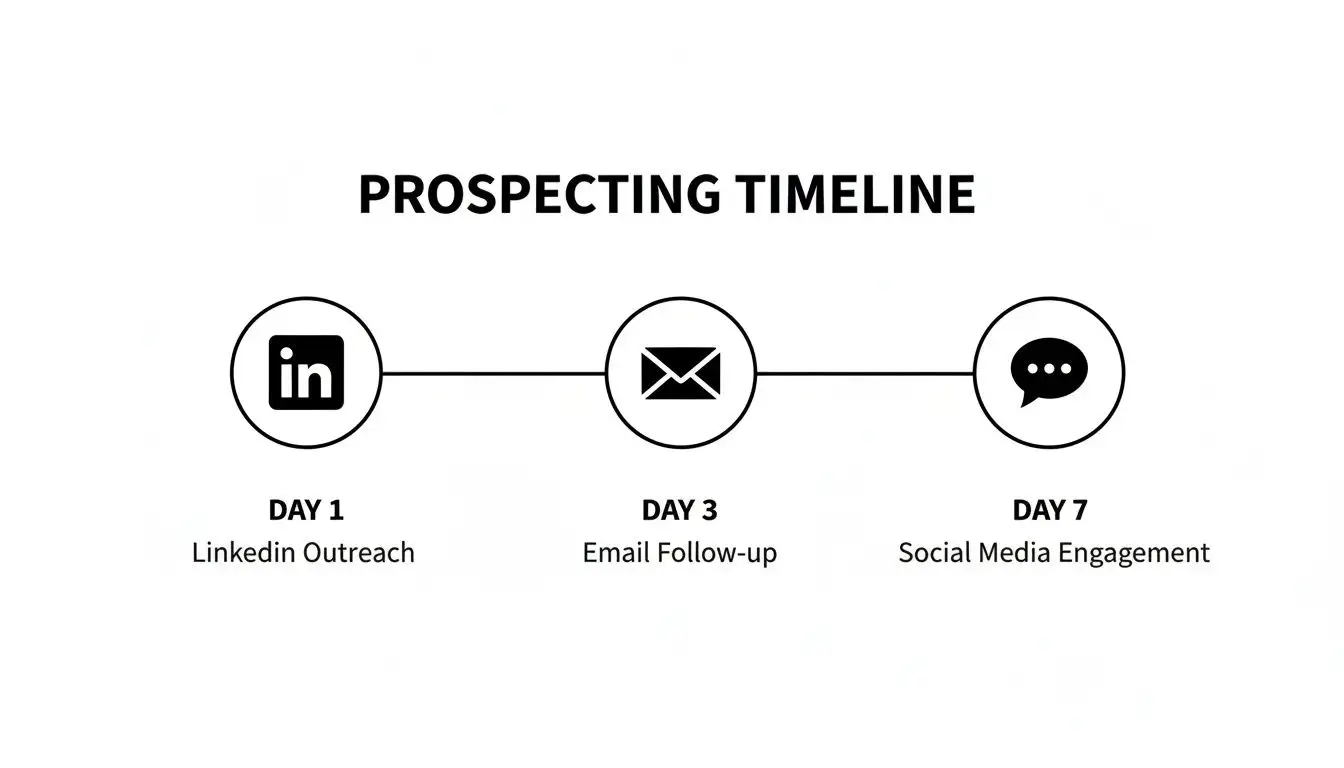
As you can see, a solid cadence isn't about being annoying. It's about spacing out your interactions across a few days and channels to build familiarity without overwhelming your prospect.
Scaling What Works
Here’s the beauty of this whole data-driven system: it scales. Once you find that golden formula, like a message template that consistently gets a killer reply rate or a cadence that books meetings on autopilot, you can share it with your entire team.
You’re no longer dependent on that one "rockstar" rep who seems to have some kind of magic touch. Instead, you're building a system where everyone can win by following a proven playbook.
This is how you scale LinkedIn prospecting the right way. You create a simple dashboard (even a Google Sheet will do) to track your core metrics, you constantly run small tests to find an edge, and you double down on what the data tells you is working. No more guesswork, just results.
Your Sales Intelligence Toolkit: The Prospecting Power-Up
Trying to run a modern LinkedIn prospecting strategy by hand is a bit like trying to build a skyscraper with a hammer and a bag of nails. Sure, you might get a few floors up, but it's going to be a long, painful, and probably wobbly process. It's just not built for today's scale.
This is where your sales intelligence toolkit comes in. Think of these platforms as your mission control center. They pull all the tedious, time-sucking parts of prospecting into one place so your team can stop digging for data and start having actual conversations.
It’s all about working smarter. These tools are designed to automate the grunt work and supercharge every single step, from finding the right people to knowing exactly what to say to them.
Lead Discovery The Smart Way
First things first: you need to find the right people to talk to. The core of any good sales intelligence platform is lead discovery, but this isn't your grandpa's phone book. We're talking about finding prospects who are practically waving a flag that says, "I'm ready to buy!"
These platforms are constantly scanning the digital universe for buying signals that you’d never find on your own. It's like having a team of researchers working for you 24/7.
-
Funding Events: Get an alert the second a target company announces a new round of funding. That’s new budget, new priorities, and a perfect time to get in the door.
-
Job Changes: You'll know immediately when a new decision-maker steps into a role, opening up that golden 90-day window when they're eager to make an impact.
-
Technology Adoption: Find out which companies just adopted a technology that integrates perfectly with your solution, or even better, just started using a competitor.
This completely flips the script on prospecting. You're no longer throwing darts in the dark; you're making precise, intelligence-backed moves on accounts that are ready to talk.
Data Enrichment For Direct Access
Okay, you've found the perfect person. Now what? A LinkedIn profile is a great start, but a direct-dial phone number and a verified email address are your golden tickets to a real conversation. This is where data enrichment saves the day.
Let's be honest, manually hunting for contact info is a soul-crushing waste of time. Clicking through endless "About Us" pages and guessing email formats is a game nobody wants to play.
A good sales intelligence tool makes this a one-click job. It instantly pulls in verified contact details, company information, and even what tech they're using, often with 95%+ accuracy on emails. All that time spent playing detective? It's now time spent connecting and selling.
AI-Powered Personalization at Scale
The final piece of this high-tech puzzle is crafting an outreach message that doesn't sound like it was written by a robot from 1998. Personalizing messages for hundreds of prospects is a massive time sink, but it's non-negotiable for getting replies. Enter AI.
Modern tools like Munch can scan a prospect's LinkedIn profile, their recent activity, and their company's latest news to generate genuinely relevant icebreakers.
Instead of the tired old "Hi Jane, I do X," the AI might give you something like: "Saw your recent post about the challenges of scaling SDR teams. Your point on data-driven coaching really hit home."
This is the unfair advantage your team needs. It combines the speed and efficiency of a machine with the nuance and human touch that actually starts conversations and, more importantly, books meetings.
Your LinkedIn Prospecting Questions, Answered
Alright, let's get into the nitty-gritty. You've got questions, and I've heard them all before. This is the rapid-fire round where we tackle the most common hang-ups and "what-ifs" that trip people up on LinkedIn.
So, How Many Connection Requests Can I Actually Send?
Look, this isn't a numbers game where the highest score wins. LinkedIn officially caps you at about 100 connection requests per week, and they're not shy about putting your account in the penalty box if you push it.
But let's be real, the limit is a distraction. The real magic isn't in maxing out your invites; it's in making every single one count. I'd take 20 hyper-relevant, personalized requests over 100 generic "I'd like to connect" messages any day of the week. Quality, not quantity.
What's The Perfect Message Length?
Short and sweet. Seriously, nobody has time to read an essay in their inbox. Think of your first message as a friendly nod, not a presidential address.
The sweet spot is right around 50 to 125 words. That gives you just enough room to prove you've done a smidgen of research, state your purpose clearly, and get out. Respect their time, and you'll get their attention.
Should I Bother With Automation Tools?
This is a tricky one. Automation can be your best friend or your worst enemy, depending on how you use it.
The secret is to automate the tasks, not the relationships.
-
Good Automation: Using tools to find contact info, schedule follow-ups, or remind you when to reach out. Think of it as a smart assistant handling the grunt work.
-
Bad Automation: Blasting out hundreds of identical, soulless messages that practically scream, "I'm a bot and I don't care about you!" This is a one-way ticket to getting ignored and, eventually, banned.
Let technology handle the tedious, repetitive stuff. But when it comes time to hit "send" on a message, a human touch is absolutely non-negotiable.
Ready to stop prospecting like it's 2009? Munch is your all-in-one sales intelligence platform that unifies lead discovery, data enrichment, and AI-powered personalization. Find high-intent prospects, get verified contact info, and craft outreach that actually gets replies. Start building a predictable pipeline today at usemunch.com.