Unlocking Sales With Data Enrichment Services

By Mriganka Bhuyan
•Founder at Munch
Imagine your CRM is filled with leads, but all you have is a name and an email address. It’s like trying to navigate a new city with a map that only shows street names but no landmarks, restaurants, or points of interest. You know where things are, but you have no idea what they are. That's raw data for you.
Data enrichment is the process of adding all that missing context. It takes your basic, incomplete customer data and fleshes it out with valuable information from other sources. Suddenly, that simple email address is connected to a job title, a company size, a specific industry, and even the software they use every day. It’s the difference between a blurry sketch and a high-definition photograph.
What Are Data Enrichment Services
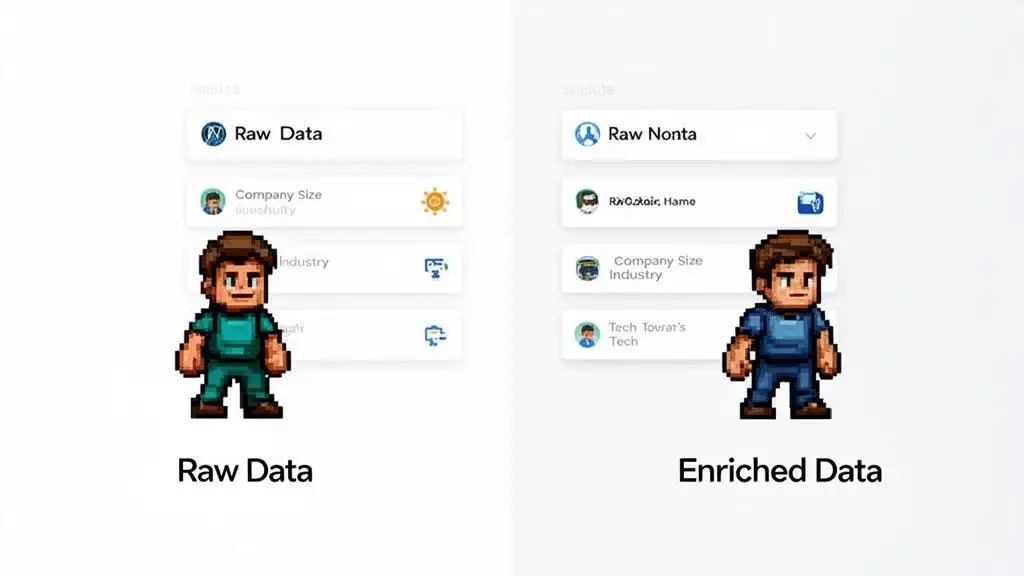
Think of your raw leads like characters in a classic 90s fighting game before you get to the select screen. They're just pixelated silhouettes. You might have their names, but you know nothing about their health bars, special moves, or killer combos. They’re just… there.
Data enrichment services are the 4K HD remaster of that roster. They take that basic, pixelated contact and layer on all the crucial stats and backstory, transforming it into a fully rendered character you can actually build a strategy around. You finally see the whole picture.
From Basic Contact to Qualified Prospect
So, how does this magic happen? It's actually pretty straightforward. A data enrichment service takes a key piece of information you already have, like an email or a company domain, and cross-references it with massive, constantly updated third-party databases. It finds a match and then appends, or adds, all sorts of valuable new data points back to your original record.
To see just how dramatic this change is, here’s a quick look at how a basic lead record transforms with enrichment.
Before and After Data Enrichment
| Data Point | Before Enrichment | After Enrichment |
|---|---|---|
| Name | Jane D. | Jane Doe |
| Company | Acme | Acme Corp |
| jane.d@acme.io | jane.d@acme.io | |
| Job Title | Unknown | VP of Marketing |
| Industry | Unknown | SaaS |
| Company Size | Unknown | 250-500 employees |
| Location | Unknown | San Francisco, CA |
| Tech Stack | Unknown | HubSpot, Salesforce, Slack |
| Funding | Unknown | $15M Series A |
As you can see, you go from having a name and an email to a complete profile of a high-value prospect.
This isn't just about tidying up your CRM. It’s about injecting strategic intelligence into your entire sales process. The benefits are huge:
-
You Actually Understand Your Customers: Forget basic demographics. Now you can see a company's tech stack, recent funding rounds, or hiring trends.
-
Personalization Gets Real: Armed with this context, you can ditch the generic "Dear Sir/Madam" outreach and start conversations that are genuinely relevant to your prospect's world.
-
Lead Scoring Becomes Smarter: You can automatically prioritize leads based on ideal customer profile (ICP) criteria like company size or industry, making sure your team is focused on the hottest opportunities.
-
Your Sales Team Becomes Way More Efficient: Reps spend less time digging around on LinkedIn for basic info and more time actually selling to the right people.
In essence, data enrichment services are the ultimate cheat code for B2B sales. They give you the intel needed to skip the generic outreach and craft personalized messages that resonate, turning cold leads into warm conversations.
The Growing Need for Better Data
This move from manual research to automated intelligence isn’t just a passing fad; it's a massive market shift. The global demand for these tools is exploding, which tells you just how critical accurate data has become. In 2023, the market was valued at around $2.39 billion and is projected to skyrocket to over $6 billion by 2033.
This incredible growth highlights a simple truth: businesses that invest in better data aren't just keeping up, they're building a serious competitive advantage. If you want to dive deeper, you can explore the full market analysis of data enrichment solutions and their projected growth on visionresearchreports.com.
The Different Flavors of Data Enrichment
Data enrichment isn't some one-size-fits-all product. Think of it more like a well-stocked kitchen pantry, filled with different ingredients you can combine to cook up the perfect sales pitch. Understanding these "flavors" of data is what turns a fuzzy outline of a prospect into a crystal-clear picture of who they are and what they need.
It’s a bit like assembling a heist crew for Ocean's Eleven. Each data type has its own special skill, but the real magic happens when they all work together. Let's meet the key players on your data enrichment team.
Firmographic Data: The Company Vitals
This is your starting point: the basic, foundational intel on the company itself. It’s the "who" and "what" of the organization, giving you the high-level stats you need to see if they're even in the right ballpark. Think of these as the stats on the back of a baseball card, but for a business.
Firmographic data usually includes details like:
-
Company Size: How many people work there?
-
Annual Revenue: Are we talking a scrappy startup or a Fortune 500 giant?
-
Industry: The specific market they play in, like SaaS, manufacturing, or healthcare.
-
Location: Where are their headquarters and other key offices?
For example: You learn a lead works at a software company (industry) with 500 employees (company size) and pulls in $50 million in annual revenue. Right away, you know they’re big enough to have a real budget but not so massive that you’ll get stuck in nine circles of corporate red tape.
Demographic Data: The People Details
Okay, so firmographics tell you about the company. Demographics zoom in on the person you’re actually trying to talk to. This is the stuff that helps your outreach feel like it was written by a human, for a human.
This layer of data adds personal context, such as:
-
Job Title: Are you talking to the ultimate decision-maker, an influencer, or someone on the front lines?
-
Seniority Level: Is this a Director, a VP, or someone in the C-suite?
-
Contact Information: This is the practical stuff, like verified email addresses and direct-dial phone numbers that actually work.
For example: You discover your contact, Jane Doe, isn't just "in marketing." She's the newly appointed VP of Marketing (job title and seniority). That's a golden nugget of information. It tells you she's fresh in her role and likely has the authority to sign on the dotted line.
Technographic Data: The Tech Stack
This is my personal favorite. Technographic data is like getting a backstage pass to your prospect’s digital toolbox, revealing the specific software and technologies they’re already using. In today's sales world, knowing their tech stack is a genuine superpower. It's like knowing your opponent's special moves in Street Fighter II before the match even starts.
This intel tells you if they’re using a competitor's product (hello, replacement opportunity!), a tool that complements yours (an easy integration story), or a piece of tech that makes them a slam-dunk fit.
For example: You find out a target company runs on Salesforce. Since your product has a killer Salesforce integration, you can tailor your entire pitch around how you'll make their existing workflow 10x better. No guesswork needed.
Intent Data: The Buying Signals
Intent data is the secret weapon. It’s the most dynamic and, frankly, the most powerful flavor of them all. It tracks a prospect's online behavior to find clues that they are actively researching a solution just like yours. It’s the digital breadcrumb trail showing you they’re in-market and ready to talk.
Want to go deeper on this? Check out our full guide on lead enrichment strategies.
For example: You get an alert that three different people from a target account have been all over review sites for your software category. On top of that, they just downloaded a whitepaper on a related topic. That’s not a coincidence; it's a massive buying signal telling you to reach out right now before your competition does.
So, How Does This Data Enrichment Sorcery Actually Work?
Ever wondered how a simple email address suddenly morphs into a full-blown professional dossier? It’s not actually magic, though it certainly feels like it. The whole process is a slick, multi-step workflow that’s less The Matrix server room and more like a lightning-fast private investigator at work.
It all starts with the scraps of info you already have. Maybe it's a list of emails from a trade show, a CSV file of new sign-ups, or that graveyard of half-complete contacts mouldering away in your CRM. This is your starting point, the single clue that kicks off the whole investigation.
The Art of Matching and Appending
Once you feed your initial data into the system, the enrichment service gets down to business. It takes an identifier, like "jane.doe@acme.com," and runs it against massive third-party databases. Think of it like running a license plate. The system scans for a match and, once it finds one, starts pulling in all the related intel.
This is the "appending" phase, where the platform starts layering on juicy new details. Your simple record gets a major upgrade with info like:
-
Job Title: VP of Marketing
-
Company Name: Acme Corp
-
Industry: SaaS
-
Employee Count: 250-500
Suddenly, a lonely email address becomes a strategic asset. If you want to go deeper, we've got a whole guide on what data enrichment truly is that breaks it all down.
The chart below shows how these different data types: firmographic, technographic, and demographic, stack on top of each other.
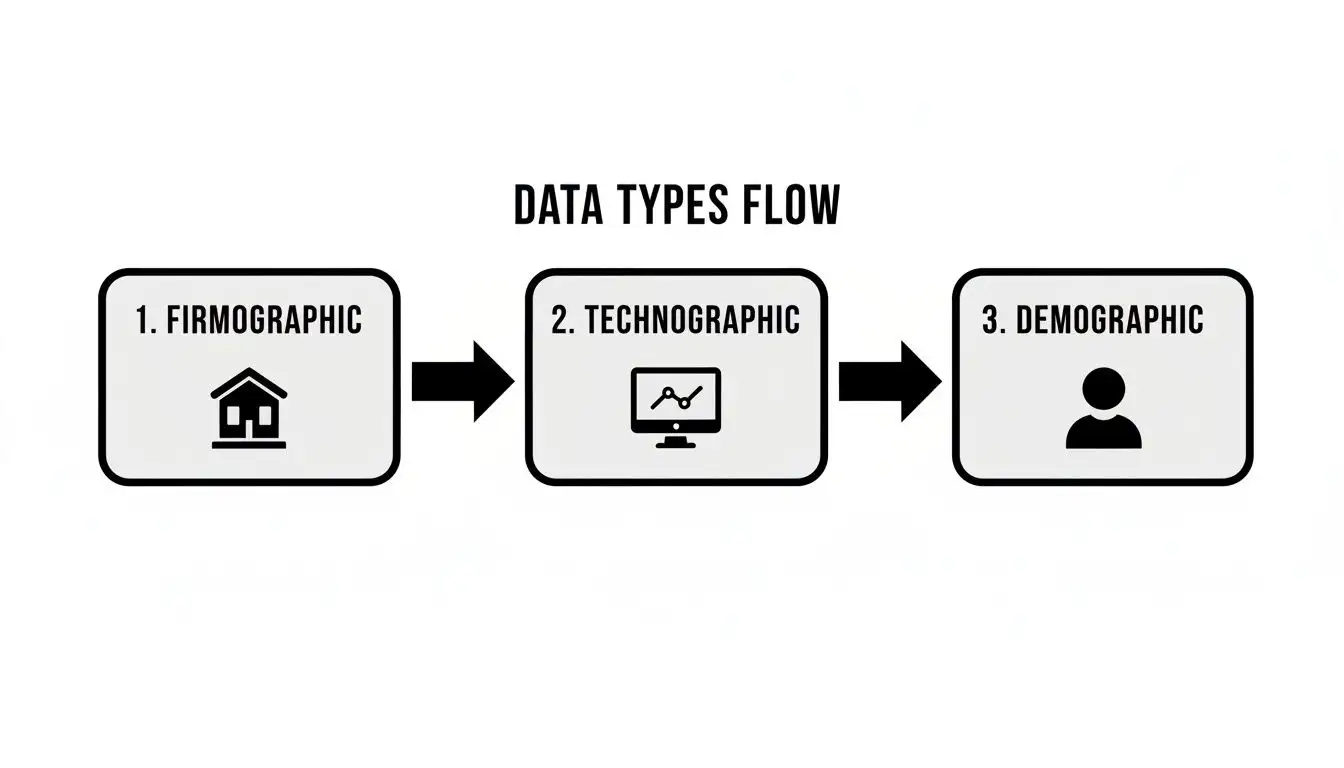
It’s a logical flow: you start with the company basics, layer on the software they use, and finish with the details about the person you're trying to reach. It's how you build a complete picture.
Keeping It Real with Validation and the Cloud
What good is a mountain of new data if it’s all wrong? This is where validation saves the day. The best data enrichment services don’t just dump information on you; they verify it. They run constant checks to make sure email addresses are live, phone numbers actually connect, and job titles haven't gone stale. This crucial step is what keeps your sender reputation safe and stops you from wasting time shouting into the void.
The engine behind this whole operation is the cloud. It’s no surprise that cloud-based platforms dominate the market, capturing between 57% and 72% of all enrichment business. They offer mind-blowing speed and scalability, often at a 40% lower cost than clunky, old-school on-premise setups.
Honestly, it’s the difference between streaming a movie instantly and having to drive to Blockbuster to rent a VHS tape.
Putting Enriched Data to Work in B2B Sales
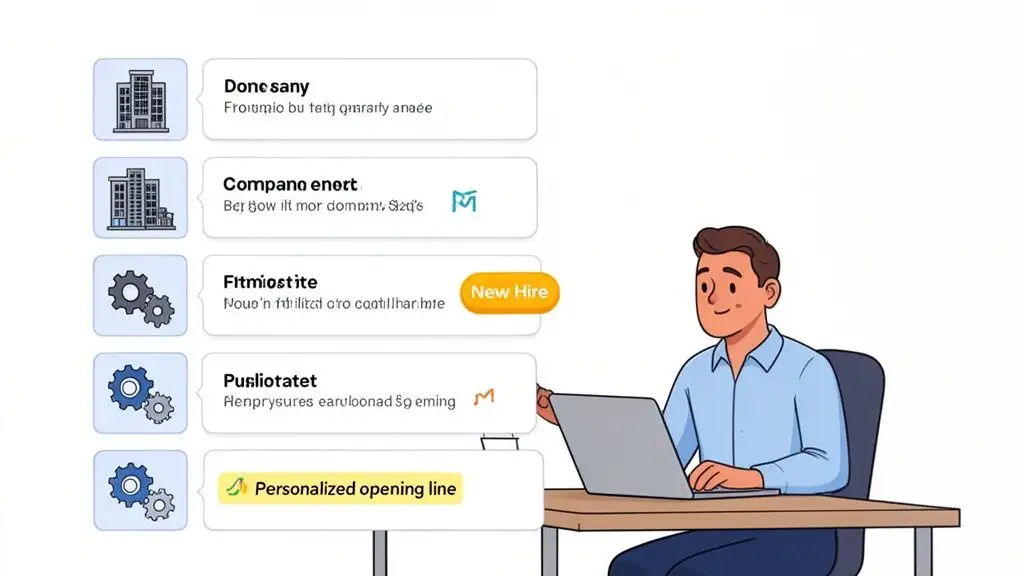
Alright, enough theory. A database packed with enriched data is great, but if it just sits there, it’s like owning a Ferrari you only drive to the grocery store. Let's talk about turning all that juicy information into a real sales pipeline and finally ditching the "spray and pray" approach for good.
This is where the magic happens and the ROI really shows up. We’re talking about transforming your sales team from generic email blasters into a squad of strategic sharpshooters who know exactly who to talk to, what to say, and when to say it.
Building Hyper-Targeted Prospect Lists
Remember the bad old days of buying a stale list and just crossing your fingers? With enriched data, you can build a prospect list so laser-focused it almost feels like cheating.
Let's say you're selling a project management tool that integrates perfectly with HubSpot. Instead of blasting every company with a pulse, you can dial in your filters with surgical precision:
-
Firmographics: B2B SaaS companies with 50-250 employees.
-
Technographics: Companies actively using HubSpot Marketing Hub.
-
Recent Events: Just closed a Series A funding round in the last six months.
Just like that, your list of 10,000 generic leads shrinks to a hyper-qualified hit list of 200 companies. These are businesses with the exact problem you solve, the tech you integrate with, and the cash to make a move. For more on this, check out our guide on how to find business emails for the right contacts.
Crafting Emails That Actually Get Opened
You've got your perfect list. Now, what do you say? Enriched data is the secret sauce for writing opening lines that cut through the noise of a crowded inbox.
Imagine your enrichment tool flags that a key prospect, Sarah, was just promoted to VP of Sales at a target account. Your generic pitch goes out the window.
Instead, your opening line becomes:
"Hey Sarah, congrats on the new VP of Sales role! I know when a new leader steps in, shaking up the old tech stack is usually high on the agenda. Since you're already using HubSpot, I had a specific idea for streamlining your team's project workflows."
That one sentence proves you did your homework. It’s relevant, timely, and positions you as a thoughtful problem-solver, not just another vendor. It’s the difference between a handwritten thank-you note and a generic flyer left on your car windshield.
Pro Tip: Munch helps you build your prospect list, enrich their contact data, do research on your leads and craft personalized outreach messages - all in one single platform!
Prioritizing Leads with Smarter Scoring
Not all leads are created equal. An account executive’s time is their most valuable asset, and data enrichment ensures they spend it on accounts that have a real shot at closing. This is where automated lead scoring becomes your team's superpower.
You can set up rules that automatically bump up a lead’s score based on key data points. For example, a lead from a 500-person company using a competitor's software gets a much higher score than a lead from a 10-person startup. This simple system directs your team's energy where it counts, on the high-value accounts, not the dead ends.
A Sample Workflow: The Enriched Outbound Cadence
So, how does this look in practice, day-to-day? Here’s a quick example of how an SDR can weave enriched data into a multi-touch outbound cadence.
Data-Driven Outbound Cadence Example
| Day | Action | Personalization Point (from Enrichment) |
|---|---|---|
| 1 | Email #1 | Mention their recent promotion or a new company funding round. |
| 2 | LinkedIn Connection | Reference a shared connection or a piece of content they recently engaged with. |
| 4 | Email #2 | Forward a case study of a similar company in their industry. |
| 5 | Cold Call | Use their company’s tech stack as a conversation starter. |
| 7 | LinkedIn Message | Comment on a recent company announcement or news article. |
| 10 | Email #3 (Breakup) | Reiterate the value prop based on their specific job title and responsibilities. |
This isn't just a sequence; it's a conversation built on relevance. Every touchpoint is informed by real data, making it feel less like a sales pitch and more like a helpful, personalized interaction.
How to Choose the Right Data Enrichment Service
Picking a data enrichment service feels like a make-or-break decision for any sales team. Get it right, and it’s like giving your reps a high-powered GPS that navigates them directly to their quota. Get it wrong, and you've just handed them a folded, coffee-stained gas station map from 1998 and wished them luck.
Look, not all of these services are the same. The differences can be the deciding factor between a killer outreach campaign and a total dud. To avoid that sinking feeling of buyer's remorse, you need to grill vendors during demos. The mission is to find a real partner who helps you close deals, not just add another subscription to the company credit card.
Key Criteria for Vendor Selection
Before you even think about signing a contract, you have to put these vendors through their paces. This isn't just another checklist; it's your battle plan for finding a tool that actually works for your team.
-
Data Accuracy: This one is everything. Flat out ask them for their verified accuracy rate, especially for email addresses. If it's below 95%, walk away. A lower rate means you’re signing up for a flood of bounced emails, which torpedoes your sender reputation and torches your team's time.
-
Data Sources and Freshness: So, where is this data actually coming from? The best providers are transparent about pulling from a massive network of verified, current sources. Then ask the follow-up: "How often do you refresh it?" Data that's old is data that's dead.
-
Integration Capabilities: Your new toy has to play nice with the rest of your tech stack. Does it have a clean, native integration with your CRM, like Salesforce or HubSpot? A clunky setup that forces your team into manual data entry completely defeats the purpose of buying the tool in the first place.
The best data enrichment services don't just sell you a list of contacts; they provide a unified workflow. Look for platforms that combine lead discovery, real-time enrichment, and outreach tools into a single, cohesive experience.
Pricing Models and Unified Workflows
You can't calculate your ROI if you don't know what you're paying for. Pricing models in this space are all over the map, so it’s critical to find one that actually fits how your team works.
A few common models you'll run into:
-
Usage-Based: You pay for each contact you enrich or each API call you make. This can be a great starting point for smaller teams, but the costs can balloon quickly as you grow.
-
Seat-Based: A straightforward flat fee for each user on your team. It's predictable, which finance loves, but can get expensive if you have a big team where only a few people need heavy access.
-
Flat Fee Subscription: A simple monthly or annual fee that gets you a specific package of features and usage credits.
Beyond the price tag, zoom in on the workflow. A platform that separates finding leads from enriching them is just creating friction, forcing your reps to constantly switch between tabs. That's a productivity killer. To get a better feel for what a seamless experience looks like, this data enrichment tool guide is a great resource.
At the end of the day, you're looking for a single solution that streamlines your entire top-of-funnel process, from finding the perfect prospect to sending that first killer email.
Common Questions About Data Enrichment
You’ve got questions, we’ve got answers. When you first hear about data enrichment services, it’s smart to be a little skeptical. It’s a powerful tool, no doubt, but it’s totally normal to wonder how it all works, if it's legit, and when you'll actually see a return on your investment.
Let's clear the air and tackle some of the most common questions head-on. Think of this as your personal cheat sheet to get you up to speed fast.
How Is This Different From Buying a Lead List?
This is a big one, and the difference is night and day. Buying a lead list is like getting a phone book from a stranger. You get a pile of names and numbers, but with zero context and questionable accuracy. Honestly, it's the digital equivalent of cold calling random numbers scrawled on a bathroom wall.
Data enrichment, on the other hand, starts with your existing data or a highly specific ideal customer profile. It takes the information you already have and makes it better by adding layers of useful detail and confirming it's all correct.
Enrichment is all about quality over quantity. It hands you the crucial context, like a recent job change or the specific tech a company uses, that turns a generic, instantly-deleted email into a personalized, relevant conversation.
Is Data Enrichment Compliant with GDPR and CCPA?
Yes, but this comes with a crucial "but." Any reputable data enrichment service worth its salt is built with compliance as a core feature, not an afterthought. They pull their data from publicly available and ethically compiled sources, like company websites, press releases, and professional networks.
Top-tier providers design their platforms around data privacy and consent. That said, the responsibility doesn't stop with them. It’s absolutely vital that you choose a vendor who is transparent about where their data comes from and that you use that enriched data responsibly, staying well within all legal boundaries.
How Quickly Can I See ROI?
The return on investment can be surprisingly quick. The first thing you'll notice is the operational boost. Your sales team will spend way less time digging around for contact info and hitting dead ends with bounced emails. You can literally measure this efficiency gain within the first month.
The more strategic ROI, like better reply rates and more meetings booked, usually starts showing up within the first quarter. This happens because your team is hitting up higher-quality leads with messaging that actually resonates from day one. You waste less time on bad fits, and the good ones are far more likely to respond. You can also check out our guide on how to verify email addresses to give your outreach an extra edge.
Platforms that combine lead discovery with enrichment often put this whole process on the fast track, giving you a shorter path from finding a prospect to booking a meeting.
Ready to transform your sales process with data that actually works? Munch unifies lead discovery, enrichment, and outreach into one powerful workflow, delivering 95%+ email accuracy and AI-powered personalization. Find your next customer with Munch.