Your Guide To Finding The Best Data Enrichment Tool

By Mriganka Bhuyan
•Founder at Munch
Picture this: your prospect list is like an old, blurry, black-and-white photograph. A data enrichment tool is the magic "enhance" button you see in spy movies. It instantly sharpens that image to a stunning 4K resolution, floods it with vibrant color, and reveals a ton of detail you never knew was there.
That's the core idea. It takes a single, lonely piece of information, like an email address, and transforms it into a rich, detailed profile your sales team can actually use.
So, What Is a Data Enrichment Tool, Really?
Let’s stick with that photo analogy. Your raw data is a grainy snapshot of a person in a crowd. You might know their name is "Jane Doe," but that's about it. A data enrichment tool is your digital detective, taking that name and email and running it against hundreds of public and private databases to give you the complete story.
Suddenly, you see that Jane Doe isn't just a name. She’s the brand-new VP of Marketing at a SaaS company that just landed a huge funding round. Oh, and she used to work at a company that used your competitor's software. She’s all over LinkedIn, posting about the challenges of scaling her team. That's the leap from raw data to enriched data.
Upgrading Your Sales Engine
Think of your sales process as a basic, no-frills, factory-model car. Sure, it gets you from A to B, but it’s a bumpy ride with a terrible sound system. A data enrichment tool is like giving that car a full-blown Pimp My Ride makeover, straight out of the 2000s.
Your standard-issue model gets a serious upgrade:
-
GPS Navigation (Firmographics): Instead of driving blind, you suddenly know the company's size, industry, location, and annual revenue. You can stop guessing and start targeting companies that are a perfect fit.
-
Onboard Diagnostics (Technographics): The tool scans their "engine" and tells you exactly what software they're already using. Now you know if they use a competitor's product or a tool that integrates beautifully with yours.
-
Live Traffic Alerts (Buying Intent Signals): This is the game-changer. You get real-time alerts when a company is actively searching for a solution like yours. These are signals like recent funding announcements, a sudden hiring spree for specific roles, or spikes in online research on relevant topics.
This isn't just a nice-to-have upgrade anymore. The market for these tools has absolutely exploded, jumping from USD 5.1 billion in 2023 to a projected USD 12.3 billion by 2033. This massive growth shows just how many businesses are done with the guessing game and ready to sell with pinpoint accuracy. You can explore more insights on this market growth and its key drivers.
Data enrichment is the difference between knowing someone’s name and knowing their favorite movie is The Matrix, their dog is named Neo, and they're hiring for a role you can fill. It turns cold outreach into a warm, informed conversation.
To really see the difference, let's look at a side-by-side comparison of a lead profile before and after enrichment.
Raw Data vs Enriched Data: The Ultimate Glow-Up
| Data Point | Before Enrichment (The Basic Profile) | After Enrichment (The Actionable Profile) |
|---|---|---|
| Contact Info | Alex Chen, alex@acmecorp.com | Alex Chen, alex@acmecorp.com, +1-555-123-4567 |
| Job Title | (Unknown) | VP of Engineering |
| Company | Acme Corp | Acme Corp |
| Industry | (Unknown) | Enterprise Software (SaaS) |
| Company Size | (Unknown) | 500-1,000 employees |
| Tech Stack | (Unknown) | Uses AWS, Salesforce, Jira, and CompetitorX |
| Recent Activity | (Unknown) | Company just raised $50M Series B funding; actively hiring 15+ senior developers. |
See the difference? The "before" profile is a dead end. The "after" profile is a sales opportunity just waiting to happen. You know exactly who Alex is, what his company needs, and the perfect angle for your pitch.
With this level of detail, your sales team can finally stop blasting out generic emails and start crafting messages that are impossible to ignore. A data enrichment tool doesn't just add data; it adds context, turning every lead into a genuine, high-potential opportunity.
How These Tools Actually Work Their Magic
So, how does a data enrichment tool turn a single email address into a goldmine of sales intelligence? It’s not exactly sorcery, but it’s close. The process is a clever blend of massive data sourcing and smart algorithms, all working together like a well-oiled machine. Think of it less like magic and more like having the ultimate digital detective on your team.
It all starts with a single clue you provide, like jane.doe@acmecorp.com. From that one piece of information, the tool kicks off a highly sophisticated scavenger hunt, querying hundreds of verified public and private databases. It scours the web, sending out thousands of tiny feelers to piece together a complete puzzle about Jane and her company.
The real genius lies in the smart matching algorithms that connect all those disparate dots. The tool is smart enough to confirm that the Jane Doe who just got a promotion on LinkedIn is the same Jane Doe from a company press release and the same one listed in a B2B contact database. It's the digital equivalent of a detective connecting pins on a corkboard, but it happens in milliseconds.
This diagram breaks down that transformation, showing how raw, basic information is morphed into a powerful, enriched profile.
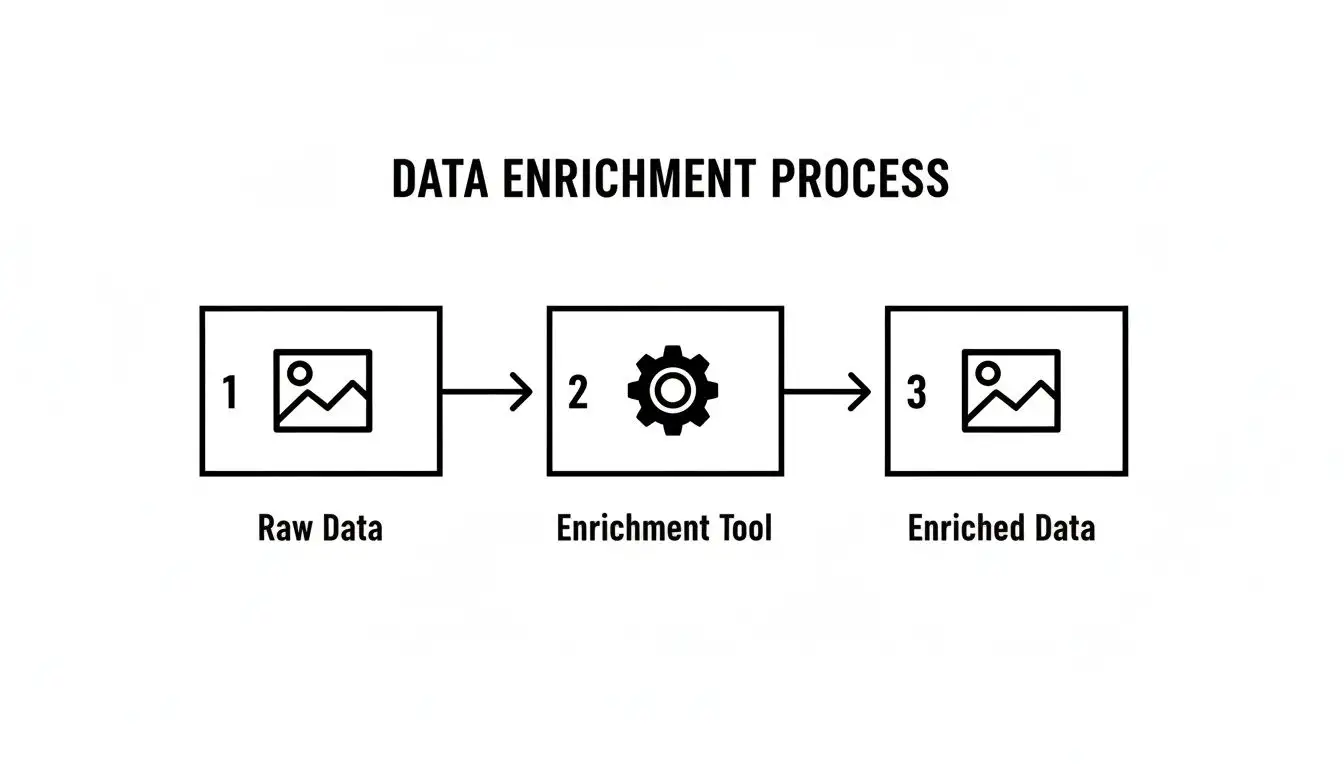
As you can see, it’s a simple but powerful journey from a blurry, incomplete contact to a sharp, actionable lead profile. It’s all powered by the enrichment engine.
The Secret Sauce: Waterfall Enrichment
One of the coolest techniques the top-tier platforms use is called waterfall enrichment. Imagine you have one of those fancy multi-stage water filters that makes tap water taste like it came from a mountain spring. If the first filter layer doesn't catch an impurity, the water flows down to the next, more specialized layer, and so on, until it's perfectly clean.
Waterfall enrichment does the exact same thing for data. The tool hits its most reliable data source first. If it can't find a verified phone number or confirm a job title there, it doesn't just give up. It automatically "falls" to the next best source in its network, and then the next, until it pins down a verified, accurate result.
This method is crucial for delivering data you can actually trust. Instead of banking on a single, potentially outdated database, the system cross-references multiple sources to find the truth. This multi-layered approach is how platforms like Munch can provide over 95% email accuracy, saving your team from the soul-crushing sound of a bounce-back notification.
From Funding News to a Booked Meeting
Let's put this into a real-world scenario. Say an SDR on your team, we'll call him Kevin, is scrolling through his tech news feed. He spots an article announcing that a target company, "Innovate Inc.," just closed a $20 million funding round. Without a data enrichment tool, that’s just an interesting tidbit.
With a powerful tool, it's a giant, flashing green light. Here's what happens next:
-
Kevin pops "Innovate Inc." into the enrichment platform. The tool instantly gets to work, pulling all publicly available data associated with the company.
-
It pinpoints key decision-makers. The algorithm flags that a new CTO, Sarah, was hired just two months ago, a classic sign of a technology overhaul.
-
It uncovers game-changing context. The tool enriches Sarah's profile with her verified direct dial and corporate email. But it also reveals Innovate Inc.'s tech stack, showing they use a competitor's software that's up for renewal in three months.
-
Kevin gets the perfect "in." He now has the CTO's direct contact info, a compelling reason to call (the funding), and a specific pain point to address (her new role and an outdated tool).
What started as a simple news headline just became a warm, hyper-relevant conversation. Kevin isn't just another SDR; he's an informed advisor. If you want to dive even deeper into the nuts and bolts, you can learn more about the complete process of enrichment of data in our detailed guide.
What to Look For: The Must-Have Features in a Data Enrichment Tool
Picking a data enrichment tool is like casting for a heist movie. You can’t just grab the first person you see. You need a team of specialists, each with a very particular set of skills. Some tools are just the safecracker, great at one specific thing, like verifying emails. Others are the whole Ocean's Eleven crew rolled into one slick, powerful platform.
To make sure you don't end up with a tool that’s more of a liability than an asset, you've got to look past the shiny brochures. A truly great data enrichment tool doesn't just hand you a phone number; it delivers a complete dossier on your target, giving your sales team an almost unfair advantage.
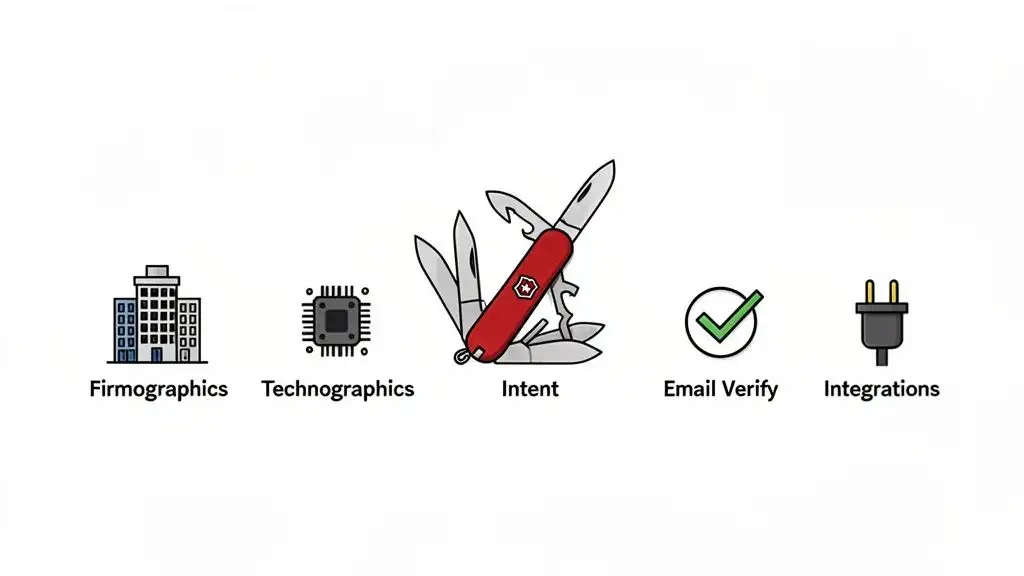
So, what are the non-negotiables? Here’s what you should be demanding from any platform you consider.
Go Way Beyond Basic Contact Info
Let's get one thing straight: finding a verified email address is just the price of admission. It’s the absolute bare minimum. To be genuinely useful, a modern data enrichment tool has to dig much, much deeper. You need a platform that paints a complete picture of both the company and the person you're trying to reach.
This all starts with firmographics. Think of this as the foundational intel that helps you qualify a company in a split second.
-
Company Size: Are we talking about a scrappy five-person startup or a global behemoth with thousands of employees?
-
Industry & Niche: Knowing they're a "SaaS" company is okay. Knowing they're a "FinTech SaaS for SMBs" is gold.
-
Annual Revenue: Can they actually afford your solution, or will your quote make their accountant break out in a cold sweat?
-
Geographic Location: This isn't just about their headquarters. You need to know where all their offices are, which is absolutely critical for planning sales territories.
Then comes technographics, which is like getting a backstage pass to their entire digital operation. This tells you exactly what software and tech a company is running. For a sales rep, this is priceless information. You can instantly see if they're using a competitor's product, a tool that integrates perfectly with yours, or an ancient, clunky system that's just begging to be replaced.
Uncover Actual Buying Intent Signals
Okay, this is where the great tools really pull away from the good ones. Intent signals are the digital breadcrumbs a company leaves across the web that show they're actively shopping for a solution like yours. It’s the difference between crashing a party and being the guest of honor.
A top-tier data enrichment tool should be your team's "sentinel," constantly scanning the market for signs of opportunity. It flips your sales process from reactive to proactive, letting you engage prospects the moment they show interest.
Here are the key intent signals you should be looking for:
-
Recent Funding Events: A company that just landed millions in venture capital is ready to spend it on new tools to fuel their growth.
-
Sudden Hiring Sprees: A sudden rush to hire a dozen "sales development reps" or "DevOps engineers"? That tells you exactly where their strategic priorities are.
-
Key Job Changes: When a new exec joins a company, they often bring their own budget and a burning desire to shake things up. They are prime targets.
-
New Technology Adoption: Seeing that they just implemented a complementary software can signal the perfect moment to introduce your own.
The Power of a Single, Unified Platform
Having one tab open for lead sourcing, another for enrichment, and a third for outreach is just organized chaos. It's like trying to cook a gourmet meal in three different kitchens at the same time. A truly superior data enrichment tool solves this mess by bringing everything under one roof.
Munch combines lead discovery, data enrichment, and AI-powered personalization into a single, seamless workflow. That kind of integration is a massive productivity booster. For B2B teams looking for an edge, you can dive deeper into the benefits of top-tier lead enrichment tools and what they can really do for you.
This all-in-one approach is quickly becoming the new standard, especially as the market for these solutions explodes. Cloud-based tools now command a 57% market share, a trend fueled by their ability to crunch enormous amounts of data for real-time insights. The global market itself, valued at USD 2.39 billion in 2023, is on track to hit USD 6.27 billion by 2033 as AI and machine learning make these platforms even more powerful.
Putting Enriched Data Into Action with Sales Workflows
Theory is great, but a pipeline overflowing with booked meetings? That’s a whole lot better. It's one thing to have a powerful data enrichment tool, but it's another thing entirely to know how to turn that firehose of intel into actual replies. It’s time to move from data points to dollars.
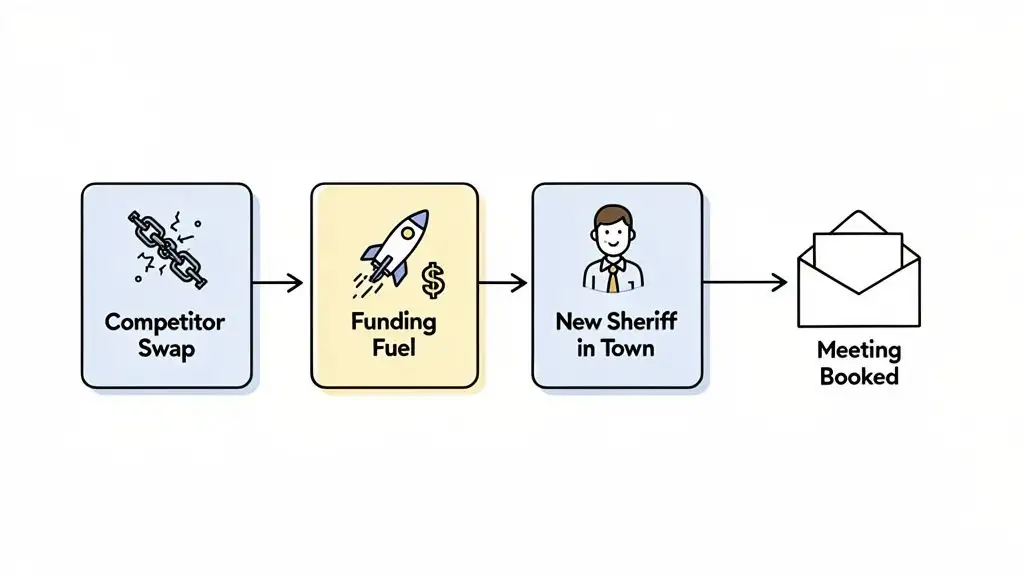
This is where the magic really happens. We’re going to stop just talking about data and start using it with three practical, high-impact sales workflows. These aren't just abstract ideas; they're field-tested plays that turn enriched data into real conversations and, ultimately, closed deals.
Workflows like these are exactly why large enterprises are adopting data enrichment so aggressively. They nabbed the biggest market share in 2023 by turning mountains of data into surgical, actionable intelligence for their sales and marketing squads. The global market for these tools is on a trajectory to rocket past USD 5.39 billion by 2033, and it's these real-world applications that are lighting the fuse. You can see the full breakdown of these market trends on Spherical Insights.
Let's dig into how you can put these strategies to work for you, right now.
Workflow 1: The Competitor Swap
This play is beautifully simple and devastatingly effective. The whole idea is to find and engage companies right after they’ve ditched a rival's software. It’s the sales equivalent of showing up with a life raft just as their old ship starts taking on water.
-
Data Points Needed: The key ingredient here is technographics. Your enrichment tool has to track what software your target accounts are using and when they stop using it. This is a massive buying signal that screams dissatisfaction or a contract ending.
-
Execution: Set up an alert in your data tool (like Munch) to ping you the second a company in your ICP uninstalls a competitor's code from their website. That's your trigger.
-
AI-Powered Outreach Example: Once you get that signal, an AI writing assistant can instantly whip up a hyper-relevant message. You’re not sending a generic "just checking in" email; you’re sending this:
"Hi [Prospect Name], noticed your team recently moved on from [Competitor's Tool]. We help companies like yours solve [Specific Pain Point of Old Tool] with [Your Solution's Key Benefit]. Worth a quick chat next week to show you how?"
This message is timely, context-aware, and proves you’ve done your homework. It’s the kind of outreach that makes a prospect sit up and think, "Okay, these guys actually get it."
Workflow 2: The Funding Fuel
When a startup announces a new funding round, it's basically a starting pistol for their next big growth sprint. They're flush with cash and have a clear mandate to spend it on the tools and talent that will help them scale. This is your chance to become their go-to partner.
-
Data Points Needed: You need real-time funding data. This means the funding amount, the series (Seed, Series A, B, etc.), and the key investors. This info tells you everything about their growth stage and what they’re prioritizing.
-
Execution: Create a saved search for companies in your target market that have announced a funding round over a certain amount (say, $5 million) in the last 30 days.
-
AI-Powered Outreach Example: AI can take those funding details and weave them into a message that’s both congratulatory and value-packed.
"Congrats on the $10M Series A, [Prospect Name]! That's huge news. As you scale the [Relevant Department] team, leaders often run into [Common Scaling Problem]. Our platform is built to handle exactly that. Any interest in seeing how we help companies like [Similar Funded Company] navigate this stage?"
This approach doesn't make you sound like a salesperson. It makes you sound like an expert who understands the unique growing pains that come with a fresh injection of capital.
Workflow 3: The New Sheriff in Town
A new executive hire is one of the most powerful catalysts for change within a company. They arrive with a budget, a 90-day plan to make an impact, and a healthy skepticism of the old way of doing things. They haven’t sworn allegiance to the legacy tech stack yet.
-
Data Points Needed: Job change signals are the golden ticket here. You need alerts for when someone with a target title (like VP of Sales or CTO) starts a new gig at a company you want to crack into.
-
Execution: Filter for new hires in key leadership roles at your target accounts within the last 60 days. That first two-month window is the absolute sweet spot.
-
AI-Powered Outreach Example: AI can help you craft a note that acknowledges their new role and offers immediate, no-strings-attached value.
"Welcome to the new role at [Company Name], [Prospect Name]! My team put together a quick brief on [Their Industry Trend] that might be useful as you get settled in. We specialize in helping new VPs like you achieve [Key Goal] in their first quarter. Open to a brief call?"
This play is all about perfect timing and positioning yourself as a helpful resource, not a pushy vendor. For more ideas on structuring these automated plays, check out our guide on how to create effective workflows. When you start turning enriched data into strategic outreach, you transform your sales process from a numbers game into a series of smart, calculated moves.
How to Choose the Right Data Enrichment Tool
Picking a new SaaS tool can feel like trying to find a decent movie on a streaming service. You scroll for an hour, get paralyzed by all the options, and end up re-watching The Office for the seventh time. The world of data enrichment tools is just as crowded, with every vendor promising the moon.
To cut through the noise, you need a game plan. You need a checklist. Think of this as your guide to sidestepping the marketing fluff and finding a platform that actually helps your team book more meetings, not just attend more training sessions.
Data Accuracy and Source Diversity
Let's be blunt: if the data is junk, the tool is junk. This is the single most important factor. Bad data doesn't just waste your time; it actively damages your brand's reputation with every bounced email and cringey, misinformed outreach message.
The key question isn't "Is your data accurate?" because every salesperson will say yes. The real questions are:
-
How do you verify your data? Look for answers that mention multi-step verification processes and real-time validation, not just a once-a-year database scrub.
-
Where do you get your data from? A great tool pulls from hundreds of diverse, verified sources, not just one or two big databases. This is what enables techniques like "waterfall enrichment," ensuring they find the right info even if the first source comes up empty.
-
What's your guaranteed email accuracy rate? Don't accept vague answers. A top-tier data enrichment tool like Munch will confidently guarantee 95%+ email accuracy because their entire system is built on finding verified, reliable data.
Does It Play Well with Others
Your new tool needs to fit into your existing workflow like the final piece of a puzzle, not a rogue Lego brick you step on in the middle of the night. If it doesn't integrate seamlessly with your CRM and other sales tools, your team simply won't use it.
A data enrichment tool should feel like an upgrade to your CRM, not a separate island of information that requires a manual ferry to move data back and forth. Seamless integration saves dozens of hours per month in manual data entry.
Look for native integrations with major platforms like Salesforce and HubSpot. This allows for automatic enrichment of new leads and keeps your existing records fresh without anyone lifting a finger. If a tool forces you to constantly export and import CSV files, run for the hills.
Usability for the Actual Users
Can your team actually use it without needing a PhD in data science? A powerful tool that’s impossible to use is just an expensive icon on your desktop. The user interface should be intuitive and designed for the speed at which sales teams operate.
Pay close attention during a demo. How many clicks does it take to enrich a list of leads? Can an SDR quickly build a target account list with just a few filters? If the demo feels clunky and confusing, imagine how frustrating it will be for your team on a busy Tuesday afternoon.
Scalability and Pricing
Your business is going to grow, and your tools need to grow with you. A platform that works for a team of two SDRs should also be able to support a team of twenty without falling over. Ask about their ability to handle larger data volumes and more complex workflows.
Pricing should be transparent and make sense. Avoid vendors with confusing credit systems that feel designed to trip you up. A clear, tiered pricing model that aligns with your usage and team size is a massive green flag. It shows the company is focused on providing value, not nickel-and-diming you for every API call.
Is There a Human to Help
When something inevitably goes wrong, you need to know there's a real, live human you can talk to. Good customer support is the ultimate safety net. Before you sign anything, find out what their support options look like.
-
Is support included, or is it an extra cost?
-
Do they offer live chat, email, or phone support?
-
What are their typical response times?
Great support indicates a company that is invested in its customers' success, not just its own sales numbers. It’s the final, crucial checkmark in finding a data enrichment tool that will become a true partner in your growth.
Data Enrichment Tool Evaluation Checklist
To make this process even easier, we've put together a handy checklist. Use this table when you're sitting in on demos or comparing different platforms. It will help you ask the right questions and spot the green flags that signal a truly valuable partner.
| Evaluation Criteria | Key Questions to Ask | What to Look For (Green Flags) |
|---|---|---|
| Data Quality & Accuracy | What is your verified email accuracy rate? How do you source and verify your data? How often is data refreshed? | A guaranteed accuracy rate of 95%+. Multi-step verification processes. Diverse, ethically-sourced data from public and private sources. |
| Integration Capabilities | Do you have a native integration with our CRM (e.g., Salesforce, HubSpot)? What other tools do you integrate with? | Seamless, two-way native integrations. Minimal setup required. Clear documentation for API access if needed. |
| User Experience (UX) | Can we get a live demo of the typical workflow for an SDR? How many clicks does it take to enrich a list? | An intuitive, clean interface. Fast processing times. Easy-to-use filtering and list-building features. |
| Scalability & Performance | How does the tool handle bulk enrichment for thousands of records? What are the limits on API calls or list sizes? | Proven ability to handle large data volumes without performance drops. Tiers that support growing teams. |
| Pricing Model | Is the pricing based on users, credits, or a flat fee? Are there any hidden costs for integrations or support? | Transparent, predictable pricing. Plans that align with business value (e.g., per seat or usage tiers). No surprise fees. |
| Customer Support | What kind of support do you offer (live chat, phone, email)? What are your standard response times? Is there a dedicated account manager? | Multiple support channels included in the plan. Quick response times. Positive reviews about their support team. |
Ultimately, the best tool is the one your team will actually use, and the one that delivers data you can trust. This checklist will keep you focused on the features that truly matter for driving B2B sales.
Measuring the True ROI of Data Enrichment
Alright, let's get down to brass tacks. We're not here to talk about cool tech or sleek dashboards. We're here to talk about money. How does dropping cash on a data enrichment tool actually fatten up your bottom line?
Think of it this way: for every dollar you put in, how many more pop back out?
Calculating the return on this kind of investment isn't some secret, dark art. It's really just about connecting the dots between having better data and seeing better results. We're not talking about some vague feeling of "being more efficient"; we're talking about hard numbers that will make your CFO crack a smile. The key is to look past the subscription fee and see the ripple effect across your entire sales process.
Suddenly, that investment stops feeling like a cost and starts looking like a revenue multiplier.
The Cost of Doing Nothing
Before we even get to the gains, let's talk about the real cost of bad data. It's not just a passive issue; it’s an active drain on your resources. Think of it like a vampire who pays for its Netflix subscription with your company card.
Every email that bounces is a conversation that never happened and a tiny hit to your sender reputation. Every call to a wrong number is a frustrated sales rep and a waste of their most precious resource: time. Some studies estimate that poor data quality bleeds businesses for up to $700 billion a year. That’s the real price you pay for standing still.
Data enrichment isn’t a cost center; it’s a revenue accelerant. It makes every single activity your sales team undertakes more effective, from the first email to the final proposal. The real question isn't whether you can afford it, but whether you can afford to operate without it.
Key Metrics That Move the Needle
To truly see the ROI, you have to track a few core metrics before and after you plug in a data enrichment tool. These are the numbers that prove the investment is paying for itself.
-
Higher Lead Conversion Rates: When your reps know a lead's company just landed a huge funding round or is using a competitor's software, their outreach becomes infinitely more relevant. This directly leads to more meetings booked and a higher percentage of leads becoming actual, qualified opportunities.
-
Shorter Sales Cycles: With all the critical info right at their fingertips, reps can ditch the tedious hours of manual research. They can qualify prospects faster, nail their pitch on the very first call, and push deals through the pipeline without all the usual friction.
-
Increased Sales Productivity: Just imagine your reps spending less time digging through LinkedIn rabbit holes and more time actually selling. By automating the grunt work of research, you hand them back hours every single week to do what they do best: build relationships and close deals.
By keeping an eye on these figures, you can paint a crystal-clear picture of the financial impact. For a deeper dive into the specific numbers that matter most, check out our guide on essential lead generation KPIs.
Still Have Questions About Data Enrichment?
You're not alone. Let's tackle some of the most common questions we hear from teams just like yours. No jargon, just straight answers.
Are These Tools Compliant With Privacy Laws?
You bet they are, or at least, the good ones are. The days of the data "wild west" are long gone. Reputable data enrichment tools are built from the ground up to respect regulations like GDPR and CCPA.
They focus on ethically sourced B2B professional information, such as company details, job titles, and business emails, from public sources and vetted private databases. They're designed to keep you on the right side of the law by avoiding sensitive personal data. Always double-check a provider's compliance page; transparency about data sourcing is a huge green flag.
Will A Data Enrichment Tool Actually Work With My CRM?
It absolutely has to. If it doesn’t, walk away. Seamless integration isn't a "nice-to-have"; it's the whole point. You need a tool that slots perfectly into your existing tech stack, not one that adds another layer of complexity.
Top-tier platforms offer native, plug-and-play integrations with CRMs like Salesforce and HubSpot. This means new leads get enriched on the fly and your existing database stays up-to-date without anyone on your team having to do a thing. If you want to dig deeper into the mechanics, you can learn more about what data enrichment is and how it fits right into your daily grind.
Is This Stuff Only For Massive Enterprise Companies?
Not a chance. That might have been true a decade ago, but today, data enrichment is for everyone. Think of it like this: streaming services took movies out of the theater and put them in everyone's living room. Cloud-based tools have done the same for data enrichment.
Startups and mid-sized businesses can now get the same competitive firepower that was once reserved for the giants. With flexible pricing models, even lean, agile teams can punch way above their weight class.
Ready to stop guessing and start selling with surgical precision? Munch combines lead discovery, waterfall enrichment, and AI personalization into one powerful workflow. Find your next customer today.