Modern Sales and Prospecting That Actually Works

By Mriganka Bhuyan
•Founder at Munch
Let's be real: the 'spray and pray' sales method is as dead as a Tamagotchi you forgot to feed. In a world of shrinking budgets and overwhelmed decision-makers, blasting out generic emails is a one-way ticket to the spam folder. Volume is out, and precision is in.
This guide is your tactical playbook for building a B2B sales and prospecting machine that actually generates revenue, not just busywork.
Building Your Unstoppable Sales Pipeline
We're skipping the vague theories and diving straight into the nitty-gritty. You'll learn how to pinpoint your ideal customer, find prospects who are practically waving a "buy now" flag, and craft outreach that sounds like you, a real person, wrote it.
Think of this as your personal 'Now That's What I Call Prospecting!' mixtape, full of hits to help you build a predictable pipeline.
To create that consistent stream of opportunities, understanding exactly how to build a sales pipeline is everything. This isn't about just jamming contacts into a CRM. It's about engineering a repeatable process that turns total strangers into your biggest fans. We’ll even show you how modern platforms unify discovery, enrichment, and AI personalization into one seamless workflow, which honestly makes your job a whole lot easier.
Why Modern Prospecting Matters Now
In the high-stakes world of B2B sales, prospecting is the engine of growth. It's no surprise that a staggering 91% of B2B marketers rank lead generation as their absolute top priority. Data shows that 73% of companies now see prospecting as essential for landing new business.
What’s driving this? Buyers with tighter budgets, as 65% of them reported stricter spending. But here's the twist: 88% of B2B buyers actually want to hear from you during their research phase. The game has changed, but the opportunity is bigger than ever.
The old playbook of cold calling down a list just doesn't fly anymore. Today's game requires a smarter, more surgical approach built on precision and timing.
The core of modern sales and prospecting is shifting from a numbers game to a relevance game. It's about being the right person, with the right message, at the exact moment your solution becomes a priority.
Before we dive into the "how," let's quickly contrast the old way with the new. It's a night-and-day difference.
Traditional vs Modern Prospecting Approaches
| Tactic | Traditional Method (The Past) | Modern Method (The Future) |
|---|---|---|
| Targeting | Broad, firmographic-based lists (e.g., industry, company size) | Hyper-specific ICPs based on behavior and tech stack |
| Signals | None. Purely cold outreach. | High-intent signals (e.g., hiring for a role, new funding) |
| Outreach | Generic, one-size-fits-all email blasts | Personalized, multi-channel sequences based on triggers |
| Focus | Volume and activity metrics | Quality of conversations and pipeline velocity |
| Tools | Separate, disjointed tools for lists, emails, and data | Unified platforms for discovery, enrichment, and outreach |
Seeing the two side-by-side makes it clear why the old methods are failing. The future is about being intelligent, not just loud.
This simple visualization breaks down the modern process into three core stages.
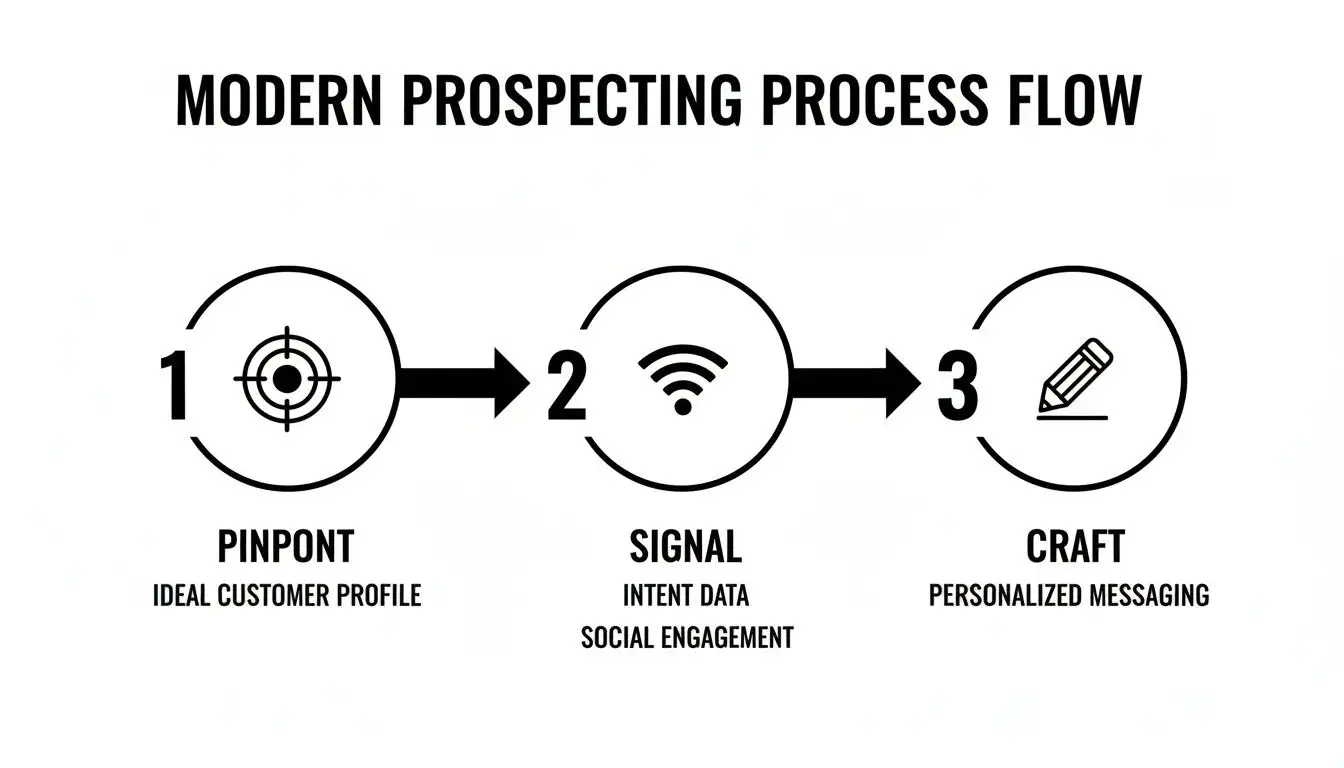
This process emphasizes a strategic sequence: first identifying your perfect customer (Pinpoint), then listening for their buying signals (Signal), and finally creating outreach that truly connects (Craft). Everything we'll cover is built on this foundation.
For those serious about growth, you might also want to check out our deep dive on how to build a sales pipeline that fuels real revenue.
Defining Your Ideal Customer Profile
Let's be honest. Prospecting without a crystal-clear Ideal Customer Profile (ICP) is a recipe for disaster. It's like trying to find Waldo in a crowd, but you're blindfolded. You end up with a pipeline full of duds and a whole lot of wasted time.
So, it's time to ditch vague descriptions like "we sell to tech companies." That's not a strategy; it's a prayer.
A truly killer ICP is surgical. It sounds more like this: “Series B SaaS companies in North America with 50-200 employees who just hired a new VP of Sales and are actively using HubSpot.” See the difference? That’s not a description; it’s a treasure map pointing directly to your next best customer.
Moving Beyond Basic Demographics
A truly powerful ICP goes way beyond just company size and industry. It’s a cocktail of three critical data layers that, when mixed correctly, gives you a 3D view of who to target and, crucially, when to hit them up.
-
Firmographics: This is your foundation. The basic stats like industry, annual revenue, employee count, and where they're located. This is your first-pass filter, helping you shrink the entire business universe into a more manageable pond. For example, if you sell high-ticket software, you can filter for companies with over $50M in revenue.
-
Technographics: This is where things get interesting. This layer tells you what software and tools a company already uses. Knowing a prospect is on Salesforce or Marketo reveals their operational maturity, hints at their budget, and uncovers potential integration plays. It’s like knowing someone’s favorite band before you even ask. If you sell a Salesforce add-on, this is pure gold.
-
Buying Signals: This is the secret sauce. These are the real-time triggers, the flares in the night sky, that scream a company is ready to buy. Think a new funding round, a key executive hire, or a surge in job postings for a specific department. These are the flashing neon signs that say, “WE HAVE A PROBLEM, AND WE HAVE MONEY!”
The whole point of an ICP isn't just to describe your customer. It’s to pinpoint the exact moment their pain becomes so acute they're actively looking for a painkiller. When you time your outreach for that moment, you stop being an interruption and start being a solution.
Finding the Patterns in Your Success
So, where do you start? Look in your own backyard. Your happiest, most successful customers are a goldmine of information.
Pull a list of your top 10-20 clients, the ones who onboarded smoothly, get a ton of value, and maybe even send you referrals. Now, play detective and look for the common threads.
-
What was going on in their business right before they signed with you?
-
Did they just close a new round of funding?
-
Did they hire a new C-level executive?
-
What tools or platforms were they all using?
When you spot these patterns, you can effectively reverse-engineer the DNA of your perfect customer. This isn't about guesswork; it's about using your own success data to build a repeatable model. If you want a structured way to do this, you can learn more about building your own ideal customer profile template.
This isn't about boxing yourself in. It's about giving your sales team the focus they need to ignore the noise and zero in on the accounts that have the highest probability of closing. A razor-sharp ICP isn't just a document; it’s the foundation of a predictable, scalable revenue machine.
Finding and Scoring High-Intent Prospects
Alright, you've got your Ideal Customer Profile locked and loaded. Now for the really fun part. Think of yourself as a detective, but instead of solving crimes, you're hunting down your future best customers.
We're not just building a giant, soulless list of names. That's old-school prospecting, and frankly, it's a massive waste of time. The goal here is to find high-intent prospects, the ones who are already sending up flares, signaling they need what you're selling. This is where modern sales and prospecting shifts from a shotgun blast to a sniper shot. It's about spotting the right signals at exactly the right moment.
Tune Into Buying Signals
Buying signals are the digital breadcrumbs your best-fit prospects are leaving all over the internet. They're screaming, "I have a problem!" and you just need to be there to hear it. Some of these signals are so loud they might as well be the Bat-Signal with your company's logo on it.
Keep your eyes peeled for these game-changing triggers:
-
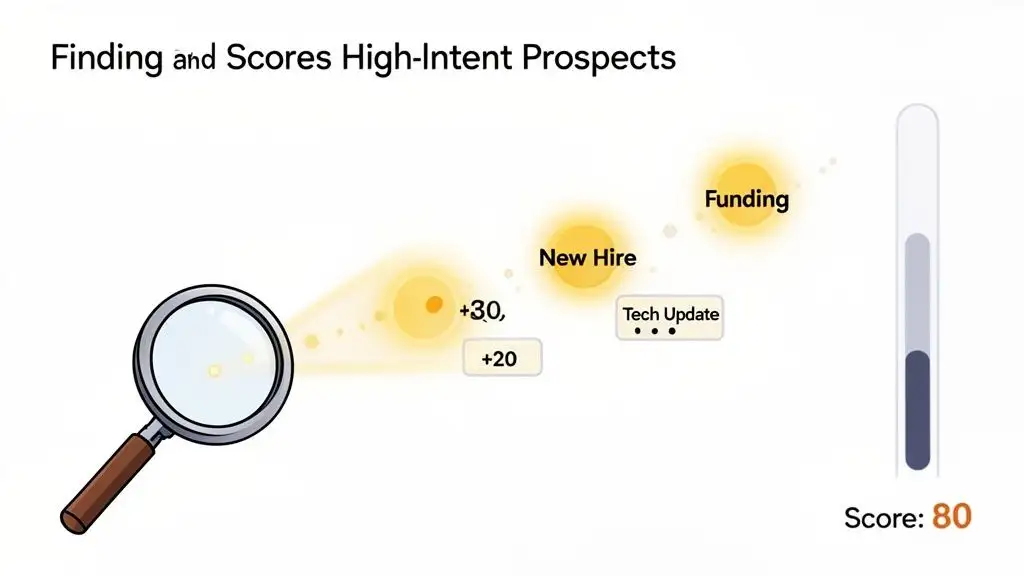
New Executive Hires: A new VP of Sales or CMO isn't brought in to admire the office plants. They’re there to shake things up and have a budget to do it. In fact, a new executive is three times more likely to purchase new tools within their first 90 days.
-
Recent Funding Rounds: Cash injection! Fresh capital means new projects, bigger teams, and a mandate to spend on tools that will fuel growth. A Series A or B funding announcement is basically a giant green light.
-
Tech Stack Updates: When a company switches its CRM or adopts a new marketing automation platform, it sets off a chain reaction. They'll suddenly need other tools that play nice with their new toy. See they just adopted HubSpot? That’s your cue to slide in with your awesome integration.
Trying to track all this manually would be a nightmare. This is where a sales intelligence platform like Munch becomes your unfair advantage, automatically surfacing these golden opportunities for you.
From Signals to Scores
So, you’ve got a list of companies flashing these buy-now signals. Who do you call first? Hint: it’s not the one that starts with "A." You need a system to prioritize your efforts so you're always focusing your energy on the accounts most likely to sign a deal.
This is exactly what lead scoring is for. It's a simple points-based system that helps you rank prospects based on how good of a fit they are and how interested they seem. Think of it as a sorting hat for your sales pipeline, separating the ready-to-buy "Gryffindors" from the "maybe-later" Hufflepuffs.
A solid lead scoring model transforms prospecting from a chaotic mess into a disciplined, data-driven machine. It ensures your top reps are always working your top opportunities, which is how you consistently crush your quota.
Let's build a quick-and-dirty scoring model. You can (and should) tweak the points based on what signals matter most to your business.
Example Lead Scoring Model:
| Attribute / Signal | Assigned Points |
|---|---|
| ICP Fit | |
| Company matches your ICP | +10 |
| Buying Signal | |
| Raised a funding round (Series A+) | +20 |
| Hired a new C-level executive | +30 |
| Job postings for a relevant role | +15 |
| Recently adopted a key technology | +10 |
| Negative Signal | |
| Layoff announcements | -20 |
With this system, a company that fits your ICP (+10), just hired a new CMO (+30), and raised a Series B (+20) gets a whopping score of 60. Boom. They go straight to the top of your call list.
On the flip side, a company that only fits your ICP (+10) but just announced layoffs (-20) ends up with a score of -10. That's a clear signal to back off for now.
This simple framework brings clarity and objectivity to your day. To dive deeper into this strategy, check out our guide on lead scoring best practices. It’s all about turning your outreach into a series of smart, strategic moves.
Enriching Prospect Data for Perfect Outreach
So you’ve done the legwork. You’ve identified a company that’s a perfect fit for your ICP, spotted a glaring buying signal, and you’re ready to make your move. But here’s the thing: finding a fantastic prospect is completely pointless if your outreach is built on shoddy data. Firing off a killer email to info@company.com, or worse, watching it bounce back, is like fumbling the ball on the one-yard line.
A bounced email isn't just a failed delivery. It's a wasted shot that torpedoes your sender reputation. This is exactly why data enrichment isn't some optional "nice-to-have" add-on; it's a foundational piece of any modern sales and prospecting playbook. It’s what separates shouting into the void from starting a real conversation.
The Magic of Waterfall Enrichment
So how do you get contact info that's actually, you know, correct? The best platforms use a clever method called waterfall enrichment.
Picture it like a detective trying to track down a phone number. First, they check their personal address book (Data Source A). No dice? They ring up a well-connected friend (Data Source B). Still coming up empty? They’ll even resort to digging through an old-school online directory (Data Source C).
By systematically querying multiple data sources one after another, waterfall enrichment stitches together the most accurate, up-to-the-minute information available. This process can push email accuracy up to 95% or higher, which drastically cuts down your bounce rates and makes sure your message actually lands where it's supposed to.
Your outreach is only as good as the data it’s built on. Inaccurate data isn't just an inconvenience; it’s a direct threat to your pipeline and sender reputation. Getting this right is non-negotiable.
Building Your Prospect Dossier
Okay, so enrichment is about more than just a name and an email. Real, a-ha-moment personalization requires a much deeper level of intel. We’re talking about collecting the specific details that transform a generic pitch into a "how did they know?" message, making you stand out from the 99 other templates clogging your prospect’s inbox.
Let’s be real, it’s getting tougher out there. B2B sales cycles are stretching out, with 65% of buyers putting the squeeze on budgets. Plus, over 20% of deals now involve six or more decision-makers. It’s a complex mess, yet 44% of reps throw in the towel after a single follow-up. This is where AI-personalized sequences, fueled by rock-solid enrichment data, become your secret weapon. With the B2B eCommerce market projected to hit a staggering $32.11 trillion, swapping guesswork for data-driven precision is the only way to turn those silent leads into real pipeline. You can dive deeper into these B2B sales benchmarks on trykondo.com.
To make sure your message not only gets delivered but also resonates, you need to build a proper prospect dossier.
Your Essential Prospect Data Checklist:
-
Verified Contact Info: A direct, verified email address and a mobile number. No more guessing games.
-
Key Firmographics: Company size, industry, annual revenue, and where they’re located.
-
Essential Technographics: What CRM, marketing automation, or other key software are they using right now?
-
Recent Buying Signals: The specific event that put them on your radar (e.g., "Just hired a new VP of Marketing" or "Closed a $20M Series B round").
-
Personalization Nuggets: Their alma mater, a recent LinkedIn post they wrote, or mutual connections you share.
Having this information ready to go turns your outreach from a cold interruption into a warm, informed conversation. If you want to really get this down to a science, I highly recommend our ultimate guide to lead enrichment.
Time to Craft Outreach That Actually Gets Replies
You've done the hard work and your data is pristine. Now for the fun part: turning all that research into revenue.
But let's be real. Your prospect's inbox is a warzone, flooded with over 100 emails a day. A generic, "Hi {first_name}, saw you work at {company_name}" is the sales equivalent of bringing a flip phone to a tech conference. It’s not just outdated; it's a one-way ticket to the trash folder.
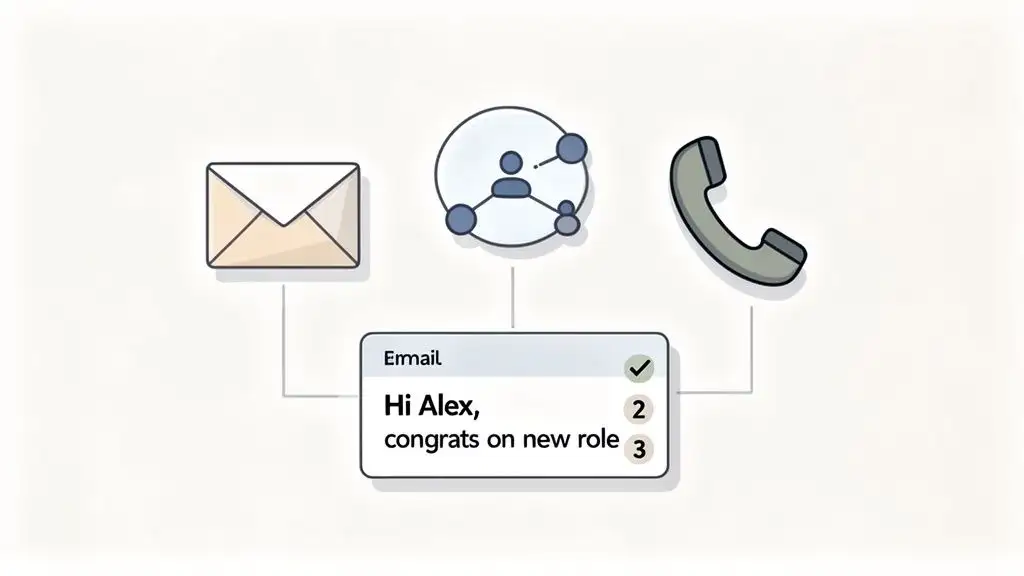
It's time to build a sophisticated, multi-channel outreach sequence. The point isn’t just to be persistent, it's to be thoughtfully present on the channels your prospects actually live on, like email, LinkedIn, and yes, even the good old-fashioned phone. It's about being the signal, not the noise.
Go Beyond the First Email
Relying on a single cold email is a recipe for a miserable pipeline. The data is clear: a shocking 2% of cold calls result in a booked appointment. Pathetic, right?
However, when you layer in a multi-channel strategy, that rate can jump to nearly 7%. That’s more than double the success, especially as email-only lead rates have cratered by 29% year-over-year. The right kind of personalization can boost your open rates by 26% and conversions by a massive 200%. These numbers scream one thing: context-aware messaging across multiple platforms isn't a "nice-to-have," it's a necessity.
A modern sales and prospecting sequence is an orchestrated dance of multiple touchpoints. You're not trying to annoy someone into submission; you're building a narrative and providing value at every step.
Here’s what a smart, multi-channel flow actually looks like in the wild:
-
Day 1 (Email): Launch with a hyper-personalized email that nails the buying signal. For instance, "Congrats on the new VP of Sales role! I've seen new leaders tasked with completely revamping the playbook in the first 90 days."
-
Day 1 (LinkedIn): Just view their profile. It’s a simple, subtle head-nod that puts you on their radar without being creepy.
-
Day 3 (LinkedIn): Send a connection request with a short, non-salesy note. "Hi Sarah, saw your post on scaling sales teams. Following up on my email, it felt like a good idea to connect here."
-
Day 5 (Email): Circle back to your original email, but this time, bring a gift. Offer up a relevant case study or a blog post that speaks directly to their world.
-
Day 7 (Phone Call): Now you can make a brief, respectful call. "Hi Sarah, Alex here from Munch. I sent a quick note last week about how we help new sales leaders ramp up their pipeline. Did you happen to catch it?"
This approach isn't about blasting them from all sides. It's about building familiarity. Each touchpoint reinforces the last, turning you from "another random SDR" into a familiar, helpful name.
Personalization at Scale (Without Losing Your Mind)
"But I don't have time to write 100 unique emails!" I hear you. And you don't have to. This is where AI tools like Munch become your secret weapon.
Forget just inserting {{first_name}}. Modern AI can spin up entire opening lines or even full emails based on the context you’ve already found. You feed it the buying signal, like that recent funding announcement, and it spits out an email that feels human, relevant, and anything but generic.
The goal of AI in outreach isn't to replace you. It's to give you superpowers, letting you craft a dozen genuinely personalized messages in the time it used to take to write one.
For example, an AI tool could generate this brilliant opener:
"Saw that Acme Corp just closed a $15M Series A, huge congrats! With that kind of fuel in the tank, I bet the pressure to scale your outbound engine is on."
That opener is instantly more compelling than any template. It shows you've done your homework and you get their world. While you should always add your own flair, starting with effective cold email templates can give you a solid foundation to then supercharge with this kind of AI-driven insight.
A/B Test Your Way to More Replies
Finally, never assume your first shot is your best shot. The best sales pros are relentless testers. A/B testing isn't some marketing gimmick; it's a core discipline for any serious sales and prospecting team.
Here are a few things you should be testing constantly:
-
Subject Lines: Pit a question ("New Sales Playbook?") against a benefit ("Scaling your outbound team").
-
Calls-to-Action (CTAs): Compare a hard CTA ("Are you free for 15 mins next Tuesday?") with a soft one ("Is this a priority for you right now?").
-
Message Length: Does a short, punchy email outperform a more detailed, value-packed one?
Track your positive reply rates like a hawk. Over time, you’ll build a playbook of what actually works for your audience. If you really want to go deep on this, we wrote a whole guide on how to write cold emails that get responses. This constant process of testing, learning, and optimizing is what separates the top 1% from everyone else.
Stop Guessing, Start Measuring: How to Actually Optimize Your Prospecting
In sales, if you're not measuring, you're just guessing. It’s like hitting the gym, putting in the hours, but never tracking your lifts or reps. You feel busy, but are you actually getting stronger? The same goes for prospecting. But here’s the kicker: tracking the wrong things is just as bad as tracking nothing at all.
Sure, that 90% email open rate feels fantastic, but if it doesn't lead to a single real conversation, who are you kidding? That's what we call a vanity metric. It's the business equivalent of getting a million views on a cat video but having a bank account that’s gathering dust. It feels good, but it doesn’t pay the bills.
It's time to get real and focus on the Key Performance Indicators (KPIs) that actually show the health of your prospecting engine and, more importantly, drive actual revenue.
Ditch the Vanity Metrics for True Velocity
Let's be honest, it's easy to get hooked on ego-boosting numbers that don't mean much. A sky-high open rate? You probably just wrote a clever, clickbait-y subject line. A huge number of new LinkedIn connections? Congrats, you’re great at clicking a button. We need to measure what moves the needle.
These are the prospecting KPIs that separate the pros from the amateurs:
-
Positive Reply Rate: This is the holy grail. It’s not about just getting a response; it’s about getting the right response. This KPI tracks the percentage of prospects who reply with genuine interest ("Tell me more," "Let's chat next week"), not just a terse "unsubscribe." A good target to shoot for is 8-12%.
-
Meetings Booked Per Rep: This one is brutally effective and cuts right through the fluff. It’s a direct measure of an SDR’s ability to turn cold outreach into warm conversations for your account executives.
-
Outbound Pipeline Generated: Now we’re talking. This is the big-picture metric that measures the total dollar value of the sales opportunities your team has created from scratch. It’s the number that directly ties your daily grind to the company’s bottom line.
The goal isn’t just to be busy; it’s to be effective. When you zero in on metrics like positive replies and pipeline generated, you ensure every single activity is laser-focused on creating real sales opportunities, not just ticking boxes.
Building Your Feedback Loop for Constant Improvement
Having the data is one thing; actually using it is where the real magic happens. These KPIs aren't just for fancy dashboards to show your boss. They are your roadmap for getting better, week after week. This is what separates a chaotic prospecting effort from a predictable, professional revenue machine.
Think of it as a continuous feedback loop.
Let's say you're running two campaigns. Sequence A, targeting VPs of Marketing with a generic message, is pulling a 3% positive reply rate. But Sequence B, targeting the exact same audience but referencing their company's recent funding round, is hitting a 10% positive reply rate. The data is practically screaming at you: double down on that funding trigger!
This is the heart and soul of optimization. You test something, measure the result, learn from it, and then iterate. Is a specific buying signal outperforming others? Pour more resources into it. Is one of your email templates falling flat? Time to A/B test a new call-to-action or a punchier value prop.
This relentless process of refinement is how you turn your sales and prospecting from a shot in the dark into a well-oiled machine that gets smarter with every single email you send.
Got Sales Prospecting Questions? We've Got Answers.
Still wrestling with some of the finer points of modern sales and prospecting? Let’s clear a few things up. Here’s a quick rundown of the questions that keep popping up from reps in the trenches.
How Many Touchpoints Does It Really Take to Book a Meeting?
Forget that ancient “eight touches to make a sale” mantra. That’s dial-up internet thinking in a fiber-optic world. It's no longer about a magic number; it’s about making each touch count across the right channels.
A well-crafted sequence that mixes email, LinkedIn, and maybe a cold call or two over a few weeks will always beat a generic, high-volume blast. Think about it: a thoughtful, 5-touch sequence that gets a warm reply is infinitely better than a 12-email auto-blast that just annoys your prospect into hitting "spam."
Some eye-opening data shows top performers booking 52 meetings for every 100 contacts, while their peers only manage 19. The difference isn't just elbow grease; it's a smarter, more targeted strategy.
What Sales Prospecting KPIs Actually Matter?
It’s easy to get lost in a sea of data. Vanity metrics like open rates are the cotton candy of sales stats, they look nice but have zero substance. You can’t take open rates to the bank.
Instead, zero in on the numbers that directly tie to revenue. These are the ones that tell you if you're actually winning.
-
Positive Reply Rate: Are people actually saying, "tell me more," or just, "unsubscribe"? This is where the magic happens. A solid goal is 8% or higher.
-
Meetings Booked: This is the most direct signal that what you're doing is working. It’s the primary scoreboard for any SDR.
-
Outbound Pipeline Generated: What’s the total dollar value of the opportunities you’ve sourced? This is the ultimate measure of your impact on the business.
Watching these KPIs is like tracking your character's stats in an RPG. They show you're not just mindlessly grinding, you're leveling up, getting stronger, and getting closer to the boss battle.
What's the Real Difference Between a Lead and a Prospect?
Let's break it down with a movie casting analogy. A lead is basically anyone who showed up for the open audition. They could be a fit, but who knows?
A prospect, on the other hand, is the person who got a callback. Why? Because they perfectly match the character description you’re looking for.
In sales speak, a lead is just a name in your system, maybe someone who downloaded a whitepaper. But a prospect is a lead you’ve actively qualified. You've vetted them, confirmed they fit your Ideal Customer Profile (ICP), and decided they are absolutely worth your time and energy.
Ready to stop guessing and start building a predictable revenue engine? Munch unifies high-intent lead discovery, 95% accurate data enrichment, and AI-powered personalization into one seamless platform. Find your next best customers today.