Lead Enrichment The Ultimate Guide To B2B Sales

By Mriganka Bhuyan
•Founder at Munch
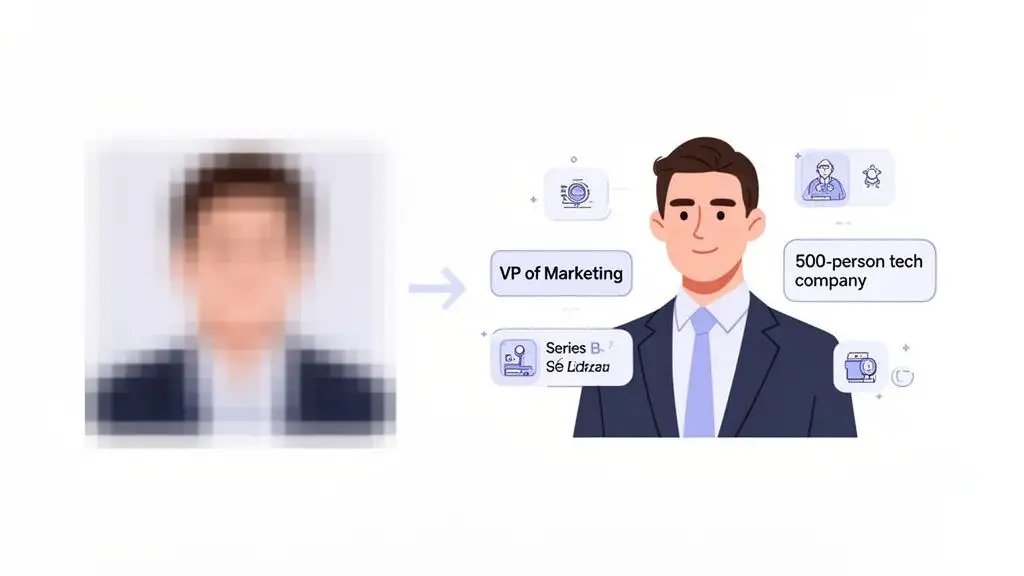
So, what's the big deal with lead enrichment? At its core, it's the process of taking a sliver of information, like a name and an email address, and building a complete, detailed picture of a person. It’s the difference between having a single puzzle piece and seeing the entire box art.
This process transforms a faceless contact into a qualified lead, giving your sales team the context they need to start a real, meaningful conversation.
What Is Lead Enrichment and Why It Matters
Picture this: your sales team gets a fresh list of sign-ups. One entry is just "j.smith@techcorp.com." Who is J. Smith? An intern? The CEO? Firing off a generic email is like throwing a dart in a dark room and just hoping for the best.
Now, what if that same contact record instantly blossomed with new information? Suddenly, you see it's Jane Smith, the new VP of Engineering at TechCorp. You also see that TechCorp is a 500-person company that just started using a software your product integrates with.
That's lead enrichment in action. It's the art of layering valuable context onto your raw contact data. Think of it as the ultimate glow-up for your CRM, turning a boring list into a strategic weapon.
From Data to Deals
In a world where everyone's inbox is a battlefield, generic outreach is a one-way ticket to the spam folder. Lead enrichment gives you the intel to cut through that noise with genuine personalization. This isn't just about dropping a {first_name} into an email template; it's about understanding your prospect's world.
Here’s why it’s no longer a "nice-to-have":
-
Real Personalization: Knowing a lead's job title, company size, and industry lets you speak directly to their biggest challenges.
-
Smarter Lead Scoring: You can finally prioritize the leads who actually match your ideal customer profile (ICP) instead of chasing dead ends.
-
Faster Sales Cycles: Armed with rich data, your first conversation is already relevant, which massively speeds up the journey from "who are you?" to "take my money."
The table below gives you a quick look at how lead enrichment transforms a basic contact into a sales-ready opportunity.
Lead Enrichment Before and After
| Data Point | Before Enrichment (Basic Lead) | After Enrichment (Actionable Prospect) |
|---|---|---|
| Contact | j.smith@techcorp.com | Jane Smith |
| Title | Unknown | VP of Engineering |
| Company | techcorp.com | TechCorp |
| Company Size | Unknown | 501-1,000 employees |
| Industry | Unknown | SaaS / Enterprise Software |
| Tech Stack | Unknown | Uses Salesforce, HubSpot, AWS |
| Location | Unknown | San Francisco, CA |
See the difference? One is a guess; the other is a game plan.
The real value of lead enrichment is simple: It stops your sales team from guessing and gives them the intelligence to act decisively. It turns cold outreach into warm, relevant conversations.
It’s no surprise that the demand for this is exploding. The global market for lead generation solutions was valued at US$3.1 billion in 2021 and is on track to hit a whopping US$9.6 billion by 2028. Businesses are pouring money into tools that make their sales efforts smarter, not just louder. To get a feel for the wider applications, you can explore general strategies for dataset enrichment.
Ultimately, lead enrichment is about working smarter. It connects the dots between raw data and real revenue by making sure every single interaction is informed and on-point. This is the foundational step that makes sure your sales team isn't just busy; they're truly productive.
The Data That Actually Closes Deals
Let's be real: not all data is created equal. Knowing your prospect’s favorite 90s boy band probably won't help you close a seven-figure B2B deal. Unless, of course, you sell vintage concert tees and their favorite is NSYNC, in which case, you've struck gold.
For the rest of us, smart lead enrichment is about zeroing in on the data points that actually move the needle. It's about gathering the kind of intel that lets you qualify, segment, and personalize your outreach with surgical precision. Think of it as the ultimate cheat code for your sales game, saving your reps from the soul-crushing black hole of manual LinkedIn stalking.
Firmographics: The Lay of the Land
Firmographics are the absolute basics, the non-negotiable details about a company. This is the "who are they?" and "what do they do?" part of the story. Getting this right is like pouring the foundation for a house; if it's crooked, everything you build on top of it will eventually fall apart.
These data points are your first line of defense, making sure a company even belongs in your pipeline by checking them against your Ideal Customer Profile (ICP).
-
Company Size: Are we talking about a scrappy startup or a Fortune 500 behemoth? Pitching a complex HR platform to a five-person team is like trying to convince a chihuahua it needs a saddle.
-
Industry: A FinTech company has wildly different problems and speaks a completely different language than a healthcare provider. This detail helps you tailor your message so it actually resonates.
-
Annual Revenue: This is the big one. Does this company have the budget for what you’re selling? It’s the difference between pitching to Scrooge McDuck and trying to sell to someone who thinks the dollar menu is a splurge.
-
Location: Knowing where they're based is crucial for territory planning, event invites, and navigating any local market quirks or regulations.
Firmographic data acts as your bouncer. It stops your sales team from wasting precious time chasing leads who were never, ever going to be a good fit, no matter how clever the email copy.
Technographics: Your Secret Weapon
This is where things get fun. Technographics tell you exactly what software and technology a company is using right now. It's like being a detective who gets a full inventory of a suspect's toolkit before the interrogation even begins.
A company's tech stack gives you incredibly powerful angles for personalization. For instance, if you sell a tool that integrates seamlessly with Salesforce, finding out a lead is a heavy Salesforce user is a massive green light.
-
CRM System: Your entire pitch changes depending on whether they use HubSpot or Salesforce.
-
Marketing Automation Platform: Are they a Marketo, Pardot, or Mailchimp shop?
-
Cloud Services: Do they live in the world of AWS, Azure, or Google Cloud?
-
Competitor’s Tools: This is the holy grail. If they’re using your direct competitor, you have a golden opportunity to craft a message highlighting exactly where your solution shines.
Buying Signals: The Flashing Neon Signs
Buying signals are the time-sensitive triggers that scream, "This company is actively looking for a solution like yours!" These are the moments when a prospect’s intent is at an all-time high. Ignoring them is like seeing the Bat-Signal light up the sky and deciding you'll finish your coffee first.
These clues tell you when to reach out for maximum impact.
-
Recent Funding: A fresh round of funding almost always means a new budget for tools, expansion, and solving problems.
-
New Executive Hires: A new VP of Sales is going to scrutinize their team's entire tech stack. 100% of the time.
-
Sudden Hiring Sprees: When a company starts rapidly hiring for sales roles, it’s a giant neon sign flashing, "We need sales tools, stat!"
-
Negative Product Reviews: Are they publicly complaining about a competitor's product on G2 or Twitter? That's your cue to slide in with a better alternative.
Trying to gather all this intel by hand is a herculean effort. Thankfully, modern lead enrichment tools automate this, pulling verified data from countless sources to give you a complete picture in seconds. To get a handle on the very first step, check out our guide on how to find email addresses for companies before you start layering on all this juicy data. By focusing on these three data categories, you turn a simple contact list into a strategic treasure map for your sales team.
So, How Does This Lead Enrichment Voodoo Actually Work?
Ever wondered how a simple email address like "jane.doe@acmecorp.com" can suddenly blossom into a full-blown dossier on your next top prospect? It’s not black magic, though it certainly feels like it. Modern lead enrichment is more like a lightning-fast private investigator, piecing together clues from all corners of the web in the blink of an eye.
The second a new lead hits your system, the hunt begins. An automated enrichment tool snags the one piece of info you have, usually that email or a company domain, and uses it like a skeleton key. It then sprints across massive, ever-growing databases from a whole network of third-party data providers to see what doors it can unlock.
Think of it as a digital scavenger hunt on steroids. The tool pings multiple sources, each a specialist in its own right, to grab different puzzle pieces and stitch them together. All this happens behind the curtain, turning what would take your best SDR hours of tedious manual research into an instant, automated win.
The Secret Sauce: Waterfall Enrichment
Here’s a pro tip: not all data is created equal. Some providers are rock stars at sniffing out company size and revenue, while others are the undisputed champs of finding direct-dial phone numbers or the exact software a company uses. Just relying on one source is like asking one friend for restaurant advice; you’re getting a pretty limited view. This is where waterfall enrichment changes the game.
Waterfall enrichment is a clever, layered approach to data-gathering that ensures you get the most accurate info possible. It’s like assembling a dream team for trivia night, where each member has their own area of expertise.
Here’s how it works:
-
Start with the Best: The system first pings your primary, most reliable data source. Let's call this one "The Ace."
-
Find the Gaps: If The Ace returns a good chunk of info but leaves a few fields blank (like a direct phone number), the system doesn't just shrug and give up.
-
Call in the Specialist: It then takes those empty fields and sends them to the next provider on the list, maybe one known for its killer contact data.
-
Rinse and Repeat: This process cascades down a prioritized list of providers, filling in each blank field with information from the strongest possible source for that specific data point.
This method isn't about getting more data; it's about getting the best data. It's a quality-first strategy that dramatically pumps up the accuracy and completeness of your lead profiles. To get a deeper look under the hood, you can check out how a dedicated data enrichment tool pulls this off.
This process builds a complete picture of your lead by layering different types of crucial data.
Pro Tip: Munch helps you build your prospect list, enrich their contact data with waterfall enrichments and even craft personalized outreach messages for every lead.
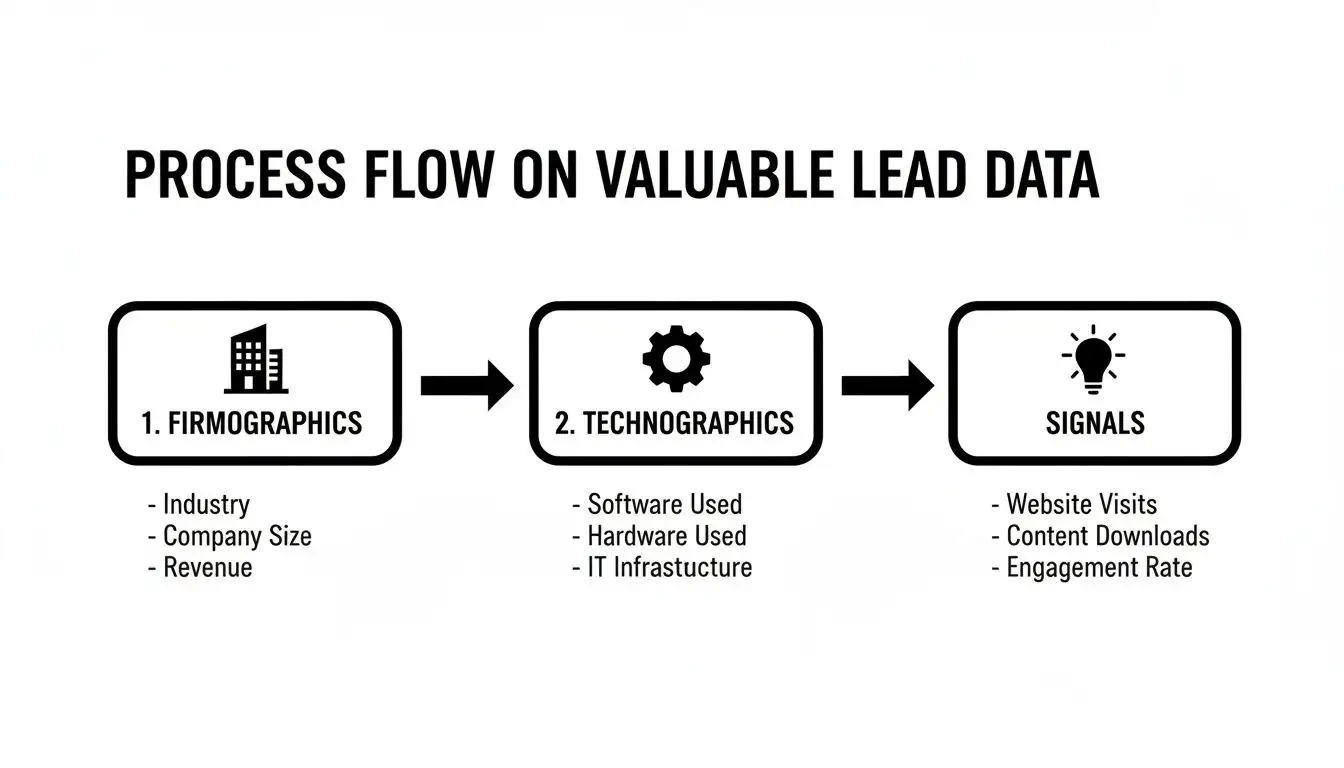
As you can see, a truly powerful lead profile comes from weaving together firmographics (the company basics), technographics (their tech stack), and buying signals (what they’re doing right now).
Putting the Intelligence to Work
Okay, so you've got this mountain of incredible data. Now what? The final, and arguably most important, step is getting this intel into the hands of your sales team. A great enrichment platform will plug right into your CRM, like Salesforce or HubSpot, and automatically update your records in real time.
No more copy-pasting. No more manual data entry. Just fresh, accurate information right where your reps live all day.
The key here is making the data impossible to ignore. It’s organized, it’s clean, and it’s right there on the screen, letting reps spot key details without having to click through a dozen tabs.
The real goal isn’t just to collect data; it's to make that data instantly actionable. By pumping this intelligence directly into your CRM, lead enrichment gives your team the context they need to turn a cold, generic email into a conversation that actually connects.
To really scale this strategy, you need the right engine. Digging into the best data enrichment tools will help you find a platform that meshes with your team's workflow and goals. After all, this backend tech is what powers personalization that truly scales.
Measuring the ROI of Your Enrichment Strategy
So, you’ve pulled the trigger on a lead enrichment strategy. Fantastic. But sooner or later, someone from the finance department is going to wander over to your desk, peer at a spreadsheet, and ask the million-dollar question: "So, what are we actually getting for our money?"
If you can't answer that with cold, hard numbers, your shiny new enrichment tool might get the axe faster than a B-list actor in a horror movie. This is where we stop talking about fuzzy benefits and start proving the real-world value of your investment. It’s not just about making sales a little easier; it’s about building a predictable revenue engine and having the data to back it up.
Key Metrics That Actually Matter
Let's get one thing straight: your finance team doesn't care if your SDRs are happier because they aren't manually Googling prospects all day (even though they totally are). They want to see a direct line between your investment and the company's bottom line.
Here’s where you should focus your attention:
-
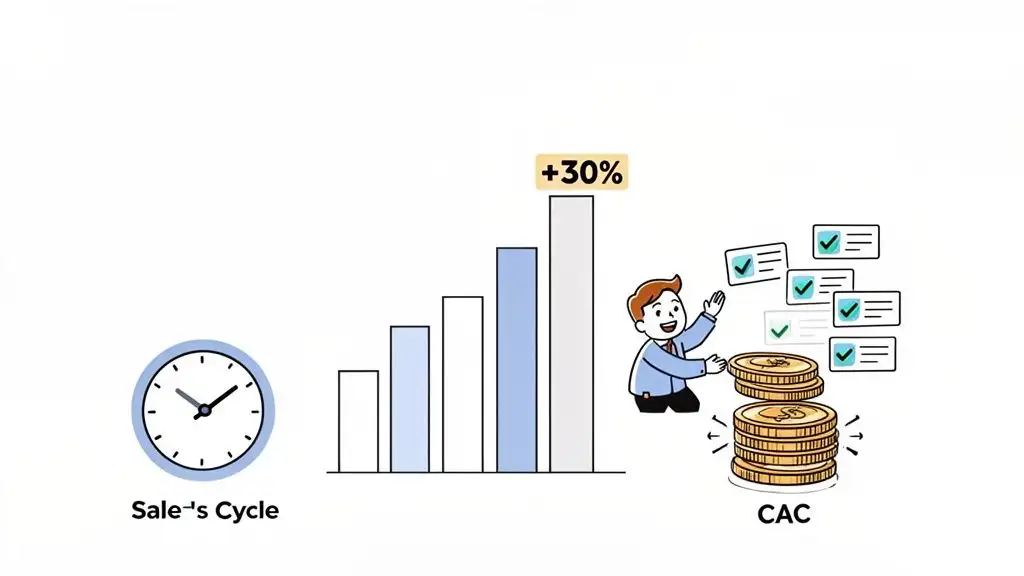
Lead-to-Opportunity Conversion Rate: This is the big one. If your reps are starting with better, more complete data, they should be turning more of those raw leads into qualified opportunities. A noticeable lift here is direct, undeniable proof that enrichment is working.
-
Sales Cycle Length: Time kills all deals. When your team has the right intel from day one, they can skip the tedious, generic discovery questions and get straight to solving the prospect's real problems. This means deals close faster, which is music to any executive's ears.
-
Customer Acquisition Cost (CAC): This is the ultimate efficiency metric. If enrichment allows your reps to have 30% more qualified conversations simply because they're not drowning in research, their productivity skyrockets. This directly lowers the cost of landing each new customer.
To really make your case, you need to establish a baseline. You have to know your numbers before implementing an enrichment tool. Track these key metrics for a solid quarter, then compare them to the results after your team has fully adopted the new workflow. The difference is your ROI.
To help you track this, here's a quick look at the core metrics and how enrichment directly impacts them.
Key Metrics to Track for Lead Enrichment ROI
| Metric | What It Measures | How Enrichment Improves It |
|---|---|---|
| Lead-to-Opportunity Rate | The percentage of leads that become qualified sales opportunities. | Better data means reps focus only on best-fit leads, increasing the odds of conversion. |
| Sales Cycle Length | The average time it takes to close a deal from first contact. | Armed with context, reps can tailor their pitch from the start, accelerating the buying decision. |
| Customer Acquisition Cost (CAC) | The total cost of sales and marketing to acquire a new customer. | Increased rep efficiency and higher conversion rates mean you spend less to win each deal. |
| Meeting Booked Rate | The percentage of outreach attempts that result in a scheduled meeting. | Personalized outreach based on rich data grabs attention and gets more "yeses." |
| Data Accuracy | The percentage of correct and up-to-date information in your CRM. | Reduces bounced emails and wrong numbers, ensuring reps connect with the right person every time. |
These metrics provide the quantitative proof you need, showing that enrichment isn’t just a "nice to have," it’s a core part of an efficient revenue operation.
Proving the Value Beyond the Spreadsheet
While the numbers tell a powerful story, don't forget the qualitative benefits that contribute to your ROI. Better data leads to hyper-personalized outreach, which in turn builds stronger relationships and drives higher-quality conversations.
Your reps are no longer just another generic email in a crowded inbox; they become trusted advisors who actually understand the prospect's world.
The core ROI of lead enrichment isn't just about efficiency; it's about effectiveness. It empowers your sales team to stop spraying and praying and start targeting the right people, with the right message, at the exact right time.
The data absolutely backs this up. Companies that use advanced enrichment with verified contact info and firmographics can see a 50% increase in sales-ready leads and slash their customer acquisition costs by up to 60%. This isn't magic; it's the result of creating more meaningful engagement from the very first touchpoint.
Ultimately, measuring ROI is about connecting the dots. When you can show a shorter sales cycle, a lower CAC, and higher conversion rates, you've built an undeniable case. Lead enrichment isn't a cost center; it’s a revenue accelerant.
For a deeper dive into the specific numbers you should be tracking, explore our complete guide to the most important lead generation KPIs. It will give you the framework and the language to confidently justify your investment to anyone who asks.
Common Lead Enrichment Pitfalls to Avoid
Getting a lead enrichment strategy off the ground can feel like you’ve just been handed the ultimate cheat code for your sales game. But even the best cheat codes can go wrong if you don't know how to use them. Rushing in without a plan can turn your brilliant strategy into the Fyre Festival of sales ops: a ton of hype, a messy reality, and absolutely zero sandwiches.
To keep your revenue engine humming, you need to know where the potholes are. Dodging these common mistakes is the difference between building a well-oiled sales machine and creating a very expensive, very confusing spreadsheet.
The Single Source of Truth Fallacy
Putting all your faith in one data provider is a bit like getting all your news from a single, heavily biased cable channel. You’re only ever going to get one side of the story, and let's be honest, it's probably not the full picture. No single provider on the planet has a monopoly on perfect, up-to-the-minute data for every single role and industry.
One vendor might be incredible with company-level data but have shaky contact info. Another might have the opposite problem. When you put all your eggs in one basket, you’re not just betting on their strengths; you're also shackled to their weaknesses. This is a fast track to incomplete lead profiles and deals that slip right through your fingers.
Forgetting About Data Decay
Here’s a fun little fact to keep you up at night: B2B data decays at a wild rate of about 22.5% per year. People switch jobs, companies get acquired, phone numbers change. The data in your CRM has a shorter shelf life than that avocado you bought last week and promptly forgot about.
Thinking of enrichment as a one-and-done task is a rookie move. That perfectly clean data you enriched last quarter? A significant chunk of it is already out of date. Without a continuous process for data hygiene, your reps will be firing off brilliant emails to people who left their jobs six months ago. It's the digital equivalent of showing up to a party right as the host is taking out the trash.
A one-time data enrichment effort is like taking a shower and expecting to be clean for the rest of the year. It’s a good start, but it requires a consistent routine to maintain.
The "More Is More" Trap
It’s so easy to fall into the trap of grabbing every single data point available. But enriching your leads with a bunch of useless trivia just creates digital clutter. Does your sales team really need to know a prospect’s college mascot or their dog’s astrological sign to close a deal? I'm going to go with no.
This data hoarding leads to a few headaches:
-
CRM Clutter: Your contact records become so bloated with irrelevant fields that reps can’t find the intel that actually matters.
-
Analysis Paralysis: Drowning in too much information can leave your team paralyzed, trying to figure out what’s important and what’s just noise.
-
Wasted Budget: You’re often paying for every piece of data you pull. Enriching with fluff is just burning cash for no good reason.
Ignoring CRM Integration
This one might be the most painful, face-palm-inducing blunder of them all. You invest time and money into a powerful enrichment tool that provides incredible insights... but that data just sits there, stranded on its own little island. If your team has to constantly switch between windows or manually copy-paste info into your CRM, they just won't do it. It’s like buying a Ferrari and leaving it parked in the garage to collect dust.
Seamless integration is non-negotiable. The enriched data has to flow automatically and directly into the CRM fields where your reps spend their day. This makes the information instantly accessible and actionable, weaving it into their natural workflow. Without that connection, you’ve just bought a very expensive data silo. To learn more about keeping your data clean right from the start, check out our guide on how to verify email addresses.
Your Actionable Lead Enrichment Checklist
Okay, let's get our hands dirty. It’s time to move from theory to action. You’re pumped, you see the potential, and now you need a lead enrichment strategy that actually works, one that doesn't just sit in a PowerPoint deck but actively pumps life into your pipeline.
This isn't about finding some magic "enrich" button. It's about following a clear, step-by-step roadmap to get you from "What the heck is lead enrichment?" to "Wow, our pipeline has never looked better."
Think of this checklist as your recipe for success. You wouldn't just start throwing ingredients in a bowl without knowing what you're baking, right? Same deal here.
First, Nail Down Your Ideal Customer Profile
Before you even think about buying a tool or hunting for data, you need to know exactly who you're aiming for. Your Ideal Customer Profile (ICP) is your North Star, your guiding light. It’s a crystal-clear picture of the company that is a perfect fit for your product.
Without a solid ICP, you’re just collecting random factoids. That’s about as useful as having a garage full of car parts but no blueprint to build the car. Get your team in a room (or a Zoom) and hash out the specifics. Be painfully specific.
-
Industry: Which specific verticals get the most out of what you do? Be precise, not just "tech," but "B2B SaaS for HR."
-
Company Size: What’s the employee headcount sweet spot? 50-200? 1,000-5,000?
-
Revenue: Are you targeting companies doing $5M or $50M in annual revenue?
-
Geography: Where are they located? North America? Western Europe?
-
Tech Stack: What software do they use that signals a need for your solution? (e.g., "They use Salesforce and Marketo but not a sales intelligence tool.")
Once you have this blueprint, you'll know exactly which data points matter and which are just digital noise.
Next, Choose and Integrate Your Tools
Alright, now you know what information you need. It’s time to pick your weapons. Choosing the right lead enrichment tool is a make-or-break decision. You need a platform that not only coughs up the data points from your ICP but also plays nice with your existing tech stack, especially your CRM.
A tool that doesn't talk to your CRM is like hiring a star player who refuses to show up for team practice. The data is totally useless if your sales reps can't see and use it inside their daily workflow. Look for tools that offer waterfall enrichment, which pulls data from multiple sources to give you the most accurate and complete picture.
Train Your Sales Team to Be Hyper-Personal
So, you've got the golden data, and it's flowing beautifully into your CRM. What now? You have to actually train your team to use this newfound superpower. This isn't just about pointing out new fields in Salesforce. It's a complete mindset shift, from a spray-and-pray approach to one built on value-driven conversations.
Run some workshops. Create simple cheat sheets that show your reps how to turn a dry data point into a killer conversation starter.
The Old, Sad Way: "Hi, I saw you work at Company X and wanted to connect."
The Enriched, Awesome Way: "Hi Jane, I noticed your team just brought on a new Head of Sales Ops and recently adopted Marketo. At this stage, many leaders I talk to are struggling with X. Our integration is built to solve exactly Y."
See the difference? That shift is what turns data into dollars.
Launch Your First Enriched Campaigns
It's go-time. Time to put all this work to the test by launching your first campaigns with this enriched data. Don't try to boil the ocean. Start small with a highly focused segment of leads that are a perfect match for your ICP.
Then, build your campaign around a specific buying signal. For example:
-
Recent Funding Round: Craft a message congratulating them on the cash injection and position your solution as the perfect way to scale their operations with that new capital.
-
Tech Stack Change: See they just dropped a competitor? Pounce on that. Send a message that hits on the common pain points of that old software and shows how you’re the better alternative.
This targeted approach will massively increase your chances of getting a reply. After all, email is still the number one lead generation channel for 42% of businesses, and speed is everything. Getting back to a lead within five minutes can boost your conversion rates by a whopping 9x.
By following these steps, you're not just running a one-off campaign; you're building a repeatable, scalable machine for turning ice-cold leads into warm, revenue-generating conversations.
Common Questions
Still got a few questions bouncing around in your head? No problem. Let's tackle some of the most common head-scratchers people have when they first dive into lead enrichment.
| Question | Answer |
|---|---|
| How is lead enrichment different from lead generation? | Lead generation is the process of finding new potential customers. Lead enrichment is the process of adding valuable data to those existing leads to qualify them and improve your outreach. Think of it as finding the fish versus learning what bait the fish likes. |
| Can I do lead enrichment manually? | You can, but it's incredibly time-consuming and inefficient. Manual research for a single lead can take significant time that a sales rep could spend selling. Automated tools do the work in seconds, ensuring data is consistent and up-to-date across your entire database. |
| How often should I enrich my leads? | Data decays quickly, people change jobs, and companies adopt new technologies. For an active database, it's best to have a system for continuous or periodic enrichment (e.g., quarterly) to keep your contact information fresh and accurate. A one-time enrichment is a good start, but ongoing data hygiene is key. |
| What's the first step to get started with lead enrichment? | Start by clearly defining your Ideal Customer Profile (ICP). Know exactly what firmographic, technographic, and buying signal data points are most important to your sales process. This will prevent you from collecting useless information and help you choose the right enrichment tool for your needs. |
Hopefully, that clears things up! Getting your data strategy right is the foundation for everything else that follows in a modern sales process.
Ready to stop guessing and start selling with precision? Munch is your all-in-one platform for finding high-intent prospects, enriching their data with over 100 verified sources, and launching personalized outreach that actually gets replies. See how Munch can transform your pipeline.