A Modern Guide to Prospecting Sales That Actually Works

By Mriganka Bhuyan
•Founder at Munch
The old "spray and pray" method of sales prospecting is about as effective as trying to explain the plot of Inception after only watching the trailer. It's a numbers game you're destined to lose, leaving you with a graveyard of unopened emails and a pipeline that’s bone dry. Real success in prospecting sales today isn’t about shouting louder; it's about finding the few people who are already leaning in to listen.
Why Your Prospecting Sales Playbook Is Broken

If you've ever spent a full day sending 100 "personalized-ish" cold emails only to get back two "unsubscribe" notifications and an out-of-office reply from 2003, you know the pain. The traditional prospecting playbook isn't just outdated; it's fundamentally broken.
And it’s not your fault. The game has completely changed.
Buyers are more informed, more guarded, and more overwhelmed than ever. Their inboxes and LinkedIn feeds are a constant firehose of pitches, making it nearly impossible for a generic message to cut through. Just cranking up the volume of your outreach is a losing strategy. It leads to burnout for your reps and serious brand damage when you become known as "that company that spams us."
The Volume Game vs. The Value Game
At its core, the problem is a massive mismatch between how sellers are still taught to sell and how buyers actually want to buy. The old way is a volume play: more calls, more emails, more contacts, more everything. The new way is all about value and timing.
For a practical example, think of it like dating. The old way is swiping right on every single profile and sending "hey" to all your matches. The new way is reading a few profiles, finding someone who also loves 90s hip-hop, and opening with a line about A Tribe Called Quest. One is a numbers game doomed to fail; the other is a targeted shot at a real connection.
Intent-based prospecting is the modern solution. It's about working smarter, not harder, by zeroing in on prospects who are actively signaling they have a problem you can solve. This approach flips the script from interrupting strangers to joining a conversation already in progress.
In the cutthroat world of B2B sales, traditional outbound strategies often struggle to hit a 1-3% conversion rate. Compare that to the 5-10% you see with warm, inbound leads. It's a tough racket. Yet data shows that 66.7% of sales reps contact fewer than 250 prospects per year, while the top 15% who consistently crush their quotas are reaching out to over 1,000.
This gap proves one thing: it’s not just about activity, but the quality of that activity. Finding high-intent prospects is the ultimate cheat code for sales success.
Shifting from Tactics to a Real Strategy
Look, a few email templates and a call script aren't a "playbook." That's just a collection of tactics. Building an effective system requires a strategic shift away from just doing more and toward doing the right things. It means ditching generic templates and embracing context. To really build an effective sales playbook, you have to understand the core principles laid out in this practical guide to sales prospecting.
The contrast between the old and new ways is stark. I like to think of it as the difference between a cheesy 90s sitcom with a laugh track and a compelling, modern streaming series you can't stop watching.
Traditional vs. Intent-Based Prospecting
| Element | Traditional Prospecting ('The 90s Sitcom Approach') | Intent-Based Prospecting ('The Streaming Series Binge') |
|---|---|---|
| Focus | Volume & quantity. "Dialing for dollars." | Value, timing, and relevance. |
| Targeting | Broad, generic lists (e.g., "all VPs of Sales in tech"). | Hyper-specific, based on buying signals. |
| Messaging | "We do X, Y, Z. Want a demo?" | "I saw you're struggling with X. We help with that." |
| Primary Metric | Activity (calls made, emails sent). | Outcomes (meetings booked, pipeline created). |
| Rep Mindset | Interrupting and convincing. | Helping and guiding. |
See the difference? One feels like an unwanted interruption, while the other feels like a timely, helpful solution.
The rest of this guide is your step-by-step playbook for making that shift happen. We're skipping the abstract fluff and giving you the real-world tactics you need for modern prospecting. You can find even more tips in our related article on outbound lead generation.
Here’s what we’ll cover:
-
Where to find prospects who are actually ready to talk.
-
How to enrich their data so you're never flying blind.
-
Real outreach sequences and templates that actually get replies.
-
The right metrics to track for scalable, predictable growth.
It’s time to stop screaming into the void and start having conversations that matter.
Finding Your Ideal Prospects Before Your Competitors Do
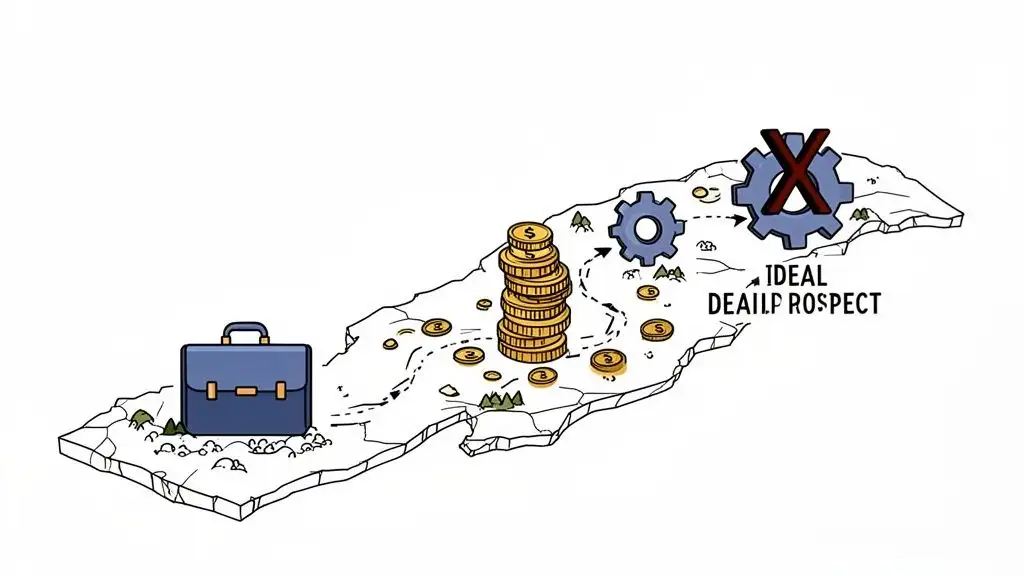
Let’s be honest, effective prospecting isn't about searching anymore; it's a science of timing. Forget aimlessly scrolling through LinkedIn hoping for a miracle. The real secret to getting ahead of your competition is learning to spot the digital breadcrumbs that signal a prospect is actively looking for a solution like yours.
These "buying signals" are your treasure map. They tell you exactly where to dig for gold, transforming your outreach from a cold interruption into a perfectly timed, welcome conversation. This is how you find high-intent prospects who actually want to hear from you.
Instead of casting a wide, generic net, you're using a sonar that pings back when it detects real movement. You’re not playing a game of chance, you’re playing a game of skill.
The New Executive Shuffle
One of the most powerful buying signals out there is a job change, especially at the executive level. Think about it: a new leader is under immense pressure to make an impact, and fast. The first 90 days are a whirlwind of auditing, planning, and shaking things up.
For example, a company just brought on a new VP of Marketing. This isn't just a personnel update; it's a massive sales opportunity. That new VP is almost certainly re-evaluating their entire marketing tech stack, their agency relationships, and their strategic priorities.
Your outreach, timed to their first few weeks on the job, isn't just another cold email. It's a lifeline. You’re not selling a product; you're offering them a quick win to help them impress their new boss. It's like showing up with a pizza on moving day. You're instantly a hero.
Your message can be simple and direct: "Congrats on the new role! Leaders in your position are often tasked with improving X. We help with that." Bam. You've just positioned yourself as an insightful problem-solver, not just another vendor begging for 15 minutes.
Follow the Money Trail
Another neon-glowing buying signal? A recent funding announcement. When a company secures a new round of investment, it's not just for bragging rights on TechCrunch. That cash comes with serious expectations and a mandate to grow, and grow fast.
A company that just raised a Series B isn't hoarding that money like a dragon on its gold pile. They're spending it to solve the new, bigger problems that come with scaling. These problems often fall into predictable categories:
-
Hiring Sprees: A sudden spike in job postings, especially for sales or engineering roles, means they need tools to support and enable all those new hires.
-
Expansion Plans: Announcing new office locations or a push into international markets signals a clear need for operational software, logistics, and localized solutions.
-
Marketing Budget Boom: More funding almost always translates to more marketing and sales spend. They'll be looking for solutions to make that spend more efficient.
Reaching out after a funding round shows you've done your homework. Your message shifts from "Can I have your money?" to "I know how you can wisely invest the money you just got." You can find a goldmine of information on this topic by exploring more about sales intelligence.
Watch Their Tech Stack
The software a company uses, or just recently adopted, tells you a story about their priorities and challenges. This is the art of using technographics for smarter prospecting.
Let’s say you sell an advanced email marketing automation platform. You notice a target account just installed a new CRM. This is a prime opportunity! They are clearly investing in their sales and marketing infrastructure, and your tool is the logical next step to get the most out of that shiny new CRM.
Your outreach can be hyper-relevant: "Saw you're now using Salesforce. Great choice! We help companies like yours supercharge their Salesforce data with targeted email campaigns that drive more pipeline."
This kind of manual detective work used to take hours. Thankfully, modern platforms can now automate this process, delivering a real-time feed of high-intent leads directly to you. This is how you stop chasing leads and start attracting opportunities.
Enriching and Qualifying Leads Without Losing Your Mind
So, you’ve spotted a promising company. Maybe they just hired a new VP of Sales, landed a huge funding round, or you saw they’re using a tech stack you integrate with. You’ve got a "who," but you're still missing the "what" and the "how." The next part of the prospecting sales game is turning that company name into a real, live person you can actually talk to.
This is where data enrichment swoops in to save the day. Forget the stuffy corporate jargon. Think of it as building a complete dossier on your target, like a spy gathering intel before a mission. It’s how you transform a vague company name into a fleshed-out human profile you can use to make a genuine connection.
Pro Tip: You can use Munch to enrich your contact data and craft personalized outreach messages for every lead!
Beyond a Name and a Title
Enrichment is so much more than just scraping an email address. It’s about layering different types of data to get a full 360-degree view of your prospect and their world. Skip this step, and your outreach is basically a shot in the dark.
Here's the critical intel you absolutely need to gather:
-
Firmographics: This is the company's basic DNA. What's their industry, revenue, and employee count? Knowing if you're talking to a 50-person startup or a 5,000-employee enterprise completely changes your entire pitch.
-
Technographics: What tech are they already using? If you sell marketing automation software and you know they just implemented HubSpot, that's a golden nugget for your outreach.
-
Verified Contact Data: This is the holy grail. You need accurate email addresses and, if you can get them, direct-dial phone numbers. A generic "info@" email is a black hole where good outreach goes to die. A verified direct email that zips past the gatekeeper? That's pure gold.
Trying to find all this by hand is a soul-crushing exercise. It’s an endless rabbit hole of LinkedIn profile stalking, clicking through company "About Us" pages, and desperately Googling "CEO of [Company] email." It’s the sales equivalent of trying to assemble IKEA furniture with a vague drawing and half the screws missing. It’s painful, and the end result is often wobbly and unreliable.
The Agony of Manual vs. The Ecstasy of Automation
Let's be real about manual enrichment for a second. You spend 20 minutes digging for one prospect's email. You find three different versions on some sketchy-looking websites. You send your beautifully crafted message to all three, only to get two immediate bounce-backs and one angry reply from a completely different person. Your time, effort, and morale? All down the drain.
Now, imagine a different reality. You spot a target company. You click a button. In seconds, a tool populates their profile with a verified email boasting 95%+ accuracy, a direct phone number, their company's revenue, and the exact software they're using.
This isn't just about saving time; it's about killing the grunt work so every single outreach attempt actually has a fighting chance. Automation is like having that IKEA furniture delivered fully assembled and placed perfectly in your living room. You just get to enjoy it.
The difference in efficiency is night and day. Instead of spending hours on tedious detective work, your reps can focus on what they do best: building relationships and closing deals. If you want to really get into the weeds, our ultimate guide offers a ton of information about effective lead enrichment.
This automated approach means that when you hit "send," you’re confident your message is reaching the right person, not just floating in the digital abyss. This is the bedrock that makes every other part of your prospecting more effective. You're not just working faster; you're working smarter.
Crafting Outreach That Earns Replies, Not Eye Rolls
Alright, you’ve done the hard work. You’ve identified prospects who are practically waving their hands in the air, ready to buy, and you’ve built a dossier on each one. Now comes the moment of truth: the first contact.
This is where so many prospecting sales efforts go off the rails. It’s where good intentions devolve into the cringey, copy-paste messages that make buyers want to throw their laptops out the window. We're not going to do that.
Forget the tired "Hi {FirstName}, I saw you're the {Title} at {Company}" formula. That’s the sales equivalent of a dial-up modem sound in 2024. Instead, we’re going to craft messages so sharp and timely, they feel less like a cold pitch and more like you’ve read your prospect’s mind.
The secret? It all boils down to the "why you, why now" principle. Your message must instantly answer two questions for your prospect: Why are you reaching out to me specifically, and why are you doing it right now? All those buying signals we talked about are your cheat codes to nailing both.
The Art of the Context-Aware Opener
Your opening line is everything. It's the bouncer at the club door of your prospect's attention span. A generic opener gets you deleted without a second thought. A context-aware opener, on the other hand, gets you read.
Let's play out a couple of real-world scenarios.
Scenario 1: The New Job
-
The Signal: Your prospect was just promoted to Head of Demand Generation.
-
The Bad Opener: "Hi Sarah, I help demand gen leaders like you improve their pipeline." (Yawn. So does everyone else.)
-
The Good Opener: "Huge congrats on the new role at Acme Corp, Sarah! Usually, the first 90 days in a demand gen leadership seat are all about finding quick wins to re-evaluate the funnel."
See the difference? The second opener shows you’re not just scraping LinkedIn for titles. You get the specific pressure she’s under in her new role. It’s the difference between saying "Hey, you own a car" and "Hey, I see you have a flat tire; I've got a jack right here."
Scenario 2: The Funding Announcement
-
The Signal: A target company just dropped news of a $20M Series B round.
-
The Bad Opener: "I saw you just raised a Series B and wanted to reach out." (Congratulations, you and every other SDR on the planet had the same idea.)
-
The Good Opener: "Just saw the Series B news, congrats to the team! From my experience with post-funding scale-ups, the pressure to efficiently deploy that new capital on sales headcount is immediate."
This opener cleverly frames their good news in the context of a new challenge, a challenge you’re perfectly positioned to solve. It shows you’re a savvy operator who understands the bigger picture.
Personalization That Goes Beyond a Placeholder
True personalization isn't just mail-merging {Company Name}. It’s about weaving the details you’ve uncovered into the very fabric of your message, proving you’ve actually done your homework. Think of it like a movie Easter egg, a small detail that rewards the person paying attention.
The real goal of great outreach is to make the prospect feel like you wrote this message just for them, even if you’re secretly starting from a template. It's about creating that "Huh, this person actually gets it" moment.
Let's face the brutal reality of the B2B inbox: only 8.5% of cold emails ever get a response. But here's the kicker, using a multi-touch sequence can double replies and boost rates by as much as 160%. This proves that persistence pays, but only if the message is worth reading in the first place.
After all, a staggering 73% of B2B buyers just hit "delete" on irrelevant pitches. And with 8 out of 10 prospects preferring email over any other channel, you simply can't afford to get this wrong.
Battle-Tested Templates for Real-World Scenarios
Templates aren't the enemy. Lazy, impersonal templates are. The key is to have a solid structure that you can adapt based on the specific buying signals you've found. For even more firepower, check out our deep dive on how to write cold emails that actually get opened.
Here are a few frameworks to get you started.
Template for a Technology Change
-
Subject: Quick question about [New Tech] at [Company Name]
-
Body:
-
Hi [FirstName], -
Noticed on your site you recently implemented [New Tech, e.g., HubSpot]. Great choice for getting all your customer data in one place. -
Often, the next step after centralizing data is figuring out how to activate it for sales plays. We help companies like [Competitor/Similar Company] turn their HubSpot contacts into qualified meetings with hyper-personalized outreach. -
Open to a quick chat next week to share how?
-
Template for a Company Growth Signal (e.g., new office, big hiring push)
-
Subject: Scaling [Department] at [Company Name]?
-
Body:
-
Hi [FirstName], -
Saw the exciting news about your expansion into the EU. That's a huge milestone. -
As you build out the new sales team there, my guess is that onboarding and ramp time will be critical. You probably don’t have time for the usual SDR hiring chaos. -
We provide a platform that gets new reps pipeline-ready in weeks, not months. Might be a timely conversation. -
Worth exploring?
-
Notice the simple, repeatable logic in each one:
-
Acknowledge the Signal: Show you’re paying attention.
-
Connect it to a Problem: Demonstrate you understand the challenge this signal creates.
-
Introduce Your Solution: Briefly and clearly position your value.
-
Low-Friction Call-to-Action: Make it incredibly easy for them to say "yes."
This approach transforms your prospecting sales outreach from just another unwanted interruption into a genuinely helpful suggestion.
Building a Multi-Channel Cadence That Actually Connects
Let's be real. Firing off a single, brilliant email and praying for a reply isn't a strategy, it's playing the lottery. If you want to consistently win at modern prospecting sales, you need a system. That means building a multi-channel, multi-touch cadence that makes you a persistent, valuable presence, not an annoying pest.
The idea is to show up in different places, at different times, with different angles. This subtle shift transforms you from just another salesperson into a helpful expert who seems to be everywhere at once. A single touchpoint is easy to ignore, but a series of well-timed, value-packed interactions? That’s much harder to miss.
Designing a Practical 14-Day Cadence
A great cadence isn't just a random sequence of pings. It’s a story that unfolds over time. Every single touch should build on the last, adding fresh value instead of just falling back on the tired, "bumping this to the top of your inbox."
Let's walk through a simple but killer 14-day sequence you can steal and tweak for your own use.
-
Day 1: The Precision Email. This is where you lead with that hyper-personalized "why you, why now" email we talked about. Pinpoint a specific buying signal and connect it directly to a problem you solve. Keep it sharp, relevant, and dead simple to reply to.
-
Day 3: The LinkedIn Fly-By. Time for a passive touch. Simply view their LinkedIn profile. They'll get a notification that you stopped by, creating a tiny flicker of recognition for your name and company. It's a small seed to plant before your next move.
-
Day 5: The Personalized Connection. Now, send that LinkedIn connection request. But for the love of all that is good, personalize it. Add a short note referencing your email. Try something like, "Hi [FirstName], I sent a note about [topic] earlier this week. Thought it made sense to connect here too."
-
Day 8: The Value-Add Email. Follow up, but don't just ask if they saw your first email. That's weak. Instead, offer something genuinely useful like a relevant case study, a short video explaining a key concept, or a blog post that tackles one of their likely headaches. Frame it as, "Thought you might find this useful."
-
Day 11: The Warm Call. Yes, the phone still works wonders. A "warm call" at this stage can be incredibly effective because they've already seen your name a few times. Your script can be simple: "Hi [FirstName], this is [YourName] from [YourCompany]. I sent you a couple of emails and we just connected on LinkedIn about [topic]. Just wanted to put a voice to the name." Even a voicemail reinforces your presence.
-
Day 14: The Graceful Exit. This is the "break-up" email. Keep it light and professional. "Hi [FirstName], I've tried to get in touch a few times without any luck, so I'll assume this isn't a priority right now and will stop bugging you. If that changes, you know where to find me." You'd be surprised how often this polite closing line gets a reply from prospects who were just slammed.
This simple flow is all about a core principle: find a signal, personalize your outreach, and work smart to earn a reply.
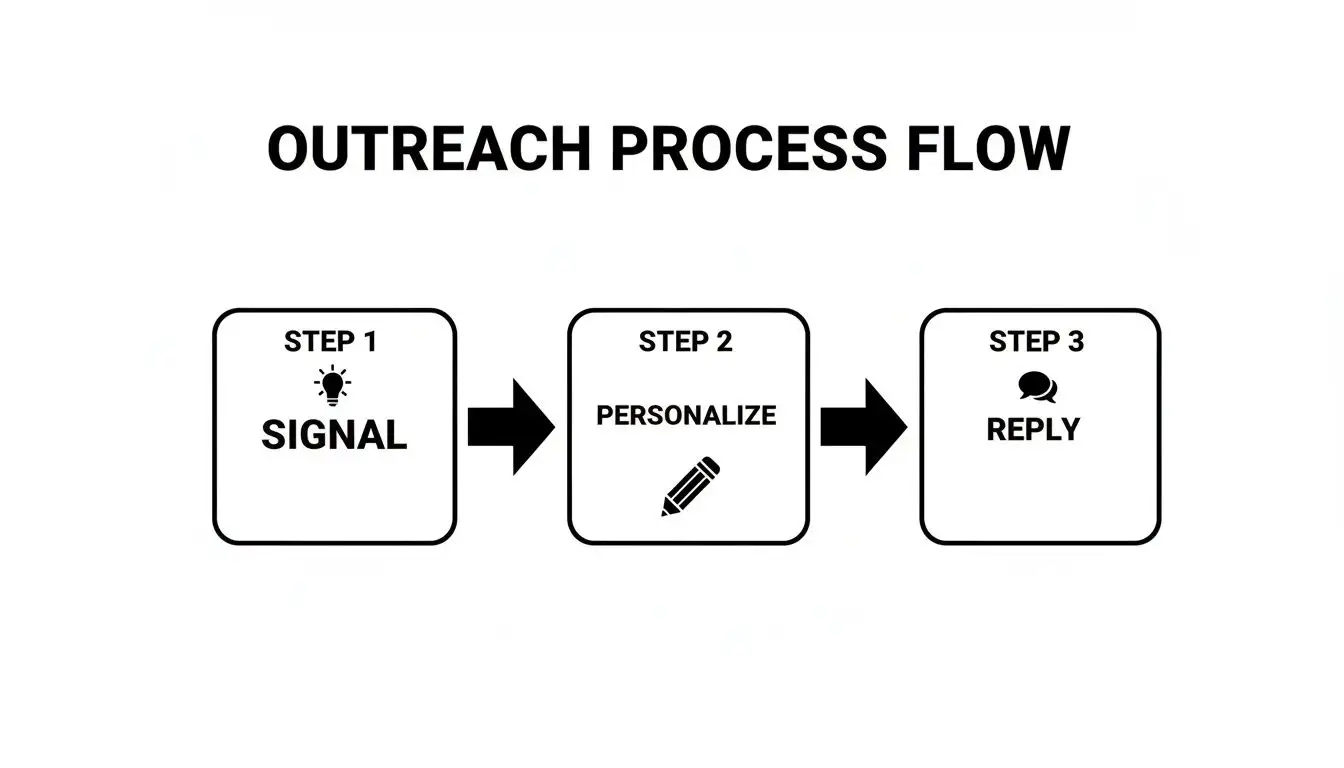
It really all boils down to these three stages, moving from an automated trigger to a human interaction that sparks a real conversation.
Testing and Optimizing Your Channels
The sequence I laid out is a fantastic starting point, but it's not scripture. The real beauty of a cadence is that you can, and absolutely should, test everything. Your audience of enterprise CFOs might live in their inbox, while startup CTOs might be more responsive on LinkedIn.
Don't assume you know what works. Let the data be your guide. Track reply rates by channel and by message. Is your connection request acceptance rate in the gutter? Tweak the note. Is your second email getting zero love? Switch up the subject line and the resource you're offering.
To really nail this, you should incorporate proven methods like these LinkedIn lead generation strategies. Weaving professional networking into your sequence adds a powerful layer of social proof and makes you feel like less of a stranger.
By turning your outreach into a structured cadence, you're graduating from random acts of prospecting to a predictable system for booking meetings. It creates a rhythm and a process that is scalable, coachable, and most importantly, gets results.
If you want to go even deeper on structuring your outreach, you'll probably dig our guide on sales cadence best practices.
Measuring What Matters to Scale Your Success
You can't get better at what you don't measure. In the world of prospecting sales, it's way too easy to get hypnotized by vanity metrics. Sure, firing off 1,000 emails in a day sounds impressive, but if all you get back is a handful of annoyed replies, you're just doing busy work. It’s like bragging about how many times you’ve re-watched Friends; it's a big number, but it doesn't mean you're actually making new friends.
To really scale your prospecting, you have to stop tracking just the activity and start measuring the outcomes. It’s all about creating a feedback loop where cold, hard data tells you what to do next. Let’s dig into the KPIs that actually move the needle.
Moving Beyond Vanity Metrics
First things first: you need to learn to tell the difference between noise and a signal of real progress. Pumping out a high volume of outreach is part of the game, sure, but it's the metrics further down the funnel that reveal if your strategy is actually working.
These are the core numbers that should be front-and-center on every sales leader's dashboard:
-
Reply Rate: This is your most immediate feedback. Are people actually reading and engaging, or are you just shouting into the void?
-
Meeting Booked Rate: This tells you if those replies are turning into real conversations. It’s the true test of your call-to-action and your ability to turn a spark of interest into a commitment.
-
Prospect-to-SQL Conversion Rate: This is the big one. How many of the meetings you book are actually qualified and get passed to the sales team as a real opportunity?
Focusing on these KPIs is like using a scalpel instead of a sledgehammer to fix your process. You can diagnose problems with incredible precision instead of just guessing.
Diagnosing Your Funnel with Data
Think of your prospecting funnel like a car engine. When something’s off, you don't just kick the tires and hope for the best; you pop the hood and look at specific parts to find the root cause. Your KPIs are the diagnostic tools that tell you exactly where the engine is sputtering.
Let’s walk through a couple of all-too-common scenarios.
Scenario A: The Silent Treatment
-
The Symptom: Your reply rate is below 5%. Crickets.
-
The Diagnosis: It's almost certainly your messaging. Your subject lines are probably getting ignored, your personalization feels flimsy, or your value prop is just not hitting home. Your outreach feels like another piece of junk mail, and it's getting deleted on sight.
-
The Fix: Go back to the drawing board on your templates. Seriously. A/B test completely different subject lines, try out more specific "why you, why now" hooks, and make damn sure you’re leading with a problem they actually care about.
Scenario B: All Talk, No Action
-
The Symptom: Your reply rate is solid (10%+), but your meeting booked rate is in the gutter.
-
The Diagnosis: You’re great at starting conversations but terrible at turning them into appointments. Your call-to-action is likely too weak or wishy-washy, or you're fumbling the handoff once they show a flicker of interest.
-
The Fix: Sharpen that CTA. Stop saying "let me know if you want to chat" and start proposing specific times. And take a hard look at the replies you're getting. Are prospects asking questions you can't answer, or are they ghosting you right after the first positive interaction?
By tracking these specific conversion points, you get the visibility needed to coach your team effectively. You can move from generic advice like "send more emails" to specific feedback like, "Let's work on turning positive replies into booked meetings."
The Ultimate Goal: Sales Qualified Leads (SQLs)
At the end of the day, the only number that really matters is how much qualified pipeline your prospecting sales efforts are generating. A high meeting booked rate is fantastic, but if those meetings are with tire-kickers and unqualified prospects, you’re just wasting your Account Executives' time and burning goodwill.
This is where the Prospect-to-SQL conversion rate becomes your North Star.
If your reps are booking meetings left and right but very few convert to SQLs, it’s a blaring alarm that your qualification criteria are too loose. They might be going after the wrong personas, talking to people without authority, or failing to uncover any real pain during their initial calls. This data is gold for a sales leader, it tells you to tighten up your Ideal Customer Profile (ICP) and provide better training on what truly makes a lead "qualified."
When you start using data this way, prospecting stops being a mysterious black box and turns into a predictable, scalable engine for growing your business. You know your numbers, you know which levers to pull, and you know exactly what to do to get better results.
Got Questions About Prospecting? We've Got Answers.
Even with the best playbook in hand, you're going to have questions. Prospecting can feel like trying to solve a puzzle with a few missing pieces. Let's tackle some of the most common head-scratchers that pop up.
How Long Should My Sales Cadence Be?
There’s no magic number here, but a great place to start is a 14-21 day cadence with around 8-12 touches. You'll want to mix it up across different channels like email, LinkedIn, and maybe a well-timed phone call.
The real key? Test everything. For a quick, transactional sale, you might get away with a shorter, more aggressive blitz. But if you're chasing a six-figure enterprise deal, you’ll need a longer, more patient sequence focused on building a genuine relationship.
Is Cold Calling Officially Dead?
Let's be clear: stupid calling is dead. Blindly dialing down a random list of names is about as effective as trying to send a message via carrier pigeon. It’s a complete waste of everyone’s time.
But a warm call? That’s a different beast entirely. Calling a prospect who just opened your last three emails or whose company just announced a huge funding round? That's not a cold call; it's a strategic move. The phone is no longer the opening act, it's the show-stopping encore in your multi-channel performance.
So, When Is the Best Time to Send Prospecting Emails?
You'll see a million studies claiming Tuesday at 10 AM is the golden hour. The problem is, everyone else has read those same studies. The real "best" time is often when your competitors are quiet. Try experimenting with off-peak hours, like early evenings or even a Sunday afternoon.
The only source of truth that matters is your own data. Watch your open and reply rates like a hawk. What works for one audience might completely flop with another. Let your numbers tell you when to hit "send."
Ready to stop guessing and start finding high-intent prospects who actually want to talk? Munch unifies lead discovery, enrichment, and AI-powered outreach into one seamless workflow. Find out how top sales teams are building predictable pipeline.