A Modern Outbound Lead Generation Playbook

By Mriganka Bhuyan
•Founder at Munch
Outbound lead generation is all about proactively hunting for potential customers who fit your ideal profile, rather than waiting for them to come to you. It’s a direct, hands-on approach where you use channels like email, phone calls, and social media to start conversations and fill your sales pipeline. The real secret to making outbound work today is strategic targeting and personalization—you have to reach the right people with a message that actually means something to them.
What Modern Outbound Lead Generation Looks Like
Let's get one thing straight. When you hear "outbound," you might picture a scene from Glengarry Glen Ross—endless, aggressive cold calls and a "spray and pray" email strategy. But that's not what we're talking about here. That old-school method is the sales equivalent of trying to catch a Pokémon by throwing a Poké Ball with your eyes closed. It's messy and ineffective.
Real outbound today is a sharp, data-driven process. It's about engaging specific, high-value accounts that are a perfect match for your ideal customer profile (ICP). Think of it as the difference between fishing with a giant, leaky net and fishing with a laser-guided spear.
The Shift from Volume to Value
The game has completely changed. Successful outbound campaigns now prioritize quality over quantity. Instead of blasting out 10,000 generic emails, a modern sales team might focus on just 100 carefully researched prospects.
Why the change? Because personalized outreach drives 80% higher engagement than generic messages. This targeted approach not only gets far better results but also protects your brand from being seen as spam.
This shift means your team's energy is better spent on:
-
Deep Research: Really getting to know a prospect’s company, their specific role, and any recent business triggers that make your solution relevant right now.
-
Personalized Messaging: Crafting emails and messages that speak directly to their pain points or business goals.
-
Multi-Channel Engagement: Using a smart mix of email, LinkedIn, and even phone calls to create a single, cohesive conversation.
The goal isn’t just to get a response; it's to start a valuable conversation. Modern outbound is about being a helpful expert who shows up at the right time with a relevant solution, not a pushy salesperson desperate to hit a quota.
Taking Control of Your Pipeline
In a world often obsessed with inbound marketing, a solid outbound strategy puts you back in the driver's seat of your sales pipeline. Inbound is great for capturing existing demand, but it's fundamentally passive—you're waiting for people to find you.
Outbound is the opposite. It’s proactive. You get to pursue your best-fit future customers, create new demand where it didn't exist before, and build a predictable revenue engine. You're no longer at the mercy of search engine algorithms or fluctuating ad costs. You define your target, build your list, and start the conversation on your terms.
This guide is a practical, no-fluff playbook for building that exact system. We'll walk through a clear framework to help you master this powerful growth lever, step by step.
Defining Your Ideal Customer Profile
Let's get one thing straight: selling to everyone is the fastest way to sell to no one. Before you even think about writing that first email or pulling a prospect list, you have to know exactly who you're talking to. This isn't just a preliminary step; it's the absolute foundation of a successful outbound strategy. We're aiming for surgical precision here.

This all boils down to building a rock-solid Ideal Customer Profile (ICP). An ICP is a super-detailed description of the perfect company you want as a customer, not just a vague buyer persona. It goes way beyond basic details like industry or employee count. A well-defined ICP is your North Star, making sure every ounce of effort is pointed directly at the right target.
Think of it like casting for a movie. You wouldn't just put out a notice for "an actor." You'd have a specific profile—their look, their style, their experience. Your ICP is that detailed casting call for your perfect customer.
Look Inward First: Your Best Customers
The most reliable place to start building your ICP is with your current, happiest customers. They're a goldmine of insights, showing you exactly who gets the most value from what you offer. You’re not guessing; you're using real, hard data.
Your mission is to find the common threads that tie your best accounts together. And don't just look at who pays you the most. Think about who had the smoothest onboarding, who uses your product the most, and who gives you the best feedback. Those are your true champions.
To get started, dive into your CRM and sales data to find these key characteristics:
-
Firmographics: What are the common industries, company sizes (both in revenue and employee count), and geographic locations?
-
Technographics: What other software do they use? Do your best customers all use Salesforce, HubSpot, or a specific project management tool?
-
Behavioral Data: How did they find you? How long was their sales cycle? What was the primary pain point that drove them to buy?
This analysis gives you a data-backed blueprint of what a great customer actually looks like, shifting you from assumptions to facts.
Uncovering the “Why” Behind the Buy
Once you have the numbers, it’s time for the qualitative part. The "what" is important, but the "why" is where the real magic for your messaging happens. This means getting to the heart of the pain points and business goals that push a company to look for a solution like yours.
A fantastic way to do this is through a simple win/loss analysis. Sit down with your sales team and talk about recent deals. For the wins, what specific problem was the customer desperate to solve? For the losses, what was the real reason you didn't get the deal? This isn't about placing blame; it's about gathering critical intelligence.
Your Ideal Customer Profile isn't just a document; it's a decision-making filter. If a prospect doesn't align with your ICP, you gain the discipline to say "no" and focus your energy where it will have the greatest impact.
Putting It All Together: A Practical ICP Framework
Now, let's pull all this information into a clear, usable framework. Your ICP shouldn't be a 10-page report nobody reads. It needs to be a concise "cheat sheet" that your entire team can use to qualify prospects in seconds.
Here’s a simple but powerful structure to build out your ICP:
| Category | Criteria | Example (for a B2B SaaS company) |
|---|---|---|
| Industry | Primary vertical(s) | Technology, Professional Services |
| Company Size | Employee count & Annual Revenue | 50-500 employees, $10M-$100M ARR |
| Geography | Key markets | North America, Western Europe |
| Technology Stack | Complementary software they use | Salesforce CRM, Slack, Google Workspace |
| Pain Points | Specific problems they face | Inefficient manual processes, poor data visibility, struggling to scale sales outreach |
| Business Goals | What they are trying to achieve | Increase sales team productivity by 20%, improve pipeline predictability |
| Negative Attributes | Red flags to avoid | Companies with no dedicated sales team, businesses in highly regulated industries |
With a profile this detailed, your BDRs aren't just firing off messages into the void. They're starting relevant conversations with companies that are genuinely a perfect fit. This makes your entire outbound lead generation engine not just better, but exponentially more effective.
Turning Your ICP into a High-Value Prospect List
Alright, you've done the hard work and defined your Ideal Customer Profile (ICP). Now comes the fun part: actually finding those people. This is where the rubber meets the road, turning your strategy into a tangible list of companies and contacts you can start talking to.
Frankly, the quality of your prospect list is everything. A meticulously built list is the foundation of a successful campaign. A sloppy one? Well, that's a one-way ticket to low reply rates and wasted effort. The goal isn't to build the biggest list; it's to build the right one.
Where to Find Your Prospects
So, where do you hunt for these perfect-fit prospects? You’ve got a few solid options, and most top-tier teams use a combination of them. Think of it like a toolkit—you wouldn't use a hammer for every job.
-
Sales Intelligence Platforms: These are your workhorses. Tools like ZoomInfo, Apollo.io, and our own platform, Munch, are massive databases packed with filters. You can slice and dice by industry, company size, revenue, and even the tech stack a company uses. Not only that, you can enrich various aspects of each lead, eg - you can find their work email id, phone number, get details about their Linkedin profile, their company's tech stack, total headcount, funding news, etc. This is the fastest way to build a large, targeted list.
-
LinkedIn Sales Navigator: For surgical precision, nothing beats Sales Navigator. It lets you get incredibly granular with your searches—think job titles, seniority, recent job changes, or even people who have posted about specific topics. It's less about bulk list-building and more about identifying specific, high-value individuals.
-
Creative & Manual Sourcing: Don't sleep on good old-fashioned digging. Some of the best leads aren't just sitting in a database waiting for you. Keep an eye on industry news for funding announcements, new executive hires, or big expansion plans. I've found some of my best opportunities by browsing speaker lists for upcoming conferences or virtual events.
Here’s a pro tip: Never rely on just one source. The best outbound programs blend data from multiple places. Munch takes data from 50+ providers to zero in on your top-tier targets and find nuanced details.
The Real Secret: Data Enrichment
Getting a name, title, and email is just the starting point. A raw list is like having a bunch of ingredients but no recipe—you can’t really do much with it. Data enrichment is the process of adding layers of context to each prospect, turning a simple contact into a powerful conversation starter.
Enrichment is what allows you to move from a generic, cold email to a warm, relevant touchpoint. When you know more than just a person's job title, you can craft a message that actually resonates. In fact, we've seen that personalized outreach can drive 80% higher engagement than the generic stuff everyone else is sending.
Look for the "Why You, Why Now" Triggers
Your mission during enrichment is to find "triggers"—those golden nuggets of information that make your outreach timely and specific. Here's what I always look for:
-
Company-Level Triggers:
-
Recent Funding: A company that just closed a funding round has cash to spend and pressure to grow. Perfect timing.
-
Hiring Sprees: If you see a ton of new job postings in a specific department (like sales or engineering), it’s a massive signal of their current priorities and pain points.
-
New Product Launches: A big launch means new strategic goals and a potential need for new tools to support them.
-
-
Individual-Level Triggers:
-
Job Changes: A new executive in their first 90 days is often looking to make an impact and shake things up. They're more open to new ideas and vendors than someone who is entrenched.
-
Recent Promotions: This is a fantastic, non-salesy excuse to reach out. A simple "Congrats on the new role!" can open the door.
-
Content Engagement: Did they just publish a great article, speak on a podcast, or post something insightful on LinkedIn? Referencing it shows you've done your homework.
-
This isn’t about being a creep; it's about being observant. It’s the difference between saying, "I sell software, want to see a demo?" and "I saw your company just launched a new AI initiative, and I had a thought on how you could get it in front of more enterprise clients." One gets ignored. The other starts a real conversation.
Crafting Your Multi-Channel Outreach Strategy
Relying on email alone for outbound lead generation is like trying to build a house with only a hammer. You might get a few things done, but you’re ignoring a whole toolbox that could make your efforts stronger, faster, and way more effective. A truly successful outbound program doesn't just blast emails; it orchestrates a thoughtful conversation across multiple channels.
The whole point is to create a cohesive experience where each touchpoint builds on the last one. It’s about being professionally persistent, not just another pest in their inbox. Think of it like a great '90s mixtape—you don't just put the same song on repeat. You build a flow, with each track setting the mood for the next, all leading to that one desired outcome: a booked meeting.
This process starts long before you ever hit "send." You have to find the right people, gather the right intel, and then decide who to contact first.
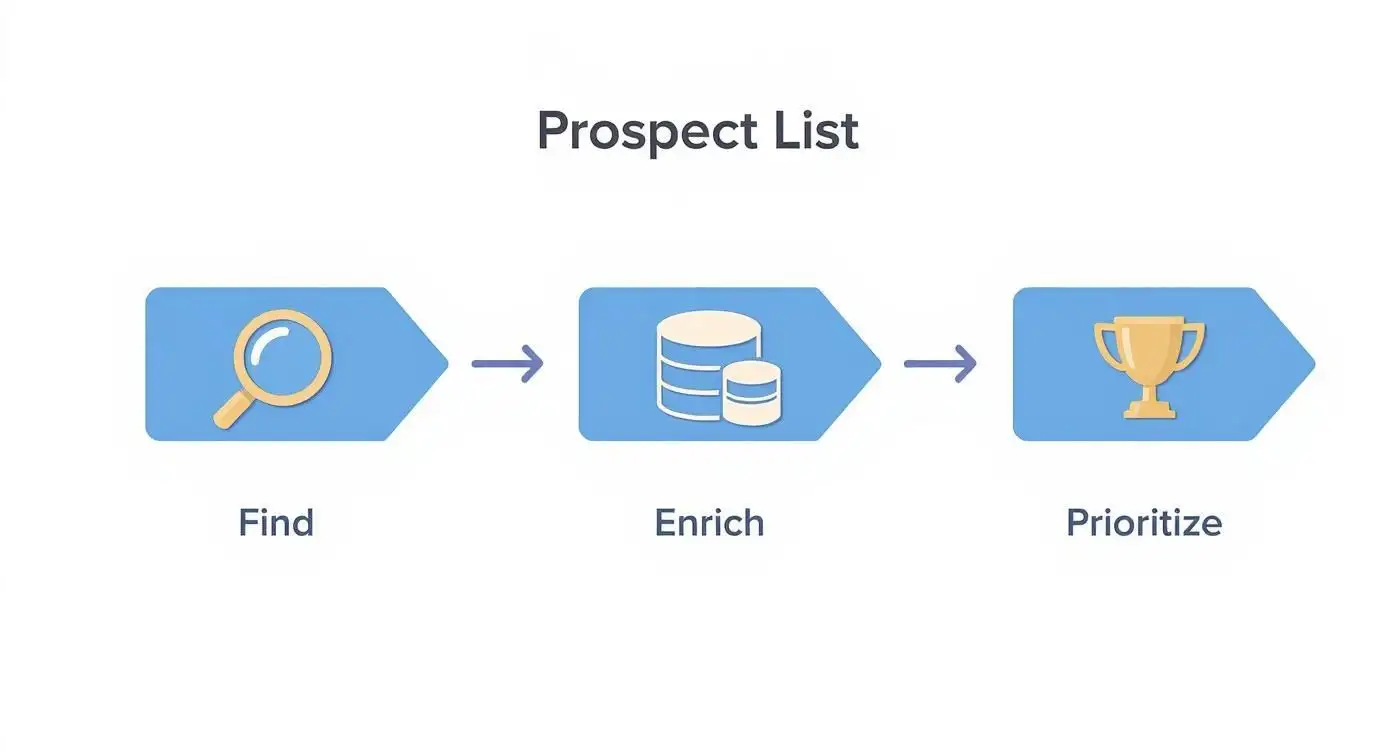
Nailing this upfront work is what makes your multi-channel strategy so much more powerful from the very first touch.
The Power Trio: Email, LinkedIn, and Phone
For most B2B outreach, your core channels are going to be email, LinkedIn, and the good old-fashioned phone. Each one has a unique, strategic role to play in your sequence. Making them work together in harmony is what separates a world-class outbound engine from a pile of unread messages.
-
Email: This is your workhorse. It's the perfect place to deliver detailed, value-packed messages right to your prospect’s inbox. A great email is where you lay out your "why you, why now" with clarity and precision.
-
LinkedIn: Think of this as your social proof and relationship-building platform. A simple profile view, a connection request, or a smart comment on a prospect's post makes you a real person, not just another automated sender. It completely humanizes your outreach.
-
Phone: It’s often feared, but it's incredibly powerful when used right. A well-timed call can cut through the digital noise like nothing else. It’s immediate, personal, and a whole lot harder to ignore than an email sitting in a crowded inbox.
The real magic happens when you start weaving these channels together. A prospect might ignore your first email but see and accept your LinkedIn request. Suddenly, when your follow-up email lands, your name is familiar. That little bit of familiarity might be all it takes to get a reply.
Designing Your Outreach Sequence
A sequence is your game plan. It’s a predefined series of actions over a set period that takes the guesswork out of follow-up and ensures a consistent, methodical approach for every single prospect.
While there's no single magic number, I've found that a sequence of 8-12 touches over 2-4 weeks is a solid starting point for most B2B sales cycles.
Remember, the point of a multi-channel sequence isn't to just keep asking for a meeting. It’s to offer value in different formats. You could share a relevant case study in an email, comment on their company's latest news on LinkedIn, and then reference that interaction when you make a call.
So, what does this look like in the real world? Here’s a sample sequence that’s balanced, effective, and won’t get you marked as spam.
Sample Multi-Channel Outreach Sequence
This is a simple, 10-day multi-touch sequence that combines email, LinkedIn, and the phone for a balanced approach that gets results without being overly aggressive.
| Day | Channel | Action | Goal |
|---|---|---|---|
| Day 1 | Send a highly personalized "why you, why now" email focused on a specific pain point or trigger event. | Grab attention and establish relevance immediately. | |
| Day 2 | View the prospect’s profile and send a connection request with a short, non-salesy note. | Create familiarity and open a new communication channel. | |
| Day 4 | Phone | Make a brief "warm call," referencing the email you sent. Leave a concise, value-focused voicemail if they don't answer. | Add a human touch and make a direct connection attempt. |
| Day 7 | Follow up with a new piece of value, like a short case study or a link to a relevant article. | Nurture and demonstrate expertise without just "bumping" the first email. | |
| Day 10 | If connected, send a short message referencing a recent post they made or company news. If not, comment on a post. | Re-engage in a low-pressure social context. |
This kind of structure ensures you're showing up in different places with different angles, which dramatically increases your chances of getting noticed and starting a conversation.
Actionable Templates That Actually Work
Templates are fantastic for saving time, but they should never, ever sound robotic. The best templates are really just frameworks—scaffolding that you fill in with genuine personalization.
The First-Touch Email Framework:
-
Subject Line: Be specific and intriguing, not clickbaity. Something like, "Idea for [Their Company Name]'s sales productivity" or "Question about [Recent News/Project]" works well.
-
Opening Line: This is where your research needs to shine. Immediately reference your "why you, why now" trigger. "Saw your post on LinkedIn about scaling your SDR team..." or "Congrats on the recent funding round..."
-
Value Proposition: In one or two sentences, connect their situation to your solution. "Companies like yours often struggle with [Pain Point]; we help by [Brief Solution]."
-
Call to Action (CTA): Keep it low-friction. Instead of the high-commitment "Can you hop on a 30-minute demo?" try an interest-based CTA like, "Would you be open to learning more about how we helped [Similar Company] achieve [Result]?"
The LinkedIn Connection Request That Doesn't Suck:
Please, stop using the default "I'd like to add you to my professional network." It’s the digital equivalent of a limp handshake. It screams zero effort.
Try one of these approaches instead:
-
The Common Ground: "Hi [Name], I see we're both in the [Industry/Group] space and I've been following [Their Company]'s work. Would love to connect."
-
The Value Offer: "Hi [Name], I came across your profile and noticed you're a leader in [Their Field]. I'm sharing some insights on [Topic] that might be useful. Happy to connect."
-
The Compliment: "Hi [Name], really enjoyed your recent article on [Topic]. Your point about [Specific Insight] was spot on. Would be great to connect."
By crafting a thoughtful, multi-channel strategy, your outbound lead generation efforts transform from a series of disjointed pings into a strategic campaign that builds real rapport, offers genuine value, and ultimately starts meaningful conversations.
Alright, let's get down to business. Launching your outbound campaign is just the start—it's like kicking off a cross-country road trip. The real work begins when the rubber meets the road. This is where you shift from setting up a project to building a predictable revenue machine, and that requires a "mission control" mindset where data, not gut feelings, steers the ship.
The second your campaign goes live, you start getting feedback. Every open, every click, and every reply tells a story about what’s landing and what’s falling flat. Your job is to listen closely to that story and adjust your course. If you’re not tracking and optimizing, you're just driving blind.
Your Mission Control Metrics
You don’t need a dashboard worthy of NASA to get started. Just a handful of key performance indicators (KPIs) will give you a surprisingly clear view of your campaign's health. The trick is to focus on the metrics that directly lead to your end goal: booking more meetings.
These are the core numbers every outbound team should live and breathe:
-
Open Rate: This tells you if your subject lines are cutting through the inbox chaos. A low open rate (anything under 40%) is a huge red flag. It probably means your subject line is boring, looks spammy, or you're landing in the promotions tab.
-
Reply Rate: This is the big one. It’s a direct measure of how compelling your actual message is. A healthy, well-targeted campaign should be pulling in reply rates between 5% and 10%. If your opens are high but replies are low, the problem is almost always your email body copy.
-
Positive Reply Rate: Let's be real, not all replies are good news. This metric cuts through the noise of "no thanks" and "unsubscribe" to show you how many prospects are actually interested in a conversation. This is your true measure of message-market fit.
-
Meetings Booked: This is the ultimate bottom line. It tracks how many of those positive replies you successfully turn into a scheduled call or demo on someone's calendar.
Think of these metrics like the stats on the back of a baseball card. They don't tell the whole story of the player, but they give you a damn good idea of their performance. If your numbers are off, it's time to go back to the film and see where you can improve your swing.
The Art of the A/B Test
Optimization is all about iteration, and the most effective way to iterate is through A/B testing. It sounds scientific and complicated, but it's really just a simple, structured way to answer the question, "Does this work better than that?" The key is to change just one variable at a time to see how it affects your results.
If you try to test five things at once, you’ll never know what actually made the difference. It's like trying to figure out which single ingredient ruined a recipe—impossible. Keep it simple and stay focused.
Remember, a failed test isn't a loss. It’s just valuable data telling you what not to do next. It’s like finding out your brilliant idea to quote a '90s boy band in a subject line didn't land with VPs of Finance. Good to know. Now you can move on to the next idea.
What to A/B Test for Maximum Impact
You can test just about anything, but some changes will move the needle far more than others. Start with the elements that have the biggest influence on those core metrics we just talked about.
Here’s a practical list to get you started:
-
Subject Lines: This is your first impression, so make it count. Test a direct, benefit-driven subject line (e.g., "Idea for [Company]'s sales productivity") against a more personal, curiosity-driven one (e.g., "Quick question, [Name]").
-
The Opening Line: That first sentence is absolutely critical. Pit a trigger-based opener ("Saw your recent post on...") against a pain-point-focused opener ("Many leaders in your space struggle with...").
-
The Call-to-Action (CTA): This is where you ask for the meeting. Compare a "hard" CTA like "Are you free for a 15-minute call next week?" with a "soft" CTA like "Would you be open to learning more?" The difference in commitment level can have a massive impact on your reply rate.
-
Value Proposition: Test different ways of framing your solution. Do your prospects respond better to cost savings or to revenue growth? Your ICP will tell you which one resonates more.
The data on this is clear: a well-nurtured lead is far more likely to convert. In fact, nurtured leads are 47% more likely to make a purchase, and companies with strong lead nurturing see 50% more sales-qualified leads at a 33% lower cost. You can get more insights on lead generation statistics from this in-depth analysis. These numbers hammer home why continuous optimization isn't just a nice-to-have; it's the core engine of an efficient and successful outbound program. By constantly testing and refining, you're not just sending emails—you're building a smarter, more effective system.
Got Questions? We’ve Got Answers.
Even with a solid game plan, you're bound to run into some tricky situations when building your outbound machine. It happens to everyone. Let's walk through some of the most common questions that pop up when teams are just getting started.
How Many Touchpoints Do I Actually Need?
Ah, the million-dollar question. There’s no magic number that fits every single industry, but a great starting point for B2B is 8-12 touchpoints over a two-to-four-week span.
If you send too few, you’ll never break through the noise. Too many, and you start to sound desperate. The real secret isn't the number, but the mix. A killer sequence blends emails, LinkedIn connection requests, and phone calls. More importantly, every single touchpoint should offer some kind of value—not just another "Hey, did you see my last email?"
Is Cold Calling Dead?
Absolutely not, but it has definitely evolved. Forget the old-school image of a salesperson randomly flipping through a phonebook. That’s dead, and frankly, good riddance.
Today's "cold call" is almost never truly cold. When you use it as part of a multi-channel sequence, it's more of a "warm call." Think about it—you're calling someone who has already seen your name pop up in their inbox and on their LinkedIn feed. You're no longer a complete stranger; you're a familiar name following up. This context completely changes the dynamic and dramatically increases your odds of sparking a real conversation.
What’s a Good Reply Rate for Cold Emails?
For a well-targeted campaign with solid personalization, you should be aiming for a reply rate somewhere between 5% and 10%.
If you're consistently seeing rates below 2-3%, that's a red flag. It’s a clear sign that something in your process isn't working. Don't sweat it—it just means it's time to do some digging.
A low reply rate almost always comes down to one of these three things:
-
Your Ideal Customer Profile (ICP) is a bit off.
-
Your prospect list is full of bad or outdated data.
-
Your messaging simply isn't hitting the mark.
My advice? Always check your ICP and list quality first. You could write the most compelling email in the world, but it won't matter if you're sending it to the wrong person.
Today's buyers have high expectations. They don't want generic templates. In fact, personalized outbound outreach drives 80% higher engagement, and 71% of buyers have come to expect it. The companies that get this right see an 81% greater return. A little personalization clearly goes a long, long way.
Ready to stop guessing and start building a predictable pipeline? Munch is the all-in-one sales intelligence platform that helps you find high-intent prospects, enrich their data, and craft personalized outreach that gets replies. Unify your entire outbound workflow at https://www.usemunch.com.