How To Create Buyer Personas That Actually Work

By Mriganka Bhuyan
•Founder at Munch
If you want to create buyer personas that actually help you sell, you need to stop making stuff up. This isn't about guessing your prospect's favorite type of coffee. It's about digging into real customer interviews and hard CRM data to build a profile that gives your sales team an almost unfair advantage.
A good persona is a cheat sheet, plain and simple. It tells you exactly what makes a prospect tick: their real motivations, their biggest headaches, and the secret language they use to talk about their problems.
Why Most Buyer Personas Are Useless
Be honest. Have you ever seen a buyer persona that described "Marketing Mary" as someone who "enjoys yoga and lattes"? It’s a classic, and it's about as useful for B2B sales as a screen door on a submarine.
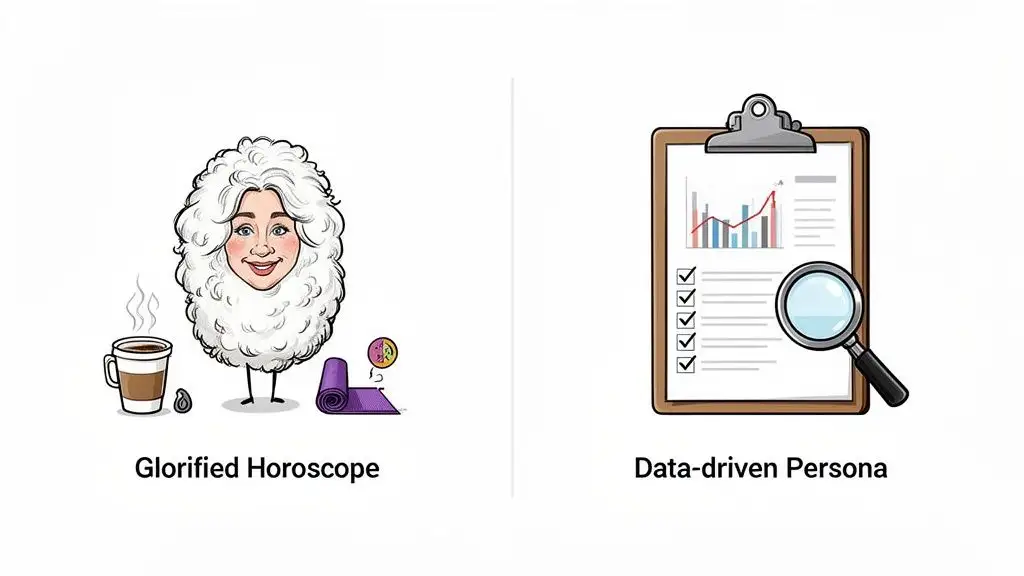
Too many of these documents are just glorified horoscopes for your ideal customer. They get created in a flurry of marketing excitement, then end up collecting digital dust in a forgotten Google Drive folder, completely ignored by the very sales team they were supposed to empower.
So, where's the disconnect? A persona isn't just a demographic profile with a stock photo. It’s supposed to be a strategic weapon. When done right, it’s less like a generic dating profile and more like having the cheat codes to a video game.
The Cardboard Cutout Problem
Here’s the fatal flaw: most personas are built on internal assumptions, not external reality. A marketing team huddles in a conference room, brainstorms for an hour, and invents a character who just so happens to love everything about their product. This "imaginary friend" approach creates a profile that falls apart the second it makes contact with a real human being.
A persona built on five real customer conversations is infinitely more valuable than one built on a two-hour brainstorming session with your marketing team. It replaces assumptions with intelligence.
A truly effective persona pushes past the fluff and answers the questions that actually help salespeople close deals:
-
What was the trigger? What event, meeting, or disaster lit a fire under them and made them start searching for a solution right now?
-
What does a win look like for them? Are they trying to slash costs, boost team efficiency, or just look like a hero to their boss?
-
What are their biggest hang-ups? What real or imagined roadblocks will stop them from signing on the dotted line?
Answering these questions turns your persona from a flimsy cardboard cutout into a dynamic sales tool. It’s the difference between knowing your buyer’s job title and knowing what keeps them up at night. For more on getting your message seen, our guide on how to improve your open email tracking can help you cut through the noise.
This guide is all about throwing out the old, useless playbook. We're going to build profiles that feel like real people, the kind that will sharpen every sales call, email, and LinkedIn message you send.
Get Your Crew Together and Figure Out the "Why"
Before you even think about building a buyer persona, you need a plan. Just jumping in is a recipe for disaster. It’s like trying to assemble a complex LEGO set without the instructions; sure, you’ll end up with something, but it’s definitely not going to be the Millennium Falcon you were hoping for. This initial prep work is what separates a game-changing business tool from a pretty PDF that just gathers dust in a forgotten folder.
The first move is to figure out your "why." Why are you even doing this? Without a clear objective, your whole persona project will drift aimlessly. This goal becomes your North Star, guiding every single decision you make from here on out.
Nail Down a Specific Goal
So, what’s the endgame? Are you trying to get better leads flowing into your pipeline? Maybe you're trying to chop down a sales cycle that’s currently longer than the entire Lord of the Rings trilogy (extended editions, of course). Or perhaps you're launching an attack on a totally new market.
Pinpointing your main objective is everything. It dictates the questions you'll ask, the data you'll hunt down, and how you'll ultimately present your finished personas. For example, if better lead quality is the mission, you'll obsess over what makes your absolute best customers tick, and what separates them from the time-wasters.
Your goal isn't just some box to check. It's the strategic lens you'll use to look at every single piece of customer data. A clear "why" is what stops you from creating a persona that’s technically correct but completely useless in the real world.
And this isn't just fluff; it works. Get this: 71% of companies that blow past their revenue goals have their personas formally documented. The ones who miss their targets? Not so much. Picture a B2B SaaS founder who builds a persona entirely around the agonizing pain of manual lead research. That sharp focus lets them craft outreach that hits home immediately, making their whole team more efficient.
Assemble Your Persona Dream Team
Building a killer buyer persona isn't a one-person show, and it definitely doesn't just belong to marketing. To get the full 360-degree view, you need to pull together a cross-functional team, your own little band of superheroes who can offer perspectives from every part of the customer's journey.
Your squad should have people from:
-
Sales: These are your folks in the trenches. They hear the raw, unfiltered objections, motivations, and buying triggers every single day. They know what really goes down in those sales calls.
-
Marketing: They’re the experts on the top of the funnel. They know which blog posts people are reading, what ads they’re clicking on, and how they first stumble upon your brand.
-
Customer Success: These folks have the inside scoop on what keeps customers happy long after the deal is closed. Their insights on what drives loyalty versus what makes people churn are pure gold.
This team effort makes sure your personas are rooted in reality, not just marketing wishful thinking. Honestly, doing this is a critical first step before you even touch an ideal customer profile template, because it adds the essential human story to all the dry company data. When you get these teams in a room together, you build a shared language and a unified vision of the customer that gets everyone pulling in the same direction.
Last but not least, do a quick "what do we already know?" audit. Dig into your CRM and analytics. What stories can the data already tell you? More importantly, where are the glaring holes in your knowledge? This initial scan points your research efforts in the right direction, ensuring you build everything on a rock-solid foundation of real intelligence.
Time to Play Detective: Gathering Your Intel
Alright, let's get to the fun part. You've got your mission, you've assembled your crew. Now it's time to gather the intelligence that will breathe life into your buyer personas. This isn't about guesswork; it's about blending two crucial types of information, qualitative and quantitative, to build a complete dossier on your ideal customer.
Think of it this way: quantitative data gives you the "what," the cold, hard facts. Qualitative data gives you the "why," the stories and emotions behind those facts. You absolutely need both to crack the case.
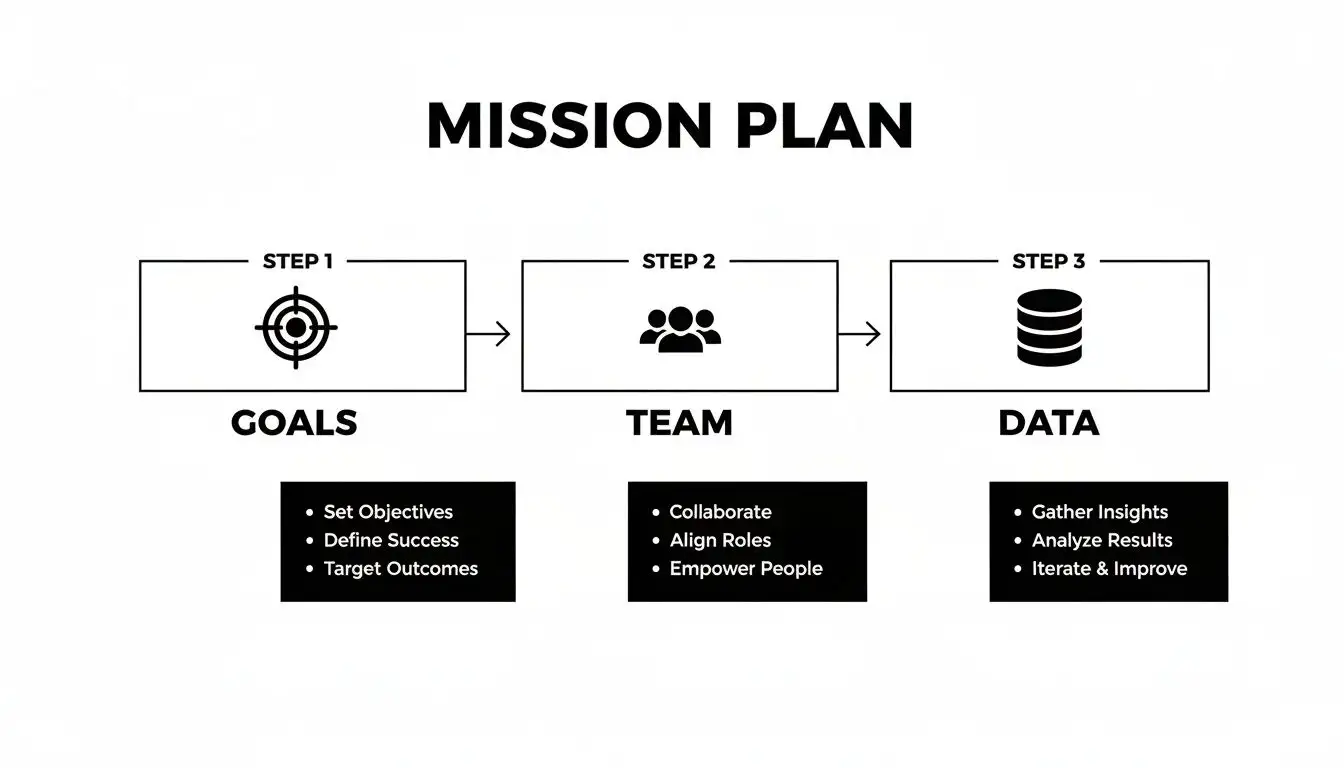
This mission plan lays it all out, showing how clear goals and the right team are the launchpad for collecting data that actually matters.
With this foundation, you’re ready to start digging.
Digging for Gold with Qualitative Research
This is where the real magic happens. Qualitative data is all about the stories: the frustrations, the ambitions, and the exact language your customers use to talk about their problems. This is the stuff that makes your personas feel real.
Your best tool here is the customer interview. But please, don't make it feel like an interrogation. You’re not trying to extract launch codes; you’re trying to understand their world. The trick is to ask questions that pull out stories, not just one-word answers.
Ditch the tired, abstract questions like, "What keeps you up at night?" Instead, get specific and situational:
-
"Walk me through the last time you had to deal with [the problem your product solves]. What did that day actually look like?"
-
"Before you found a solution, what was the most infuriating part of that process? Can you give me an example?"
-
"Take me back to the meeting where this project got the green light. What was the conversation that finally got everyone on board?"
See the difference? These questions force people to recall real moments, giving you juicy, authentic details instead of generic business-speak. You’ll be shocked at what you learn when you stop asking for opinions and start asking for stories.
Pro Tip: Don’t just interview your biggest fans. Talk to customers who churned or prospects who ghosted you for a competitor. Their insights are pure gold because they expose your blind spots and the real-world objections your sales team is up against.
Beyond interviews, you're sitting on other treasure troves of qualitative data:
-
Sales Call Recordings: Unfiltered conversations where prospects lay all their cards on the table. Listen for recurring objections, common questions, and those "aha!" moments.
-
Customer Support Tickets: What are people constantly confused about? What features are they begging for? Your support team's chat logs are a direct pipeline into your customers' daily headaches.
Finding the Patterns with Quantitative Data
If stories are the soul of your persona, quantitative data is the skeleton. These are the numbers that reveal broad patterns and validate the anecdotes you’ve been collecting. This is the hard evidence that confirms your hunches.
Here, you’re looking for trends at scale. The best place to start is with the data you already have.
Your Customer Relationship Management (CRM) system is ground zero. Filter for your best customers, the ones with the highest lifetime value and smoothest sales cycles, and hunt for commonalities. Are they all in a specific industry? Are they a certain company size? What was their original lead source? This helps you sketch out a foundational profile.
Next up, your website analytics. Tools like Google Analytics can show you exactly what content your best prospects are binge-watching. If you see that all your Director of Ops leads are devouring a specific case study, that’s a massive clue about their priorities. For a refresher on this, our guide on how to track website visitors has some great tips.
Finally, don’t sleep on social media insights. Check out the LinkedIn profiles of your recent customers. What groups are they in? Who do they follow? What kind of language do they use in their posts? It all adds another rich layer of context.
Qualitative vs Quantitative Data Sources
To help you get started, here’s a quick breakdown of where to look for each type of intel.
| Data Type | Source Examples | What You'll Learn |
|---|---|---|
| Qualitative | • Customer interviews<br>• Sales call recordings<br>• Customer support tickets<br>• Online reviews (G2, Capterra)<br>• Open-ended survey questions | • Motivations, goals, and fears<br>• The "why" behind their decisions<br>• Pain points in their own words<br>• Objections and buying triggers |
| Quantitative | • CRM data (industry, company size)<br>• Website analytics<br>• Product usage data<br>• Social media demographics<br>• Closed-ended survey results | • Common firmographics & demographics<br>• Behavioral trends at scale<br>• Content and feature preferences<br>• Conversion paths and drop-off points |
Think of these sources as complementary. The numbers from your CRM might tell you who your best customers are, but the stories from your interviews will tell you why they chose you.
By weaving together the emotional depth of qualitative stories with the statistical certainty of quantitative data, you'll move beyond a flat caricature. You’ll start building a 3D model of a real human being, someone you can actually talk to.
Turning Raw Data into Actionable Personas
So, you’ve done the detective work. You’re sitting on a mountain of interview transcripts, CRM reports, and analytics data. It probably feels like you just wrapped a season of True Detective, staring at a corkboard full of cryptic clues and trying to connect the dots. Now comes the fun part: turning that beautiful mess into something your team can actually use.
The point isn't just to tidy up your notes; it's to find the signal in the noise. You're hunting for the common threads that tie specific groups of customers together, letting you carve out distinct, meaningful personas. This is where raw intel becomes a strategic weapon.
Spotting the Patterns in the Chaos
First things first, you need to start grouping your findings. Think of it like sorting laundry after a long trip. You’ve got your whites, your darks, and that one rogue red sock that always threatens to ruin everything. Except here, you’re sorting by job titles, goals, and what keeps them up at night.
Start by looking at the big picture. Lay out your interview notes and CRM data side-by-side. Are clusters forming around certain job titles? Maybe you notice that every "Director of Operations" you spoke to mentioned "reducing manual data entry" as their number one headache. Bingo. That’s a pattern.
Fire up a simple spreadsheet or a digital whiteboard and start bucketing key phrases and data points.
-
Group by Role: All the VPs of Sales go in one column, all the Marketing Managers in another.
-
Group by Goal: Who’s all about revenue growth? Who’s obsessed with team efficiency?
-
Group by Challenge: Make a list of everyone who brought up budget constraints, integration nightmares, or the pain of getting buy-in from their boss.
After a bit of this, you’ll start to see distinct personalities peeking through the data. You’ll spot a group that’s all about moving fast and breaking things, and another that’s cautiously focused on security and compliance. These are your persona embryos.
From Clusters to Characters
Once you've identified these core groups, it's time to give them a name and a story. This is huge. "Enterprise Emily" is a thousand times more memorable and useful than "Segment B, Cohort 3." A good name makes the persona feel like a real person your team can get behind.
But don’t just stop at a name and a job title. You need to flesh out their story using all that rich, qualitative data you gathered. This is where you breathe life into them.
The most powerful personas go beyond demographics. They capture a person's worldview, their daily frustrations, and the professional wins that will get them that promotion. It’s the difference between knowing someone’s address and knowing what they worry about on their commute home.
For example, "Startup Steve, the Scrappy Founder" isn't just a label. He's the guy putting in 70-hour weeks, fueled by coffee and a desperate need to show his investors some traction. He makes decisions in a snap, despises long sales cycles, and only cares about tools that deliver immediate ROI.
This is the kind of detail that lets you create messaging that actually connects. If you want to add another layer of precision, understanding the principles of data enrichment can help you automatically fill in any missing firmographic or technographic details for your profiles.
Avoiding the Persona Zoo
Here’s a classic trap: creating a persona for every tiny variation you find. Before you know it, you’ve got a dozen different profiles, and your sales team is completely overwhelmed. It’s like the later seasons of a TV show where they introduce too many new characters, and you can't keep track of who’s who. Nobody cares about the random cousin who showed up for one episode.
For most growing companies, the 80/20 rule applies. A small handful of key personas will almost always drive the vast majority of your revenue. Focus is your friend. SDRs and revenue leaders should concentrate on the 3-4 key personas that drive over 90% of sales. This laser focus prevents you from spreading resources too thin across a dozen vague profiles. You can learn more about these powerful buyer persona statistics and how they shape sales strategy.
Identify your VIPs, the personas representing your most profitable and loyal customers, and build them out first. You can always add more later if a new, distinct segment pops up. But start with the ones that truly move the needle. This approach ensures your team can deeply understand and effectively target the buyers who matter most.
Time to Put Your Personas to Work
Alright, you did it. You wrestled with the data, talked to real humans, and now "Startup Steve" and "Enterprise Emily" are no longer just names on a slide. They’re detailed, living profiles pinned to your team’s virtual corkboard. High five!
But here's the hard truth: a buyer persona that just sits in a Google Drive folder is about as useful as a screen door on a submarine. It’s time to unleash these characters into the wild. Let's turn that research into a revenue-generating machine. This is where the rubber meets the road.
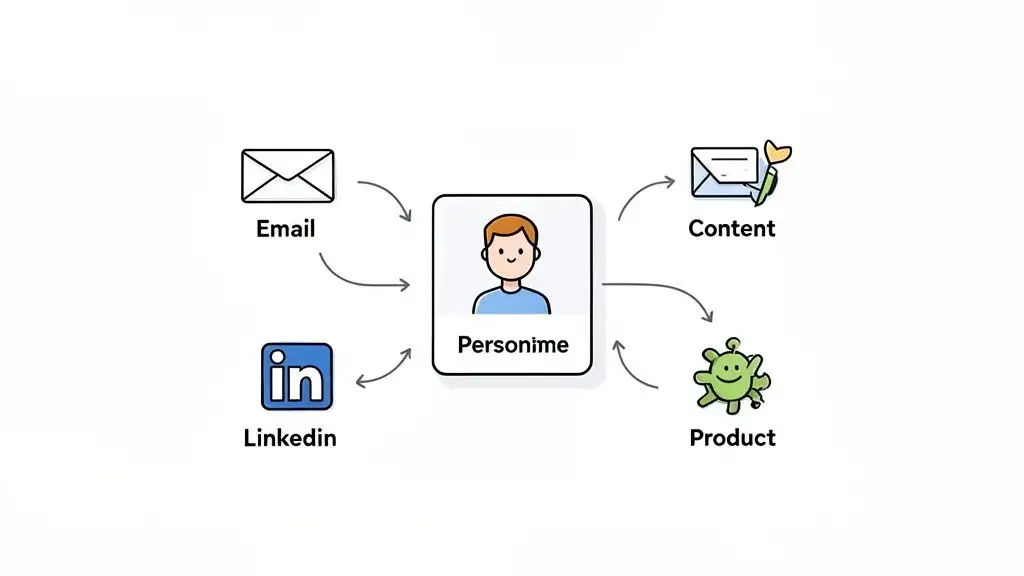
The goal is simple: make every single touchpoint, from the first cold email to the final proposal, feel like it was crafted just for them. Because with your new personas, it actually was.
Map Personas to the Twists and Turns of the Buyer's Journey
Think of your personas as your GPS for navigating the sales funnel. Each one takes a different route to the same destination. "Startup Steve" might see a LinkedIn ad and smash the "Book a Demo" button, while "Enterprise Emily" needs to download three whitepapers and consult with her entire department before she even thinks about talking to a sales rep.
Mapping their unique journey helps you show up with the right message at exactly the right time.
-
Awareness Stage: Steve is scrolling his tech feed on his phone. A snappy blog post titled "5 Hacks to Scale Your Sales Team Before Your Next Funding Round" will stop him in his tracks. Emily, on the other hand, is searching for a comprehensive "State of the Industry" report to share with her C-suite.
-
Consideration Stage: Now they know they have a problem and are actively looking for a fix. Steve is looking for quick wins; he’ll be hooked by a case study showing a 200% ROI in 90 days. Emily needs a detailed webinar comparing your solution against three top competitors, complete with a security compliance one-pager she can forward to IT.
-
Decision Stage: It’s go-time. Steve just wants a free trial he can start right now. Emily needs a personalized demo for her entire team and a formal proposal that clearly outlines implementation support and onboarding.
When you align your actions to their journey, you meet them where they are and speak their language. It's the difference between being a helpful guide and just another pushy salesperson.
Tailor Your Outbound Messaging (And Ditch the Generic Crap)
Let’s be honest: generic outreach is dead. If your opening line is "I noticed we share a connection," you're already on a one-way trip to the ignore pile. Your personas are your secret weapon for crafting messages that actually cut through the noise.
Let's get practical. Imagine you're reaching out to our two key personas:
| Outreach Element | For "Startup Steve" (The Scrappy Founder) | For "Enterprise Emily" (The Efficiency Expert) |
|---|---|---|
| Email Subject Line | Quick question about scaling your sales | Idea for streamlining [Company Name]'s ops |
| LinkedIn Connection Request | Hey Steve, saw you're scaling fast. Your post on growth hacking was spot on. Have a quick idea for your SDR team if you're open to it. | Emily, your work on operational efficiency at [Company Name] is impressive. I have a relevant case study on how a similar firm reduced software spend by 30%. |
| Email Opening Line | I help founders like you get more demos without hiring more reps. | My team helps VPs of Ops like you consolidate their tech stack and prove ROI to leadership. |
See the difference? The content is laser-focused on their specific goals and pain points. Steve cares about speed and growth hacking. Emily cares about efficiency, risk mitigation, and looking good to her boss. This isn't just about dropping in a name; it’s about framing your entire value prop around their world.
The impact here is staggering. Personalized, persona-driven emails don’t just feel better; they generate 18 times more revenue than generic blasts. In fact, customer-centric companies that use these insights are 60% more profitable than their peers.
Let Personas Steer the Ship (Not Just the Sales Emails)
The influence of a well-made persona goes way beyond sales outreach. They should be the guiding voice in nearly every strategic conversation your company has. Think bigger!
-
Content Strategy: Stop guessing what to write about. Your personas tell you exactly what questions they're typing into Google. If "Enterprise Emily" is constantly searching for "how to calculate software ROI," well, there’s your next blog post and webinar topic handed to you on a silver platter.
-
Ad Targeting: On platforms like LinkedIn, you can build audiences that mirror your persona's demographics and firmographics with scary accuracy. This means you stop wasting money showing your high-ticket enterprise solution to "Startup Steve" and his three-person team.
-
Product Development: Is your sales team constantly hearing that "Enterprise Emily" needs a specific security feature before she can sign? That feedback, filtered through the persona lens, becomes a powerful argument for prioritizing it on the product roadmap.
When you integrate your personas into these core functions, you create a powerful feedback loop. Your sales and marketing get more effective, which in turn generates better customer data, which you then use to refine your personas even further. It's a beautiful cycle of continuous improvement that starts with truly understanding who you're talking to.
Want to take this a step further? Check out our guide on lead scoring best practices to prioritize the prospects who are practically waving their hands to talk to you.
Got Questions? We've Got Answers.
Alright, so you're on board with building buyer personas. But even the best-laid plans can hit a few snags. Let's tackle the questions I hear all the time from teams diving into this for the first time. Think of this as your cheat sheet to sidestep the common pitfalls.
So, How Many Personas Do We Actually Need?
This is the big one, isn't it? Everyone wants to know the magic number. The honest answer? It’s all about quality over quantity. The goal isn’t to wallpaper your office with a persona for every possible customer. That’s just a fast track to confusing your team and diluting your message.
For most B2B companies, the sweet spot is somewhere between three to five core personas. These should be the heavy hitters, the profiles that represent a whopping 90% of your customer base. Trying to cover every single edge case is a rookie mistake.
Think of it this way: you’re casting the main characters for your company’s story. You need a few distinct, well-developed protagonists, not a crowd of forgettable extras.
My best advice? Start with just one. Seriously. Identify your single most profitable customer segment and build out that persona with an almost obsessive level of detail. Once you've absolutely nailed that one, then you can think about adding another, but only if you find a group with truly different goals and buying habits.
This laser-focused approach means your team can really get inside the heads of the buyers who matter most.
Are Personas a "Set It and Forget It" Deal?
Absolutely not. Treating your personas like ancient relics carved in stone is a huge mistake. Your market is alive. It shifts, new tech pops up, and your customers' biggest headaches this year probably weren't even on their radar back in 2022.
A good rule of thumb is to give your personas a full check-up and refresh every 6 to 12 months.
But don't just wait for the calendar to tell you it's time. You need to watch for triggers that signal your intel might be getting stale. Ask yourself:
-
Did we just launch a game-changing new product?
-
Is the sales team suddenly complaining that their go-to messages are falling flat?
-
Are we trying to break into a totally new industry?
If you answered "yes" to any of these, it's time to pop the hood and see what's changed. The top-performing companies I’ve worked with are religious about this. Many of the ones blowing past their revenue goals update their personas at least once every six months. It’s how they stay sharp.
What's the Single Biggest Mistake People Make?
Oh, this one’s easy. The most catastrophic, work-destroying mistake you can make is creating personas in a vacuum, based purely on what you think you know. It’s how you end up with what I call "imaginary friend" personas.
They look fantastic in a slide deck, all polished and full of clever details. But then you hand them to your sales team, and they immediately see that these "personas" bear zero resemblance to the people they talk to every single day. And just like that, all your hard work gets ignored and stuffed in a digital drawer forever.
Want to avoid that grim fate? Root your entire process in real-world data, especially the gold you dig up in actual customer interviews. A persona built on five deep, honest conversations with real customers is a thousand times more valuable than one dreamed up in a two-hour marketing brainstorm.
The proof is in the pudding. Look at a company like Thomson Reuters. They saw a staggering 72% reduction in lead conversion time after they started using data-backed personas. That’s what happens when you stop guessing and start listening.
Ready to find the right people and build outreach that gets replies? Munch is the all-in-one sales intelligence platform that helps you discover high-intent prospects, enrich their data with 95%+ accuracy, and generate AI-powered messages that feel human. Stop guessing and start selling. Explore Munch today.