What Is Enrichment Data And How Does It Fuel Sales Growth

By Mriganka Bhuyan
•Founder at Munch
Here’s the simple truth about enrichment data: it’s all about adding layers of valuable context to a single piece of information you already have. This turns a basic fact, like a prospect's email address, into a rich, detailed profile.
Think of it this way: it transforms a blurry, flip-phone photo of your ideal customer into a high-definition portrait.
What Is Enrichment Data, Anyway?
Let's say you get a new neighbor. All you know is their name, "Alex." That’s your raw data. It’s not wrong, but it’s not very useful, is it? You have no idea if you should invite them to your weekly Dungeons & Dragons game or your quarterly investor meetup.
Now, imagine you learn a few more things. Alex is a VP of Engineering at a fast-growing tech company, just moved from a city known for its startup scene, and their company just landed a massive round of funding.
That’s enrichment. You took a single, lonely data point ("Alex") and layered on meaningful context. This simple process changes absolutely everything.

From Guesswork to Guided Selling
Prospecting with raw data is like trying to find a specific character in 'Where's Waldo?' without knowing what they look like. You're just scanning a massive crowd, hoping to get lucky. It’s a frustrating, inefficient, and colossal waste of time.
Enrichment data gives you the red-and-white striped shirt, the goofy hat, and the glasses. It helps you spot your opportunity in an instant and stop wasting energy on leads that will never, ever convert.
Suddenly, your sales outreach becomes laser-focused. Instead of firing off a generic "Hi, I'd like to connect" message, you can craft something that actually resonates.
For example, a sales rep could now send a message that references:
-
Their new role: "Congrats on the new VP of Engineering role!"
-
A company trigger: "Saw your company just closed its Series B. Huge news."
-
A specific pain point: "As you scale your engineering team, our platform can help..."
This level of personalization is completely out of reach without good enrichment data.
The Foundation of Modern Sales
This process isn't just a "nice-to-have" feature anymore; it’s the bedrock of any successful B2B sales or marketing strategy. The quality of your data directly dictates the quality of your pipeline and, ultimately, your revenue.
Without it, you’re flying blind. You might have a list of 10,000 names, but you have no clue which 10 are ready to buy, which 100 might be a great fit in six months, and which 9,890 are completely irrelevant.
Good enrichment data provides that much-needed clarity, letting your team focus their efforts where they’ll actually make a difference. It’s the difference between shouting into the void and having a meaningful conversation.
Meet the Avengers of Your Data Stack
Not all enrichment data is the same, and knowing the difference is what separates the pros from the amateurs. Think of the four main types as the Avengers of your outreach. Each one has its own superpower, but when you assemble them? You get a complete, unstoppable picture of your ideal customer.
Let's meet the team.
Firmographics: The Company's Trading Card
First up, you have firmographics. This is the absolute bedrock, the basic trading card stats for any company. It gives you the high-level, foundational details you need to decide in seconds if an account is even worth looking at. It’s the essential "who" and "what" of a business.
Firmographic data includes stuff like:
-
Industry: Is this a SaaS company, a manufacturing plant, or a hospital?
-
Company Size: How many people work there? A 50-person team has different problems than a 5,000-person enterprise.
-
Annual Revenue: Are we talking about a scrappy startup with $1 million in ARR or a behemoth pulling in $500 million?
-
Geographic Location: Where are they headquartered? Where do they operate?
For instance, knowing a company is a B2B SaaS player in the fintech space with 250 employees and $50 million in revenue tells you instantly if they fit your Ideal Customer Profile (ICP). Without it, you're just throwing darts in the dark.
Technographics: Your Peek Under the Hood
Next is technographics, which is the secret weapon for anyone selling tech. This data tells you exactly what software and hardware a company is running. It's like getting a peek under the hood of their car before you try to sell them a new engine.
This is your team's Black Widow: the intel that gives you a massive tactical advantage. You can stop asking, "So, do you use a marketing automation platform?" and start saying, "I see you're on Marketo. Our native integration would slot right into your team's current workflow." See the difference?
Knowing a prospect's tech stack turns a generic cold call into a highly relevant, consultative conversation. It shows you've done your homework and actually understand their world.
Contact Data: The Direct Line to a Human
Of course, all the company intel in the world doesn't mean a thing if you can't actually talk to anyone. That's where contact data comes in. Think of this as Captain America, the direct, no-nonsense way to get the job done. It's the verified info you need to actually start a conversation.
This means verified email addresses and direct-dial phone numbers for the decision-makers you need to reach. And the keyword is verified. B2B contact data decays at a terrifying rate (up to 70.3% per year) as people change jobs, get promoted, or just abandon old inboxes. Bad data leads to bounced emails and dead-end calls. You can learn more about the challenges of finding accurate business emails in our detailed guide.
Intent Signals: The Crystal Ball for Buyers
Finally, we have the most powerful hero on the team: intent signals. This is the Doctor Strange of enrichment, giving you a glimpse into the future by showing you who is actively in-market for a solution like yours right now.
Intent signals are the digital breadcrumbs people leave behind as they research solutions. This could be:
-
Searching for keywords related to your product.
-
Checking out your competitors' websites or G2 pages.
-
Binge-reading articles about a specific business problem you solve.
Imagine an engineering leader from a target account suddenly starts devouring articles on "improving developer productivity" and checking out project management tools. That’s not a coincidence; it’s a massive buying signal. It tells you their pain is urgent, making it the absolute perfect moment to reach out.
When you combine all four, your ICP goes from a fuzzy outline to a crystal-clear, actionable targeting model.
Turning Raw Data Into Revenue Opportunities
Alright, let's get down to brass tacks. Having a mountain of data is useless if you can't spin it into gold. The real magic happens when you weave that data into your day-to-day sales motion to actually start conversations and fill your pipeline.
This is the playbook for turning a list of names into real, revenue-generating opportunities. It all kicks off with one simple, non-negotiable step: knowing exactly who you're trying to sell to.
Define Your Ideal Customer Profile
Before you even think about enriching a single contact, you need a laser-focused Ideal Customer Profile (ICP). Think of your ICP as your North Star. It’s the detailed blueprint of the dream company that gets a ton of value from your product and, in return, gives the most value back to you.
Without a solid ICP, you're just hoarding random facts. But with one, you instantly know which data points are pure gold and which are just noise. Your best bet is to build this profile based on your happiest, most successful customers.
-
Firmographics: What industry are they in? How many employees do they have? What's their revenue? (e.g., "B2B SaaS companies with 50-250 employees and $10M-$50M in ARR.")
-
Technographics: What’s in their tech stack? (e.g., "They have to be using Salesforce as their CRM and HubSpot for marketing automation.")
-
Triggers: What events signal they might need you right now? (e.g., "They just hired a new VP of Sales or announced a fresh round of Series B funding.")
Once you have a clear picture of what a perfect customer looks like, it's time to go find them.
Sourcing and Enriching Your Leads
Now for the fun part. With your ICP in hand, you can start gathering raw leads. These might come from a list you built on LinkedIn Sales Navigator, a spreadsheet from a recent conference, or even your own inbound signups that are missing key details.
This raw list is just the starting block. It’s like having a phone book full of numbers but no names. This is where you bring in an enrichment tool. You feed it a starting data point (like a name and a company), and it works its magic, layering on all the crucial ICP-matching data you need to make an intelligent outreach. The payoff is massive. A whopping 81% of B2B buyers are more willing to buy when vendors connect with personalized, data-backed outreach.
This whole process is about building a complete picture, starting with the basics and adding layers of detail.
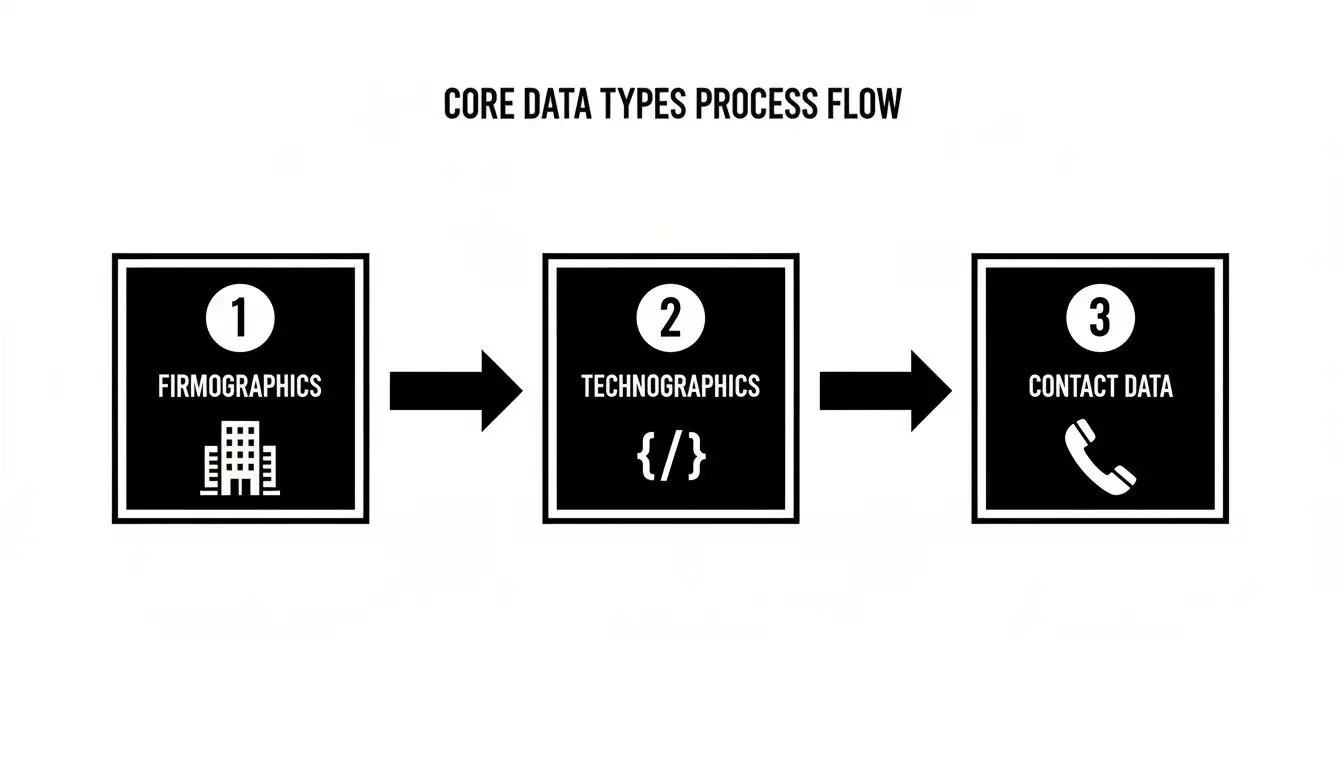
You systematically build a 360-degree view of a target account, moving from broad company attributes to the specific, actionable intel you need to start a conversation.
Pro Tip: Use Munch to build your prospect lists, enrich their contact data and craft personalized outreach messages.
Segment and Prioritize With Triggers
Okay, you've got a fully enriched list. Now what? You slice and dice it into priority tiers. The truth is, not all ICP-fit accounts are created equal. Some are ready for a conversation today, while others might be a better fit in six months. The secret is to spot the buying signals, or what we call "triggers."
Triggers are events that create urgency. A company that just hired a new decision-maker or secured a fresh round of funding has new problems to solve and a new budget to solve them with.
Start bucketing your enriched list like this:
-
Tier 1 (Red Hot): These accounts are a perfect ICP fit and have a recent, highly relevant trigger event (new exec, funding round, competitor tech dropped). Go after these first.
-
Tier 2 (Warm): They fit your ICP like a glove but aren't showing any immediate buying signals. These are perfect candidates for nurturing campaigns.
-
Tier 3 (Lukewarm): They loosely match your ICP and have no triggers. Keep them on the radar, but don't burn your prime selling hours here.
This tiered system ensures your sales team is always focusing its firepower where it counts, which is a cornerstone of smart automated lead generation strategies.
Mini Playbook: Crafting a Killer Outreach Message
This is where the rubber meets the road. Let’s look at how an SDR can use this enriched data to write an email that actually gets a reply.
The Raw Lead:
-
Name: Sarah Jones
-
Company: InnovateTech
The Enriched Profile:
-
Title: New VP of Marketing (started 2 months ago)
-
Company Announcement: Just announced a major European expansion.
-
Tech Stack: Uses Marketo for marketing automation.
-
Contact Info: Verified direct email and phone number.
Instead of a tired, generic "Hi Sarah, saw you work at InnovateTech," an SDR can now hit them with this:
Subject: Congrats on the new role & InnovateTech's expansion
Hi Sarah,
Huge congrats on the new VP of Marketing role! Joining a company right before a major European expansion must be an exciting challenge.
As you scale your demand gen efforts for the new market, I imagine getting your Marketo instance to support multiple regions and languages will be a top priority. Our platform helps teams do exactly that by automating campaign localization, which our other partners in the B2B SaaS space have used to cut their international launch times in half.
Worth a brief chat next week?
See the difference? This message is specific, relevant, and shows you did your homework. It’s the gap between being more noise in their inbox and being a helpful partner. That’s the real power of enrichment data in action.
Choosing Your Enrichment Strategy
Picking the right data enrichment method feels a lot like deciding how you're going to watch your favorite show. Do you download the entire season for a long flight, or do you stream each episode the second it drops? There's no single right answer. It all boils down to what your sales team needs right now.
Let's walk through the three main plays you can run. Each has its own vibe and is built for different parts of your sales and marketing engine.
Batch Enrichment: The Netflix Download
First up is batch enrichment. This is the data equivalent of downloading an entire season of a show before you go offline. You gather up a big list of contacts or accounts, usually in a CSV file, send it off, and get it back with all the missing pieces filled in. It’s a simple, set-it-and-forget-it approach.
This is your go-to move for big, one-off projects where you don't need the data this exact second. Think of it as a much-needed deep clean for your database.
Batch enrichment is perfect when you need to:
-
Scrub your entire CRM. Got thousands of records gathering digital dust? A batch update can refresh all those old job titles, company details, and phone numbers in one go.
-
Prep a massive campaign list. You just scanned 2,000 badges at a trade show. Batch enrichment gets you all the info you need to segment that list and kick off your follow-up sequences.
-
Re-score your existing database. You want to run all your existing accounts through your ICP criteria to find hidden gems that are now a perfect fit.
The only catch? The data starts aging the moment you get it back. That list you enriched on Monday might have a few stale details by Friday.
Real-Time Enrichment: The Live Sports Game
Then you have real-time enrichment. This is like watching a live game. The information comes in hot, fresh, and at the exact moment you need it. It works by hooking directly into your systems, like your web forms or CRM, through an API.
For instance, when a new lead pops their email into a form on your site, a real-time tool instantly pings a data provider. In a blink, it sends back their full name, job title, company size, and even the software they use, right into your CRM.
Real-time enrichment is all about speed and immediate action. It makes sure your reps have the freshest intel possible, letting them jump on buying signals the instant they appear.
This is the play for inbound lead routing, personalizing your website on the fly, and any other workflow where timing is everything. The trade-off is that it can be a bit pricier per record compared to a massive batch job.
Waterfall Enrichment: The Ultimate Playlist
Finally, we have waterfall enrichment, the clever, hybrid strategy that gives you the best of both worlds. Imagine a music app building you the perfect playlist by pulling songs from every catalog it can find. That's waterfall. Instead of hitting up just one data source, it intelligently checks multiple providers in a specific order.
Here’s how it works:
-
The system asks Provider A for a prospect's direct-dial phone number.
-
No luck? It automatically moves on to Provider B.
-
Still nothing? It pings Provider C, and so on, until it either finds what it’s looking for or runs out of places to check.
This method seriously boosts both your data accuracy and fill rates because it covers the weak spots of any single provider. It’s about building the most complete picture possible for every single lead. For teams obsessed with data quality, waterfall is the undisputed champ. You can check out different data enrichment tools that offer these strategies to see what fits your team's needs.
Enrichment Methods At a Glance
Deciding between these methods can be tricky, so here’s a quick cheat sheet to help you match the right strategy to your sales team's goals.
| Method | How It Works | Best For | Potential Downside |
|---|---|---|---|
| Batch | Upload a large list (e.g., CSV), get it back fully enriched. A one-and-done process. | Large-scale database cleanups, prepping event lists, periodic CRM audits. | Data starts aging immediately after the batch is completed. |
| Real-Time | An API call enriches a single record instantly, the moment it enters your system. | Inbound lead routing, website form fills, personalizing user experiences. | Can be more expensive on a per-record basis. |
| Waterfall | Queries multiple data providers in a prioritized sequence until it finds the needed data. | Maximizing data fill rates and accuracy; when a single source isn't enough. | Can be more complex to set up and manage initially. |
Ultimately, the best strategy often involves a mix of all three. You might run a massive batch job once a quarter, use real-time enrichment for all your new inbound leads, and apply a waterfall process to your most high-value target accounts. The key is to be flexible and align your data strategy with your revenue goals.
How to Stay Compliant and Secure
As Uncle Ben from Spider-Man almost said, "With great data comes great responsibility." Diving into the world of enrichment data doesn't mean you have to navigate a legal minefield blindfolded. It just means you need to be smart about your sources and get serious about your data hygiene.
The goal isn't just to have data; it's to have trustworthy, compliant data. Think of yourself as the bouncer for your CRM. You’re not letting just anyone in. Only the legitimate, verified contacts who are actually on the list get past the velvet rope. This approach keeps your database clean, your reputation spotless, and your company safe.
Understanding the Rules of the Game
Let's talk about the big acronyms in the room: GDPR and CCPA. These aren't just annoying strings of letters; they're the rulebooks for handling people's personal information, and you ignore them at your own peril.
-
GDPR (General Data Protection Regulation): This is the European Union’s heavyweight champ of data privacy. It gives individuals serious control over their personal data and requires businesses to prove they have a legitimate reason for processing it. No more wild-west data scraping.
-
CCPA (California Consumer Privacy Act): This is California’s trailblazing counterpart, giving residents the right to know what data is being collected about them and the power to tell you to stop.
These regulations aren't meant to kill sales. They're designed to stop sketchy, invasive data practices. Your single most important move? Partner with a reputable enrichment provider that is completely transparent about its sourcing methods.
Your Data Hygiene Checklist
Keeping your data clean and compliant isn't a one-time task; it's an ongoing commitment. Bad data doesn't just lead to bounced emails. It creates very real security risks. And the consequences are steep. The average cost of a data breach has climbed to a record $4.88 million globally, with human factors like stale or incorrect data contributing to over 60% of incidents. You can learn more about the sobering security statistics of B2B data sharing and how to protect your organization.
Think of data hygiene as the digital equivalent of brushing your teeth. If you neglect it, you’ll eventually face some expensive and painful problems. A little daily maintenance goes a long, long way.
Here are a few non-negotiable practices to keep your CRM sparkling:
-
Vet Your Vendors: Ask data providers the tough questions. Where do you get your data? How often is it verified? Are you GDPR compliant? If they start sounding like a character from Glengarry Glen Ross giving you the runaround, walk away. Fast.
-
Regular Verification and Deduplication: Don't let your CRM become a digital graveyard of duplicate contacts and outdated information. Run regular checks to merge duplicate records and verify that John Doe still actually works at Acme Corp.
-
Honor Opt-Outs Immediately: When someone asks to be removed from your list, do it. No questions asked. This is a fundamental requirement of modern privacy laws and, frankly, a basic sign of respect. For more on our approach, feel free to read our full privacy policy.
By being disciplined about compliance and hygiene, you build a powerful, secure, and effective sales engine fueled by high-quality enrichment data you can actually trust.
Still Got Questions About Enrichment Data? Let's Clear Things Up.
Got a few more questions bouncing around in your head? Good. That means you're thinking about this the right way. Let's tackle some of the most common things people ask about enrichment data.
How Do I Actually Measure the ROI of This Stuff?
Thinking about the return on investment for data enrichment doesn't have to be a headache. Forget dusting off your old algebra textbook. Instead, just look at the real-world impact it has on your team's day-to-day.
You can get a solid grip on the ROI by tracking a few simple improvements:
-
SDR Productivity: How much time are your reps wasting on manual research? If enrichment gives each SDR back 5 hours a week, you can literally calculate that saved time against their salary. That's half a day of extra selling time, per rep, every single week.
-
Conversion Rates: Pit your enriched leads against your non-enriched ones. See which group converts from lead to opportunity at a higher rate. That lift? That’s pure, measurable return right there.
-
Reply Rates: Run a simple A/B test. Send your old generic templates to one group and hyper-personalized outreach (powered by enriched data) to another. More replies mean more conversations, which leads directly to more pipeline.
-
Fewer Bounced Emails: Just track your email bounce rate before and after you plug in an enrichment tool. When that number drops, it's a clear sign your data quality has improved and you're wasting less time and effort.
When you look at it this way, a good enrichment data strategy often pays for itself way faster than you'd expect.
What's the Difference Between Data Enrichment and Data Cleansing?
Let's use a home renovation analogy. You wouldn't install a brand-new, high-end kitchen on top of a crumbling foundation, right?
Data cleansing is the foundational repair work. It’s about fixing the data you already have. This means correcting misspelled company names, getting all your addresses into a standard format, and finding and merging all those annoying duplicate records. It’s making sure the house is structurally sound before you do anything else.
Data enrichment, on the other hand, is the fun part: adding all the cool new features that make the house more valuable. This is where you bring in missing job titles, find direct-dial phone numbers, and add details like company revenue or recent funding rounds. You start with a solid structure, and enrichment adds the swimming pool and home theater.
You absolutely need both. Cleansing makes sure your data is trustworthy, and enrichment makes it a powerful tool you can actually use to win.
Can I Use Enrichment Data for More Than Just Sales?
One hundred percent. Thinking enrichment is only a sales tool is like thinking a Swiss Army knife is just for opening cans. It’s a versatile powerhouse that can level up your entire company.
-
For Your Marketing Team: They can use it to build incredibly specific audience segments. Imagine creating ad campaigns and content so targeted they feel like they were written for an audience of one. This data is also gold for tracking your most important lead generation KPIs.
-
For Your Customer Success Team: They can use it to proactively spot upsell opportunities or identify at-risk accounts by keeping an eye on trigger events, like a key executive leaving or the company getting acquired.
-
For Your Product Team: They can tap into technographic data to see what software your best customers are already using. This is a game-changer for prioritizing which integrations to build next.
Enrichment data is rocket fuel for any team that needs to truly understand its customers. It helps break down those departmental silos and gets everyone focused on the same clear picture of who you're all working to serve.
Ready to stop guessing and start selling with surgical precision? Munch is the all-in-one sales intelligence platform that combines lead discovery, waterfall enrichment, and AI-powered personalization. Find high-intent prospects, get verified contact data, and craft outreach that actually gets replies. Use Munch Today!