A Guide To Automated Lead Generation That Actually Works

By Mriganka Bhuyan
•Founder at Munch
Automated lead generation is all about building a machine that finds, qualifies, and nurtures potential customers for you, freeing you from manual grunt work. Instead of a sales rep losing half their day hunting on LinkedIn, this system is out there 24/7, pinpointing prospects, beefing up their data, and even kicking off the first conversation.
Escape the Manual Prospecting Grind
Remember that soul-crushing routine? Endlessly scrolling through LinkedIn, hunting for the right person at the right company. Then you’d spend another hour playing detective to guess their email address, only to send a message that bounces. It’s a classic Wile E. Coyote scheme that just never seems to pay off.
This is where automated lead generation comes in. It’s not some abstract buzzword; it’s your practical escape hatch from that relentless grind. You build the machine once, and it finds your ideal customers around the clock. That leaves you to focus on what you actually do best: selling.
From Novelty to Necessity
Automation isn't just a cool trick anymore. It's a core survival strategy in the B2B world. A few years back, it was a game for the big enterprises. Today, it's just the standard way to operate.
91% of marketers say lead generation is their top goal, and a massive 80% of them are now using automation to get there. That tells you everything. These tools have gone from being "nice to have" to being fundamental infrastructure for any team serious about growth. You can find more details on these marketing automation trends to get the full picture.
The real power here is swapping monotonous, low-value tasks for high-impact strategic work. It’s not about replacing humans; it’s about upgrading them from digital prospectors to strategic closers.
By tying together lead discovery, data enrichment, and personalized outreach into one smooth, automated workflow, you build a pipeline you can actually count on. No more guessing where your next lead will come from. You have a system that delivers them consistently. For a deeper dive, check out our guide on creating an effective sales automation process that drives real results.
Forget the abstract theories. We're talking about building a practical, efficient engine that identifies your perfect buyers based on real-time signals, like a company hiring for a specific role or landing a new round of funding. This lets your team connect with prospects at the exact moment they need you most, turning cold outreach into warm, relevant conversations.
Build Your Lead Generation Machine
Alright, let’s get our hands dirty and build this thing. The absolute first move in creating a killer automated lead gen machine is nailing your Ideal Customer Profile (ICP). And I don’t mean jotting down "tech companies in North America." We're getting surgical here.
Think of your ICP as the DNA sequence for your perfect customer. If you mess this up, your automation will happily go out and find you thousands of the wrong leads. It’s like telling a boy band you want a hit song but forgetting to mention you run a death metal label. The results might be catchy, but they'll be wildly off-target.
A rock-solid ICP is built on three pillars of data. You can't skimp on any of them if you want your system to know exactly who to hunt for.
The Three Pillars of a Modern ICP
First up, firmographics. This is the basic, must-have data about a company. But don't just stop at industry and location. Go deeper with specifics like:
-
Company Size: Are you after scrappy startups with 11-50 employees or established enterprises with over 1,000? Their pain points, budgets, and buying processes are worlds apart.
-
Annual Revenue: Pinpoint the financial health that screams "good fit." A company pulling in $5 million in ARR has completely different problems than one at $50 million.
-
Funding Stage: For startups, knowing if they're at Seed, Series A, or beyond is a huge tell about their immediate priorities and spending power.
Next, we have technographics. This is your secret weapon, revealing the software and tech a company already uses. Knowing their tech stack is like having a copy of their playbook. For example, if you sell a brilliant HubSpot integration, your prime targets are, you guessed it, companies that use HubSpot.
Finally, we get to the most powerful pillar: buying signals. These are real-time events that scream a company is actively looking for a solution like yours right now. A generic list of companies is cold. A list built on buying signals is practically buzzing with intent.
A buying signal is the market waving a giant flag, telling you exactly who to talk to and when. Ignoring them is like a detective walking past a fresh set of footprints at a crime scene. It's the clue that cracks the case.
Common signals include a company announcing a fresh funding round, hiring a key executive (like a new VP of Sales), or rapidly expanding their marketing team on LinkedIn. These are the triggers that tell your machine, "Go get 'em!"
This kind of high-resolution targeting isn't just a "nice-to-have." The data is clear: automation can boost qualified leads by a staggering 451%. On top of that, more than half of B2B companies report getting higher-quality leads and more conversions after putting these systems in place.
Programming Your Discovery System
With your ICP crystal clear, you can now program your discovery system. Picture it as a smart sonar pinging the entire market, but it only listens for the echoes that match your precise criteria. This system doesn't just find leads; it scores them based on how perfectly they fit your profile.
Here's a look at how that process flows from discovery all the way to outreach.
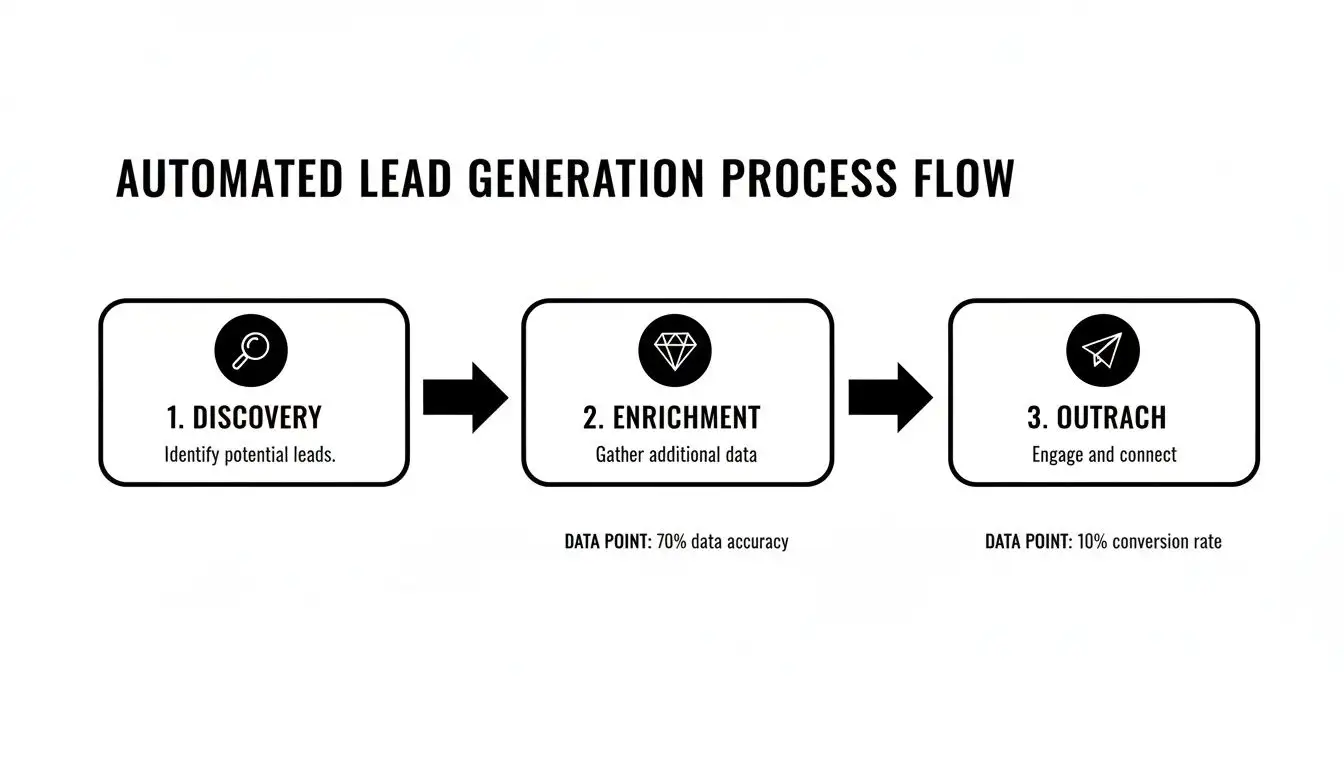
The diagram shows the magic in action: the system finds potential leads using your ICP, enriches their data so it's clean and accurate, and then kicks off a personalized outreach campaign.
Let's walk through a real-world example. Imagine this is your ICP:
-
Firmographics: B2B SaaS companies in the US, 50-200 employees.
-
Technographics: Actively using both HubSpot CRM and Salesforce.
-
Buying Signal: Hired a new "VP of Sales" in the last 90 days.
You’d set up your platform to constantly scan the market for companies that match these firmographic and technographic rules. The second it detects a "New VP of Sales" announcement at a company that fits, bam: it triggers an action. That lead gets a high score and is instantly dropped into a tailored outreach sequence.
This is how you build dynamic, self-updating lead lists that practically run themselves. For more on turning these signals into concrete actions, dive into our guide on how to create workflows.
Your machine is now officially online.
Example ICP and Buying Signal Configuration
To make this even more tangible, here's a simple table that shows how you translate your goals into specific criteria for your lead generation platform. This is the kind of instruction sheet your machine needs.
| ICP Component | Criteria | Example Buying Signal |
|---|---|---|
| Industry | B2B SaaS, FinTech | Company featured in a "Top 50 FinTech Startups" article |
| Size | 50-250 employees | LinkedIn shows employee count grew by 20% in the last 6 months |
| Tech Stack | Uses HubSpot, Intercom, and Google Analytics | Job posting for a "HubSpot Administrator" |
| Key Hire | Hired a new VP of Marketing in the last 90 days | Press release or LinkedIn update announcing the new hire |
| Funding | Recently closed a Series B or C funding round | TechCrunch article detailing the recent funding announcement |
This table is your blueprint. By combining these different data points, you're not just finding companies; you're finding companies at the exact moment they need you most.
Master Waterfall Enrichment and AI Personalization
Alright, so your lead-finding machine is humming along, spitting out perfect-fit prospects. Awesome. Now what? Are you really going to hit them with a generic, "Hi {first_name}, I saw your profile..." and cross your fingers?
That’s like getting a golden ticket to Willy Wonka's factory and trying to trade it for a stale candy bar. It's a massive waste of a perfect opportunity.
You’ve found the right people, now you need the right intel and the right message to actually start a conversation. This is where two absolute game-changers come into play: waterfall enrichment and AI-powered personalization. Think of them as the one-two punch that turns a cold shoulder into a warm handshake.
Uncovering the Full Picture with Waterfall Enrichment
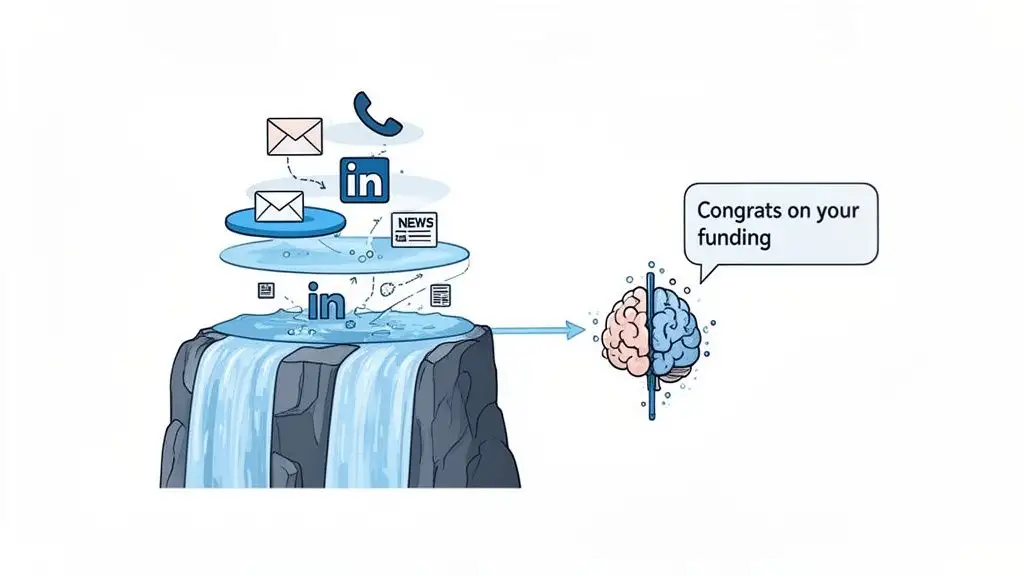
Imagine sending a team of digital P.I.s to build a complete dossier on every single target. That's waterfall enrichment. It’s a clever, systematic process that chains multiple data sources together to fill in all the blanks, making sure you never walk into a call blind again.
Here's the problem it solves: one data provider might have a great email but no direct phone number. Another might have the number but a totally outdated LinkedIn profile. It's a data crapshoot.
Waterfall enrichment fixes this by checking sources one after another. If the first provider comes up empty on a verified email, the system automatically pings the next one in line, and then the next, until it strikes gold. This sequential process is how you get the most accurate and complete data possible, often pushing 95% accuracy on contact information.
It’s the secret sauce for turning guesswork into a sure thing. If you want to get really nerdy about it, you can dive deeper into the nuts and bolts of data enrichment for sales teams.
Waterfall enrichment is your insurance policy against bad data. It’s how you make sure your perfectly crafted messages actually land in the right inbox and that you have the context you need to build a real connection.
The result is a rich, actionable profile that gives you everything you need:
-
Verified Work Emails: Kill your bounce rate. Dead.
-
Direct-Dial Phone Numbers: Get straight to the decision-maker, not their assistant's assistant.
-
Updated LinkedIn Profiles: See their latest projects, promotions, and who you both know.
-
Recent Company News: Find out about that funding round or product launch before you reach out.
Armed with this intel, you're not just another salesperson. You're a well-informed peer.
From Data Points to Personalized Hooks
Having all this fantastic data is one thing. But turning it into an irresistible, non-salesy opening line is where the magic truly happens. And let's be real, manually digging through news articles and LinkedIn updates for hundreds of prospects is a one-way ticket to burnout. It just doesn't scale.
This is where you let the AI off its leash.
Modern AI tools can digest all that enriched data in the blink of an eye. They scan for the most compelling buying signals and spin them into hyper-personalized opening lines that feel like they were written by hand. It’s like having a world-class copywriter who works 24/7, crafting a unique hook for every single lead.
The AI takes raw info and turns it into a powerful, human-sounding hook.
-
The Old Way: "I noticed you're the VP of Engineering at Acme Corp. I'd love to show you our tool." (Yawn.)
-
The New Way: "Congrats on the recent funding round for Project Phoenix! Scaling your engineering team to meet those new goals must be a top priority right now."
Feel the difference? One is a pitch. The other is a conversation starter. It instantly shows you've done your homework, even if it was the AI that pulled the all-nighter.
Bringing It All Together in Your Workflow
The real power move is when waterfall enrichment and AI personalization snap together like LEGOs in a single, automated workflow. The moment your system identifies a new lead that fits your ICP, this whole process kicks off automatically. No human intervention is needed.
Let’s walk through a real-world example:
-
Discovery: Your system flags a B2B SaaS company that just brought on a new CMO. This is your trigger.
-
Waterfall Enrichment: Instantly, the machine pulls the new CMO’s verified email, direct dial, and fresh LinkedIn profile. It also finds a recent podcast interview where she mentioned focusing on marketing ROI.
-
AI Personalization: The AI engine takes all that juicy data and drafts a custom opening line: "Hey Jane, saw your recent interview on the Marketing Mavericks podcast. Your point about data-driven ROI really stood out, especially as you settle into your new role at InnovateTech."
This entire sequence, from discovery to a killer personalized draft, happens in the background. Your sales reps just have to give it a quick once-over and hit "send."
This is how you build a system that doesn't just find leads; it equips you to build genuine relationships from the very first touch. This is how you stop being another unread email and start being the person they’re excited to meet.
Pro Tip: Use Munch to build your prospect list, enrich their data and craft personalized outreach messages - all in one platform!
6. Launch, Test, and Optimize Your Outreach Machine
Alright, you’ve done the hard work. Your lead list is enriched and primed with high-intent signals. Your AI is spitting out personalized messages that even your top AE would be proud of. It’s time for liftoff.
But let’s be clear: hitting the "launch" button isn't the finish line. It’s the starting gun. The real genius of an automated system isn't just about sending a bunch of emails and LinkedIn messages; it’s about building a machine that learns, adapts, and gets sharper with every interaction. This isn't "set it and forget it." It's more like constantly tinkering with a high-performance engine to squeeze out every drop of power.
Crafting Multi-Channel Sequences That Don't Feel Robotic
Automation's true purpose is to execute a human-first strategy at a scale no human could manage. The best way to do this? A multi-channel sequence that combines email and LinkedIn. This creates a natural, helpful presence around your prospect without being obnoxious, dramatically increasing your odds of getting a response.
Here’s a simple, four-step flow that just plain works:
-
Day 1 (Email): Lead with your best shot: that hyper-personalized, AI-generated email triggered by a specific buying signal. Make it count.
-
Day 3 (LinkedIn): Pop up on their radar with a connection request. Keep it short and contextual. Something like, "Hi [Name], saw your post on marketing ROI and had to connect."
-
Day 5 (LinkedIn): Once they accept, follow up with a brief message. Don't pitch! Instead, connect back to your email and offer a valuable resource or quick insight.
-
Day 7 (Email): Send one last, concise follow-up. This could be a gentle "breakup" email or a final offer of value from a different angle.
This rhythm prevents you from burning out a single channel. If you want to dive deeper into the nuts and bolts of structuring these interactions, exploring some battle-tested sales cadence best practices will give you some great blueprints to start with.
The Art and Science of A/B Testing
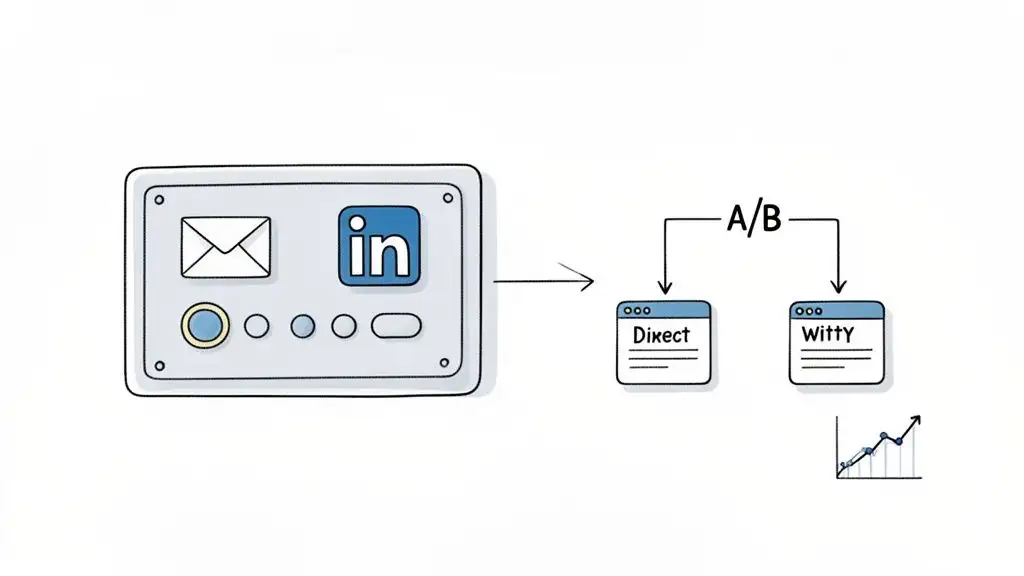
So, how do you really know if your outreach is firing on all cylinders? You test everything. A/B testing is what separates the pros from the amateurs, turning your lead generation engine from a sputtering jalopy into a finely-tuned race car.
The golden rule is to change only one variable at a time. Otherwise, you'll never know what actually moved the needle. Think of it like a clean science experiment: you have your control (the original sequence) and your variable (the sequence with one change).
A/B testing is where assumptions go to die. It’s the difference between saying, "I have a good feeling about this clever subject line," and knowing, "The direct subject line gets a 15% higher open rate with VPs of Sales." Data doesn't have feelings.
So what should you be testing? While you can test nearly anything, here are a few high-impact variables that will give you the most bang for your buck:
-
Subject Lines: Test a witty, curiosity-driven line against a direct, benefit-focused one. For example, "A thought on Project Phoenix" vs. "Quick idea for your scaling goals."
-
Channels: Does your audience live on email, or are they more responsive on LinkedIn? Test whether your first touch should be an email or a connection request.
-
The Ask (CTA): See what works better: a soft CTA like "Is this a priority for you right now?" or a more direct one like "Do you have 15 minutes to connect next week?"
-
Timing is Everything (or is it?): The age-old debate. Does 9 AM on Tuesday really beat 4 PM on Thursday? Stop guessing and test it for your specific audience.
-
Personalization Hooks: Pit different signals against each other. Does an opening line about a recent funding announcement outperform one that mentions a key executive hire?
An A/B Testing Framework You Can Steal
To put this into practice, let’s map out a simple framework for a five-step sequence. In this scenario, we’re trying to figure out if a direct, benefit-driven subject line (Sequence B) can beat our current champion, a casual, curiosity-based one (Sequence A).
A/B Testing Framework for a 5-Step Outreach Sequence
| Step | Sequence A (Control) | Sequence B (Variable Test) | Metric to Track |
|---|---|---|---|
| 1 | Email: Subject "Quick question" | Email: Subject "Idea for scaling your sales team" | Open Rate |
| 2 | LinkedIn: Connection Request | LinkedIn: Connection Request | Acceptance Rate |
| 3 | Email: Follow-up 1 | Email: Follow-up 1 | Reply Rate |
| 4 | LinkedIn: Message with valuable resource | LinkedIn: Message with valuable resource | Clicks/Replies |
| 5 | Email: "Breakup" email | Email: "Breakup" email | Reply Rate |
You’d run this test across a solid sample size, maybe 500 leads for each sequence, and let the cold, hard data declare the winner.
Once you’ve found a new champion, it becomes your new "Control," and you move on to testing the next variable. This relentless cycle of testing and optimization is what turns a decent automated system into an absolute monster that books meetings while you sleep.
Are We Winning? How to Measure Success and Sidestep Common Traps
Alright, you've built your lead generation engine, gassed it up with quality data, and hit the big green "launch" button. So... now what? You can't just set it and forget it. Letting an automated system run without supervision is like giving a toddler the keys to a Ferrari. You need to be checking the gauges constantly.
If you can't measure it, you can't improve it. And if you can't improve it, you have no clue if you're building a revenue rocket ship or just a very noisy, expensive paperweight.
It’s so easy to get distracted by shiny objects, vanity metrics like email open rates or LinkedIn connection requests. While those might give you a little ego boost, they don't pay the bills. The real story, the one your CFO cares about, is told by the numbers that tie your efforts directly to business results.
The KPIs That Actually Tell the Truth
Let's cut through the noise. To really understand if your automated machine is humming along or about to seize up, you need to zero in on a few critical metrics. These are the numbers that prove you're booking meetings and creating real pipeline, not just making a racket.
Here are the vital signs you should be obsessively tracking:
-
Positive Reply Rate: This is your north star. It’s the percentage of prospects who hit you back with something like, "Sure, I can chat next week." A high positive reply rate is the ultimate validation that your ICP, data, and messaging are all singing in perfect harmony.
-
Meetings Booked: Let's be honest, this is the main event. This metric shows how many qualified meetings your sequences are actually generating. It's the most direct link between your outreach and a tangible sales opportunity.
-
Pipeline Generated: Now we're talking. How much potential revenue did those meetings create? This connects the dots from your automation directly to the company's bottom line.
-
Customer Acquisition Cost (CAC): How much are you spending to land each new customer through this channel? A healthy, shrinking CAC is the hallmark of an efficient, scalable system that's ready for more investment.
These numbers give you a clear, unfiltered view of what's working and what isn't. They help you move beyond "I think this is working" to "I know this is working because it generated $50,000 in new pipeline last month."
Measuring success isn't just for high-fives and victory laps. It’s about finding the friction. If your reply rate is stellar but your meetings booked are in the gutter, you might have a broken call-to-action or a clunky handoff process to your sales reps.
Dodging the Ghosts in the Machine
Now for the fun part: everything that can (and will) go wrong. Even the most perfectly designed systems can go sideways. Automation is incredibly powerful, but it's not foolproof. A few common, rookie mistakes can completely sabotage your results before you even get started.
Think of us as your friendly neighborhood Ghostbusters, here to warn you about the common specters that haunt lead generation setups.
The biggest trap of all is setting your ICP too broadly. This is the classic "I’ll sell to anyone with a pulse and a budget" mistake. It’s a surefire recipe for abysmal reply rates and a calendar full of calls with unqualified leads. Remember, your automation is only as smart as the instructions you feed it. Vague instructions get you vague, useless results. You can get way more specific by digging into some lead scoring best practices and seeing how precision is the name of the game.
Another classic blunder is ignoring negative replies. So many teams just see a "not interested" email, archive it, and move on. What a waste! These replies are a goldmine of feedback. Are you talking to the wrong person? Is your value prop missing the mark? Dig into these responses; they'll tell you exactly how to refine your targeting and messaging.
Finally, you've got the ever-present danger of stale messaging. The killer subject line from last quarter might be today's spam folder fodder. Markets shift, priorities change, and your prospects get banner blindness for the same old pitches. You have to be constantly A/B testing and refreshing your copy. As the great Ferris Bueller once said, "Life moves pretty fast." If you don't stop and look around once in a while, your outreach could get left in the dust.
Got Questions? We've Got Answers.
Alright, let's talk about the questions probably rattling around in your head. It's smart to have them. This isn't just about flipping a switch; it's about building a machine that fuels your growth. Let's clear up a few of the most common hang-ups.
So, How Much Time Am I Really Going to Sink into This Setup?
Look, this isn't a five-minute job, but it’s not a six-month project either. Getting the bones of your system in place, nailing down your ICP, hooking up your accounts, and firing up your first signals, can genuinely be done in an afternoon.
The real magic, though, happens in the tuning. Plan on dedicating 2 to 3 hours a week for the first month. That’s your time for checking what's working, refining who you're targeting, and split-testing your messaging. Once you've got it dialed in and the engine is purring, you could be looking at less than an hour a week for maintenance. It's all about front-loading the strategy so the tech can do the grunt work forever.
Is This Going to Make My Outreach Sound Like a Tin Can on a String?
This is the big one, isn't it? We all have PTSD from those awful, generic "Hi [First Name]" emails from a decade ago. But modern automation is the exact opposite of that. A hard "no" on sounding robotic.
Think about the difference. Robotic sounds like: "Hi Jane, I saw your profile on LinkedIn." Yawn. An AI-powered, data-enriched message sounds like this: "Jane, congrats on the recent promotion to VP of Marketing at Acme Corp! Stepping into that role right after a Series B funding round must be a wild ride."
See the difference? That's a level of timely, specific personalization that's almost impossible to pull off at scale by hand. Modern automation doesn't make you less human; it makes you more relevant. It’s like having a personal research team whispering the perfect conversation starter in your ear for every single prospect.
The AI is just scanning data points, like a job change or a company's new product launch, to craft an opener that feels like you've been paying close attention. It’s less "robot" and more "hyper-observant sales pro."
What's a Realistic Budget for a Small Team? Do I Need Deep Pockets?
You can absolutely get in the game without a Fortune 500 budget. A solo operator or a lean team can get a powerful platform that handles lead discovery and outreach for as little as $49 a month. As you grow, you might scale up to a plan that costs a few hundred bucks.
The trick is to stop thinking of it as a cost and start seeing it as an investment.
-
Time Is Money: If a $100/month tool saves your sales rep 10 hours of mind-numbing manual prospecting, you've already won.
-
ROI is King: If that same tool lands you just one solid meeting that turns into a $5,000 deal, the math speaks for itself.
This isn't just another line item on your software bill. It's a predictable, scalable revenue engine. Instead of hiring another person to grind through spreadsheets, you're buying a system that works 24/7 for a tiny fraction of the cost, making everyone on your team more dangerous.
Ready to build your own automated lead generation engine, without all the guesswork? Munch brings lead discovery, data enrichment, and AI-powered outreach together in one seamless flow. Stop hunting for leads and start having conversations with people who actually want to talk to you. Explore Munch and start your free trial today.