What Is Data Enrichment and Why Is It Your Secret Sales Weapon

By Mriganka Bhuyan
•Founder at Munch
Picture this: your CRM is a dusty old address book. It’s got names, maybe a company, and a bunch of email addresses that haven't been updated since flip phones were cool. That's raw data. Data enrichment is the process of taking that outdated book and transforming it into a dynamic, intelligence-packed dossier on every single contact. It's about filling in the blanks with accurate, relevant details from outside sources, turning a basic entry into a complete, actionable profile.
Why Your Sales Data Needs a Glow Up
Your CRM is probably a ghost town of incomplete contacts, outdated job titles, and emails that bounce harder than a dropped Nokia 3310. This is where data enrichment steps in, not as some boring database chore, but as your sales team's ultimate cheat code. Think of it as giving your raw data a full-on makeover: transforming it from a sad, blurry Myspace profile into a polished LinkedIn masterpiece.
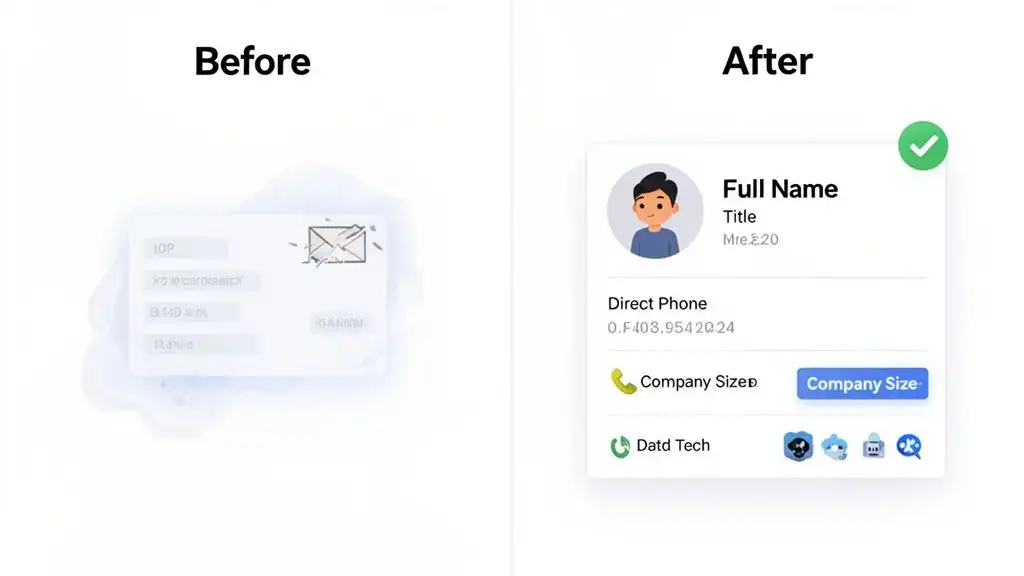
Without it, your sales team is basically flying blind, firing off generic messages into the void and just hoping something sticks. This spray-and-pray approach doesn’t just waste precious time; it actively damages your brand's reputation with every irrelevant pitch. It’s the digital equivalent of trying to sell a juicy steak to a lifelong vegetarian. You’re not just wrong, you’re downright annoying.
From Basic Contact to Qualified Lead
Data enrichment takes a skeletal record like 'John Doe, Acme Corp' and fleshes it out into a rich, detailed profile. Suddenly, you're armed with critical intelligence that fuels outreach that actually works.
-
Correct Job Title: You learn John is actually the VP of Engineering, not some intern you can ignore.
-
Verified Contact Info: You get his direct-dial phone number and a work email that won't bounce.
-
Firmographic Data: You discover Acme Corp has 500 employees and is a major player in the fintech industry.
-
Technographic Data: You see they’re using a competitor's software, giving you the perfect opening for your pitch.
This process turns a cold contact into a warm, qualified lead. Instead of spamming, your team can start highly targeted, personal conversations that get replies. They can lead with, "I noticed you're using Competitor X at Acme Corp," a line that immediately shows you’ve done your homework.
Data enrichment is the difference between shouting into a crowd and having a one-on-one conversation. It equips your team with the intelligence to stop guessing and start engaging with precision.
The Business Case for Better Data
The impact of this glow-up is huge. Clean, enriched data leads directly to better efficiency and much higher conversion rates. When your outreach is personalized and relevant, prospects are far more likely to listen. This also has a massive effect on your technical performance. For instance, having verified emails is a cornerstone of learning how to improve email deliverability and avoid getting your domain blacklisted.
Over the past decade, data enrichment has gone from a niche marketing add-on to a multi-billion-dollar linchpin of the B2B revenue engine. Back in 2020, the global data enrichment market was pegged at around $1.1 billion, with projections it would rocket past $5 billion by 2025. This explosive growth just confirms what B2B sales teams already know: there's more data, more channels, and more pressure to personalize than ever before. This technology has quickly become the backbone of modern sales intelligence.
The Building Blocks of High-Quality Sales Data
Let’s be honest, not all data is created equal. To build a killer sales strategy, you need way more than just a name and an email address. Think of it like assembling The Avengers: each piece of data is a hero with a unique power, and when you bring them together, you've got an unstoppable force. A basic contact list is just a random group of people; an enriched list is like discovering you’ve got Captain America, Iron Man, and Thor ready to win the deal for you.
The real goal here is to transform a simple contact into a red-hot, qualified lead. That magic happens when you gather four critical types of data. Each category adds another layer of intelligence, giving your sales team the context they need to stop guessing and start closing deals with confidence.
Let's break down these essential building blocks.
The Four Pillars of B2B Data Enrichment
To really understand a prospect, you need to look at them from multiple angles. This table breaks down the four core data types that turn a cold lead into a qualified opportunity. Each one provides a different piece of the puzzle, and together, they paint a complete picture for your sales team.
| Data Type | What It Is | Example | Why It Matters for Sales |
|---|---|---|---|
| Firmographics | The vital statistics of a company, its DNA. | A 500-employee SaaS company with $50M in annual revenue. | Tells you if the company is a good fit for your product at a foundational level. |
| Demographics | Details about the specific individual you're contacting. | Jane Doe, the VP of Marketing, and her direct-dial phone number. | Helps you find the right person, the decision-maker, within the target company. |
| Technographics | The technologies a company currently uses. | They use Salesforce for their CRM and Marketo for marketing automation. | Reveals their tech sophistication, budget, and potential pain points with competitors. |
| Buying Signals | Actions or events that show a company is ready to buy now. | They just raised a $20M Series B funding round and are hiring ten new sales reps. | Perfect timing. It’s the "why you, why now" that makes your outreach impossible to ignore. |
Putting these four pillars together is how you move from "who could we sell to?" to "who should we sell to, and what's the best way to do it?" Now, let's dive a little deeper into each one.
Firmographics: The Company's DNA
First up, we have firmographics. Think of these as the basic, must-know stats of a company. This is the foundational stuff that tells you if a business is even in your league, helping you weed out bad-fit accounts from the get-go. For a deeper dive, check out our guide on creating an ideal customer profile template.
Firmographics are like the company's Tinder profile. You get the essentials at a glance:
-
Industry: Are they in SaaS, manufacturing, or healthcare? You wouldn't pitch a construction management tool to a hospital.
-
Company Size: How many people work there? The sales process for a 10-person startup is a world away from selling to a 10,000-employee enterprise.
-
Annual Revenue: Do they actually have the budget for what you're selling? This separates the real contenders from the window shoppers.
-
Location: Where are their headquarters and other key offices? This is gold for territory planning and localized outreach.
Demographics: Who Are You Actually Talking To?
Okay, so you’ve found the right company. Now you need to find the right person. That's where demographics come into play. This data is all about the individual, helping you pinpoint the decision-maker who holds the purse strings and can give you a firm "yes."
Trying to sell without solid demographic data is like sending a message in a bottle. You're just hoping it washes up on the right shore.
Key demographic details include:
-
Job Title: Is this person a VP of Sales, a Marketing Manager, or a Software Engineer? Their title is a massive clue to their specific pain points and daily priorities.
-
Seniority Level: A C-suite executive thinks about the business very differently than a department head.
-
Contact Information: We're talking a verified email and a direct-dial phone number, the holy grail for any ambitious sales rep.
Technographics: What’s in Their Tech Stack?
This is where things get really juicy, especially for B2B tech sales. Technographics give you a peek under the hood at the technology stack a company is currently using. It's like getting a look inside their digital toolbox, and this info is pure gold. It tells you about their needs, their budget for software, and even their potential unhappiness with a competitor.
Knowing a company uses your main competitor isn't a dead end; it's a golden opportunity. It means they've already identified the problem you solve and have a budget for it. Your job is simply to show them a better way.
This data allows you to craft messages that are scarily relevant. Imagine sending an email that says, "I see you're using Competitor X. Our platform integrates seamlessly and solves the common scaling issues their users complain about." An outreach message that specific and insightful is almost impossible to ignore.
Buying Signals: Nailing the Perfect Timing
Finally, we have buying signals. These are the trigger events that scream, "This company is actively looking to buy a solution like yours right now." In sales, timing isn't just one thing; it's everything. A buying signal is like the Bat-Signal lighting up the Gotham sky: it’s a clear call to action.
Keep an eye out for signals like these:
-
Recent Funding: A fresh round of investment usually means they have a pile of cash they need to spend on growth.
-
Hiring Sprees: If a company is suddenly hiring a dozen new sales reps, you can bet they'll need a better CRM or sales intelligence tool to support them.
-
New Executive Hires: A new VP of Marketing almost always re-evaluates the entire marketing tech stack within their first 90 days.
-
Negative Product Reviews: Spotting them complaining about a competitor online? It's the absolute perfect time to slide in and introduce your superior solution.
How Data Enrichment Actually Works Behind the Scenes
So, what’s really going on when you “enrich” data? It’s not some dark art, even if the results feel like magic. Think of it less like waving a wand and more like having a hyper-efficient pit crew for your sales data. They’re swapping out flat tires and refueling your engine before you even notice you're running on fumes.
Behind the curtain, a few core methods are at play, dictating when and how your data gets its glow-up. Getting a handle on these will help you pick the right strategy for your team, so you’re not just hoarding data but making it work for you right when it matters most.
The whole point is to layer different types of information like firmographics, demographics, technographics, and buying signals to build a complete, 360-degree view of a prospect. It's like building a puzzle, piece by piece, until the full picture snaps into focus.
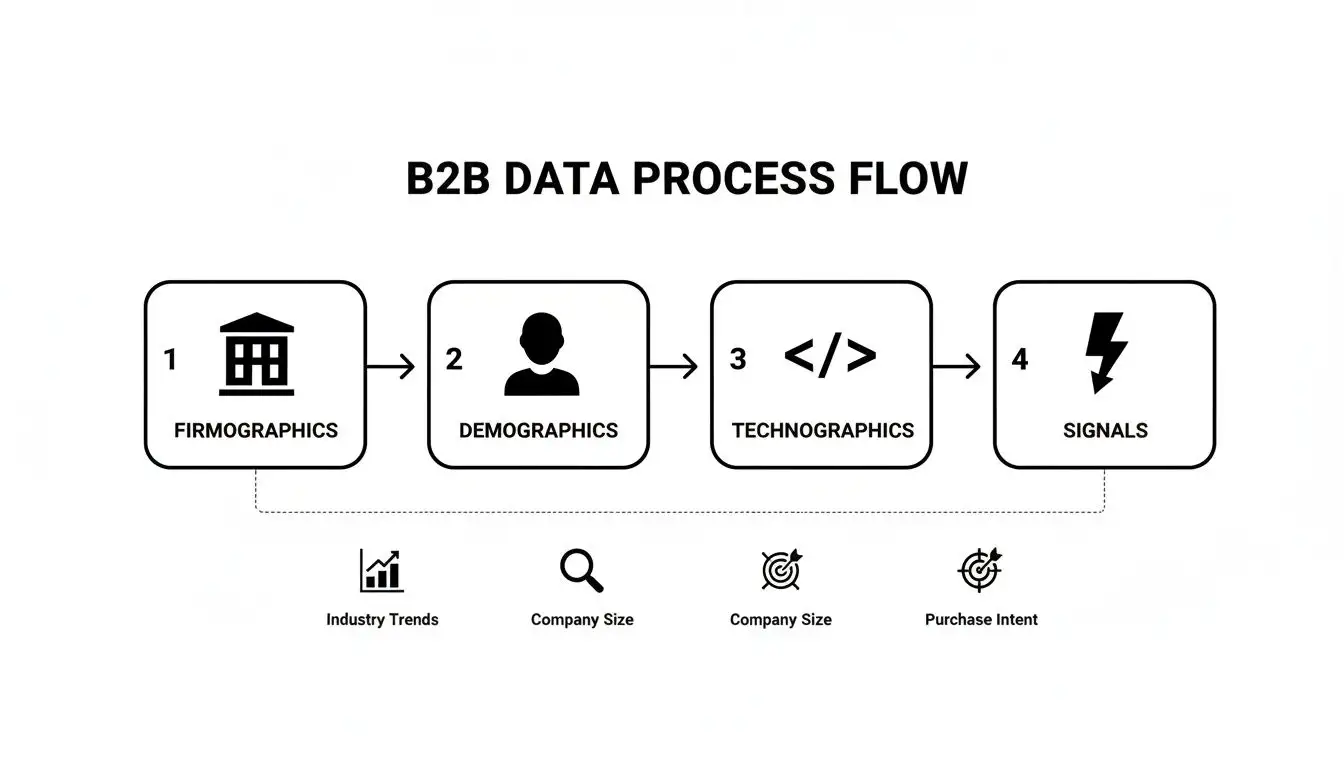
As you can see, you start with the basics about the company and then layer on more specific, timely details. This turns a simple name and email into a profile so rich your sales team knows exactly how to approach them.
Batch Enrichment: The Big CRM Spa Day
First up, we have batch enrichment. This is exactly what it sounds like: sending your entire CRM database on a much-needed weekend spa retreat. You bundle up your existing list of contacts, all those names you’ve collected over the years, and hand it off to an enrichment provider. They scrub it against their massive databases, toss out the old info, fill in the blanks, and send it back to you sparkling and ready for action.
This approach is a lifesaver in a few situations:
-
The Initial Cleanup: For example, when you first sign up for an enrichment platform, a batch run is your first move to get your house in order.
-
Quarterly Health Checks: Data gets stale fast. A person's job title, company, even their name can change. A quarterly batch run keeps your database from turning into a digital graveyard.
-
Post-Event List Uploads: Just got back from a trade show with a fishbowl full of business cards (or, more likely, a fat CSV file)? A batch job enriches that whole list at once before you dump it into your CRM.
The only catch? It's not instantaneous. Just like a real spa day, it takes a little time. The data is only as fresh as the day you ran the process, so it won’t catch a promotion that happened yesterday.
Real-Time Enrichment: The On-Demand Hero
If batch enrichment is the planned retreat, real-time enrichment is the instant makeover that happens the second a new lead walks through your digital front door. The moment someone fills out a "Contact Us" form or signs up for a webinar, an API zaps their info to the enrichment service. In seconds, their profile is automatically fleshed out with fresh, accurate data.
This is the secret sauce for lightning-fast lead routing and killer first impressions. Your sales team gets a fully loaded profile the instant it arrives, not hours later.
This on-demand method is all about speed. A sales rep can follow up within minutes, armed with a highly relevant message that mentions the lead's company size, tech stack, or recent funding round. It’s the difference between a conversation that feels personal and a generic "Thanks for your interest!" email that gets instantly archived.
Waterfall Enrichment: The Quest for the One True Email
Now for the seriously cool part: waterfall enrichment. If data enrichment were The Lord of the Rings, this method would be the quest to find the One Ring, or in our case, the one, true, verified email address. Instead of just asking a single data provider for info (who might not have the answer), the waterfall method intelligently checks multiple sources in sequence.
Here’s how the quest unfolds:
-
The First Stop (The Shire): The system first pings Provider A for the contact’s email. If it finds a high-confidence match, awesome. Quest over.
-
The Second Stop (Rivendell): But if Provider A comes back empty-handed or with a sketchy-looking address, the system automatically moves on to Provider B. No one has to lift a finger.
-
The Final Check (Gondor): If Provider B also whiffs, it cascades down to Provider C, D, and so on, until a verified, high-quality email is found.
This layered approach dramatically boosts your hit rate. Since no single data provider is infallible, the waterfall technique stacks the odds in your favor by querying multiple trusted sources. It’s a core feature in platforms like Munch and is the reason we can consistently hit data accuracy rates of 95% or higher. If you want to dive deeper into this, check out our guide on how to find business emails that actually land.
By combining these methods, using batch for big cleanups, real-time for new leads, and a waterfall process for pinpoint accuracy, you build a powerful, resilient data strategy. It’s how you keep your pipeline full of opportunities that are actually worth chasing.
Pro Tip: Use Munch to build you prospect list based on firmographic, technographic and intent signals. You can also use waterfall enrichment to get richer details about your leads and even write personalized outreach messages.
Choosing Your Data Enrichment Tools Wisely
Picking the right data enrichment tool can feel like trying to choose a movie on Netflix on a Friday night. You scroll endlessly through options until you finally give up and just rewatch The Office for the tenth time. The market is crowded, and every platform promises the moon, but not all of them deliver. To avoid this paralysis, you need to focus on a few non-negotiable quality metrics that separate the contenders from the pretenders.
From a go-to-market perspective, data enrichment is quickly becoming as essential as the CRM itself, fueled by the intense demand for personalization and real-time decision-making. The market for these tools is projected to hit $5 billion in 2025 and soar past $15 billion by 2033. For sales teams, this means enrichment is no longer optional. When 80-90% of your interactions start digitally, having precise data is the only way to cut through the noise. Learn more about how the data enrichment tool market is growing.
The Three Pillars of Data Quality
Before you even glance at a tool's bells and whistles, you need to grill it on three core metrics: accuracy, completeness, and freshness. These are the foundations of any worthwhile data enrichment strategy. Get one wrong, and the whole structure crumbles.
-
Accuracy Is Everything: An enrichment tool that gives you wrong information is worse than one that gives you nothing at all. Bad data leads to bounced emails, calls to disconnected numbers, and wasted time chasing ghosts. Imagine your SDRs trying to call a "direct dial" that's actually the company's main fax line from 1998. That’s not just inefficient; it’s embarrassing. You should demand 95% or higher accuracy on critical contact info like email addresses.
-
Completeness Fills the Gaps: A good tool doesn't just verify existing data; it fills in the missing pieces of the puzzle. It takes "Jane, Acme Inc." and turns it into "Jane Smith, VP of Marketing at Acme Inc., a 500-person SaaS company that uses Salesforce and Marketo." Completeness is what gives your team the context to personalize their outreach beyond a generic "Hi {first_name}."
-
Freshness Fights Data Decay: Contact data gets stale faster than a bag of opened chips. People change jobs, companies get acquired, and phone numbers are reassigned. A top-tier tool provides data that is current, not information that was scraped a year ago. If your data says a prospect is the CTO but they actually left the company six months ago to start a goat yoga farm, your pitch is dead on arrival.
Standalone Vendors vs Integrated Platforms
Once you’ve established your quality standards, you’ll face a key decision: do you go with a standalone data vendor or an all-in-one integrated platform? Each has its own pros and cons, and the right choice depends entirely on your team's workflow.
A standalone data vendor is like a specialized shop. It does one thing, providing raw data, and often does it very well. You buy lists or use an API to enrich your existing contacts. This can be great if you have a sophisticated tech stack and just need to plug a data gap.
The downside of standalone vendors is that you become the general contractor. You have to stitch together multiple tools for lead discovery, enrichment, and outreach, which can quickly turn into a messy, time-consuming puzzle.
An integrated platform, on the other hand, is designed to be your entire sales intelligence hub. Platforms like Munch bundle lead discovery, waterfall enrichment, and outreach tools into a single, cohesive workflow. This approach simplifies your tech stack and ensures your team isn't wasting time toggling between five different browser tabs to do their job.
For a deeper look at the options available, you might be interested in our breakdown of the top lead enrichment tools on the market today. Choosing a tool isn't just about the data; it's about finding a workflow that empowers your team to work smarter, not harder.
Putting Your Enriched Data into Action
Alright, so you’ve got the theory down. You've picked a tool, you know what data enrichment is supposed to do, and you're ready to roll. Now for the fun part: actually making it work. Because let's be honest, theory is great, but cash in the bank comes from action. This is where the rubber meets the road.
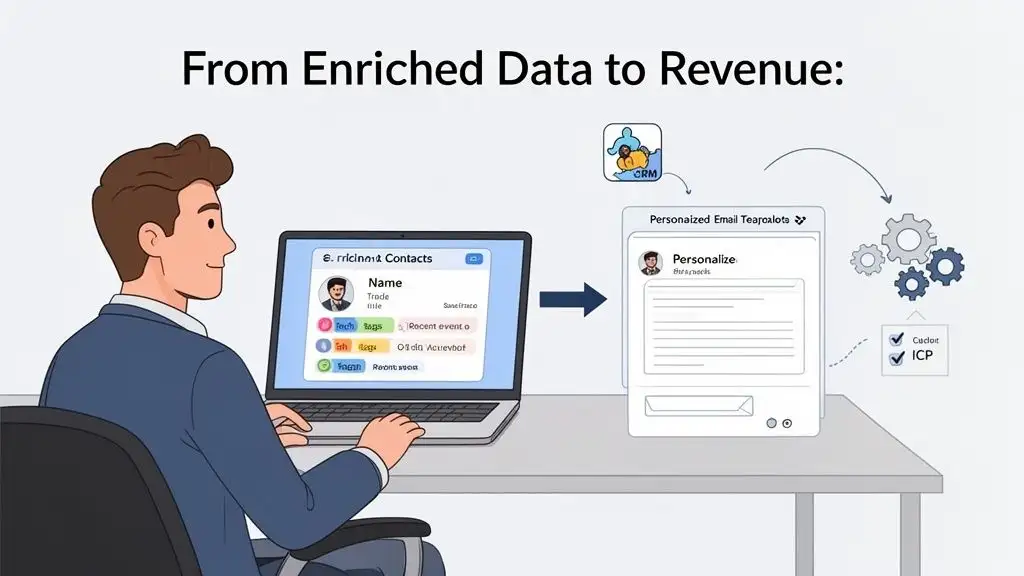
Without a solid game plan, even the world's best data is just expensive noise cluttering up your CRM. The goal here is to build a system that turns raw information into real opportunities, preferably while you sleep. Let’s dive in.
First Things First: Define Your Ideal Customer Profile
Before you even think about enriching a single contact, you absolutely must know who you're looking for. Seriously. Enriching data without a clear target is like meticulously planning the perfect road trip to the wrong city. You'll execute flawlessly and still end up miserable.
Your Ideal Customer Profile (ICP) is your North Star. It's the blueprint for the companies that get the most out of what you sell. This isn't some fluffy wish list; it’s a rock-solid set of firmographic and technographic data points.
-
Industry: Which specific verticals do you absolutely crush it in?
-
Company Size: Are you talking to 10-person startups or 1,000+ employee enterprises?
-
Geography: Is your sweet spot North America, EMEA, or somewhere else?
-
Technology Stack: Do your best customers all seem to be using Salesforce? HubSpot? A specific coding language?
Nailing this down ensures you're spending your enrichment budget on leads that could actually become your next favorite customer. Don't you dare skip this step.
Audit and Segment What You've Already Got
Okay, time to face the music. Let's take a hard look at the data you already have. A quick audit of your CRM will probably reveal some interesting gaps and inconsistencies. Think of it as that moment in a home renovation show where they tear down a wall and find a family of squirrels. It’s better to know what you’re dealing with upfront.
Figure out which key fields are constantly empty. Is it direct-dial phone numbers? Accurate employee counts? Verified emails? This little exercise tells you exactly what to prioritize.
Once you have the lay of the land, start segmenting your database. Not every contact is a top priority. You could break them down into buckets like:
-
High-Priority Accounts: Your best customers or five-star prospects who need the white-glove enrichment treatment, like, yesterday.
-
Marketing Qualified Leads (MQLs): People who've raised their hand but need a little more intel before sales jumps in.
-
Cold/Inactive Contacts: The "maybe someday" pile that can be enriched in a big batch process when you have downtime.
This approach lets you be smart with your resources, pointing your enrichment cannons at the contacts most likely to turn into revenue.
Integrate Your Tools and Automate the Heck Out of It
This is where you connect the pipes and let the magic happen. Integrating your data enrichment tool directly with your CRM (like Salesforce or HubSpot) is the move that saves your team from the soul-crushing agony of manual research. The goal is to create automated workflows that just work, no clicking required.
Automation is your team’s superpower. It frees up your sales reps from being data-entry clerks and turns them back into sellers. An effective workflow should operate silently in the background, making your team smarter with zero extra effort.
For example, you can set up a trigger: the second a new lead hits your CRM from a demo request form, it’s instantly whisked away to your enrichment tool. A few moments later, it returns, now packed with their job title, company size, and tech stack. This is the foundation of a sales machine that actually scales. To get this right, our guide on how to create workflows is a fantastic place to start.
Train Your Team to Use Their New Superpowers
Last but not least, all this shiny new data is completely useless if your team doesn't know what to do with it. Please, don't just dump a bunch of new data fields on your reps and hope for the best. You have to train them to turn this intel into razor-sharp, personalized outreach.
They can finally move from cringey generic templates to hyper-relevant messages.
-
The Old Way: "Hi {first_name}, I'd love to show you our product."
-
The Enriched Way: "Hi Jane, I saw your team at Acme Corp is hiring 5 new SDRs and uses Salesforce. Our platform could help you get them ramped up in half the time."
Teach your team to hunt for conversation starters within the enriched data. A recent funding round, a new exec hire, or the fact that they use a competitor’s tool are all golden nuggets. This is how you turn data enrichment from a background task into the engine that drives your revenue.
Common Data Enrichment Pitfalls and How to Dodge Them
Let's be real, diving into data enrichment can sometimes feel like you're trying to assemble IKEA furniture in the dark. One wrong move, and your whole sales pipeline could collapse. Even with the shiniest new tools, a few classic blunders can send your efforts right off a cliff. Knowing what these traps are is half the battle.
The absolute biggest mistake? Thinking enrichment is a magic wand that can miraculously fix a foundation of bad data. It can't. If your starting data is a dumpster fire, you're basically just paying to put a tuxedo on a scarecrow. This is the timeless "garbage in, garbage out" problem, and it's very much alive and well.
It’s like that episode of Seinfeld where a tiny lie from George Costanza snowballs until his entire world unravels. In the same way, one bad data point, an outdated job title or a misspelled company name, can cascade into a comedy of errors, leading to botched outreach, wasted time, and a bruised brand reputation.
The Dangers of Stale Data and Putting All Your Eggs in One Basket
Another major landmine is ignoring data decay. B2B data goes stale faster than a carton of milk left on the counter. People change jobs, get promotions, and switch companies all the time. A "set it and forget it" mindset is a surefire way to turn your once-precious contact list into a digital ghost town.
Relying on a single data source is like getting all your news from one eccentric uncle at Thanksgiving. You're probably not getting the full picture. Diversifying your data providers with a waterfall enrichment process saves you from the inevitable blind spots and errors of any one source.
To sidestep these issues, the pros use a multi-pronged attack:
-
Start Clean: Get your initial data collection processes in order first.
-
Don't Monopolize: Use a waterfall enrichment process with multiple vendors to verify and fill in the gaps.
-
Schedule a Scrub: Run a batch enrichment process every quarter to combat that inevitable data decay.
Enterprise-Grade Data Isn't Just for the Big Guys Anymore
Here's the good news: avoiding these face-palm moments is easier than ever. What was once a pricey luxury reserved for giant corporations is now a must-have for small and medium-sized businesses. According to Segment data, while enterprises had the largest market share in 2023, the SME segment is now the fastest-growing.
For startup founders and B2B agencies, this is huge. It means enterprise-level data power is becoming accessible without needing a Fortune 500 budget, making a predictable pipeline a reality for everyone. You can explore more about the growing data enrichment market and see how it's leveling the playing field.
Got Questions About Data Enrichment? Let's Unpack Them.
Still have a few questions rolling around in your head? You're definitely not the only one. Let's tackle some of the most common ones so you can get your data strategy off the ground with confidence.
How Often Should I Be Enriching My Sales Data?
Think of your CRM data like produce: it has a shelf life. Letting it sit for too long means you’re working with rotten information. A good rule of thumb is to run a full batch enrichment on your entire database at least once a quarter. This is your big spring cleaning to clear out the cobwebs and fight off data decay.
But for new leads? You need to act faster. Real-time enrichment is an absolute must the second they hit your system. Your reps need the full picture immediately to strike while the iron is hot.
And for your top-tier accounts? Treat them like a VIP list. You should be watching them constantly for buying signals, leadership changes, or new projects. It’s less of a quarterly check-up and more like having a 24/7 news ticker dedicated to their business.
How Does Data Enrichment Fit into an ABM Strategy?
Fit into it? It's the engine that makes the whole thing run. Trying to do Account-Based Marketing (ABM) without solid enrichment is like trying to build a mansion without a blueprint. You're just guessing.
Data enrichment lets you build a ridiculously detailed dossier on every single target account. You can map out the entire buying committee, see what technologies they’re already using, and get a heads-up on trigger events like a fresh round of funding. This is the secret sauce for crafting those highly personalized, multi-channel campaigns that actually get noticed.
Think of it this way: Data enrichment is to ABM what a high-powered scope is to a sniper. It gives you the precision to focus on the right target, at the right time, instead of just spraying bullets and hoping one hits.
Is Data Enrichment Compliant with Regulations like GDPR and CCPA?
Yes, but with one huge caveat: you must work with a reputable, compliant provider. This isn't the data-scraping free-for-all of the early 2000s. Modern, trustworthy enrichment platforms are built on a foundation of ethically sourced, publicly available business information.
Do your due diligence here. A good partner will be completely transparent about where their data comes from and how they maintain compliance. Before you sign on the dotted line, ask the tough questions and verify their credentials. It’s the only way to keep your company on the right side of the law.
Ready to stop guessing and start selling with precision? Munch unifies lead discovery, waterfall enrichment, and AI personalization into one powerful workflow. Find your next customer today.