7 Best AI Sales Tools to Crush Your Quota in 2026

By Mriganka Bhuyan
•Founder at Munch

Let's be honest, modern sales feels less like Glengarry Glen Ross and more like trying to solve a Rubik's Cube in the dark while riding a unicycle. You're drowning in data, manual research is a soul-crushing time sink, and writing a 'personalized' email that doesn't sound like a generic template is a daily struggle. The "always be closing" mantra is great, but it's hard to follow when you're "always be prospecting" instead.
But what if you could automate the tedious parts and focus on what you do best: having actual conversations and closing deals?
Enter the world of the best AI sales tools. These aren't just glorified CRMs with a new coat of paint. They are intelligent assistants designed to find your perfect customer, enrich their data with surgical precision, and even craft outreach that actually gets replies. Think of them as a team of tiny, hyper-efficient sales development reps who never sleep, never complain, and never ask for coffee. They handle the grunt work so you can be the strategic closer.
This guide breaks down the top platforms and marketplaces to find the perfect AI-powered addition to your tech stack. We'll give you the lowdown on each, complete with screenshots, direct links, and actionable advice to help you find the tool that fits your team's specific needs. Stop wrestling with spreadsheets and start having meaningful conversations with high-intent prospects who are ready to buy. Your pipeline is about to get a serious upgrade.
1. Munch
If your sales stack feels more like a precarious Jenga tower of single-purpose apps than a streamlined machine, Munch is the all-in-one platform ready to play the hero. It’s not just another tool; it’s a complete top-of-funnel operating system designed to take you from a vague idea of your ideal customer to launching a hyper-personalized outreach campaign in about the time it takes to watch an episode of The Office. Munch consolidates prospect discovery, data enrichment, and AI-powered personalization into a single, cohesive workflow, making it one of the best AI sales tools for teams that value both speed and substance.
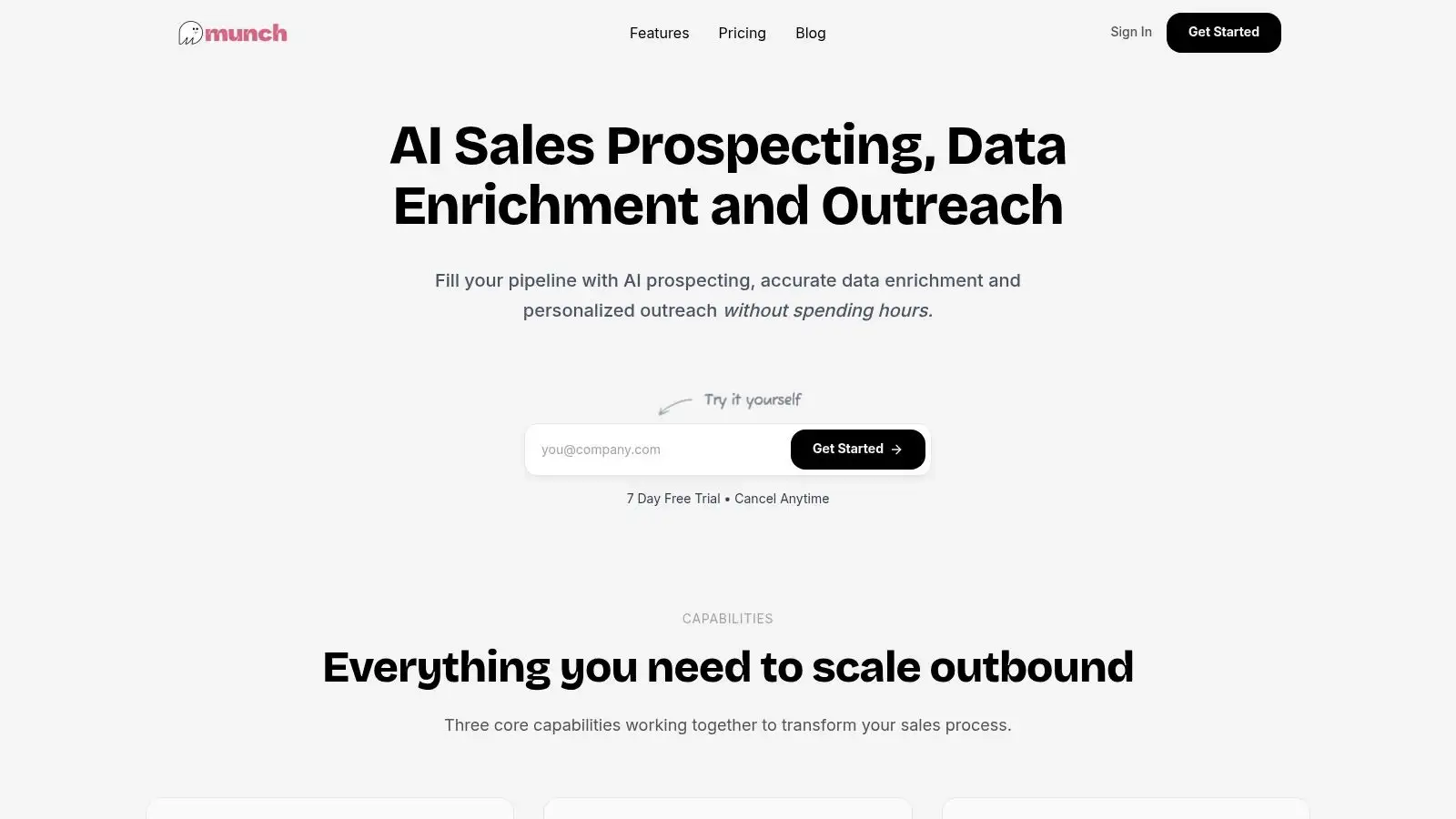
It’s built for B2B teams who are tired of gluing together a prospect database, a verification tool, and a separate AI writer, only to end up with disjointed data and generic "hope you're having a great Tuesday" emails. Munch turns this chaotic process into a simple, three-step sprint.
Why It Stands Out: The All-in-One Advantage
Munch’s core strength is its unified approach. Instead of juggling subscriptions for lead databases, email finders, and AI copywriters (a stack that can easily run into thousands per month), Munch integrates these functions seamlessly. This isn't just about cost savings; it's about eliminating the friction that kills momentum.
Here’s how it works in practice:
-
Discovery & Intent Signals: You start by defining your Ideal Customer Profile (ICP). For example, you might look for "B2B SaaS companies in North America with 50-200 employees that just hired a new VP of Sales." Munch then scans over 50 data sources for these real-time buying signals. This ensures you’re finding companies that fit your criteria at the exact moment they’re most likely to need you.
-
Waterfall Enrichment: Once you have a list of high-intent prospects, Munch’s waterfall enrichment process kicks in. It cross-references multiple premium data providers to find and verify contact information, delivering a stellar 95%+ email accuracy rate. This systematic, multi-layered approach to verification is a key differentiator and a godsend for anyone who has suffered the pain of high bounce rates. For a deeper dive, you can learn more about data enrichment tools and techniques to see how this process works.
-
AI-Powered Personalization: This is where the magic happens. The platform’s AI doesn’t just insert
{FirstName}and{Company}. It analyzes each prospect's LinkedIn profile, company website, and recent activity to craft unique, context-aware opening lines. For instance, it might generate a line like, "Saw your recent post on scaling sales teams; your point about data-driven coaching really resonated." It then helps you build multi-channel sequences (Email + LinkedIn) and even A/B tests your messaging to optimize reply rates.
The Nitty-Gritty: Features & Use Cases
| Feature | What It Does & Why It Matters |
|---|---|
| All-in-One Workflow | Integrates prospect discovery, enrichment, and AI personalization. Benefit: Replaces 3-4 separate tools, slashes subscription costs, and gets your first campaign live in minutes, not days. |
| Waterfall Data Enrichment | Scans 50+ data sources and uses a layered verification process. Benefit: Delivers 95%+ email accuracy, dramatically reducing bounce rates and protecting your domain reputation. |
| AI Personalization at Scale | Generates unique, context-aware outreach based on individual prospect data. Benefit: Scales true 1-to-1 personalization, helping you break through the noise and get more replies without spending hours on research. |
| Multi-Channel Sequences | Supports building and managing automated outreach across both email and LinkedIn. Benefit: Engages prospects where they are most active, increasing your chances of connecting and starting a conversation. |
Who Is It For?
Munch is an exceptionally strong fit for early and growth-stage B2B companies, founders, and agile sales teams who need to generate pipeline without a massive budget or a dedicated sales ops team. Its speed and efficiency make it perfect for SDRs aiming to crush their quota and for agencies needing to quickly spin up effective outbound campaigns for clients.
Pros:
-
A True All-in-One: Genuinely replaces multiple tools, simplifying your workflow and tech stack.
-
High-Fidelity Data: The waterfall enrichment process provides exceptionally accurate contact info.
-
Effective AI Personalization: Moves beyond basic tokens to create relevant, human-sounding outreach.
-
Incredible Value: Starts at just $49/month, offering enterprise-grade capabilities for a startup-friendly price.
Cons:
-
Limited CRM Integrations: Native syncs with platforms like HubSpot or Salesforce are still in development, which might require manual data entry or workarounds for now.
-
Credit-Based System: For teams with massive, unpredictable outbound volume, the credit limits on standard plans might feel restrictive.
The Final Word
Munch delivers on its promise of a faster, smarter, and more integrated approach to sales prospecting. By bundling the entire top-of-funnel workflow into one accessible platform, it empowers teams to focus on what they do best: building relationships and closing deals.
Ready to try it out? Sign up now!
2. G2 – AI Sales Assistant category
Think of G2's AI Sales Assistant category as the Mos Eisley Cantina of sales software. It's a bustling hub where every tool imaginable, from the galaxy's most notorious incumbents to plucky upstarts, is on display. You won't find a more wretched hive of scum and... well, you get the idea. It's crowded, chaotic, and absolutely essential for anyone looking for the real dirt on the best AI sales tools.
G2 isn't a tool itself; it's a B2B software marketplace powered by peer reviews. Its strength lies in its sheer volume of user-generated content. Instead of a polished vendor demo, you get unfiltered feedback from real SDRs, sales leaders, and RevOps pros who are in the trenches using these tools every single day.
Why It's Your Ultimate Research Hub
What makes G2 a must-visit destination is its "Grid®" report for AI Sales Assistants. This quadrant chart plots tools based on user satisfaction and market presence, giving you an at-a-glance understanding of the landscape. It's like a fantasy football draft board for your tech stack.
You can slice and dice the data with impressive granularity:
-
Filter by Company Size: Find out what mid-market companies love versus what works for scrappy startups.
-
Feature-Specific Search: Need a tool that excels at email sequencing and integrates with HubSpot? Check the boxes and watch the list shrink.
-
Side-by-Side Comparisons: Pit up to four tools against each other to see how they stack up on key features, ratings, and user satisfaction scores.
How to Use G2 Like a Pro
To get the most out of G2, don't just look at the overall score. Dive into the reviews and look for patterns. Are multiple users from companies like yours complaining about a clunky UI or a lack of support? That’s a massive red flag.
Pro Tip: Ignore the 1-star and 5-star reviews. The real gold is in the 3 and 4-star reviews. These users often provide the most balanced feedback, highlighting what they love and what they wish was better, giving you a much more realistic picture of day-to-day use.
The platform is free to browse, though you'll need to create a free account to unlock some of the more detailed comparisons and reports. Just be prepared for the occasional sponsored placement trying to catch your eye.
Best For:
-
Sales Ops & RevOps Teams: Vetting new tools and building a business case for a purchase.
-
SDR Leaders: Comparing solutions to find the best fit for their team’s specific workflow.
-
Founders: Getting a quick, unbiased overview of the market without sitting through dozens of demos.
G2 provides an essential, crowd-sourced perspective on the role of AI in sales. To go deeper into this topic, you can learn more about how artificial intelligence is transforming sales workflows on usemunch.com.
3. Capterra – AI Sales Assistant software directory
If G2 is the Mos Eisley Cantina, think of Capterra as the slightly more organized, family-friendly galactic trading outpost. It's less chaotic, a bit more straightforward, and has price tags clearly displayed on most of the droids and starships for sale. For sales leaders who just want to know the bottom line, Capterra's directory of the best AI sales tools cuts right to the chase.
Like its B2B marketplace brethren, Capterra isn't a tool but a comprehensive software directory powered by user reviews and vendor-supplied data. Its superpower is its focus on practical, purchase-decision information, especially pricing. It helps you quickly figure out what you can actually afford before you fall in love with a tool that costs more than your entire marketing budget.
Why It's Your Go-To for Budgeting
Capterra shines with its easy-to-digest vendor pages and comparison tools that put costs front and center. While other platforms can be cagey about pricing, Capterra often gets vendors to list their starting prices, giving you an immediate filter for what fits your budget.
You can drill down into the specifics with some seriously useful filters:
-
Feature Filters: Need an AI copilot that also handles conversation intelligence? Capterra lets you check boxes for must-have features to narrow the field instantly.
-
Pricing & Plan Type: Filter tools by those offering free trials, free versions, or one-time licenses to match your procurement process.
-
Compare Head-to-Head: The comparison tool lets you create a shortlist and see how up to four products stack up on features, pricing, and user ratings in a clean, side-by-side view.
How to Use Capterra Like a Pro
Start with the filters to create a manageable shortlist based on your non-negotiable features and budget. Once you have a handful of contenders, dive into their individual profile pages. Look for the "Pricing" and "Alternatives" tabs. The alternatives section is particularly useful, as it often surfaces competitors you may not have considered.
Pro Tip: Use Capterra to build your initial "long list" of potential tools based on budget and features. Then, cross-reference your top 3-5 choices on a review-heavy site like G2 to get deeper, more nuanced user feedback before booking any demos.
Browsing Capterra is completely free. Just keep an eye out for sponsored listings at the top of the search results; they're clearly marked but are still designed to grab your attention first. Always verify pricing and feature details directly on the vendor's website.
Best For:
-
Founders & Small Business Owners: Quickly finding budget-friendly tools with clear pricing.
-
Sales Ops: Building a preliminary list of vendors that meet both functional and financial requirements.
-
SDRs: Finding tools with free trials to test out before pitching them to management.
Capterra provides a pragmatic, price-conscious starting point for your research. To see how these platforms fit into a modern sales motion, you can explore the wider world of artificial intelligence sales tools on usemunch.com.
4. Product Hunt – AI Sales Tools category
If G2 is the established cantina, Product Hunt is the Silicon Valley launch party where the next big thing might be demoing in the corner. It's less of a marketplace and more of a daily showcase of what's new, what's hot, and what's unapologetically experimental. For sales pros looking for a competitive edge, this is where you spot the best AI sales tools before they hit the mainstream.
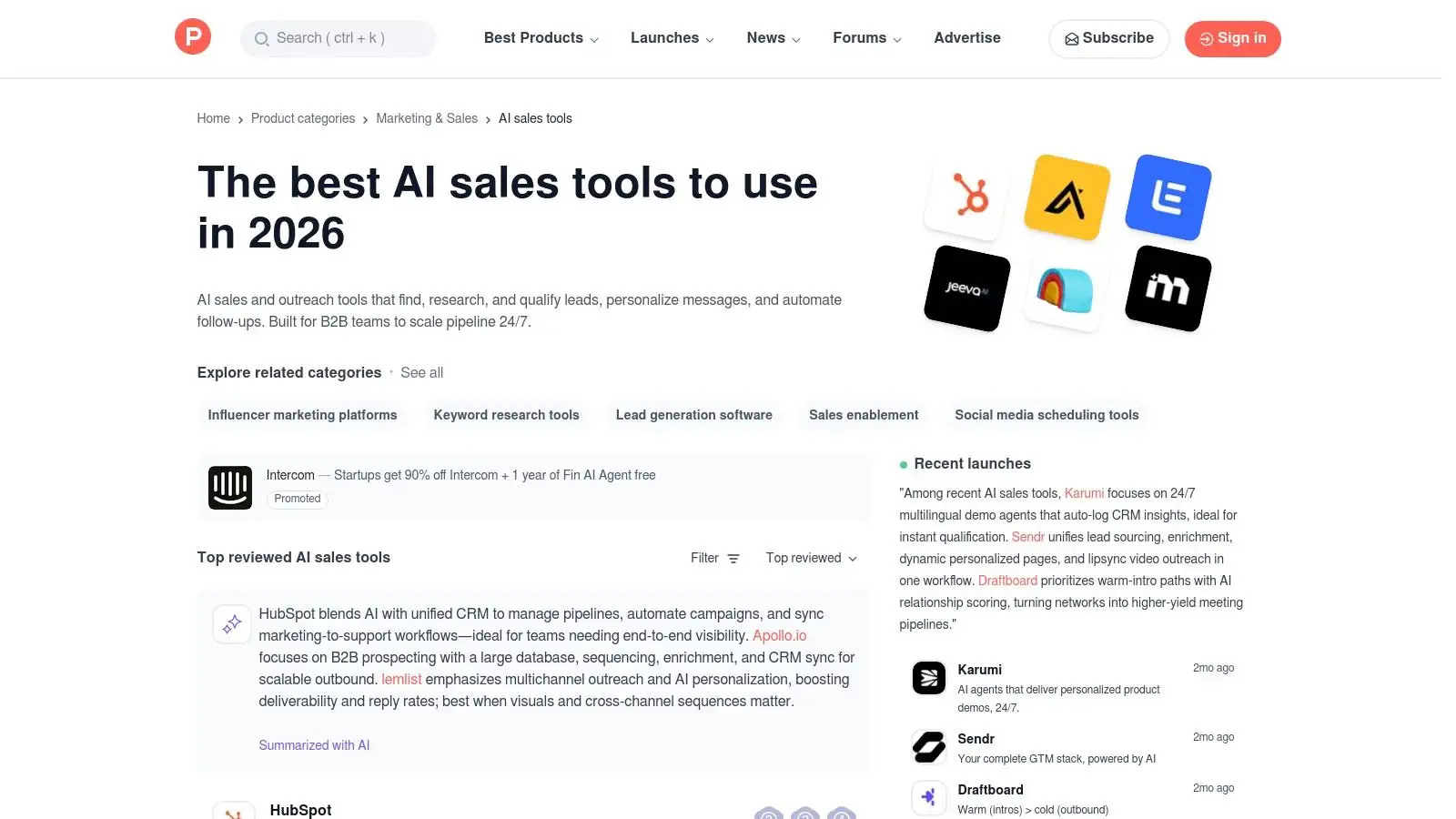
Product Hunt is a curation platform where new tech products are launched and ranked daily by community upvotes. It's a meritocracy of buzz, offering a real-time glimpse into the future of sales tech. You won't find deep enterprise vetting here; instead, you get direct access to the founders, raw community feedback, and a front-row seat to innovation.
Why It's Your Innovation Radar
Product Hunt's "AI Sales Tools" category is a treasure trove for discovering nascent technologies. It’s the place to find a niche Chrome extension that solves one specific, nagging problem or a full-fledged platform built on the latest GPT model. It’s less about exhaustive comparisons and more about serendipitous discovery.
Here’s what makes it a unique resource:
-
Launch Day Buzz: Catch tools on day one. You can see founder notes, watch their demo videos, and often snag early-adopter discounts.
-
Community Q&A: The comment section of each launch page is a goldmine. You can ask the makers direct questions and see what other early adopters are saying.
-
Trending Filters: Quickly sort by what's popular today, this week, or this month to see which tools are gaining momentum in the community.
How to Use Product Hunt Like a Pro
To find real gems, go beyond the daily leaderboard. Use the search function to look for specific keywords like "AI cold email," "prospecting," or "meeting notes." Follow "Makers" whose products you admire to get notified of their future launches.
Remember that upvotes don't always equal quality. A slick marketing video can generate a lot of hype, but the product might still be in a buggy beta stage. Use Product Hunt for discovery, then do your due diligence.
Pro Tip: Check out the "Collections" feature. Many users create curated lists like "Best AI tools for SDRs" or "Outbound Sales Stack." These collections can save you hours of searching and point you toward community-vetted products.
The platform is completely free to use. Just sign up for an account to upvote, comment, and create your own collections of your favorite finds.
Best For:
-
Founders & Indie Hackers: Keeping a finger on the pulse of the latest tech and spotting emerging trends.
-
SDRs & AEs: Finding innovative plugins and niche tools to gain a personal productivity advantage.
-
Tech-Forward Sales Leaders: Discovering disruptive tools to pilot with their teams before competitors do.
Product Hunt is an excellent starting point for finding new ways to streamline your pipeline. To dive deeper into how these tools fit into a broader strategy, you can explore the principles of automated lead generation.
5. Salesforce – AppExchange and AgentExchange
If your sales team lives and breathes Salesforce, then the AppExchange is your Jedi Temple. It’s the central, trusted source for extending your CRM's power, and now with AgentExchange, it’s become a full-blown deployment center for AI agents. Think of it less as a chaotic marketplace and more as a highly curated, heavily guarded vault of enterprise-grade AI sales tools.
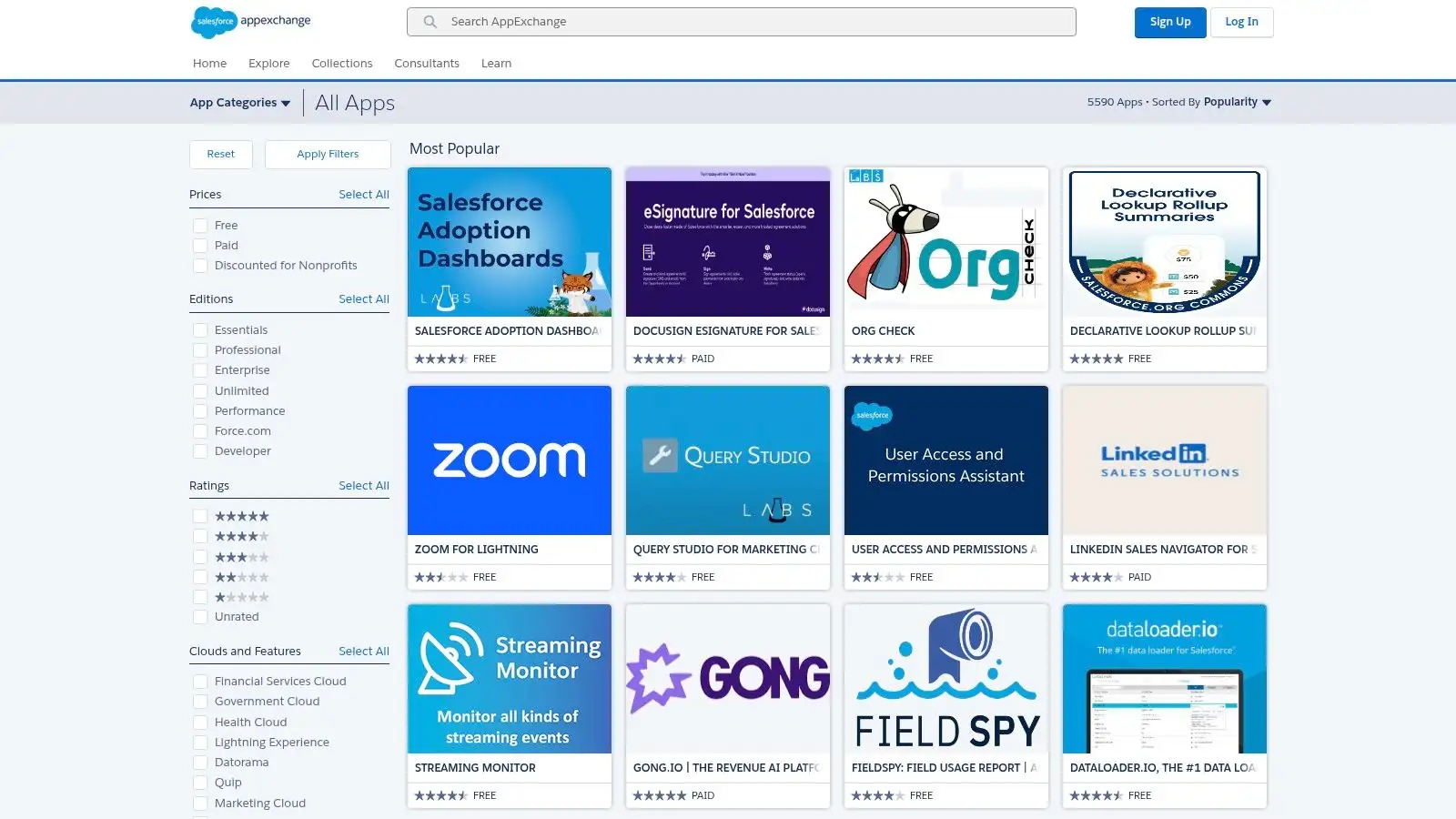
The AppExchange isn't just a list of apps; it's an ecosystem built on the Salesforce platform. This means any tool you find has gone through a rigorous security review and is designed to integrate seamlessly into your existing workflows. AgentExchange takes this a step further, offering pre-built AI agents for specific tasks that you can deploy directly within your Salesforce environment, no PhD in data science required.
Why It's Your Integrated AI Command Center
What sets the AppExchange apart is its native integration. You’re not just connecting another tool via an API key and hoping for the best. You're installing applications and deploying agents that are built to work within the Salesforce architecture. This eliminates data silos and simplifies procurement, billing, and security into a single, unified process.
The platform offers powerful ways to find the right solutions:
-
Curated Listings: Browse apps with detailed user ratings, pricing tiers, and release notes to see how often the tool is updated.
-
Prebuilt AI Agents: AgentExchange provides ready-to-deploy agents and actions for common sales and service scenarios, complete with governance and audit trails.
-
Native Installation: Provision licenses and manage single sign-on (SSO) directly from your Salesforce org, making scaling a breeze for your IT team.
How to Use AppExchange Like a Pro
To maximize your search, start with your biggest pain point. Is it forecasting accuracy? Lead scoring? Use the specific categories and filters to narrow down the options. Pay close attention to the "Highlights" section on each listing, which breaks down the app's core value propositions and integrations.
Pro Tip: Always check the "Reviews" tab and sort by "Most Helpful." Look for reviewers from companies similar in size and industry to yours. Their real-world experiences will tell you more about an app's day-to-day performance than any marketing copy ever will.
Access to browse the AppExchange is free, but the apps and agents themselves vary wildly in price. Many offer free trials, which you should absolutely take advantage of to test the tool within your own Salesforce instance before committing.
Best For:
-
Enterprise Sales Teams: Who need vetted, secure, and deeply integrated AI solutions.
-
Salesforce Admins & RevOps: Tasked with managing the tech stack and ensuring data integrity.
-
Companies Already on Salesforce: Who want to add AI capabilities without the headache of complex, third-party integrations.
The tools on AppExchange are a prime example of how AI can supercharge sales processes. You can learn more about how sales automation is changing the game.
6. HubSpot – App Marketplace and Breeze (HubSpot AI)
If your sales team lives and breathes HubSpot, then its App Marketplace is less of a shopping trip and more like grabbing a power-up in Mario Kart. It’s the native, integrated way to add new capabilities without straying far from your CRM home base. With the introduction of Breeze, HubSpot's own AI agent, it's also becoming a central command for automating some of the most tedious parts of sales.
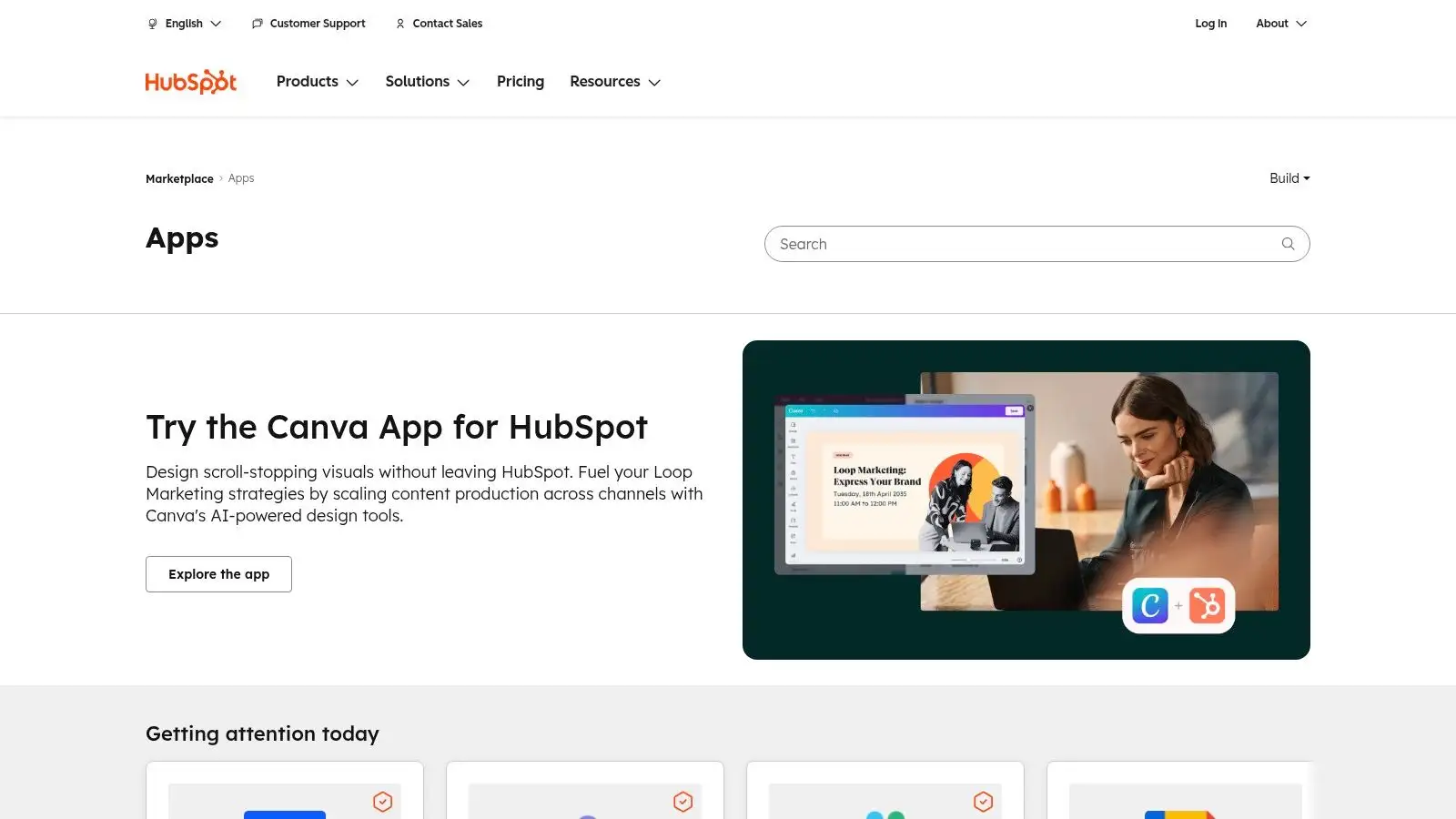
Think of it as your own personal Q, equipping your sales agents with a suite of gadgets that plug directly into the mothership. The marketplace is where you find both third-party apps and HubSpot's own AI-powered tools, designed to work seamlessly with your existing contact data and workflows. This is a one-stop shop for growth teams looking to enhance their existing HubSpot investment.
Why It's Your Integrated Power-Up
The core advantage here is the tight CRM integration. Installing an app is often a one-click affair, eliminating the complex setup and data-syncing headaches that come with standalone tools. This makes it one of the best AI sales tools ecosystems for teams that want immediate value without a lengthy implementation project.
The marketplace helps you find exactly what you need with helpful filters and collections:
-
Curated Collections: Discover "Essential Apps for Sales" or "New and Noteworthy" to see what other teams are adopting.
-
Breeze AI Agents: HubSpot's first-party tools, like the Prospecting Agent, are designed to automate research, find buying signals, and help personalize outreach using your own CRM context.
-
Clear Social Proof: See how many teams have installed an app, giving you a quick read on its popularity and market adoption.
How to Use the Marketplace Like a Pro
The key is to think "workflow first." Instead of browsing aimlessly, identify a bottleneck in your sales process. Is it prospect research? Is it writing follow-up emails? Then, search the marketplace for a solution that solves that specific problem.
Look for apps with deep, bi-directional sync capabilities. The goal is to enrich your CRM, not create another data silo.
Pro Tip: Pay close attention to the "Requirements" section on each app listing. Some apps require specific HubSpot subscription tiers (e.g., Sales Hub Professional or Enterprise) to function, so confirm compatibility before you get too excited.
Accessing the marketplace is free, but the apps themselves come with their own pricing models, ranging from free to tiered subscriptions. Costs can add up, so it's wise to budget for each new tool you add to your stack. Many of the AI agents are still in beta, so be sure to check for availability and usage limits.
Best For:
-
SMB & Growth-Stage Teams: Companies already standardized on HubSpot for their CRM.
-
SDR Teams: Quickly adding new tools for prospecting and outreach without leaving their primary platform.
-
Sales Ops: Evaluating and deploying vetted, integrated tools that minimize tech stack friction.
7. AppSumo – Marketplace deals on AI sales tools
Imagine a digital treasure chest where shiny new tech toys appear, but instead of costing a fortune, they're available for a one-time fee. That’s AppSumo for sales leaders. It’s less of a single tool and more of a bustling bazaar where emerging and often undiscovered best AI sales tools are offered up with jaw-dropping lifetime deals (LTDs). It’s the Costco of software: you go in for one thing and leave with an AI-powered outreach automator you never knew you needed.
AppSumo is a marketplace, not a developer. Its value proposition is simple: get your hands on promising new software for a fraction of the typical subscription cost. For sales teams looking to experiment without committing to a hefty annual contract, this is an absolute goldmine. You get to test drive the next potential game-changer while it’s still on the ground floor.
Why It's Your Secret Weapon for Budget-Friendly Innovation
What makes AppSumo a unique stop on your tool-hunting journey is the sheer thrill of the deal. The platform specializes in lifetime offers, where a single payment grants you access to a tool forever. This is perfect for locking in value on AI sales assistants, agent builders, or cold outreach platforms before they hit mainstream pricing.
The marketplace is a dynamic, ever-changing landscape:
-
Lifetime Deals (LTDs): Pay once, use forever. It’s the ultimate way to stretch your software budget, especially for core functions like AI-driven personalization or lead enrichment.
-
Generous Refund Policy: Most deals come with a 60-day money-back guarantee. If the tool doesn't live up to the hype or the UI feels like it was designed in 1998, you can get a full refund, no questions asked.
-
Centralized Management: All your purchases, license keys, and redemptions are handled in one place, making it easy to manage your experimental tech stack.
How to Use AppSumo Like a Pro
The key to winning on AppSumo is due diligence. Not every tool is a diamond in the rough. Scrutinize the user reviews on the deal page, paying close attention to questions asked of the founder. Is the support team responsive? Do they have a clear product roadmap?
Pro Tip: Look for the "Verified" and "Plus Exclusive" tags. Verified reviews come from actual purchasers, and Plus deals often represent more vetted, mature products. Also, check the founder's comment history on the deal page. An active and transparent founder is a huge green flag.
Browsing and buying on AppSumo is straightforward. Just be prepared for the temptation to buy everything that looks promising. The platform itself is free to use; you only pay for the deals you purchase.
Best For:
-
Founders & Startups: Gaining a competitive edge with powerful tools without the recurring SaaS bill.
-
SDR Teams on a Budget: Piloting new AI outreach and coaching tools at a low, fixed cost.
-
Sales Ops & RevOps: Experimenting with emerging technologies to find hidden gems for the tech stack.
AppSumo provides a low-risk environment to discover and test the AI tools that could become indispensable parts of your sales motion.
Top 7 AI Sales Tools Comparison
| Item | 🔄 Implementation complexity | ⚡ Resource requirements | ⭐ Expected outcomes / 📊 Impact | 💡 Ideal use cases | Key advantages |
|---|---|---|---|---|---|
| Munch | Low for basic setup; moderate if needing deep CRM syncs 🔄 | Subscription + credit limits; affordable tiers ($49–$249/mo) ⚡ | High data accuracy (≈95% email); typical ~3x pipeline growth ⭐📊 | SDRs, growth teams, founders, agencies needing fast campaign launch 💡 | Waterfall enrichment, real‑time intent, AI personalization at lower cost |
| G2 – AI Sales Assistant category | Minimal (browse & compare); some content behind sign‑in 🔄 | Free to browse; time investment for review reading ⚡ | Better shortlist quality via verified reviews; market presence signals ⭐📊 | Vendor shortlisting, peer validation, pre‑purchase research 💡 | Large volume of peer reviews, side‑by‑side grids, vendor links |
| Capterra – directory | Minimal (filter & shortlist) 🔄 | Free; quick visibility into starting prices ⚡ | Fast budget‑appropriate shortlists; decent feature filtering ⭐📊 | Quick vendor vetting when budget is a priority 💡 | Clear pricing snippets, sortable filters, broad coverage |
| Product Hunt – AI Sales Tools | Minimal; discovery-focused, lightweight pages 🔄 | Free; lightweight engagement with demos/community ⚡ | Early visibility on emerging tools; qualitative signals only ⭐📊 | Scouting new/innovative tools, early adopters, demos 💡 | Fast discovery of launches, founder notes, community Q&A |
| Salesforce – AppExchange / AgentExchange | Higher if not already on Salesforce; native installs streamline deployment 🔄 | Requires Salesforce org, procurement and license management (enterprise) ⚡ | Enterprise‑grade integrations, governance, audit trails; reliable at scale ⭐📊 | Enterprise sales teams using Salesforce seeking native AI agents 💡 | Deep CRM integration, security reviews, centralized procurement |
| HubSpot – App Marketplace & Breeze | Low–moderate when on HubSpot; Breeze agents simplify setup 🔄 | HubSpot subscription + app/agent costs; add‑ons may apply ⚡ | Quick CRM‑contextual automations and Prospecting agents; SMB growth impact ⭐📊 | SMBs and growth teams standardized on HubSpot for fast adoption 💡 | Tight CRM integration, first‑party agents, marketplace balance |
| AppSumo – Marketplace deals | Low for purchase; post‑purchase validation advised 🔄 | Low upfront cost; lifetime deals and refund window reduce risk ⚡ | Cost‑effective pilots; long‑term value varies by vendor ⭐📊 | Budget‑conscious teams piloting tools or seeking LTDs 💡 | Lifetime deals, 60‑day refunds, access to niche/early products |
So, Are You Ready to Let the Robots Help?
We've just zipped through a digital marketplace of the best AI sales tools, and if your head is spinning like a confused Roomba, that's completely normal. From the treasure troves of G2 and Capterra to the bleeding-edge launches on Product Hunt and the deep integrations within Salesforce and HubSpot, one thing is crystal clear: the age of manual, soul-crushing sales grunt work is over. The robots are here, and they’ve come bearing gifts of efficiency, personalization, and pipeline.
The main takeaway isn't that you need to adopt every single shiny new AI tool. That's a recipe for subscription fatigue and a tech stack more convoluted than the plot of Inception. The real goal is to find your perfect co-pilot. Think of it like assembling your own team of Avengers. You need the right hero for the right job. One tool might be your Hulk for smashing quota, while another acts as your Jarvis, intelligently orchestrating your outreach.
Your Next Mission: Choosing Your AI Sidekick
So, how do you pick the winner? It's less about finding the "best" tool and more about finding the best tool for you. Start by looking inward. No, not in a deep, meditative way, but by auditing your current sales process.
-
Where are the bottlenecks? Is your team spending half their day sifting through LinkedIn for leads? Is crafting personalized first-touch emails eating up valuable selling time? Pinpoint the single biggest time-suck in your workflow.
-
What's your budget? Are you a scrappy startup founder who needs maximum impact for minimal spend (hello, AppSumo deals)? Or are you a sales leader at a growth-stage company with a budget to build a robust, integrated system?
-
What does your current stack look like? If your team lives and breathes in Salesforce, starting your search on the AppExchange is a no-brainer. The same goes for HubSpot devotees. A tool that plays nicely with your existing CRM is worth its weight in gold.
Once you’ve identified your biggest pain point, you can move forward with a clear mission. If lead discovery and enrichment are your personal kryptonite, a platform like Munch, which combines discovery, enrichment, and AI personalization, is designed to solve that entire workflow from start to finish. If you’re just dipping your toes in the water, maybe a specific AI-powered copywriting assistant is the right first step.
Don't Just Buy, Strategize and Implement
Remember, buying the tool is the easy part. The real magic happens during implementation. This isn't a "set it and forget it" situation. You need a plan.
-
Start Small: Pick one or two high-impact tools. Don’t try to overhaul your entire sales process overnight.
-
Get Team Buy-In: Show your team how the new tool will make their lives easier, not just add another login to their password manager. Frame it as a way to help them hit their targets and make more money.
-
Use the Free Trials: Every tool on this list worth its salt offers a free trial or a demo. Use them religiously. Kick the tires, run a few real-world campaigns, and see if the user experience clicks with your team's workflow.
The world of AI sales technology is moving at the speed of light, but the fundamentals of good selling remain the same: building relationships and solving problems. The best AI sales tools are the ones that clear the administrative clutter, giving your team the time, data, and insights to do what they do best: sell. So go on, let the robots handle the boring stuff. Your commission check will thank you.
Ready to stop hunting for leads and start closing them? Munch combines lead discovery, data enrichment, and AI-powered personalization into one powerful platform, so you can build targeted lists and craft compelling outreach in minutes, not days. See why it’s one of the best ai sales tools for teams that want to build pipeline faster.