Unlocking Revenue with Artificial Intelligence in Sales

By Mriganka Bhuyan
•Founder at Munch
Use of artificial intellegence in sales is already a core part of the modern B2B toolkit and is the ultimate sidekick for every single person on your sales team. Its whole job is to handle the tedious, data-heavy "science" of selling, freeing up your reps to focus on what they do best: the "art" of it.
Your Sales Team Is Now Officially Part Cyborg
Welcome to the new world of sales, where your top performer might just be an algorithm. But if you’re picturing a machine replacing your best SDR, you’re missing the point entirely. This isn't about replacement; it’s all about augmentation.
Imagine giving your team a co-pilot that can instantly sift through mountains of data, spot a buying signal before anyone else, and even draft a killer, personalized email opener. That’s what AI in sales actually looks like today. It takes on the soul-crushing grunt work that eats up a rep's day, so they can get back to what actually moves the needle.
Beyond Automation to Augmentation
This is a really important distinction to make. Basic automation is just a set of dumb rules, like "send a follow-up email three days after the first one." AI, on the other hand, gives your sales process a brain. It can look at thousands of different data points and make a genuinely intelligent recommendation.
For instance, an AI tool might analyze a prospect's recent LinkedIn activity, their company’s new job postings, and a recent funding announcement to flag them as a high-intent lead. That’s not just automation; it's a strategic weapon that lets your team stop guessing and start selling with surgical precision.
The core idea is simple: AI handles the data analysis, pattern recognition, and repetitive tasks, so humans can master building relationships, strategic thinking, and closing complex deals.
Why Is This Happening Now?
The massive push toward AI in the sales world isn't just some passing trend; it's a strategic shift driven by cold, hard business results. In the crazy-fast world of B2B sales, companies are pouring cash into any tool that promises a real competitive edge. In fact, according to recent data, more than 50% of all corporate AI budgets are now being funneled directly into sales and marketing automation. That tells you exactly where leaders see the biggest payoff. You can discover more about AI investment trends in sales and marketing.
Think of this guide as your no-fluff playbook. We're going to break down exactly how you can use AI to:
-
Pinpoint leads who are actually ready to have a conversation.
-
Personalize your outreach at a scale that would make The Flash jealous.
-
Forecast your revenue with almost unsettling accuracy.
-
Build a sales engine that runs smarter, not just harder.
The Real-World AI Abilities That Will Change Your Sales Game
So, what does AI in sales actually do? Let's skip the jargon and the sci-fi fantasies. Think of AI as a set of practical superpowers you can hand your team, turning them from overworked reps into quota-crushing heroes.
Each of these "superpowers" targets a specific, soul-crushing part of the sales process and replaces it with something fast, smart, and frankly, a little bit magical. These aren't far-off concepts; they're tools you can use right now to completely change how you sell.
Let's break down the four core abilities that truly matter.
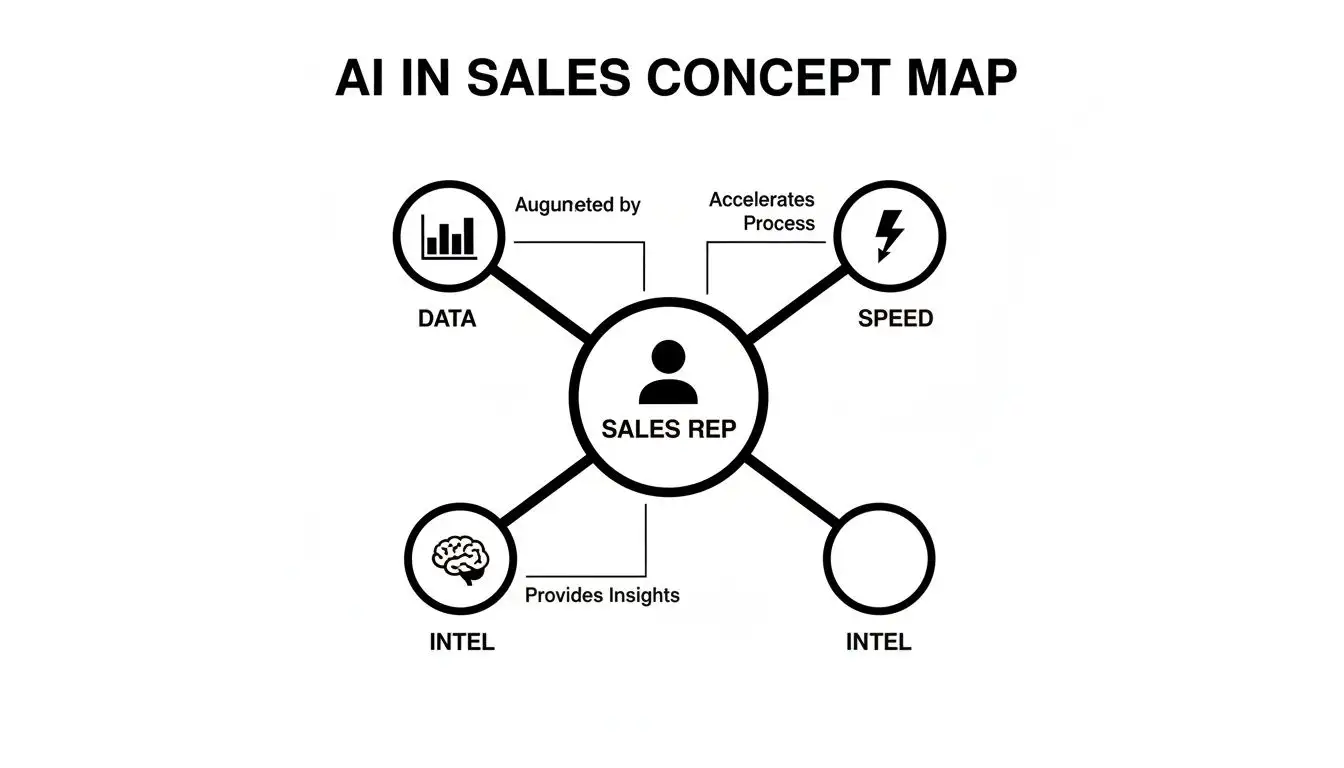
The image above gets it right: AI isn't here to replace salespeople. It's here to give them a massive boost.
Predictive Lead Scoring
First up is predictive lead scoring. This is your sales team’s crystal ball. Instead of just sorting leads by basic stuff like job title or company size, AI digs through thousands of data points to predict who is most likely to buy, right now.
Think of it this way: a traditional "good" lead is a Marketing Director at a 500-person tech company. An AI-scored "hot" lead is that same Marketing Director, but the AI also knows their company just hired a new VP of Sales, posted five new jobs for their growth team, and recently adopted a new CRM. The AI connects those dots for you and basically screams, "Hey, call this one first!"
Intelligent Data Enrichment
Next, we have intelligent data enrichment. This is your team's personal private investigator, working at computer speed. A rep starts with just a name and a company, and the AI instantly gets to work, finding and verifying everything else you need.
It scours the web to pull verified email addresses, direct-dial phone numbers, LinkedIn profiles, and recent company news. This one ability alone wipes out hours of manual Googling and data entry, turning a bare-bones lead list into a rich, actionable set of contacts. No more dialing dead numbers or getting bounce-backs.
AI transforms lead generation from a numbers game into a precision sport. Using AI for lead generation can boost conversion rates by a massive 25% while cutting down manual work by 15% or more.
That efficiency means a lower cost to acquire each customer and a much healthier pipeline. You're working smarter, not just harder.
AI-Powered Personalization
The third game-changer is AI-powered personalization. Let’s be real, nobody is impressed by "Hi [First Name]" anymore. This is where AI becomes your team's ghostwriter, crafting unique and relevant opening lines that prove you’ve done your homework, even when you haven't.
For example, an AI tool can scan a prospect's recent LinkedIn activity, their company’s latest press release, or a podcast they just appeared on. It then whips up a line like, "Saw your post on the challenges of scaling outbound teams and it really resonated..." It's the difference between a generic template that gets deleted and a message that feels like it was written by a human who actually cares.
Pro Tip: Use Munch to build your lead list, enrich their contact information and craft personalized outreach messages - all in one single platform!
AI Sales Forecasting
Finally, there’s AI sales forecasting. This is "Moneyball" for your sales leadership. Instead of relying on gut feelings and reps' overly optimistic pipeline reports, AI forecasting crunches the numbers on historical data, deal progression, individual rep performance, and even market trends.
The result is a shockingly accurate prediction of future revenue. This lets leaders allocate resources confidently, set realistic targets, and report to the board without crossing their fingers. It pulls the guesswork out of the equation and replaces it with data-driven certainty.
Let's look at how these AI capabilities stack up against the old way of doing things.
AI Capabilities vs Manual Sales Tasks
| Traditional Sales Task | The AI-Powered Upgrade | What This Means for You |
|---|---|---|
| Guessing which leads are best based on firmographics. | Predictive Lead Scoring analyzes thousands of buying signals in real-time. | Spend 100% of your time on leads that are actually ready to talk. |
| Hours of manual data entry and Googling contact info. | Intelligent Data Enrichment autofills profiles with verified emails and numbers. | More dials, more conversations, and a cleaner CRM without the grunt work. |
| Sending generic, templated outreach emails. | AI Personalization drafts unique openers based on a prospect's online activity. | Higher reply rates and conversations that start off on the right foot. |
| Relying on "gut feel" and rep estimates for forecasts. | AI Sales Forecasting uses historical data and deal analysis for accurate predictions. | Make smarter business decisions and stop guessing about hitting your number. |
As you can see, this isn't about minor tweaks. It's a fundamental shift in how sales teams operate.
For a closer look at the specific platforms that deliver these abilities, check out our guide on the top AI sales tools on the market today.
How AI Is Changing the Game in the Real World
Alright, enough with the theory. Let's get down to brass tacks and see how this stuff actually works on the sales floor. The real magic of AI in sales isn't some abstract, futuristic concept, it's in the daily grind, helping teams absolutely crush their numbers.
We're not talking about sci-fi fantasies here. These are real-world plays that are happening right now, giving reps and their managers an almost unfair advantage. Let's walk through a few.
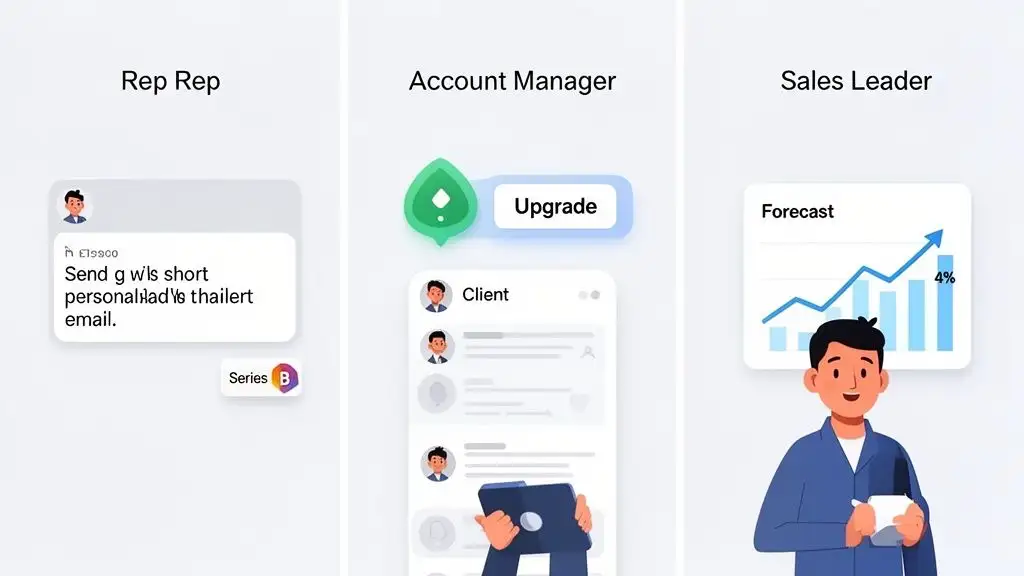
The Hyper-Targeted Outbound Campaign
Picture Sarah, an SDR. Her old routine was a painful grind. She'd spend hours manually sifting through company lists, trying to find a good fit. It felt like trying to find one specific person in the middle of a massive music festival by just yelling their name.
Now, Sarah’s got an AI sidekick. Her new playbook is slick and ridiculously efficient:
-
She drops a breadcrumb for the AI: "Hey, let me know when a North American software company lands a Series B funding round."
-
The AI gets to work: A few hours later, ping! A company announces its big funding news. The tool not only flags the company but also points out they hired a new Head of Sales just last month.
-
The grunt work is automated: The platform instantly digs up and verifies the new contact's direct email and phone number with 95%+ accuracy. No more guesswork or bouncing emails.
-
AI crafts the perfect icebreaker: It scans the funding announcement and suggests an opening line: "Congrats on the Series B! Saw your CEO mentioned scaling the go-to-market team. That's exactly where we come in."
In less than five minutes, Sarah goes from discovery to sending a personalized, highly relevant email. The reply she gets back? "Perfect timing. Let's talk next week." This strategy of finding perfectly-timed leads is a game-changer; our guide on automated lead generation explains how to set this up.
The Proactive Upsell Opportunity
Now let’s check in with Mark, an Account Manager. His world is all about keeping clients happy and finding ways to grow those accounts. Before, this was mostly based on gut feelings and the annual contract review. He was more of a firefighter, always reacting to problems instead of getting ahead of them.
Today, his AI-powered CRM sends him a notification. One of his biggest accounts just posted job openings for three new "Data Analysts." The AI knows this client isn't using the premium analytics feature in Mark's product, a feature built for, you guessed it, data analysis.
This is the ultimate conversation starter. Mark ditches the generic "just checking in" email and sends something with real value: "Saw you're building out your data team. Are you looking for a better way to dig into performance? Our premium analytics module was literally built for this."
It’s a timely, helpful conversation triggered by an intelligent signal. He's not being pushy; he's being a partner.
The Unshakeable Sales Forecast
Finally, let's look at Jessica, a sales leader. End-of-quarter used to be a nightmare of chasing reps for pipeline updates and just crossing her fingers. Her forecasts felt more like wishful thinking than solid predictions, leading to some very uncomfortable chats with the board.
Now, she uses an AI forecasting tool that dives deep into her CRM, analyzing everything:
-
Each rep's historical win rate
-
The average time it takes to close a deal
-
Engagement scores based on email and call logs
-
Broader market trends impacting their industry
The AI crunches all this data and spits out a quarterly revenue prediction with over 90% accuracy. Better yet, it flags at-risk deals that have gone quiet, letting Jessica jump in to coach her team before it's too late. She now walks into board meetings with confidence, armed with data instead of just hope. This is how artificial intelligence in sales turns chaos into predictable success.
How to Roll Out AI Without Causing a Skynet Uprising
Bringing AI into your sales stack doesn't have to feel like a scene from 'The Terminator'. I promise, you won’t have robots demanding your clothes, boots, and motorcycle. Instead, a successful rollout is a methodical process that turns a cool piece of tech into a revenue-generating machine.
The key is to sidestep the classic "shiny object syndrome." Don't buy an AI tool because it's the hot new thing; buy it because it solves a painful, specific problem that’s actively holding your team back.
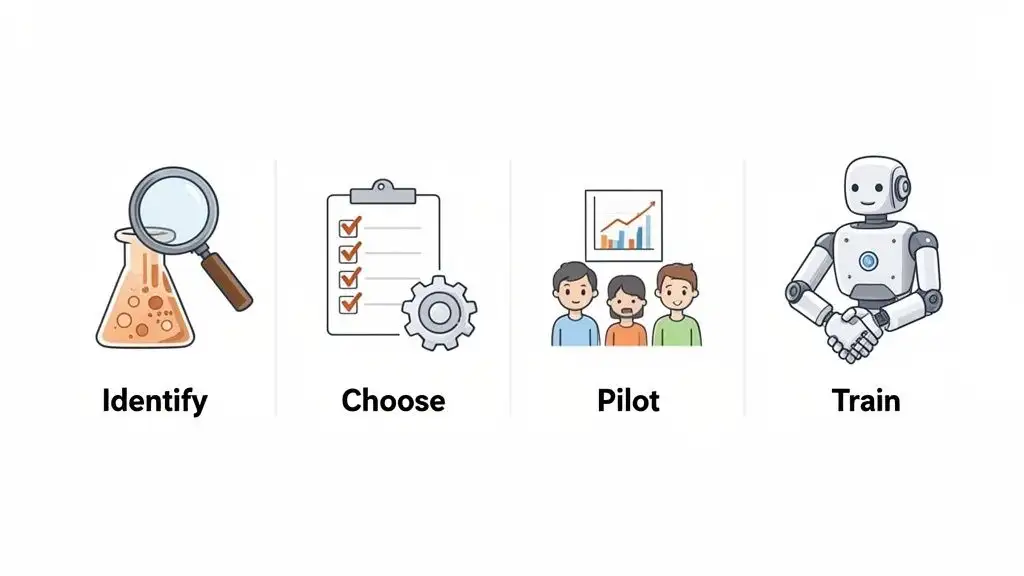
Step 1: Pinpoint Your Biggest Bottleneck
First things first, you need to play detective. Before you even think about watching a demo, you have to figure out where the biggest leaks are in your sales process. Don't start with the solution; start with the pain.
Is your team burning half their day manually digging through LinkedIn profiles? Is your CRM a graveyard of stale, unverified leads? Are your reps blasting out generic emails because they’re too swamped for real personalization?
The goal of AI isn't to be "futuristic." The goal is to fix what is currently broken or painfully slow. Pinpoint the single biggest time-waster or source of inefficiency in your sales motion and make that your target.
Once you know the problem, finding the right tool becomes infinitely easier. If manual research is the killer, you need an enrichment tool. If personalization is the hurdle, you need an AI copywriter. Start there.
Step 2: Choose the Right Tool for the Job
Now that you have a target, it's time to find your weapon. The market for artificial intelligence in sales tools is absolutely exploding. We’re talking a sector valued at $20.44 billion in 2024 and projected to rocket to a staggering $82.23 billion by 2030. This growth means you have plenty of options, but also a ton of noise to cut through. You can learn more about the rapid adoption of AI across business functions.
When you’re vetting vendors, zoom in on these critical areas:
-
Integrations: Does it play nicely with your CRM and sales engagement platform? A tool that doesn’t sync is just another data silo waiting to happen.
-
Data Accuracy: Get straight to the point and ask about their data verification methods. For something like email enrichment, anything less than a 95% accuracy guarantee should be a major red flag.
-
Ease of Use: If it looks like the cockpit of a space shuttle, your reps won't touch it. Find a tool that feels intuitive and slots right into their existing process. Our guide on how to create workflows can help you map this out.
Step 3: Start Small and Measure Everything
Whatever you do, don't unleash a new AI tool on your entire sales floor at once. That's a surefire recipe for chaos, confusion, and a revolt that would make ‘90s-era cyberpunk novelists proud. Instead, pick a small pilot group of two to four reps, ideally a mix of top performers and solid core players.
This approach lets you iron out the kinks in a controlled environment. Even better, it allows you to measure the impact with laser precision. Before you kick things off, get a clear baseline of your pilot team's current performance.
Then, track these key metrics obsessively:
-
Time Saved: How many hours per week are reps getting back from prospecting and research?
-
Activity Lift: Are they able to make more calls or send more personalized emails?
-
Engagement Improvement: Are reply rates and meeting-booked rates ticking up?
-
Conversion Lift: Are more opportunities from the pilot team converting to closed-won deals?
Armed with hard data, you can build a business case for a full rollout that even the most skeptical CFO can't argue with.
Step 4: Train Your Team to Trust the Machine (But Verify)
Finally, you have to manage the human element. The most powerful AI tool is worthless if your reps see it as a threat or a black box they don't understand. Frame the technology as a co-pilot, not an autopilot.
Train them to use AI suggestions as a smart starting point. An AI-generated email opener is a great time-saver, but a great rep will tweak it to add their own voice and personality. This "human-in-the-loop" approach is where the real magic happens, combining the sheer scale of machine intelligence with the irreplaceable nuance of human connection.
Common Mistakes and How to Avoid Them
With great power comes great responsibility... and maybe a few awkward, robotic email intros that make prospects cringe. Rolling out AI in your sales process is a massive advantage, but it’s surprisingly easy to get wrong. It’s a bit like giving a toddler the keys to a sports car. The results can get messy if you don’t set some ground rules first.
Let's break down the most common pitfalls that can turn a powerful sales engine into a soulless spam machine, and more importantly, how you can steer clear of them. Think of this as your guide to not becoming "that" company in your prospect's inbox.
Avoiding the Creepy Personalization Line
There's a very fine line between "cleverly personalized" and "uncomfortably stalker-ish." AI makes it incredibly easy to pull hyper-specific details about a prospect, but that doesn't mean you should use all of them.
Mentioning a prospect's recent company announcement? That's smart. Referencing the name of their dog from a vacation photo they posted three years ago? That's just plain creepy. It’s the difference between being a helpful researcher and being the sales equivalent of Joe Goldberg from You. You want to show you've done your homework, not that you've been hiding in the bushes outside their office.
A good rule of thumb: only reference publicly available professional information. Stick to their LinkedIn activity, company news, or industry awards. If it feels like a detail you’d only know from deep-diving their personal social media, leave it out.
Dodging the Over-Reliance on Automation
Remember when everyone on LinkedIn started sending that exact same connection request? "I noticed you're a [Job Title] at [Company Name] and thought I'd connect." That’s what happens when you let the machine take the wheel completely. You end up with a soulless outreach machine that alienates prospects faster than you can say "synergy."
Artificial intelligence in sales should be your co-pilot, not the autopilot. Its job is to serve up the perfect assist, not to take the shot for you. Here’s how to keep the human touch front and center:
-
Review and Refine: Never, ever send an AI-generated message without reading and tweaking it first. Add your own voice, your personality, and a genuine human insight.
-
Automate Tasks, Not Relationships: Use AI for the grunt work like finding data, scheduling meetings, and logging activities. Save the actual conversations and relationship-building for a real person.
The 'Bad Data In, Bad AI Out' Problem
This is the golden rule of AI, and it's not forgiving: your output is only as good as your input. Feeding your shiny new AI platform a diet of inaccurate, outdated, or incomplete data is like asking a Michelin-star chef to cook a gourmet meal with ingredients from a gas station. The result is going to be disappointing, and probably a little weird.
If your CRM is a graveyard of bounced emails and incorrect job titles, your AI will just get really efficient at contacting the wrong people with the wrong message. This makes a clean database non-negotiable. For a deeper dive, our guide on how to verify email addresses is a great place to start your data cleanup.
Ignoring Ethical Boundaries
Alright, let's talk about the elephant in the room. Just because AI can scrape data from all corners of the internet doesn't give you a free pass to ignore privacy and transparency. People deserve to know how their data is being used.
Be upfront about it. Don't try to hide the fact that you're using technology to make your outreach more relevant. Most people are fine with personalization as long as it’s helpful and not intrusive. The moment it feels sneaky or manipulative, you've lost their trust for good. Building a sales process on a foundation of respect is always the winning strategy.
So, What's Your Next Move?
Alright, let's bring this home. Where do you go from here? The world of AI in sales isn't some sci-fi fantasy waiting to happen; it's here, and it’s happening right now. The absolute worst thing you can do is sit on your hands and wait.
The big idea isn't that robots are gunning for your commission checks. It's that AI is ready to be the best damn sidekick your team has ever had, making them faster, sharper, and way more effective. Think of it as letting the machine crunch the numbers so your reps can focus on what they do best: being human.
Your Game Plan
If you’re a sales rep, your mission is simple: start using the tools that get rid of the soul-crushing admin work. Let an AI sift through data and fill in the blanks so you can spend your time mastering your pitch, handling tricky objections, and actually connecting with people.
If you’re a sales leader, you need to invest with purpose. Don't get distracted by the latest flashy gadget. Pinpoint the single biggest logjam in your sales process and find an AI tool that fixes it with a clear return on investment. That might mean getting better at predicting your pipeline or just making your team more efficient. A great starting point is exploring some of the top lead enrichment tools to see just how much research time you can get back.
The game has changed, but that’s a good thing. It’s an opportunity. With the right AI tools and a strategy that puts people first, your team won't just keep up, they'll set the pace.
This isn't about grinding harder; it's about working smarter. It’s less about the old-school hustle and more about operating with surgical precision.
The future is already here. Time to get in the game.
Frequently Asked Questions About AI in Sales
Jumping into the world of AI in sales can feel a lot like trying to assemble IKEA furniture without the instructions. You know the end result will be great, but the first few steps are a bit baffling. Let's tackle some of the biggest questions that always come up when teams start kicking the tires on this tech.
Think of this as your personal cheat sheet, minus the confusing corporate-speak.
Will AI Replace Sales Development Representatives?
Let's get this one out of the way first: absolutely not. This is the number one fear, but it comes from a deep misunderstanding of what AI is actually good at. AI is a world-class assistant, but it's a terrible conversationalist. It can't build real human rapport, think on its feet to solve a unique customer problem, or navigate the subtle cues of a negotiation.
So, what does it do? AI automates the soul-crushing parts of the job like manual data entry, the endless lead research, and the hours spent qualifying contacts. It takes the "robot" work off your reps' plates so they can focus on what they do best: being human and selling. It turns good reps into great reps, and great reps into absolute legends.
How Do I Know If My Company Is Ready for AI?
You're probably ready if any of these sound painfully familiar. Is your team drowning in manual tasks instead of actually talking to prospects? Are your inbound leads a mixed bag of gold and garbage, with no easy way to tell them apart? Are your reps sending the same generic email templates to everyone because they just don't have time for personalization?
If you’re hitting bottlenecks that are slowing down your sales cycle and putting a ceiling on what your team can achieve, you’re ready. The trick is to start small. Pinpoint your single biggest headache and find an AI tool designed to fix that specific problem.
How Much Does It Cost to Implement Sales AI?
The price range for AI tools is massive. We're talking everything from a cheap lunch to a down payment on a house. You've got massive, enterprise-level platforms with price tags that'll make your finance team break out in a cold sweat. But you also have a growing number of powerful, user-friendly SaaS tools that are shockingly affordable.
The real question isn't "What does it cost?" but "What's the ROI?" A tool that costs $100 a month per user might seem like an expense, but if it saves each of your reps five hours a week and helps them book two extra meetings, it pays for itself before the first invoice is even due. Focus on the value, not just the sticker price.
What Is the Difference Between AI and Automation?
Great question. People throw these terms around like they're the same thing, but they're fundamentally different.
Here’s a simple way to think about it:
-
Automation is a simple "if-then" command. It’s like setting a smart light to turn on at sunset. "If a prospect downloads our ebook, then send them this specific email." It’s a dumb, loyal worker bee that just follows the rules you set.
-
AI is the brain that decides what the rules should be. It analyzes thousands of data points to predict which leads are most likely to buy, what email subject line will get the best open rate, or when the perfect time to call a prospect is.
Automation executes the command; AI figures out the smartest command to execute.
Ready to stop guessing and start selling with precision? Munch is the all-in-one sales intelligence platform that combines lead discovery, data enrichment, and AI-powered personalization. Find high-intent prospects and launch outreach that gets replies. Sign Up Today!