Artificial Intelligence Sales Tools Unlocking Your Revenue Potential

By Mriganka Bhuyan
•Founder at Munch
Let's talk about AI sales tools. What are they, really?
These are software platforms designed to take the tedious, repetitive, and often soul-crushing parts of sales off your team's plate. They help you find prospects, tailor your pitch, and ultimately, close deals faster. It’s the difference between handing your team a shovel to dig for gold and giving them a treasure map with an "X" that marks the spot.
Your Sales Team Needs an Upgrade, Not Another Spreadsheet
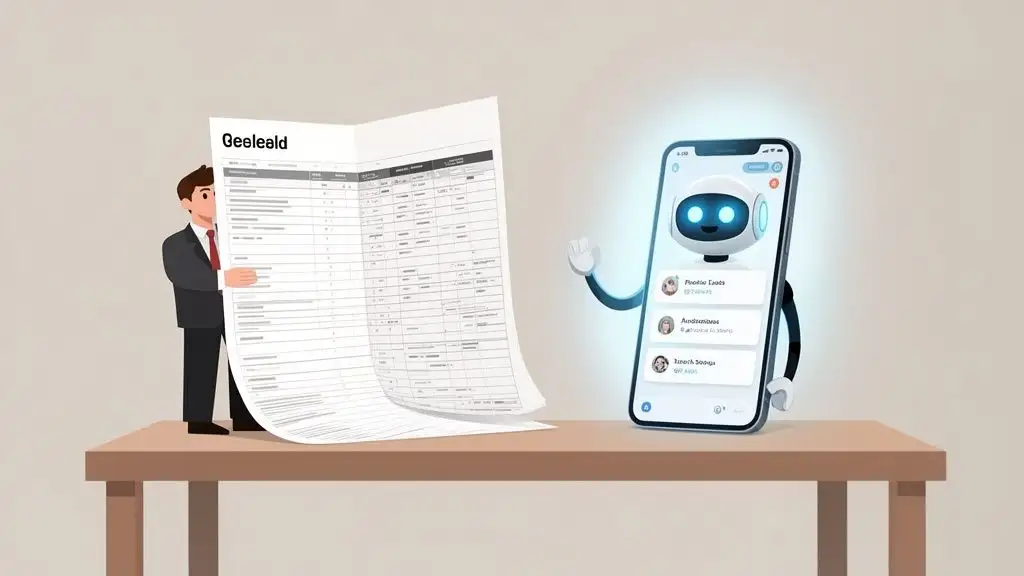
Let’s be brutally honest for a second. Far too many sales teams are still held together by spreadsheets and sheer willpower. While that old-school hustle is admirable, it’s like showing up to a Formula 1 race with a go-kart. You might be a great driver, but you’re not going to win.
Your reps are burning precious hours on mind-numbing tasks: endlessly scrolling through LinkedIn, guessing email formats, and blasting out generic messages that get deleted on sight. It’s a grind, and it’s holding you back.
This is exactly where artificial intelligence sales tools come in to save the day. This isn't some futuristic, sci-fi concept. We’re talking about practical, ready-to-use platforms that fundamentally change how your team operates. It's less I, Robot and more Iron Man, giving your team a super-powered suit to do their jobs with more speed, precision, and impact.
Automating the Grind So Reps Can Actually Sell
What if your best rep could clone themselves? Imagine one clone spending all day finding companies that just landed a huge round of funding. Another clone would be busy spotting businesses that are hiring for a key role your product is perfect for. A third would be writing a perfectly personalized opening line for every single outreach email.
That’s basically what AI does.
These tools put the most tedious parts of the sales cycle on autopilot. We're talking about:
-
Prospect Discovery: Instead of just guessing, AI actively scans the internet for real buying signals. For example, it can flag a company that just hired a new VP of Sales or an executive posting on LinkedIn about a problem your software solves.
-
Data Entry: Kiss manual CRM updates goodbye. AI tools can automatically find and fill in missing contact details, from verified emails and direct dials to company firmographics.
-
Repetitive Outreach: The follow-up is everything, but it’s also the first thing to get dropped when things get busy. AI can handle the initial outreach and persistent follow-ups, making sure no lead ever falls through the cracks.
The real magic here is that AI turns sales from a guessing game into a science. It uses data to tell you who to contact, what to say, and when to say it, massively stacking the odds in your favor.
The market is screaming this from the rooftops. The global sales intelligence market, which is almost entirely fueled by AI, exploded to USD 4.85 billion in 2025 and is on track to hit USD 5.37 billion in 2026. And it’s not stopping there; projections are aiming for a staggering USD 12.45 billion by the mid-2030s. This crazy growth, highlighted in reports from firms like Fortune Business Insights, shows just how essential platforms like Munch are becoming for any serious B2B sales team.
By bringing these tools into your stack, you start building predictable pipelines and repeatable processes. For a closer look at getting that structure right, check out our guide on how to create workflows that can actually scale with you. This isn't about just adding another piece of software; it's about building a smarter, more powerful sales engine.
The Five Core Powers of AI Sales Tools
To really get what artificial intelligence sales tools can do, stop thinking of them as just another piece of software. Picture them as the Infinity Stones for your sales team. Each one gives you a specific, earth-shattering power that, when brought together, makes your reps practically invincible. Let's cut through the marketing fluff and get real about what these powers are and how they fix the daily headaches that make reps want to flip their desks.
This isn't just a minor upgrade; it's a complete shift in how the sales game is played. The market growth proves it. We’re looking at the AI in sales sector exploding from an estimated USD 8.8 billion in 2025 to a staggering USD 63.5 billion by 2032. Why the massive jump? Because companies are pouring over half of their AI budgets into sales and marketing automation, and they're seeing a clear return. You can check out this detailed analysis of the AI in sales market to see just how fast this rocket ship is moving.
Prospect Discovery: Finding New Worlds of Customers
Old-school prospecting feels like trying to find a specific person in a packed stadium by just yelling their name. You’re loud, you’re not getting anywhere, and you're mostly just annoying people. AI-powered prospect discovery is like slipping on a pair of heat-seeking goggles that only light up the people who are already waving back at you.
Instead of working off stale, generic lists, these tools scour the web for real-time buying signals.
-
Job Changes: A new VP of Sales just landed at a dream account? They’ve got a fresh budget and a mandate to shake things up. AI flags this the moment it happens.
-
Funding Announcements: A startup just locked in a $20 million Series B? They're about to go on a spending spree. AI gets them on your radar the day the news drops.
-
Technology Usage: Did a company just ditch a competitor's software? That's your Bat-Signal. Time to swoop in.
This isn't just another list of names. It’s a living, breathing feed of genuine opportunities, letting your team quit chasing ghosts and focus only on the accounts that are actually showing signs of life.
Data Enrichment: Turning Contacts into Rich Profiles
Okay, so you've found a name and a company. Great. Now comes the painful part: the digital detective work to find out how to actually reach them. This is where data enrichment tools step in, acting like an all-knowing oracle, but for B2B data.
You feed it a name and a company, and it hands back a goldmine of verified info, like a direct-dial phone number and a work email with 95%+ accuracy. Say goodbye to bounced emails and soul-crushing dial tones. The whole process takes a cold, basic contact and transforms it into a warm, actionable lead. To really get into the nuts and bolts, you can learn more about how artificial intelligence and sales join forces to make this magic happen.
AI-Powered Personalization: Getting Inside Their Head
Generic outreach is dead. An email that kicks off with "Dear Sir/Madam" is the modern-day equivalent of a dial-up modem screech: instantly irritating and completely obsolete. AI personalization tools help you write messages so spot-on, they feel like they came from a trusted colleague.
The goal isn't just to know their name and company. It's to know the project their team just launched, the article they shared on LinkedIn last week, or the award their company just won.
For instance, an AI tool can scan a prospect's recent LinkedIn activity and spit out an opener like, "Saw your post on scaling engineering teams and loved your point about asynchronous communication." Boom. That’s a conversation starter, not a sales pitch. It shows you’ve done your homework, even when the AI did it for you. This is how you book meetings in a world where everyone's inbox is a war zone.
Pro Tip: Munch analyzes multiple points and researches your leads including analyzing their LinkedIn posts, research about the company and latest news about the company and crafts personalized outreach messages in minutes!
Time to Pick Your Weapon: A No-Nonsense Guide to AI Sales Tools
Alright, let's get to the good stuff. Diving into the world of AI sales tools feels a lot like walking into a massive arcade. Every machine is flashing, making noise, and promising to be the one that gets you the high score. To save you from burning through your budget on demos and getting stuck in analysis paralysis, we're going to break down the top contenders, category by category.
Think of this as your personal buyer's guide. We're taking a straight-up look at the key players in lead discovery, data enrichment, and personalization. We’ll cover what they actually do, who they're built for (from a founder grinding it out in a garage to a massive enterprise team), and what makes them awesome versus what might make you want to punt your laptop across the room.
It's helpful to visualize how these pieces fit together. A central AI engine is the brain behind the whole operation, driving the three core functions that turn strangers into customers.
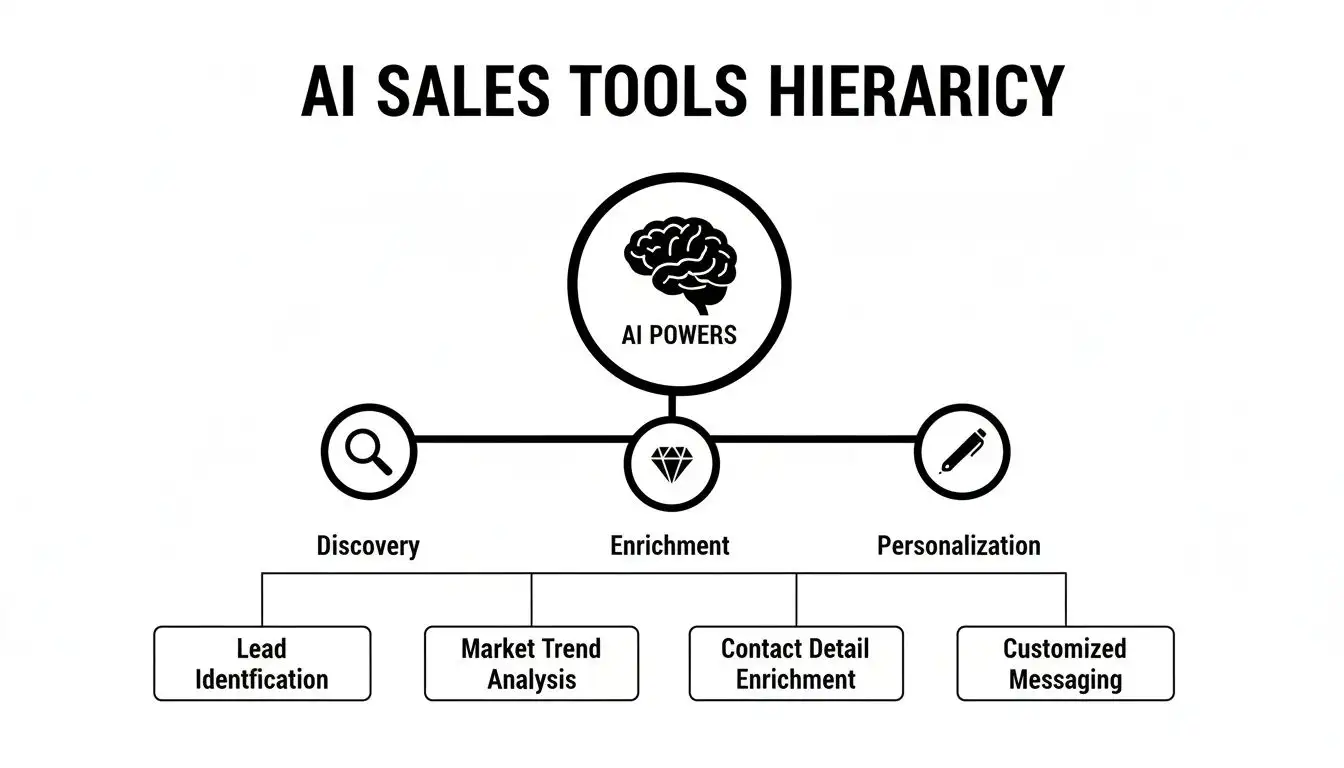
The big takeaway here? These aren't separate, isolated tasks. They're all part of a connected system, with a powerful AI weaving them all together to create a seamless workflow.
To make this even clearer, let's line up the heavy hitters side-by-side.
The Lead Discovery Champions
Think of these tools as your team of scouts. You send them out into the vast wilderness of the internet to find high-value targets. They don't just come back with a list of names; they bring back genuine opportunities.
-
Apollo.io: This one is a veteran in the sales game. Its main claim to fame is its absolutely massive database of contacts. It’s like the Costco of lead data: you get a ton for your money. Its AI sifts through millions of profiles to find matches for your ideal customer and flags some basic buying signals.
-
Best For: Teams that need sheer volume and have the manpower to qualify a large list.
-
Pros: Huge database, very affordable entry-level plans, decent filtering.
-
Cons: Data accuracy can be a real coin flip, and the most valuable intent signals are often locked behind the expensive plans.
-
-
ZoomInfo: If Apollo is Costco, ZoomInfo is the high-end, members-only boutique. It's famous for data accuracy, especially when it comes to getting those precious direct-dial phone numbers. Their AI is all about pinpointing "in-market" buyers by tracking intent signals across the web.
-
Best For: Enterprise teams with deep pockets who simply cannot afford to waste time on bad data.
-
Pros: Best-in-class data accuracy, deep company insights, powerful intent data.
-
Cons: The price tag will make your CFO break out in a cold sweat. It's a major investment.
-
-
Munch: Here's the smart, agile new player that's all about quality over quantity. Instead of just giving you access to a giant, static database, Munch's AI is constantly scanning for over 100 verified buying signals in real-time. It’s less about finding everyone and more about finding the right one, right now. Think sniper rifle, not shotgun.
-
Best For: Lean teams, startups, and founders who need to be ruthlessly efficient and can't afford to chase low-intent leads.
-
Pros: Laser-focused on high-intent signals (like new funding or job changes), a unified workflow, and it’s brilliant for building a predictable pipeline.
-
Cons: The contact database isn't as gigantic as Apollo's, but every lead it finds is far more likely to be a real opportunity.
-
Data Enrichment Demystified
So, you've got a name. Now what? The next mission is to get their actual contact info. Data enrichment tools are the Q to your James Bond; they give you the gadgets (verified emails, phone numbers, job titles) you need to actually start a conversation.
The biggest issue with standalone enrichment tools is the sheer friction they create. You find a prospect in one tab, then copy-paste their name into another tool to find their email. This workflow is slow, clunky, and a breeding ground for mistakes.
This is exactly why a unified platform like Munch is such a game-changer. It smashes discovery and enrichment into a single, seamless step. When the AI surfaces a high-intent lead, it's already enriched it with a verified email boasting 95%+ accuracy. If you want to go deeper on this, check out our guide on the best lead enrichment tools and how they fit into a modern sales process.
The Personalization Powerhouses
You've found the right person and you have their email. The final boss battle is writing an outreach message that doesn't sound like it was spit out by a 1990s chatbot. AI personalization tools analyze a prospect's data to help you craft an opening line that actually gets a reply.
-
Lavender: This tool is like having a tiny sales coach living inside your inbox. Lavender analyzes your emails as you write them, giving you a score and real-time suggestions for improvement. It helps you cut the fluff, avoid spam trigger words, and personalize based on social data it pulls in.
-
Best For: Reps who are serious about improving their writing and email performance.
-
Pros: Real-time coaching is amazing for skill development and building better habits.
-
Cons: It's a coaching tool, not an all-in-one outreach platform. You still need other tools to find and send to leads.
-
-
Jasper AI: Originally a beast in the marketing content world, Jasper has made a strong move into the sales space. It can generate creative copy for just about anything, including cold outreach emails. You feed it the context and the key points, and it spins up the creative flair.
-
Best For: Teams that need to produce a high volume of creative copy across both sales and marketing.
-
Pros: Incredibly versatile and can generate some surprisingly good creative copy.
-
Cons: If your prompts aren't super specific, the output can feel a bit generic. It's not purpose-built to write based on sales signals.
-
How to Implement AI Without a Team Meltdown
Alright, you’ve picked out your shiny new AI sidekick. Now for the real challenge: getting your team to actually use it without staging a mutiny. Let’s be honest, dropping new tech on a sales team can make people feel threatened, confused, or just plain annoyed.
The trick is to make it feel less like a hostile robot takeover and more like Tony Stark getting his first Jarvis upgrade.
First thing's first: manage expectations. No, this AI isn’t going to close a seven-figure deal on its first day. It's an incredibly powerful tool, not a magic wand. Be realistic and set clear goals for the first 30, 60, and 90 days.
Maybe the initial goal is just to cut the time reps spend on manual data entry by 20%. Or perhaps it's boosting email open rates by a modest 5%. These small, early wins are crucial for building momentum and showing everyone this thing actually works.
Get Your Team Onboard
Team buy-in is everything. If your reps see the new tool as another top-down mandate to track their every move, they will fight it every step of the way. You have to frame it as a superpower that makes their lives easier, not a Big Brother bot looking over their shoulder.
The best way to do this is to get right to the point: the "what's in it for me?" factor. Show them exactly how the AI helps them hit their commission goals faster.
-
Less Admin, More Selling: Pitch it as a personal assistant that handles the grunt work. "This tool will find verified emails and log your activities automatically, giving you back five hours a week to actually talk to people and close deals."
-
Smarter Prospecting: Explain how it serves up warmer leads on a silver platter. "Instead of randomly dialing a cold list, the AI will feed you leads who just got funding or are hiring for roles your product is perfect for."
-
Better Conversations: Show off the personalization features. "It’ll give you the perfect icebreaker for every email, so you can stop staring at a blinking cursor and start booking more meetings."
When you position the tool as a straight line to a bigger paycheck and less tedious work, you'll have cheerleaders instead of critics.
Start Small, Win Big
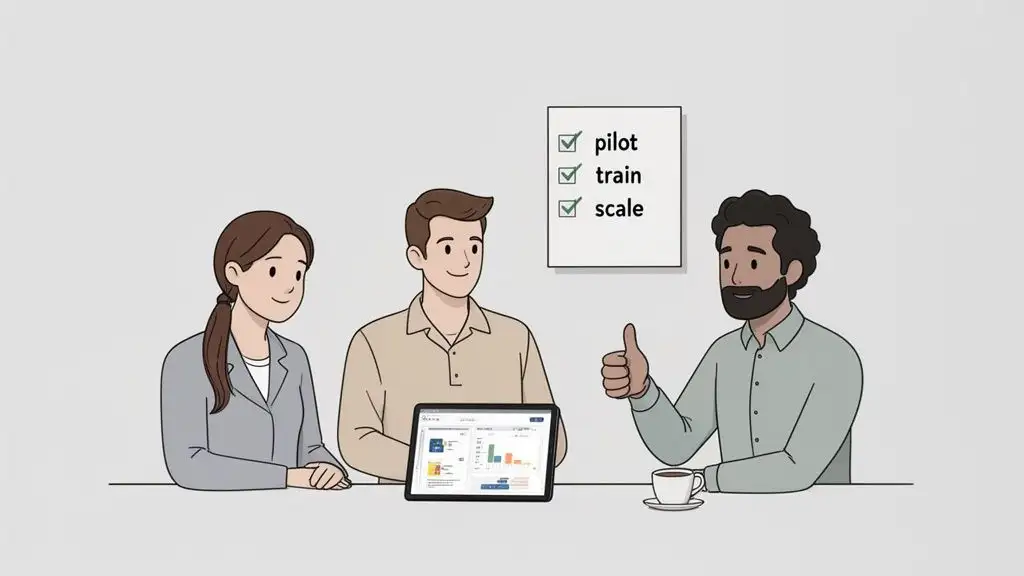
Whatever you do, don't try to boil the ocean. A "big bang" rollout where everyone gets the tool at once is a recipe for chaos. The smart play is to start with a small, controlled pilot program.
Pick a handful of your most tech-savvy and open-minded reps to be your champions. Let them test-drive the tool, give you honest feedback, and become your internal experts. Once they start crushing their numbers and telling their peers about it, adoption will spread like wildfire.
The goal is to create a success story, not a support-ticket nightmare. Focus on one high-impact use case first, like automating lead scoring or personalizing the first email in a sequence. Nail that, then expand.
The data backs this up, big time. Sales teams that properly integrate AI are seeing huge results, with 54% reporting direct efficiency gains and productivity boosts of up to 40%. Those improvements can also lead to 25% shorter sales cycles, completely changing how fast you bring in revenue. You can dive deeper into the powerful stats behind AI in sales to see the full picture.
Once your pilot group is humming along, create simple, crystal-clear Standard Operating Procedures (SOPs). I'm not talking about 50-page manuals nobody will read. Think simple checklists or short video tutorials showing exactly how to use the tool for key tasks. To learn more about setting up these workflows, check out our guide on building a scalable sales automation process. This structure makes sure everyone uses the tool correctly and consistently, turning your new tech into a reliable part of your sales engine.
So, Should You Just Get an All-in-One Platform?
After diving into all these specialized artificial intelligence sales tools, you might feel like a kid in a candy store with only a dollar. Do you buy the awesome discovery tool? The enrichment gadget? Or the super-smart personalization writer?
The truth is, you often need all of them. This is the point where your tech stack starts to look like a messy Frankenstein's monster, and your sales team gets lost trying to manage it all.
This is exactly where an all-in-one platform strolls in, looking less like a single tool and more like a Swiss Army knife for your entire sales motion. Instead of trying to duct-tape three different subscriptions together and pray they work, a unified platform rolls all the critical functions into one smooth workflow.
The alternative? Chaos. Your reps find a lead in one system, flip to another tab to hunt for an email, then jump into a third to actually write a personalized message. It's a workflow bogged down by friction, wasted minutes, and data that gets lost in translation between browser tabs.
The Magic of a Unified Workflow
An all-in-one platform like Munch is built on a simple but game-changing idea: the best sales process is a connected one. It merges the three most vital jobs into a single, fluid motion.
-
Find High-Intent Leads: It all starts with scanning over 100 verified buying signals in real-time. We're not talking about stale, cold lists here. This is about spotting companies that are actively waving their hands in the air, showing they need a solution like yours right now.
-
Instantly Get the Details: As soon as a high-intent lead is flagged, the platform automatically enriches it with a verified email boasting 95%+ accuracy. No more manual sleuthing or copy-pasting.
-
Write Killer Personalized Outreach: Finally, the AI uses that buying signal as the perfect icebreaker to draft a hyper-relevant, personalized email that people actually want to reply to.
This completely connected approach means your reps can go from spotting a trigger event to hitting "send" on a perfectly tailored message in minutes, not hours. The whole process is designed to eliminate the constant context-switching that absolutely murders productivity and morale.
Think of it this way: Juggling multiple tools is like trying to build a car with parts from a Toyota, a Ford, and a lawnmower. It might technically run, but it’s going to be wildly inefficient and probably break down. An all-in-one platform is like getting a brand-new, factory-built Tesla where every single part is designed to work together in perfect harmony.
When an All-in-One Just Makes Sense
Let’s get out of theory and into the real world. A unified platform isn't just about making life easier; it's about unlocking some serious growth.
Take a founder trying to build a predictable pipeline from scratch. An all-in-one is a total lifesaver. Instead of blowing a limited budget on three separate tools, they can use one platform to find their first 50 high-intent customers, get their accurate contact info, and send personalized outreach, all without needing a full-time sales team yet. We dig into this strategy more in our guide to B2B lead generation software.
Or what about a seasoned sales rep trying to triple their meeting booking rate? Instead of drowning in a generic database, they can set up alerts for specific, high-value triggers. For example, the second a target account hires a new VP of Marketing, the platform pings them, hands over the new VP's verified email, and helps them write a clever congratulatory message.
That single, perfectly timed message is infinitely more powerful than 100 cold calls. It’s the very definition of working smarter, not harder.
The real win with an all-in-one isn't just having a bunch of features under one roof. It’s about how those features work together to create a workflow that is faster, smarter, and way more effective than the sum of its parts.
A Few Lingering Questions You're Probably Asking
Alright, we've covered the tools and the tactics, but I bet there are still a few questions bouncing around in your head. It's totally normal. Let's tackle the big ones head-on so you can move forward with confidence.
Is an AI Going to Steal My Job?
Let's get this one out of the way. Short answer: no. But, and this is a big but, it will absolutely replace salespeople who refuse to adapt and use it.
Think of it this way: this isn't a Terminator scenario where Skynet is coming for your commission checks. It's more like Jarvis becoming an indispensable part of Tony Stark's Iron Man suit. AI is your new, insanely efficient sidekick.
It swoops in to handle the soul-crushing, repetitive tasks that make your eyes glaze over: the data entry, the endless lead research, the scheduling grind. This frees you up to do what humans are irreplaceable for: building genuine relationships, solving complex customer problems, and closing those big, strategic deals. AI is brilliant at sifting through mountains of data to tell you who to call and when, but you're the one who builds the rapport that actually seals the deal.
Salespeople who embrace artificial intelligence sales tools will run circles around those still clinging to their spreadsheets. They’ll become strategic advisors, not just quota-chasers.
So, What's the Damage? How Much Do These Tools Cost?
The price range for these tools is all over the map. It’s like comparing the cost of a fancy cup of coffee to a brand-new car. There's a solution for pretty much every budget, so it's really about finding the right fit for your team.
-
Simple, single-purpose tools: You can get started with these for as little as $20 to $50 per user, per month. This could be a basic email finder or a simple writing assistant.
-
All-in-one platforms: A unified platform that handles discovery, enrichment, and personalization, like Munch, often has entry-level plans starting around the $49 per month mark.
-
Enterprise-grade solutions: For large teams needing deep intent data and a whole suite of advanced features, these can easily climb into the hundreds or even thousands of dollars per month.
The price tag isn't the most important number to look at. The real question is about return on investment (ROI). If a tool costs you $100 a month but helps you close one extra $5,000 deal, it's paid for itself 50 times over. Always look for transparent pricing and plans that can scale with you as you grow.
Okay, But How Long Until I Actually See Results?
You won't go from zero to sales hero overnight, but the good news is you can see real, tangible results surprisingly fast. This isn't like waiting years for the final season of a TV show only to be let down. The payoff here is much quicker and far more satisfying.
For tools focused on data accuracy and enrichment, the benefits are immediate. In the very first week, you'll see fewer bounced emails and save hours of mind-numbing manual research. That’s a win you can feel right away.
For lead discovery and outreach automation, you can expect to see higher-quality leads and better reply rates within the first 30 to 60 days. This is the sweet spot where you're fine-tuning your messaging and figuring out what really works.
The truly massive impact, however, comes from consistent use over time. The AI models learn from your team’s actions, so the longer you use a platform, the smarter its recommendations get. A realistic timeline is seeing a measurable jump in your key metrics, like meetings booked and pipeline generated, within the first quarter. It’s an investment that keeps paying bigger and bigger dividends.
Ready to stop chasing dead-end leads and start closing deals with prospects who are actually ready to buy? Munch unifies high-intent lead discovery, 95%+ accurate enrichment, and AI-powered personalization into one seamless workflow. Build your predictable pipeline today.