Mastering Sales Artificial Intelligence For B2B Success

By Mriganka Bhuyan
•Founder at Munch
Sales AI is about giving your team a super-soldier serum. It’s smart software that automates the soul-crushing repetitive tasks, crunches data to pinpoint your best leads, and helps you personalize outreach at scale.
It’s less of a hostile takeover and more of an incredibly smart sidekick, like Watson to Sherlock Holmes, but for your CRM.
What Is Sales Artificial Intelligence, Really?

Sales artificial intelligence isn't some futuristic fantasy; it's technology that sales pros are using right now to find better prospects and close deals faster. It’s the ultimate co-pilot, handling the tedious grunt work that burns out even the most seasoned reps.
Think of it like having a research assistant who never sleeps, has read the entire business internet, and can spot a buying signal from a mile away. That's sales AI.
This Isn’t Your Dad’s Automation
It's crucial to understand that sales artificial intelligence is a massive leap beyond basic automation. Old-school automation is like setting a timer on your coffee maker. It follows a simple, pre-set rule: at 6 AM, start brewing. It's helpful, but it's not smart.
Sales AI, on the other hand, is like a personal barista who notices you've been working late and suggests an extra shot of espresso. It learns from data, recognizes patterns, and makes intelligent suggestions.
For instance, an AI tool can chew through all your past closed-won deals and discover a hidden trend: your best customers are B2B tech companies in the Midwest with 50-200 employees that just hired a new VP of Marketing. Then, it actively scours the web to find more companies that fit that exact profile.
Sales AI doesn't just follow orders; it generates insights. It shifts your team’s focus from "Who should I even call?" to "Here are the five people most likely to buy this week, and here’s a killer opening line for each one."
How It Works in the Real World
This isn't magic; it's just insanely good at spotting patterns in data. The AI plugs into your CRM, social media feeds, news articles, and tons of other sources to hand you genuinely useful intel. We have a complete guide that digs into how artificial intelligence and sales work together to build a more predictable pipeline.
Here’s what that actually looks like day-to-day:
-
Predictive Lead Scoring: Instead of flying blind, the AI analyzes thousands of data points to score each lead, telling you exactly who to call first. For example, a company that just secured Series B funding and is hiring 15 sales reps gets a 9/10 score, while a company with recent layoffs gets a 2/10.
-
Data Enrichment: The AI acts like a digital detective, finding a prospect’s direct dial, verified email, and recent LinkedIn posts, saving you hours of mind-numbing research.
-
Personalized Outreach: It can scan a company's latest press release or a prospect's tweet and suggest a relevant, timely icebreaker for your email.
At the end of the day, sales AI takes over the robotic parts of the job. This frees up your reps to do what humans do best: build real relationships, have strategic conversations, and actually close deals. It’s not about replacing people. It’s about making them superhuman.
Where AI Actually Changes the Game for Sales Reps
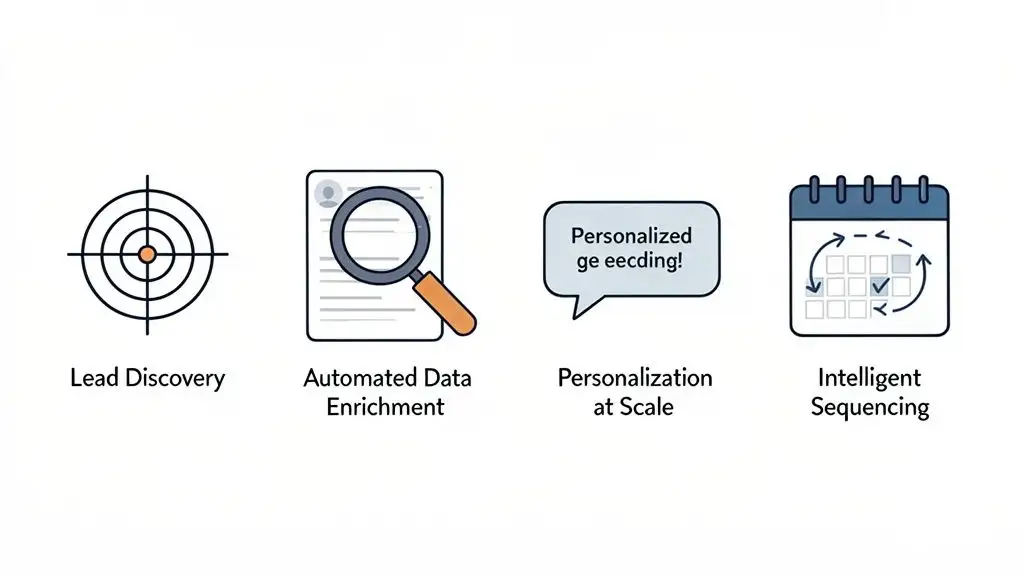
Alright, we've established that sales AI is more than just a shiny new toy. It's the secret sauce top teams are using to blow past their numbers. But what does it actually do in the real world?
This is where we leave the fluffy theory behind and get into the nitty-gritty of hitting your quota. Let's break down the four biggest ways AI is flipping the script on the daily B2B sales grind.
Discover and Score Leads Like a Mind Reader
In the old days, finding good leads felt like panning for gold with a spaghetti strainer. You'd buy stale contact lists, scrape websites, and basically throw stuff at the wall, hoping something would stick. It was a numbers game, and the odds were rarely in your favor.
Now, imagine having a sixth sense for deals. That's what sales artificial intelligence does. It digs into all your past wins and losses to build a razor-sharp profile of your Ideal Customer Profile (ICP).
-
The Old Way: Your team burns hours scrolling through LinkedIn Sales Navigator, plugging in vague filters like "software" and "100-500 employees." The result? A mountain of lukewarm leads.
-
The AI Way: The system instantly alerts you to a company that just snagged $20 million in Series B funding, brought on a new VP of Sales, and is hiring 10 new reps. The AI scores this lead a 9.5/10 and zips it straight to the top of your team's to-do list.
This shifts prospecting from a messy art form into a precise science. If you want to dive deeper into setting this up, our guide on automated lead generation is the perfect next step.
Instantly Enrich Your Data (and Ditch the Drudgery)
So you've found a great company. Awesome. Now comes the part everyone hates: hunting down the right person's contact info. It’s the sales equivalent of doing your taxes: tedious, mind-numbing, and a total momentum killer.
AI-powered data enrichment makes this whole process disappear. It's like having a personal private eye on staff who works at the speed of light.
The AI scours hundreds of sources to pull in verified emails, direct-dial numbers, LinkedIn profiles, and other key details. This frees up your reps to do what you actually pay them for: selling. A HubSpot survey even found that reps get back over two hours a day by handing these manual tasks over to AI and automation.
This is about more than just saving a few hours. It’s about arming your team with good, clean data. Bad data means bounced emails, dead-end calls, and a serious blow to morale. AI is your quality control.
Personalize Outreach That Doesn't Feel Creepy
Let’s be honest, most "personalized" outreach is just a lazy mail merge. Yelling "Hey you!" into a crowded room is just as effective. Real personalization has always been the key to breaking through the noise, but who has time to research hundreds of prospects a week?
This is where sales AI completely changes the game. It scans a prospect’s recent LinkedIn activity, their company’s press releases, and industry news to cook up hyper-relevant talking points. It gives you the power to look like you spent an hour on research, when it really took the AI a few seconds.
Here’s how it plays out:
-
The Trigger: The AI spots that your target account just dropped a big case study with an impressive enterprise client.
-
The Context: It also sees the CMO of that company shared it on LinkedIn, talking about what a great partnership it was.
-
The AI-Crafted Hook: Your tool whips up an opening line: "Just saw the new case study you shared with [Enterprise Client]. Huge congrats on the win. That stat about cutting their onboarding time by 40% really jumped out."
Boom. You're no longer just another cold email. You're a relevant, informed peer starting a real conversation.
Run Outreach Sequences That Actually Adapt
What happens after you send that perfectly crafted first email? The old playbook says to just ping them every two days with a generic "circling back" message. It’s annoying for them and feels desperate for you.
With intelligent sequencing, the AI acts like a chess master, planning your entire follow-up strategy based on how your prospect behaves.
It keeps an eye on opens, clicks, and replies across both email and LinkedIn. Based on that data, it tweaks the timing and content of your next touchpoint. If a prospect opens your email three times but doesn't reply, the AI might suggest connecting on LinkedIn next. If they click the link to your pricing page, it could trigger an alert for you to call them right now. This data-driven approach means you're always making the smartest move.
Pro Tip: Use Munch to build your lead list, enrich your contacts and craft AI powered personalized outreach for each lead - all in one single platform!
How to Implement Sales AI Without a Meltdown
Alright, you're sold. You're ready to plug into the Matrix and let AI supercharge your sales process. Hold on there, Neo. A successful rollout isn't as simple as instantly "knowing Kung Fu." If you just dive in headfirst, you're setting yourself up for confused reps, wasted money, and an AI tool that’s about as useful as a screen door on a submarine.
A solid game plan is your ticket to avoiding a full-blown meltdown. This guide breaks down the essential steps for sales leaders and reps, making sure your venture into sales AI is a strategic win, not a costly misfire. Let's get this show on the road.
Get Your Data House in Order First
You wouldn't pump regular unleaded into a Formula 1 car, right? The same logic applies here. Your CRM data is the high-octane fuel for any sales AI engine. If it's a mess of incomplete, outdated, or just plain wrong information, your shiny new AI will spend all its time making terrible predictions based on garbage.
It's the classic "Garbage In, Garbage Out" principle. An AI fed a diet of stale contacts, duplicate accounts, and missing deal info will spit out equally useless insights. Before you even think about shopping for tools, you have to commit to a data cleanup project. I know, it’s not the most glamorous work, but it’s the absolute foundation for everything that follows.
Think of it this way: Your AI can only be as smart as the data you give it. Clean, structured data is what allows the AI to spot accurate patterns, identify real opportunities, and make recommendations that actually help you close deals.
Choose Your Tools Wisely
Once your data is sparkling clean, it's time to choose your weapon. The market is flooded with sales AI tools, and it's ridiculously easy to get overwhelmed. The biggest decision you'll face is whether to stitch together a bunch of single-function apps or go all-in with a unified platform.
A patchwork approach might seem cheaper upfront, but it often creates a Frankenstein's monster of a tech stack. Your team will be stuck toggling between different tabs, dealing with clunky integrations, and trying to make sense of conflicting data. It’s a recipe for frustration and abysmal adoption rates.
A unified platform, on the other hand, brings everything under one roof:
-
Lead Discovery: Pinpointing high-intent prospects based on what they're doing right now.
-
Data Enrichment: Automatically filling in the blanks with verified emails and phone numbers.
-
AI Personalization: Generating outreach that's actually relevant and gets replies.
This integrated approach just makes sense. It removes the friction and creates a smooth, efficient process from start to finish.
Get Your Team on Board
Here’s a hard truth: if your reps don't use the tool, it's worthless. A lot of sellers view AI with suspicion, fearing it's here to replace them like some T-800 from The Terminator. Your job is to frame it not as a replacement, but as a powerful sidekick, more like Jarvis to their Iron Man.
Focus on how AI eliminates the worst parts of their job. Show them how it automates mind-numbing research, surfaces the hottest leads first, and helps them craft better emails in seconds. When they see it as a tool that helps them hit quota faster and make more money, they'll jump on board. Besides, with 81% of sales teams already using or experimenting with AI according to Salesforce, getting left behind really isn't an option.
Weave AI into Your Daily Workflow
The final piece of the puzzle is making it all stick. The goal is for AI-powered actions to feel like a natural part of your team's daily sales motion, not some clunky chore they have to remember. Map out exactly where the AI fits into your existing processes. For a deep dive, check out our guide on how to create workflows that actually get the job done.
For example, a new high-intent lead flagged by the AI should automatically trigger a multi-step sequence. The first step could be an AI-generated personalized email, followed by a task for the rep to connect on LinkedIn two days later. By seamlessly embedding these actions, you make AI an indispensable part of how you sell, driving both productivity and predictable revenue.
Measuring Success and Proving ROI
Alright, you’ve pulled the trigger and invested in sales AI. Fantastic. But before you get too comfortable, your CFO is going to pop their head in and ask the question every team leader dreads: "This is great, but what did it actually do for us?"
Just saying "it's working" isn't going to fly. You need to show them the money. Let's talk about how to prove the return on investment (ROI) with cold, hard numbers, moving beyond fuzzy metrics and getting straight to the KPIs that matter.
Key Metrics That Don’t Lie
Tracking the right numbers is everything. It’s the only way to know if your new AI tool is a genuine game-changer or just a shiny, expensive new toy. We need to look past vanity metrics like email open rates and zero in on what directly hits the bottom line.
Here are the big three you should be obsessing over:
-
Lead-to-Opportunity Conversion Rate: This is your headline act. It answers the most critical question: are the leads your AI finds actually turning into real, qualified sales opportunities? A good AI won't just find more leads; it will find the right leads, causing this number to jump.
-
Sales Cycle Length: How long does it take to turn a handshake into a signed contract? Sales AI should slash this timeline. By equipping your reps with sharper insights and better data, they can say the right thing at the right time and stop wasting energy on dead-end conversations.
-
Average Deal Size: Is your AI helping you land bigger fish? It should be. By uncovering hidden pain points and upselling opportunities, your reps can build stronger business cases and close larger deals. For a deeper look at the numbers you should be watching, check out our complete guide on lead generation KPIs to track.
This chart breaks down the three essential pillars of any successful sales AI rollout.
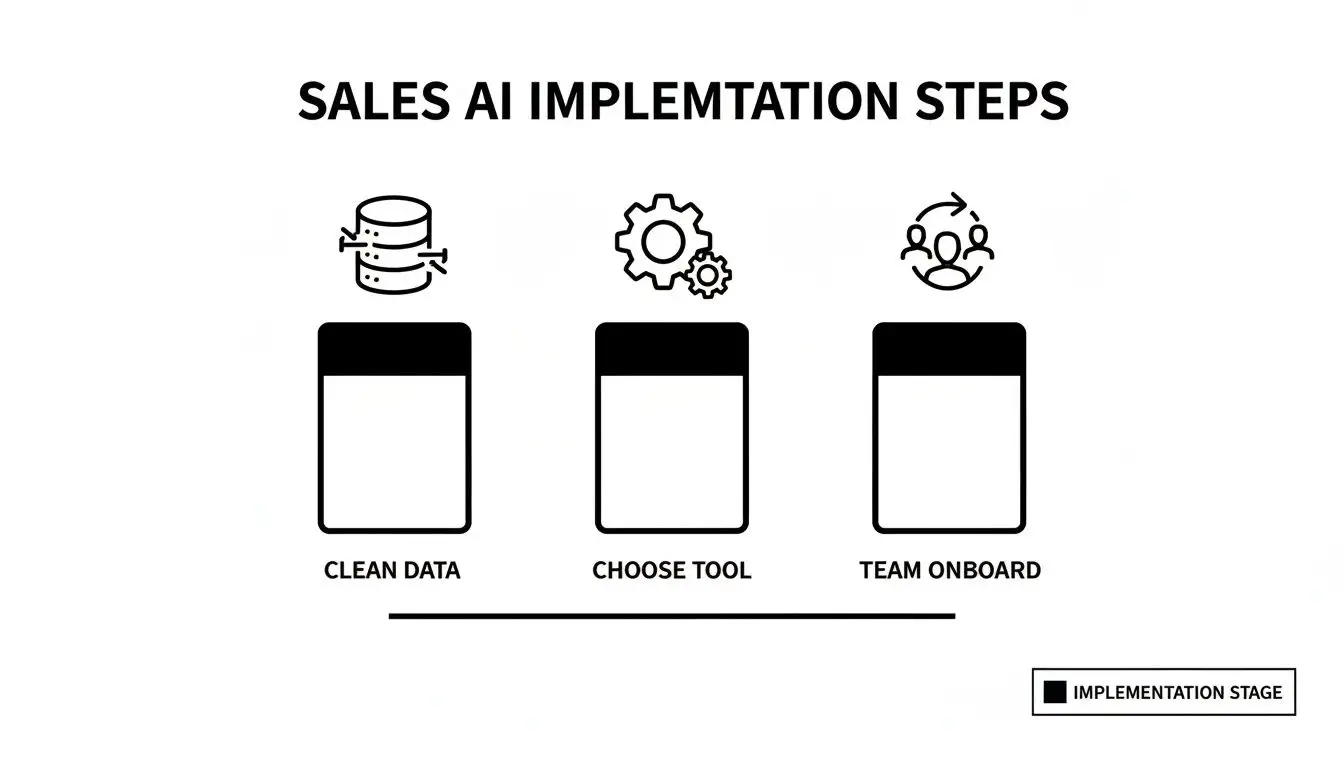
As you can see, getting your data, tools, and team in sync is the absolute foundation for getting a return on your investment.
Building Your Business Case
The proof is in the pudding, and the numbers are compelling. Enterprise spending on generative AI is on track to hit a staggering $37 billion in 2025, which is a 3.2x leap from 2024. And where is that money going? Over half is being poured into applications that people actually use every day, with sales-specific tools grabbing a $7.3 billion piece of the pie.
This isn't just wishful thinking. A full 71% of companies using AI in sales and marketing are already reporting direct revenue growth. It’s having an immediate impact.
The math is pretty straightforward: for every $1 spent on generative AI, companies are seeing an average return of $3.71. This isn't a gamble; it's a calculated investment that pays for itself.
Calculating Your Own AI ROI
To really nail this down, you need to connect the dots from those improved KPIs directly to revenue. It’s a simple "before and after" snapshot.
Let's walk through a quick example. Imagine you've had a sales AI platform running for about six months. You pull the numbers and compare them to your old baseline. The results could look something like this.
Sample ROI Calculation for Sales AI Implementation
This table shows how a sales AI platform can directly impact key financial metrics, turning performance improvements into measurable revenue gains over a six-month period.
| Metric | Baseline (Without AI) | Result (With AI) | Percentage Improvement | Estimated Revenue Impact |
|---|---|---|---|---|
| Lead-to-Opp Rate | 10% | 15% | +50% | +$150,000 in new pipeline |
| Sales Cycle Length | 90 Days | 60 Days | -33% | Faster time-to-revenue |
| Average Deal Size | $25,000 | $30,000 | +20% | +$5,000 per deal |
In this scenario, the AI didn't just make things "better". It directly generated $150,000 in new, qualified pipeline and added thousands to every deal closed.
That’s a story your leadership team wants to hear. By tracking these kinds of concrete results, you can build an undeniable case that sales AI isn't just another line item on the budget. It's a revenue machine.
How to Avoid the Classic Sales AI Face-Plants
Jumping into sales AI can feel a bit like trying to assemble a piece of IKEA furniture without the instructions. You're excited about the sleek, finished product, but one wrong move and you end up with a wobbly mess and a pile of leftover screws. Let's walk through the most common traps so your AI investment actually works as advertised.
The buzz around AI isn't just hype. The global sales automation market is on a rocket ship, expected to hit $16 billion by 2025. That's more than double its $7.8 billion valuation in 2019. This isn't just about shiny new tech; teams using AI are reporting they're 47% more productive and clawing back a stunning 12 hours a week. You can see more stats on the real-world impact of AI on sales productivity over at SuperAGI.com.
But here’s the thing: buying the tool is the easy part. Avoiding the face-plants takes a bit more finesse.
The “Garbage In, Garbage Out” Fiasco
This is the oldest rule in the book, and it's never been more true. Your AI is a brilliant, lightning-fast intern who believes every single thing you tell it. If your CRM is a wasteland of duplicate contacts, outdated emails, and half-finished notes, your AI will just give you bad advice at warp speed.
- Here’s how it plays out: You ask your fancy new AI to surface your hottest leads. It points you to a "perfect fit" company. Your rep spends a week chasing them, only to discover the contact info is from 2018, the decision-maker left two jobs ago, and the company has completely changed its business model. Ouch.
Before you even think about shopping for an AI platform, you have to get your data house in order. It's the unglamorous-but-essential grunt work that makes everything else possible.
Forgetting There's a Human on the Other End
Over-automating is the fastest way to make your prospects feel like they’re just another number on a spreadsheet. Nobody, and I mean nobody, wants to read an email that sounds like it was written by a chatbot having a bad day. AI is a fantastic tool for getting your outreach off the ground, but it can’t fake genuine human connection.
The trick is to think of AI as an assistant, not a replacement. Let it do the heavy lifting: the research, the data crunching, the first draft. But always have a human step in to add that final touch of personality, humor, and actual insight.
A good sales AI tool doesn't turn your reps into robots. It handles the robotic tasks for them so they can be more human and build real relationships.
Stumbling into the Compliance Minefield
This is the pitfall that can get you into real trouble. In the mad dash to personalize everything, it’s frighteningly easy to step over the line with privacy rules like GDPR in Europe or CCPA in California. Using AI to scrape up personal data without clear consent isn't just bad form; it can result in fines that will make your eyes water.
Make sure you know exactly where your data is coming from and that your tools and processes are buttoned up. Your legal team shouldn't be an afterthought here; they need a seat at the table from the very beginning.
Thinking AI Is a Magic Wand
Here's the biggest mistake of all: treating AI as a silver bullet that will magically fix a broken sales process. It won't. AI is an amplifier, not a miracle worker.
If your value proposition is weak, your sales training is nonexistent, or you don't really understand your customers, AI will just help you fail faster and more efficiently. You have to set realistic expectations. AI is the ultimate sidekick for a great sales team. It gives them superpowers. But it can't be the hero of the story. Your team still has to be the hero.
How Munch Ties Your Whole Sales Workflow Together
Let's be honest, juggling a dozen different sales tools feels like trying to beat a video game on the hardest difficulty setting while your little brother keeps unplugging the controller. You've got one tool for finding leads, another for enriching them, and a third for writing emails. It’s a clunky, inefficient mess that completely kills your team's momentum.
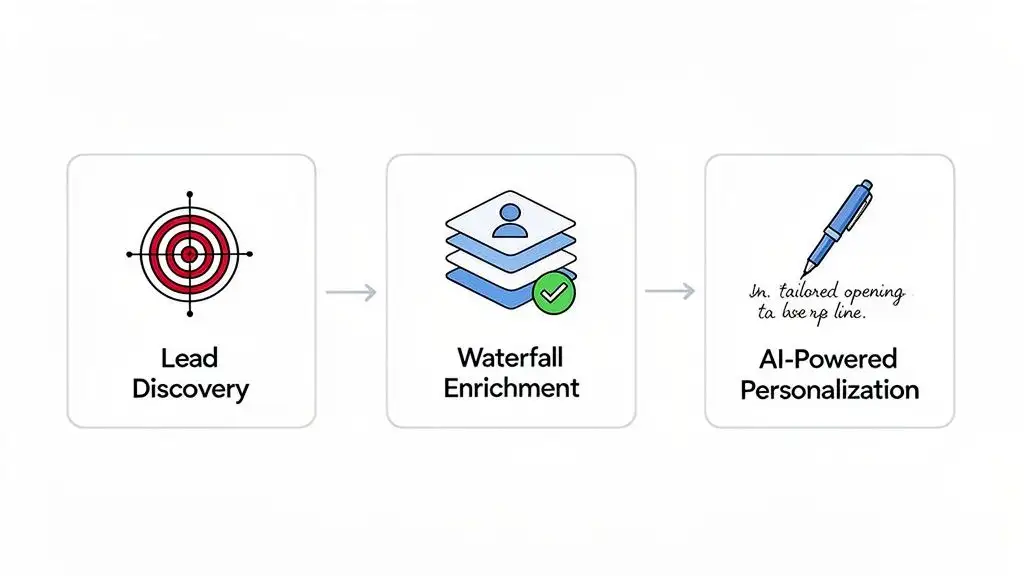
This is the exact headache we built Munch to solve. Instead of duct-taping multiple apps together, our approach brings the core pillars of modern sales outreach into one seamless workflow. It's designed from the ground up to eliminate friction and let your team focus on what they do best: selling.
Let's walk through how this sales artificial intelligence system works in the real world, from spotting a golden opportunity to crafting that perfect first touch.
Step 1: Lead Discovery and Scoring
Imagine you sell marketing software, and your absolute dream customers are B2B tech companies that just hired a new Chief Marketing Officer. This is a classic buying signal: a moment of change that comes with new budgets, fresh strategies, and an openness to new tools.
Instead of your reps burning their entire morning manually sifting through LinkedIn and news sites, the Munch platform acts like a heat-seeking missile. It scans over 100 verified data sources for this exact trigger.
The moment a company matching your Ideal Customer Profile (ICP) appoints a new CMO, our system flags it instantly. It’s not just another random lead; it’s a high-intent opportunity, delivered on a silver platter.
Step 2: Instant Waterfall Enrichment
Okay, you've found the company and know the new CMO's name. Now for the soul-crushing part, right? That endless hunt for their actual contact info, a process that usually involves a dozen browser tabs and a whole lot of guessing.
This is where our Waterfall Enrichment kicks in. The moment a lead is identified, our system automatically runs a multi-step verification process to find that new CMO’s direct contact details.
We instantly pull their verified work email and LinkedIn profile with 95%+ accuracy. There’s no manual digging, no bouncing emails, and no wasted time. Your rep gets the complete picture in seconds, ready for action.
Step 3: AI-Powered Personalization
This is where the real magic happens. Armed with the lead and their contact info, your rep is ready to reach out. But a generic "Congrats on the new role!" email is lazy and gets deleted on sight.
Our AI steps in to generate a context-aware opening line that makes your rep look like a research wizard. It might whip up something like this:
- "Saw the news about you stepping into the CMO role at [Company Name]. Congrats! Moving from [Previous Company] to lead the charge there must be an exciting shift."
This simple, smart personalization shows you’ve done your homework, even though it took the AI about three seconds. Early deployments of sales artificial intelligence have shown stunning results, with some companies boosting win rates by over 30%. By automating these tedious tasks, AI frees up reps to spend more time on what actually moves the needle. You can read more about how AI is driving impressive sales results on CirrusInsight.com.
By unifying these three crucial steps, Munch creates a smooth, repeatable motion that generates a predictable pipeline. It’s a smarter, faster way to sell.
AI-Generated Outreach Templates for High-Intent Signals
To make this even more tangible, let's look at how Munch's AI crafts outreach based on different buying signals. These aren't just generic templates; they're tailored starting points designed to grab attention and start a real conversation.
| Buying Signal | Channel | AI-Generated Opening Line | Full Message Template |
|---|---|---|---|
| New Executive Hired | Saw you just took the helm as the new VP of Sales at {Company}. Congratulations! | Subject: Congrats on the new role at {Company}<br><br>Hi {FirstName},<br><br>Saw you just took the helm as the new VP of Sales at {Company}. Congratulations!<br><br>New leaders often look to reassess their team's tooling to hit the ground running. We help sales teams like yours automate their lead gen with real-time buying signals, so they can focus on closing.<br><br>Worth a quick chat next week? | |
| Company Hiring Surge | Noticed on LinkedIn that {Company} is on a hiring spree for sales roles. That kind of growth is awesome to see. | Hey {FirstName},<br><br>Noticed on LinkedIn that {Company} is on a hiring spree for sales roles. That kind of growth is awesome to see.<br><br>Scaling a team often brings challenges with pipeline generation. Munch provides a steady stream of high-intent leads so your new reps can start hitting quota faster.<br><br>Mind if I share a quick one-pager on how we do it? | |
| Mentioned in News | I just read the TechCrunch article about your recent Series B funding. Huge congrats to the team at {Company}! | Subject: Read about the big news!<br><br>Hi {FirstName},<br><br>I just read the TechCrunch article about your recent Series B funding. Huge congrats to the team at {Company}!<br><br>With new capital, the pressure to scale revenue is on. We help post-funding companies build a predictable pipeline by identifying prospects who are ready to buy right now.<br><br>Could be a powerful way to accelerate your growth plans. Open to learning more? | |
| Technology Change | Looks like your team recently switched from Salesforce to HubSpot. Hope the transition is going smoothly! | Hey {FirstName},<br><br>Looks like your team recently switched from Salesforce to HubSpot. Hope the transition is going smoothly!<br><br>Since you're already updating your tech stack, I thought you might be interested in a better way to source and enrich leads directly within HubSpot. Our platform finds in-market buyers and syncs their verified data right into your new CRM.<br><br>Could save your team a ton of time. Thoughts? |
These examples show how AI can turn a simple data point into a relevant, human-sounding reason to connect, dramatically increasing the chances of getting a reply.
Got Questions About Sales AI? We've Got Answers.
Alright, let's cut through the noise. You've heard the buzz about artificial intelligence in sales, but you've probably still got some nagging questions. Good. Healthy skepticism is the mark of a smart sales pro. Let's tackle the big ones head-on.
Is AI Coming for My Sales Job?
Short answer? No. The real answer? Absolutely not, but it is going to supercharge it.
Think of AI less like a terminator sent to make you obsolete and more like having an impossibly smart, lightning-fast assistant. It's built to take on the mind-numbing, robotic tasks that drain your energy and kill your commission dreams. We're talking about the endless hours of manual data entry, digging through LinkedIn for prospects, and guessing which email to send next.
By offloading that grunt work, you're free to double down on what you do best: building real relationships, telling a killer story, and navigating the tricky art of the deal. The goal isn't to replace you; it's to turn you from a spreadsheet-filler into a strategic closer.
Do I Need to Be a Tech Genius to Use This Stuff?
If you can find your way around LinkedIn, you've got all the technical skills you need. The myth that you need a computer science degree to use sales AI is a holdover from a bygone era. Today's best platforms are designed for salespeople, not Silicon Valley engineers.
Most of these tools have clean, intuitive interfaces. You're not writing code; you're just telling the tool what you need in plain English. Setting up a search for new leads can be as simple as saying, "Find me every software company that just hired a new VP of Marketing." It's about strategy, not syntax.
Wait, Isn't This Just Fancy "Sales Automation"?
Great question, and a super important distinction. While they sound similar, they’re playing two completely different ballgames.
-
Sales Automation is a dumb robot. It follows simple, rigid rules you set up. Think of it like your out-of-office message: IF a trigger happens (you get an email), THEN it performs a set action (sends a canned response). It’s useful, but it can’t think for itself.
-
Sales AI is a smart partner. It doesn't just follow rules; it analyzes mountains of data to make its own decisions and get smarter over time. For example, it might figure out that VPs of Finance are 70% more likely to open emails with case study subject lines on Tuesday mornings, then automatically adjust your outreach for you.
Here’s the bottom line: Automation follows your commands. AI makes decisions to get you better results.
Ready to see how a unified Munch platform can streamline your entire sales process, from finding high-intent leads to launching personalized outreach? Sign up today!