Your Ultimate Guide To The Best Lead Enrichment Tool

By Mriganka Bhuyan
•Founder at Munch
A lead enrichment tool is your secret weapon against bad data. Think of it as a private investigator for your contact list. It takes a basic lead, maybe just a name and an email, and automatically digs up the rest of the story, fleshing it out into a rich, detailed profile.
Stop Selling to Ghosts in Your CRM
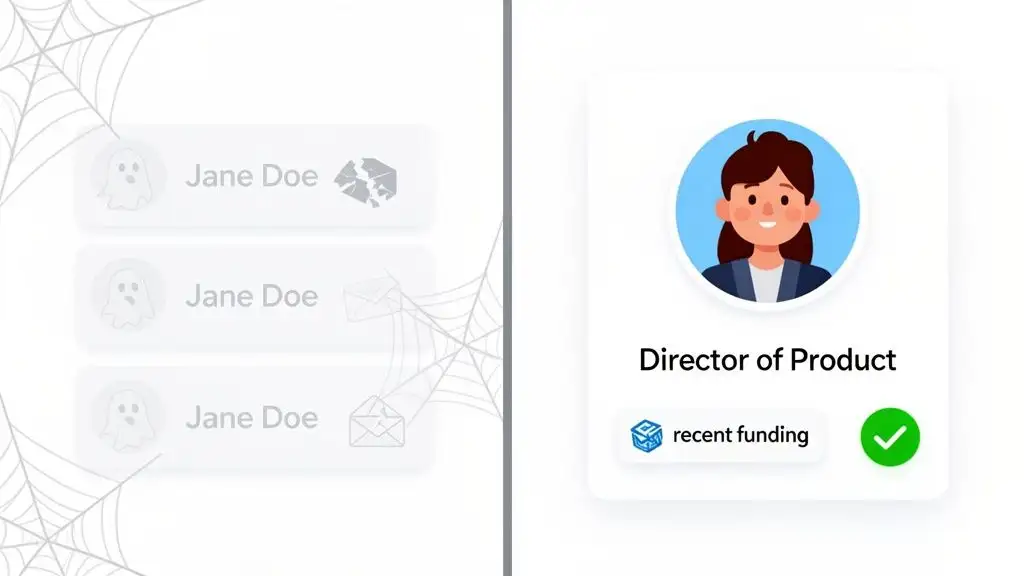
Does your CRM feel like a digital graveyard? It's filled with the ghosts of contacts past: names with outdated emails, job titles from two years ago, and zero context. You're not alone. This is the reality for too many sales teams, forcing them to waste countless hours chasing phantoms.
A good lead enrichment tool is the ghostbusting service your pipeline desperately needs. It turns those skeletal records into living, breathing opportunities loaded with intel you can actually use. A big part of this process is understanding proper CRM lead management, which helps you track and nurture these newly enriched prospects.
The Pain of Bad Data
Picture this: your new sales rep gets a lead for "Jane Doe, Manager at Acme Corp." They dig around, find what looks like a company email, and fire off a carefully crafted message. A minute later... bounce. A quick LinkedIn search reveals Jane left the company six months ago.
That's time, energy, and morale down the drain. This exact scenario plays out thousands of times a day in businesses everywhere. Bad data isn't just a minor headache; it's a silent killer of revenue and productivity.
The true cost of bad data is the opportunity cost. Every minute spent on a dead-end lead is a minute not spent with a prospect who is ready to buy.
The Power of Enriched Data
Okay, let's rewind and run that same play, but this time with a lead enrichment tool in your corner. It's like giving your sales team a cheat code.
The same "Jane Doe" lead lands in the CRM. Before your rep even sees it, the tool instantly springs into action, updating her profile with fresh, actionable details:
-
New Title: Jane is now the Director of Product.
-
Company News: Acme Corp just closed a $20 million Series B funding round.
-
Tech Stack: They're a new Salesforce user, a key integration for your product.
-
Contact Info: Her verified work email and direct-dial phone number are now in the record.
Now, your rep’s outreach is worlds apart. Instead of a generic "Hi Jane," they can lead with something compelling: "Congrats on the promotion and the huge funding round! As you scale the product team, getting the most out of your new Salesforce instance will be critical. Here's how we can help."
See the difference? It's night and day. You've gone from a cold guess to a warm, relevant conversation. That’s not just about having more data; it’s about having the right data to build real relationships and close deals. That’s the magic of lead enrichment.
Pro Tip: Use Munch to enrich your lead list's contact data, get firmographic and technographic data and craft personalized outreach messages.
How Lead Enrichment Transforms Your Sales Process
So, what does a lead enrichment tool actually do for your bottom line? Let's get past the theory and talk about the real-world, dollars-and-cents impact on a B2B sales team. It’s all about turning your sales process from a frustrating game of Guess Who? into a strategic mission where you have all the intel you need.
Enrichment isn't just about cramming more fields into your CRM; it's about fundamentally changing how you sell. It’s the difference between showing up to a party with a generic "Hello, my name is..." sticker and walking in knowing exactly who to talk to, what they care about, and maybe even the name of their dog. Okay, maybe not the dog's name, but you get the picture.
Stop Guessing and Start Personalizing
"Hyper-personalization" is one of those buzzwords that usually deserves an eye-roll, because it often just means someone used a {{first_name}} mail merge. Real personalization goes so much deeper. A lead enrichment tool gives your team the ammunition to write messages that are impossible to ignore because they’re genuinely, specifically relevant.
Instead of a generic pitch, your reps can open with timely, specific hooks that prove they've done their homework (even though a tool did it for them). This simple shift respects your prospect's time and instantly frames you as a thoughtful advisor, not just another pushy salesperson.
-
Mention recent funding: "Congrats on the Series A! Scaling your engineering team is a huge step, and that's often when data security becomes a top priority."
-
Reference their tech stack: "I noticed you're using HubSpot and Intercom. Our platform integrates directly with both to create a seamless customer support workflow."
-
Acknowledge a job change: "Saw you just started as the new VP of Marketing at Innovate Inc. Congrats! Many leaders in your shoes are focused on proving early wins in the first 90 days."
This level of detail is a complete game-changer for getting replies. To dig into this a bit more, check out our deep dive on using enrichment data to fuel growth.
Boost Productivity and Pipeline Velocity
You hired your sales reps to sell, not to spend half their day playing detective on LinkedIn and company websites. Manually researching leads is a monumental time-suck that kills momentum and morale. A lead enrichment tool puts that entire process on autopilot, handing back dozens of hours to your team every single week.
That newfound time goes straight into more selling activities, which means a faster sales cycle and a much healthier pipeline. There's a reason the demand for this stuff is exploding. The lead generation software market is set to rocket toward $295 billion globally by 2027. Businesses using AI for enrichment are reporting a 50% increase in sales-ready leads and a 60% drop in customer acquisition costs, numbers that get any revenue leader's attention. Discover more insights about lead generation statistics.
A sales team without enriched data is like a chef without prepped ingredients. They can still cook, but everything will take ten times longer, and the final dish won't be nearly as good.
From Startup Founder to First 100 Customers
Let's make this real. Picture a startup founder with an amazing new SaaS product for e-commerce brands. She has a basic list of 1,000 potential leads, but it's just names and companies. Where on earth does she begin?
With a lead enrichment tool, she can turn that generic list into a targeted hit list. She just needs to apply a few simple filters:
-
Technographics: Show me companies using Shopify Plus.
-
Firmographics: Filter for businesses with 50-200 employees.
-
Buying Signals: Prioritize companies that got funding in the last six months.
Just like that, her list of 1,000 ghosts shrinks to 100 high-intent prospects. She now knows exactly who is a perfect fit, why they're a perfect fit, and how to kick off a conversation that actually matters. Finding those first customers is no longer an impossible mountain to climb; it’s a clear, data-driven strategy. This isn't about buzzwords; it's about making more money, faster.
Decoding the Must-Have Features of a Lead Enrichment Tool
Let's be honest, not all lead enrichment tools are built the same. Some are like a fully-loaded Swiss Army knife, packed with everything you need for any situation. Others are more like a plastic spork: it might get the job done, but it’s going to be a clumsy, frustrating experience. To avoid that sinking feeling of buyer's remorse, you need to know exactly which features are mission-critical.
When you're looking at the best sales AI tools out there, the enrichment features are what separate the good from the great. These are the gears and levers that turn a bland contact list into a high-octane sales intelligence engine. Let's pop the hood and see what really matters.
The Big Three Data Types
At its heart, lead enrichment is all about data. But we’re not talking about just any data. We need specific intel to craft a message that actually connects. Think of these as the primary colors on your prospecting palette; with them, you can paint a complete picture of your ideal customer.
-
Firmographics: This is the company's basic DNA. We're talking industry, company size, annual revenue, and location. Knowing you're talking to a 50-person SaaS startup in Austin versus a 5,000-employee manufacturing giant in Detroit completely changes your approach, your pitch, and your value proposition.
-
Technographics: This is like getting a peek inside their digital toolbox. Technographics reveal the software and tech a company is using. Finding out your prospect just installed Salesforce or is using a competitor’s marketing automation platform? That’s not just data; it's a massive tactical advantage.
-
Buying Signals: These are the smoke signals that tell you a company might be ready to pull the trigger. We're talking about recent funding rounds, key executive hires, a spike in hiring for specific roles, or major company news. For instance, knowing your ideal contact just got a huge promotion is the perfect moment to reach out with a solution that makes them look even smarter.
This infographic really nails how these core features fuel the benefits that actually move the needle for your business.
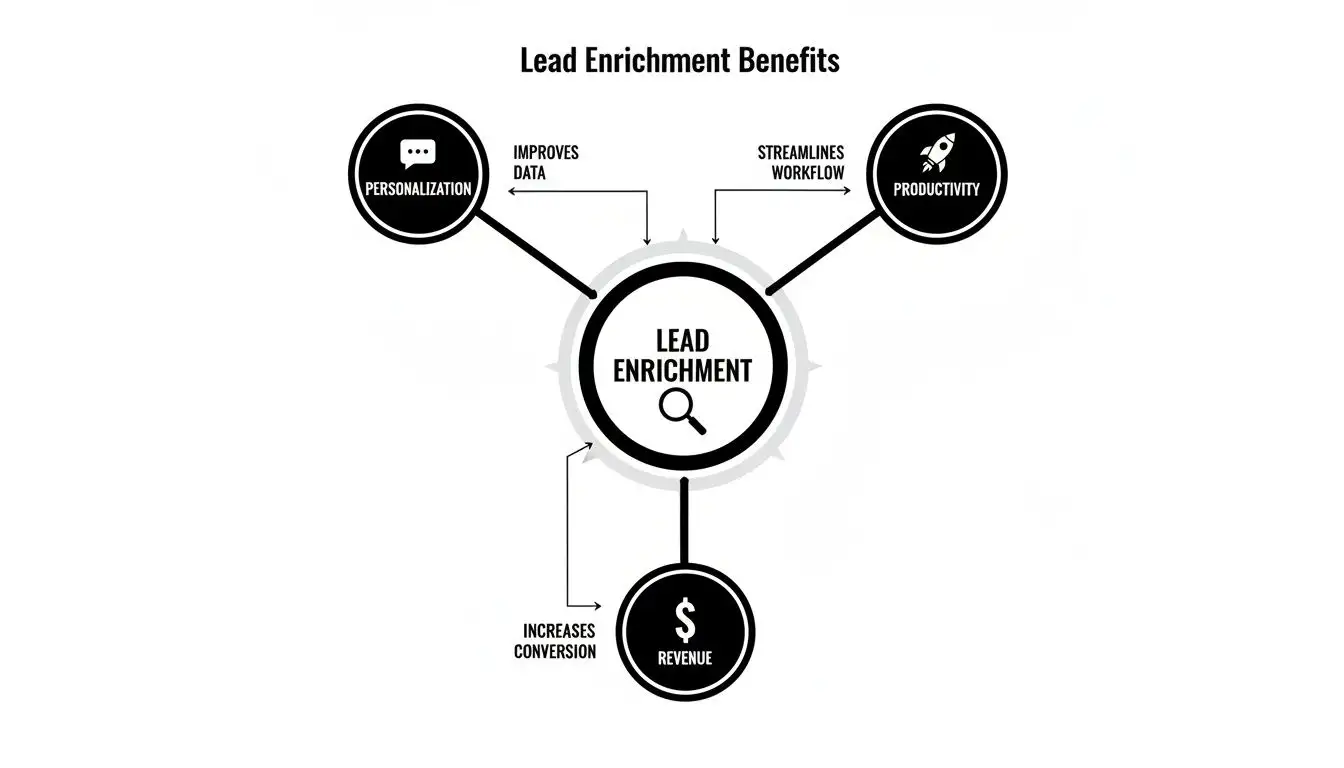
As you can see, it's a straight line from better data to killer personalization, which boosts productivity and, you guessed it, drives more revenue.
To make this crystal clear, here’s a breakdown of the core features and what they actually mean for your team on the ground.
Core Lead Enrichment Features and Their Business Impact
| Feature | What It Is | Why It Matters (The 'So What?') |
|---|---|---|
| Firmographics | Company-level data like industry, size, and revenue. | Tells you if they're a good fit before you waste time. No more pitching a startup solution to a Fortune 500. |
| Technographics | The tech stack a company uses (CRM, marketing tools, etc.). | Unlocks perfect "pain-point" conversations and competitive displacement opportunities. |
| Buying Signals | Real-time triggers like new hires, funding, or expansion. | Turns cold outreach into warm, timely conversations. "Saw you're hiring 20 new SDRs..." |
| Contact Data | Verified emails, direct-dial phone numbers, and job titles. | Gets you straight to the decision-maker, bypassing gatekeepers and generic inboxes. |
| CRM Integration | Automatic data syncing with platforms like Salesforce or HubSpot. | Eliminates soul-crushing manual data entry and keeps your single source of truth accurate. |
| Waterfall Enrichment | A sequential data-sourcing method to find the best info. | Ensures you get the most accurate, up-to-date intel without paying for redundant or junk data. |
These features aren't just bells and whistles; they're the engine that powers a modern, high-performing sales motion.
Waterfall Enrichment and Why It Matters
Now for a feature that sounds a bit technical but is actually brilliantly simple: waterfall enrichment.
Imagine you need a friend's new phone number. First, you check your own contacts. No dice. Next, you ask a mutual friend. Still nothing. Finally, you ping someone from your old college group chat, and bingo, you've got it.
Waterfall enrichment is the digital version of that exact process. The tool queries one data source for info. If it comes up empty or the data looks sketchy, it automatically cascades to the next source, and the next, until it finds the best, most accurate information available.
This sequential check guarantees you get the highest quality data without paying for duplicate or low-confidence info. It's a world away from tools that just pull from a single, static database that's probably as outdated as a flip phone.
The Technical Nuts and Bolts
Finally, even the world's best data is useless if you can't get it where you need it, when you need it. This is where the under-the-hood stuff, like integrations and automation, comes into play. These are the features that make a lead enrichment tool a true powerhouse instead of just another browser tab you have open.
Two things here are absolutely non-negotiable:
-
Seamless CRM Integration: Your enrichment tool has to play nice with your CRM, whether it’s Salesforce, HubSpot, or something else. It should automatically update records in real-time, so your team is always working with the freshest data without ever having to copy and paste.
-
Robust API Access: For any team that wants to build custom, scalable workflows, a solid API is a must. It lets you programmatically enrich leads from anywhere, like a new sign-up on your website or a list from a trade show, creating a fully automated process that runs itself.
How to Choose Your Lead Enrichment Tool
Alright, let's get down to it. Stepping into the marketplace for lead enrichment tools can feel a lot like walking into a massive arcade: blinking lights, a thousand different games, and a whole lot of noise. Some are classics, some are flashy but shallow, and only a few are the real deal that will actually get you to the next level.
Choosing the right one isn't about finding the single "best" tool on the market. It's about finding the right tool for your team, your budget, and your goals. To avoid that dreaded buyer's remorse, you need a game plan.
The Vendor Interrogation Checklist
When you're demoing a new tool, it's time to go from polite prospect to seasoned detective. Don't be shy; ask the tough questions. Here are the non-negotiables to get you started:
-
What is your data accuracy guarantee? If a vendor gets squirrely on this one, that's a massive red flag. You're looking for a clear, confident answer and a guarantee of 95% or higher on key data points like email addresses. Anything less is a waste of your time.
-
How often is your data refreshed? Bad data ages like milk, not fine wine. You need a tool that's constantly updating its records, preferably in real-time or at least daily. A static database is a dead database.
-
Where do you source your data? Transparency is everything. A reputable vendor will be open about where their data comes from, which should be a healthy mix of public records, private partnerships, and their own verification processes. If it sounds like a secret family recipe, be wary.
-
Does it integrate with my existing tech stack? This is a huge one. Your new tool absolutely must connect seamlessly with your CRM and any other sales platforms you use. If the integration is clunky, it'll kill adoption before you even get started.
Choosing a lead enrichment tool is like casting a character in your company's movie. You need someone who not only looks the part but also delivers their lines perfectly every time and works well with the rest of the cast.
Scalability and Pricing Models
Once you've grilled them on the data, it's time to talk money. A tool might look amazing, but if the pricing model is designed to punish you for growing, it's not a true partner.
-
Is the pricing model scalable? Look for plans that grow with you. A per-seat model is common, but make sure it doesn’t become ridiculously expensive as you add reps. Usage-based models (where you pay per enriched lead) can be a fantastic option for startups.
-
Are there hidden fees? Always ask about implementation costs, support packages, or extra charges for API access. The price you see should be the price you pay.
For example, a platform like Munch is built with this in mind. It offers a clear starting price of $49/month, which is perfect for ambitious SDRs, solo founders, and small agencies who need enterprise-grade power without the enterprise-level price tag. It’s a pricing model designed to help you win, not just to bill you.
How Munch Answers the Call
Let's use Munch as a practical example of how a modern lead enrichment tool should answer these critical questions. This isn't a hard sell; it's a clear benchmark for what you should expect from any provider.
-
Data Accuracy: Munch delivers 95%+ email accuracy by using a waterfall enrichment process that scans over 100 verified sources. This means you get the best possible data every single time, drastically reducing bounce rates.
-
Data Freshness: The platform provides real-time enrichment. The moment a lead enters your system, Munch gets to work, ensuring your team always has the most current information at their fingertips.
-
Integrations: Munch is designed to fit right into your existing workflow, connecting smoothly with the CRMs and tools modern sales teams rely on. You can also explore our article on using AI for sales prospecting to see how these integrations can supercharge your efforts.
-
Affordability: The accessible $49/month starting point makes it a no-brainer for teams who need to prove ROI quickly without a massive upfront investment.
In the fast-paced world of B2B sales, these tools are no longer a "nice-to-have"; they're indispensable. Take Apollo, another major player in the space; it boasts a massive database covering over 790 million people and 70 million companies. This scale is crucial because poor data quality can lead to 30-50% wasted time on outreach. Tools like Apollo and Munch tackle this problem head-on by delivering over 95% accuracy.
Choosing the right lead enrichment tool is one of the most impactful decisions your sales team can make. Arm yourself with these questions, and you'll find a partner that helps you stop chasing ghosts and start closing deals.
Putting Your New Tool to Work
Alright, you did it. You’ve got the shiny new tool. Now what? Just owning a powerful piece of tech is like having the Millennium Falcon without Han Solo at the controls. It looks impressive, but it’s not making any Kessel Runs for you. This is your training montage: the part where we turn that lead enrichment tool into a lean, mean, revenue-generating machine.
First things first, and it’s not the sexy part, but it’s crucial: integration. Get that tool hooked up to your CRM and any other sales or marketing platforms you live in. A well-designed tool should make this a simple plug-and-play affair, not a week-long IT headache that feels like you’re deciphering ancient texts.
With everything connected, it’s time to tell your new sidekick who you’re actually looking for. You need to define your Ideal Customer Profile (ICP) right inside its filters.
Defining Your Ideal Customer Profile
Think of your ICP as a treasure map for your tool. If your map is too vague, you'll end up with a pile of rocks. But if it's too specific, you might not find anything at all. The goal is to hit that sweet spot with a precise, data-backed profile of your absolute perfect customer.
Your lead enrichment platform will use this ICP to score and prioritize every new lead that comes through the door. Start with the foundational attributes:
-
Firmographics: What's the perfect company size, industry, and annual revenue?
-
Technographics: What technology do they absolutely have to be using (or, just as important, not using)?
-
Geographics: Are you zeroing in on specific regions, countries, or even just a handful of cities?
Once you nail down the basics, you can get way more granular. Setting these rules up correctly is mission-critical, and so is making sure you’re starting with clean contact info. If your data’s a bit shaky, it's worth checking out a guide on how to verify email addresses to make sure your messages actually land.
Creating Automated Workflows and Alerts
This is the fun part. This is where you graduate from manually digging for info to having a 24/7 sales assistant working for you. Automated workflows are the secret to scaling up your outreach without completely burning out your team. They can trigger actions based on specific buying signals, so you never miss a golden opportunity.
For example, you can set up an alert that pings the right account owner the second a target account makes a move. A few killer alerts to set up immediately include:
-
New Executive Hire: Get a notification when a target company brings on a new VP of Sales or CMO. That’s a classic window of opportunity to introduce a new way of doing things.
-
Funding Announcement: Bam! An instant alert when a prospect closes a new funding round. Your outreach can be perfectly timed with a congrats and a pitch on how you can help them scale.
-
Technology Change: Get a heads-up when a company adds or drops a competitor’s software. That’s an open invitation to start a conversation.
Owning a lead enrichment tool is just the beginning. The real magic happens when you move from simply having the data to building an operational rhythm around the insights it provides.
Reviving Your "Closed-Lost" Graveyard
Here’s one of the most underrated plays in the book: using your enrichment tool to breathe new life into old, dead deals. That "closed-lost" list in your CRM isn't a monument to failure; it's a potential goldmine of future business.
Run your list of past lost opportunities through the enrichment tool. Look for what’s changed. Has the company been acquired? Did that key decision-maker who blocked the deal finally leave? Did they just land a huge round of funding that solves their old budget problem?
This one tactic can fire up a whole new pipeline of warm leads who already know who you are. It’s the sales equivalent of your favorite 90s band announcing a reunion tour: it’s familiar, it’s nostalgic, and it can be shockingly profitable. The key is training your sales team not just on how to use the data, but why it helps them craft those compelling, personalized comeback stories.
Real-World Scenarios Where Lead Enrichment Wins Deals
Theory is great, but let's talk about what happens when the rubber meets the road. How do lead enrichment tools actually perform in the wild? Think of this as the part of the movie where the hero finally gets to use their new powers. We're going to ditch the abstract concepts and jump into a few short, real-world stories of sales pros winning deals they almost certainly would have missed otherwise.
These aren't fairy tales. They're everyday examples of how having the right data at the right time is the ultimate cheat code in sales. It’s about turning a generic, forgettable pitch into a perfectly timed, can't-ignore conversation.
The Agency Hunter
First up, meet Sarah. She’s a business development manager at a digital marketing agency. Her team is incredible at building sleek, high-performance websites, but finding companies stuck in the digital dark ages is a total grind. She starts using a lead enrichment tool to hunt for a very specific signal: companies running on old, clunky content management systems.
Her tool pings her with a fresh target. It’s a mid-sized manufacturing company whose website is running on a dinosaur of a platform, making it slow and a security nightmare. The enrichment data also gives her a golden nugget: the company just hired a new VP of Marketing.
Armed with this intel, Sarah’s outreach is surgical. She doesn’t just email them saying, "Hey, your website is old." Instead, she sends a personalized message: "Congrats to Maria on the new VP role! As you look to make an early impact, you might find your current CMS is holding back your lead generation goals. We specialize in migrating brands like yours to modern platforms without the usual headaches."
The result? Maria, who was already frustrated with the old site, books a meeting on the spot.
The Startup Founder
Next, let's look at Ben, the solo founder of a B2B SaaS startup. He’s got a handful of early customers who absolutely adore his product. The problem? His marketing budget is basically zero, and he needs to find new leads who are a perfect match for his existing fans.
He gets creative. He sets up an alert in his lead enrichment tool to watch for a specific buying signal: job changes. He uploads his small list of happy customers and tells the tool to notify him the moment any of them start a new gig at a different company.
A few weeks later… ding. One of his power users just became the Director of Operations at a much larger firm. Ben now has the warmest of warm intros. He shoots over a simple note: "Hey Alex, great to see the big move to Acme Corp! I know you were a huge fan of our workflow automation at your last role. Would love to show you how we can bring that same magic to your new team."
It was the easiest sale he ever made.
The most valuable lead is often a past champion in a new role. Lead enrichment is the only way to track these champions systematically and turn their career moves into your revenue.
The SDR Pro
Finally, there’s Chloe, an SDR at a fast-growing tech company. She lives and dies by one rule: timing is everything. Blasting out emails to companies without budget or a pressing need is just a fast track to the spam folder. She configures her lead enrichment tool to alert her to funding announcements for companies that fit her ideal customer profile.
A notification pops up. A 100-person logistics company just closed a $15 million Series A round. Chloe knows that with new funding comes immense pressure to scale operations efficiently.
Her email is perfectly timed and hits the nail on the head: "Huge congrats on the Series A! That's a massive milestone. As you start deploying that new capital to grow, our platform can help your operations team scale without adding headcount."
She gets a reply in under an hour from the COO. He was literally just tasked with finding a solution to that exact problem. This kind of precision is only possible with quality data.
In B2B outbound, data quality is the make-or-break factor, and modern tools are delivering accuracy we could only dream of a few years ago. The best platforms give you access to hundreds of millions of contacts and companies, with features like AI prioritization and waterfall enrichment from over 100 sources, pushing bounce rates below 5%. To see who's leading the pack, you can learn more about the best lead enrichment tools.
Got Questions About Lead Enrichment? We’ve Got Answers.
You’ve got questions, we’ve got answers. Let’s dive into some of the most common things people ask about lead enrichment tools. By the end, you'll be ready to hit the ground running.
What's the Difference Between Lead Enrichment and Lead Generation?
This is a classic. Think of it like fishing. Lead generation is casting a wide net and seeing what you pull into the boat. You’ve got a bunch of fish, but you don’t know which ones are keepers.
Lead enrichment is like having a fish finder and a detailed guide on board. It tells you which fish are the prize-winners, what bait they like, and where they hang out.
Generation gets you the contact list; enrichment tells you who on that list is actually worth talking to and exactly what to say to get their attention. You need both, but enrichment is what turns a long list of maybes into a shortlist of definite opportunities.
How Do I Actually Measure the ROI of a Lead Enrichment Tool?
Great question. Measuring the return on your investment goes way beyond just looking at the final number of deals closed (though that’s a big, juicy part of it). The real magic is in the efficiency gains you can track before and after you start using a tool.
Here’s what to keep an eye on:
-
More Productive Sales Reps: How much time are your SDRs wasting on manual research? If you give them back 5-10 hours a week, that’s a massive amount of extra time they can spend doing what they do best: selling.
-
Skyrocketing Response Rates: Watch what happens to your reply and meeting-booked rates. When personalization is on point, people actually respond. This is the clearest sign that you’re hitting the mark.
-
Better Conversion Rates: Are more of your initial leads turning into qualified opportunities? Better data from the start means you’re not wasting time on dead ends.
-
Faster Sales Cycles: When you can pinpoint the real decision-maker and understand their needs from the first email, deals just move faster. It’s that simple.
Your ROI is the sum of all these parts. It’s the cost of the tool measured against the massive financial upside of a faster, smarter, and more effective sales machine.
Is This a Good Idea for a Small Business or Startup?
Absolutely. In fact, small teams and startups often see the biggest benefits. When you’re small, you can’t afford to waste a single shot. Every email, every call, every minute has to count. You don't have a massive budget to burn through on bad data and generic outreach that gets ignored.
A smart lead enrichment tool is the great equalizer. It gives a small, scrappy team the same kind of sales intelligence that was once only available to enterprise giants with deep pockets. It lets you compete by being smarter, not by spending more. You can build a predictable pipeline right from day one, turning a small operation into a force to be reckoned with.
Ready to stop guessing and start closing? Munch gives you everything you need to find, enrich, and connect with high-intent prospects, all backed by 95%+ data accuracy. See how Munch can work for you.