A Guide To AI For Sales Prospecting That Actually Works

By Mriganka Bhuyan
•Founder at Munch
Let's be honest, using AI for sales prospecting isn't some far-off, futuristic concept anymore. It's about using smart tools to find, qualify, and tee up conversations with the right people, automatically. You're essentially swapping out hours of manual grunt work for a data-driven workflow that uncovers high-intent leads and helps you write outreach that actually gets a response.
Your AI Sales Prospecting Playbook Starts Now
Forget everything you think you know about prospecting. We're not talking about dusty rolodexes or stale call lists. The modern sales floor is powered by something that works 24/7 to find your next best customer, and it's not a person; it's AI. Think of it like swapping a map for a GPS. You’re still in the driver’s seat, but you’re getting there faster and with a lot less guesswork.
AI tools for prospecting have gone from a "nice-to-have" novelty to a core part of the modern sales stack. This guide cuts through the fluff and gets straight to the point, whether you're a rep sick of chasing dead-end leads or a sales leader trying to build a pipeline you can actually count on.
From Manual Drudgery to Strategic Selling
The big shift isn't just about doing things faster; it's about being smarter. The old way meant spending your days scrolling through LinkedIn, guessing email formats, and blasting out generic templates. The new way? Using AI to spot precise buying signals and automate the most mind-numbing parts of the job.
This diagram lays it all out, showing how we've moved from the old-school manual grind to a slick, AI-powered workflow.
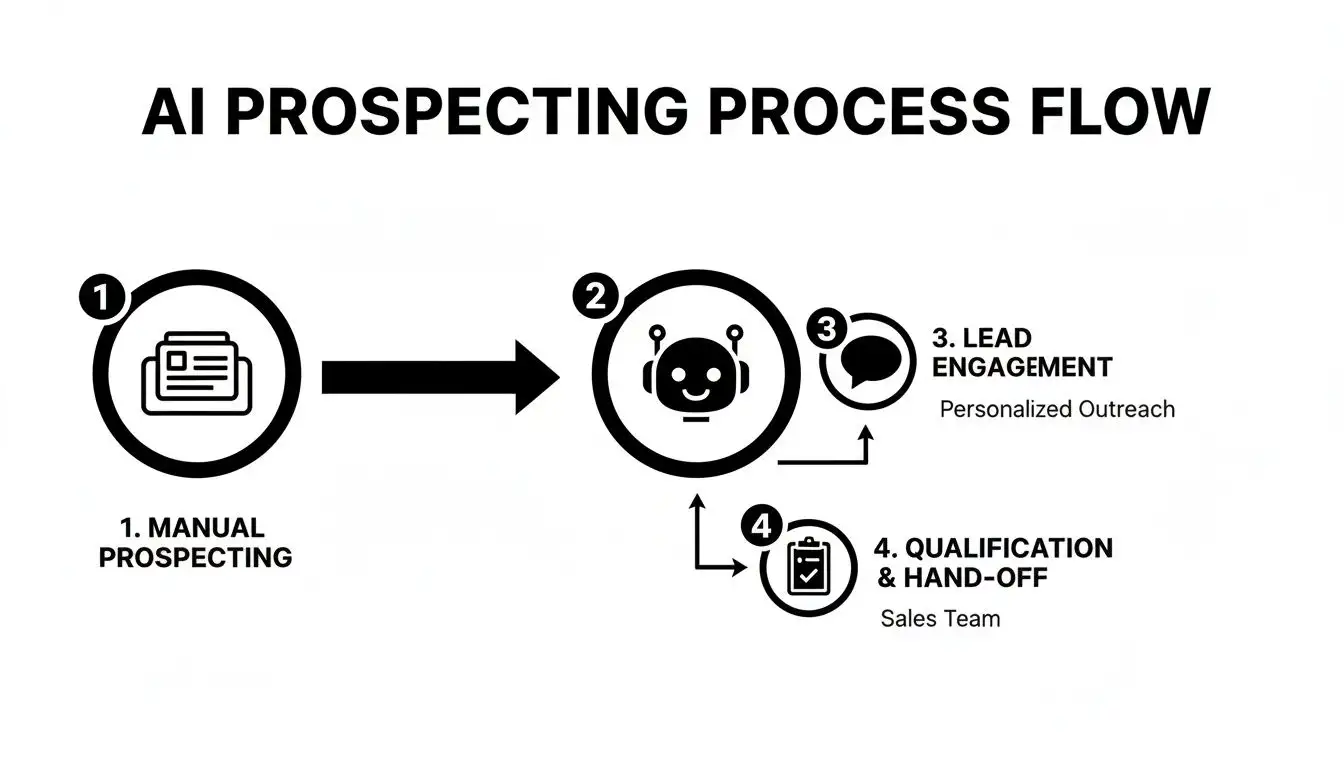
It's pretty clear that AI injects a layer of intelligence that just wasn't possible before. It frees up your team to think about strategy instead of getting bogged down in repetitive tasks.
The numbers don't lie. A recent Salesforce State of Sales Report found that a whopping 87% of sales organizations are already using AI for things like prospecting and lead scoring. Even more telling, top performers are 1.7 times more likely to be using AI for prospecting than their peers. This isn’t a future trend; it’s what high-growth teams are doing right now.
The goal is simple: let the machines handle the repetitive, data-heavy lifting. This frees up your reps to do what they do best, which is build relationships and close deals. It’s about trading manual drudgery for strategic, high-value conversations.
The Shift from Manual to AI-Powered Prospecting
Here’s a quick look at how AI transforms traditional prospecting tasks, saving time and boosting results.
| Manual Prospecting Task | AI-Powered Prospecting Solution |
|---|---|
| Guessing which companies to target based on gut feel. | Identifying best-fit accounts using firmographic, technographic, and intent data. |
| Manually searching LinkedIn for contacts. | Automatically discovering and verifying decision-makers who match your ideal profile. |
| Writing one-size-fits-all email templates. | Generating hyper-personalized outreach based on a prospect's unique pain points and activities. |
| Juggling follow-ups in a spreadsheet or CRM. | Building intelligent, multi-channel sequences that adapt based on prospect engagement. |
| Spending hours on research before every single call. | Getting instant, AI-generated summaries and talking points delivered right before a meeting. |
What this table really shows is a trade-off: you're swapping hours of low-value work for minutes of high-impact, strategic action.
This playbook will walk you through the exact steps to make it happen, from dialing in your ideal customer profile to building and measuring your first AI-driven sequences. Let’s get to it.
Defining Your Ideal Customer and Buying Signals
Before you unleash your shiny new AI prospecting tool on the entire internet, you need to give it a mission. Just pointing it at a vague target like “tech companies” is like telling a super-smart homing pigeon to “fly west.” It’s a spectacular waste of powerful technology.
The whole point of using AI is to move from a shotgun blast to a laser-guided missile. That precision starts by getting brutally specific about your Ideal Customer Profile (ICP). This isn’t about just slapping together a basic profile with industry and company size. That’s the sales equivalent of a Myspace page from 2006. True AI-powered prospecting needs a much deeper, multi-layered definition that acts as a precise set of coordinates for your AI to follow.
Beyond Basic Firmographics
Look, everyone starts with firmographics (company size, revenue, industry). That’s just table stakes. To really get your AI cooking, you need to layer on more sophisticated data points that scream genuine intent and immediate need.
Think of it as building your ICP on three core pillars:
-
Technographics: What’s in their software stack? Knowing they use a specific CRM (like HubSpot), a marketing automation tool (like Marketo), or even a competitor's product gives your outreach instant context and relevance. For example, if you sell an advanced analytics plugin for HubSpot, you can instantly filter out anyone who doesn't use it.
-
Behavioral Signals: These are the breadcrumbs they leave behind that show they’re actively trying to solve a problem you can fix. Are they suddenly hiring their first-ever "Head of Sales"? Did their marketing team just publish five blog posts about "improving lead quality"? These actions are practically a cry for help.
-
Trigger Events: These are the big company moments that create new needs or sudden urgency. A juicy new funding round, a C-suite shake-up, an acquisition, or expansion into a new market are all powerful triggers that open a window for perfectly timed outreach. A company that just got a $50 million funding injection is probably looking to spend some of it on growth.
When you start combining these elements, your targeting becomes exponentially more effective.
From Vague Ideas to Razor-Sharp Targets
Let's make this real. A lazy, old-school ICP might be "SaaS companies with 50-200 employees." An AI can find thousands of those, sure, but most won't be ready to buy.
Now, let's look at a modern, AI-ready ICP.
Old ICP: SaaS companies in North America.
AI-Ready ICP: Series B SaaS companies with 75-150 employees, using HubSpot and Salesforce, that have recently hired their first VP of Sales and have active job postings for SDRs.
See the difference? The second one isn't just a profile; it's a story. It’s a story about a company that’s clearly scaling its sales function and has an immediate, painful need for tools that drive efficiency. This is the kind of detail AI absolutely thrives on.
If you need a hand structuring this, our guide on creating an ideal customer profile template is a great place to start.
Creating Your AI Prospecting Blueprint
To get started, don't just brainstorm who your customer is. Instead, think about the exact circumstances that make them a perfect fit right now. A fantastic exercise is to work backward from your last five to ten best customers. What did they all have in common right before they signed?
Ask yourself these questions to build out your blueprint:
1. Firmographics (The Basics):
-
What’s the sweet spot for employee count (e.g., 50-250)?
-
What’s the annual revenue range (e.g., $10M-$50M)?
-
Which specific industries or sub-industries are killing it for you (e.g., FinTech, not just "Finance")?
-
Where are they located?
2. Technographics (Their Tech Stack):
-
What complementary software do they already use (e.g., Salesforce, Slack)?
-
Are they stuck using a competitor's product? This is a golden signal for a displacement campaign.
-
What marketing or sales automation platforms are they running?
3. Buying Signals (Their Actions):
-
What key roles are they hiring for right now?
-
Have they recently closed a funding round (e.g., Series A, B, C)?
-
Are they showing high engagement on your website or downloading specific content?
-
Did a key decision-maker you’ve sold to before just join their company?
Nailing this with precision is the single most important step in this entire playbook. Get this right, and your AI will become a pipeline-generating machine. Get it wrong, and you'll just be automating bad prospecting at a terrifying speed.
Time to Unleash Your AI Copilot for Discovery and Scoring
Alright, you’ve meticulously defined your Ideal Customer Profile. Think of it as a finely tuned recipe for your perfect customer. Now, it's time to let your AI copilot step into the kitchen and start cooking. This is where the magic really happens. You'll configure your AI prospecting tool to be your eyes and ears across the internet, constantly scanning millions of data points for those exact buying signals you just laid out.
Think of it as setting up a digital tripwire. Instead of you manually sifting through endless data for clues, your AI is on 24/7 alert. It’s like having your own personal Jarvis, but instead of managing an Iron Man suit, it’s building your sales pipeline. You can set it up to send real-time notifications for the trigger events that mean business.
Imagine getting a Slack ping the moment a target account posts a job for a "Head of Demand Generation." Or what about an alert when a company you've been watching announces a $20 million Series B funding round? That's not just a lead; it's a piping-hot opportunity served up on a silver platter, giving you a serious head start on the competition.
Setting Up Your Signal Scanners
Don’t worry, configuring your AI isn't about writing complex code. It’s more about giving it clear, simple instructions. Most modern platforms let you plug in your ICP criteria and then tell the AI which specific signals to hunt for.
Here’s what that looks like in the real world:
-
Job Change Alerts: This one’s a goldmine. Set your AI to flag when a previous champion, someone you've successfully sold to before, starts a new gig at another company on your target list. It’s one of the warmest intros you could ever ask for.
-
Funding Announcements: Create a trigger for any company that fits your firmographics and just raised a fresh round of capital. New money almost always means new budget and a hunger for tools that drive growth.
-
Tech Stack Signals: Your AI can scan for companies that recently adopted a complementary technology. For example, if you sell a Salesforce add-on, you want to know the second a company signs on with Salesforce.
This simple shift moves your prospecting from a reactive, manual grind to a proactive, automated machine. You stop searching for opportunities and start having them delivered right to you.
Getting Beyond "Hot" or "Cold" Leads
Now let's talk scoring. The old way of scoring leads was, frankly, a mess. Reps would slap on a subjective "hot," "warm," or "cold" label based on a gut feeling. It was about as scientific as a Magic 8-Ball. AI-driven lead scoring is a different beast entirely. It's dynamic, data-driven, and brutally effective.
Instead of a vague label, a modern AI assigns a numerical score based on dozens of real-time data points. It intelligently weighs how closely a prospect matches your ICP against how many buying signals they’ve recently thrown off. This ensures your sales team is always focused on the accounts most likely to buy right now. For a deeper dive, check out our guide on modern lead scoring best practices.
AI Lead Scoring in Action: An AI doesn't just see a lead; it sees a story told through data. It's the difference between a blurry photo and a high-definition video of your prospect's buying journey.
This data-backed approach isn’t just hype; it has a massive impact. Statistics show that prospecting is one of AI's most powerful use cases, with 69% of businesses reporting better results from improved need identification and tailored outreach. It’s no wonder that 57% of companies have increased their AI spending on prospecting and personalization. As one guide points out, AI shifts the focus from 'who' to 'when' to call, making outreach up to 10x more effective by capitalizing on timely triggers. You can discover more insights on the impact of AI in sales and marketing.
A Practical Scoring Example
Let's see how an AI might score a potential account. Your system will be completely customizable, but a common setup might look something like this:
| Scoring Criteria | Matched Signal | Points Awarded |
|---|---|---|
| Firmographics | Company size is 50-200 employees, in the FinTech industry. | +20 |
| Technographics | The company uses a competitor's product. | +15 |
| Trigger Event | The company just raised a Series A funding round. | +50 |
| Behavioral Signal | Hiring a new VP of Engineering. | +25 |
| Total Score | 110 |
In this scenario, you could set a threshold where any account scoring over 100 points is automatically flagged as a Tier 1 priority and routed to your top reps. Accounts with lower scores? They can be funneled into automated nurturing sequences until they heat up. This system guarantees your most valuable resource, your sales team's time, is spent on the opportunities with the highest potential, turning prospecting into a calculated and ruthlessly efficient process.
From Data Enrichment to Drop-Dead-Awesome Outreach
So you’ve found the perfect company. High-five! But that’s just getting to the starting line. Now for the real race: finding the right person inside that company and writing something they’ll actually read.
This is where AI shifts from being your scout to your silver-tongued speechwriter, handling the nitty-gritty of data enrichment and personalized outreach at a scale that would make your head spin.
The old way was just painful. You’d find a promising company, then sink an hour into playing detective on LinkedIn, guessing email formats (john.doe@, jdoe@, johnd@...), and finally sending a limp, "Hi {FirstName}, I saw you work at {Company}" message. It’s the sales equivalent of walking into a party and using the same cheesy pickup line on every single person. It doesn’t work.
The Magic of Waterfall Enrichment
Before you can personalize a single word, you need accurate contact info. AI tools have a neat trick for this called waterfall enrichment. Instead of just pinging one database and calling it a day, the AI systematically checks multiple sources, one after another, until it lands on verified contact details. It's like a bloodhound for data, cross-referencing everything to nail down the highest possible accuracy.
This process is an absolute game-changer. It means you’re not staring at a list of bounced emails or getting stuck in a maddening phone tree. The AI does the grunt work to serve up verified emails and direct dials, giving you a clean shot at the decision-maker. If you want to dive deeper into this, we've put together a complete guide to data enrichment tools that breaks it all down.
Graduating from Generic Templates
Once you have verified contact data, the fun begins. This is where you leave behind basic, mail-merge-style personalization and step into the world of truly relevant, context-aware outreach. Your AI copilot takes those specific buying signals it found, that new funding round, the executive hire, the tech stack change, and spins them into compelling opening lines that are impossible to ignore.
This isn't about just dropping a company name into a template. It's about connecting the dots. The AI understands the context behind the signal and drafts a message that proves you’ve done your homework.
A killer AI-generated message doesn't just state a fact; it builds a bridge between that fact and the problem you solve. It instantly answers the prospect's unspoken question: "Why are you bothering me, and why should I care?"
The efficiency boost here is just massive. An analysis from Outreach found that top-performing teams are all over the hybrid human-AI model, letting AI do the initial heavy lifting. The results? A mind-blowing 90% reduction in research time and a 35% jump in engagement.
Think about that. One of their customers, LivePerson, took their prospect research time from 20 minutes down to just two. That’s a 10x efficiency gain, freeing up sellers to do what they do best: build relationships and close deals.
AI Personalization From Basic to Brilliant
The gap between lazy, template-based personalization and strategic, AI-driven outreach is a canyon. One gets deleted, the other starts conversations.
Let's look at what this really means in practice.
| Personalization Tactic | Example | Effectiveness |
|---|---|---|
| Basic (The Meh) | "Hi Sarah, I saw you're the VP of Marketing at Acme Corp." | Low. This is information they already know and screams "template." |
| Intermediate (Getting Warmer) | "Hi Sarah, saw your company recently launched a new product line. Looks exciting!" | Medium. It shows you're paying attention but lacks a direct connection to their needs. |
| AI-Powered (Brilliant) | "Hi Sarah, congrats on the new product launch! As you scale demand, ensuring your SDRs can handle the influx of leads is often a challenge." | High. It's timely, relevant, and immediately connects their recent win to a potential pain point you can solve. |
That "brilliant" example is exactly what modern AI for sales prospecting brings to the table. It crafts an opening so specific and relevant that the prospect can't help but be intrigued.
Pro Tip: Use Munch to automate the boring task of researching your leads to craft personalized outreach messages.
Don't Forget the Final Human Touch
As amazing as AI is, it's not a "set it and forget it" Ronco rotisserie cooker. The best reps treat the AI's output as an incredible first draft. Your job is to be the editor-in-chief, adding that final layer of human nuance, personality, and strategic insight that seals the deal.
Here’s how you can polish that AI-generated gold:
-
Inject Your Voice: Add a sentence that sounds like you. Maybe it's a quick, relevant story or a clever observation that shows your personality.
-
Check the Tone: Is the tone right for your brand and the prospect? You'd talk to a startup founder differently than you would a C-suite executive at a Fortune 500 company.
-
Add a P.S.: Never underestimate the power of the postscript! Use it to drop in a personal touch, like a nod to a mutual connection or a recent article they published.
This hybrid approach gives you the best of both worlds: the speed and raw data power of AI combined with the empathy and creative spark of a great salesperson. It’s the magic formula for turning cold outreach into warm conversations.
Weaving Your AI Magic into Sales Sequences That Actually Work
So, you've got this killer list of perfectly enriched contacts and AI-crafted messages that are so on-point they're almost psychic. Awesome. Now what?
Don't just fling them out into the void and cross your fingers. The real magic happens when you build intelligent, multi-channel sequences that turn that brilliant outreach into actual conversations.
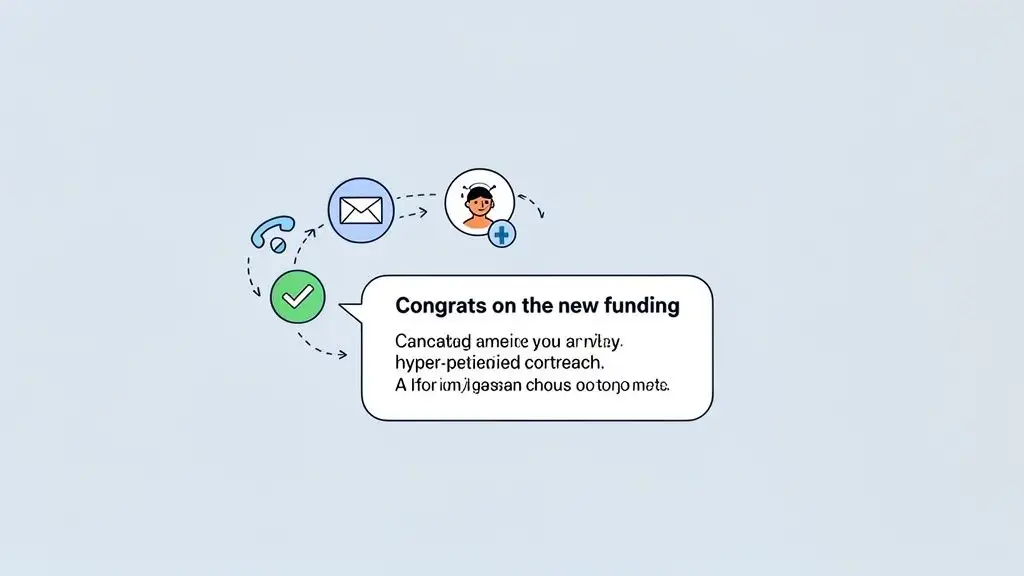
It's time to ditch the old "send email, wait a few days, send another email" playbook. We're talking about a dynamic flow of touchpoints across email, LinkedIn, and maybe even a cold call, all orchestrated by your AI. This creates a cohesive experience for the prospect that feels attentive and relevant, not like you're just another annoying robot in their inbox.
A/B Testing on Autopilot
Here’s where things get really fun. One of the best parts of using AI is its power to run sophisticated A/B tests without you needing a Ph.D. in data science. You can finally get real answers to the questions sales teams have been debating over lukewarm coffee for years.
-
Does a casual subject line like "Quick question" really beat a formal one?
-
Will referencing a prospect's recent LinkedIn post get more replies than mentioning their company's new funding round?
-
Is a direct CTA like "Are you free Tuesday at 2 PM?" better than a softer "Worth a chat?"
Instead of relying on gut feelings, your AI can automatically test these variations across thousands of prospects. It then crunches the numbers and tells you exactly which combination is booking meetings. It’s like having your own personal mad scientist, constantly tweaking the formula for maximum impact.
Measuring What Actually Matters
For way too long, sales teams have been obsessed with vanity metrics. Let's be honest: open rates and click rates are interesting, but they don't pay the bills. An open just means your subject line worked; it doesn’t mean the prospect is even remotely interested in what you have to say.
With AI-driven prospecting, we shift our focus to the KPIs that directly fatten the pipeline and boost revenue. These are the numbers that tell you if you're actually making money or just making noise.
The true measure of success in AI-powered prospecting isn't getting seen, it's starting conversations. Ditch the obsession with open rates and focus relentlessly on reply rates, meetings booked, and pipeline generated.
Here are the only metrics you really need to care about:
-
Reply Rate: What percentage of people actually hit "reply"? This is your first, best sign that the message is landing.
-
Positive Reply Rate: Let's get more specific. How many of those replies are a "tell me more" versus a "get lost"? This separates genuine interest from polite brush-offs.
-
Meetings Booked: The holy grail of prospecting. How many sequences are turning into actual calls on the calendar?
-
Pipeline Generated: The big one. What’s the dollar value of the opportunities you’ve created? This is the number that gets your CFO to smile.
How Do Your Numbers Stack Up?
Tracking these numbers is one thing, but knowing if they're any good is another. While benchmarks can vary wildly by industry, this table gives you a solid starting point for what a well-oiled, AI-assisted prospecting machine should be hitting.
| KPI (Key Performance Indicator) | Industry Benchmark | What It Tells You |
|---|---|---|
| Email Reply Rate | 5-10% | The overall relevance and punch of your messaging and targeting. |
| Positive Reply Rate | 1-3% | How well your value prop and call-to-action are resonating with the right people. |
| Meetings Booked per 100 Prospects | 1-2 Meetings | The end-to-end effectiveness of your whole sequence, from hook to conversion. |
| Lead-to-Opportunity Conversion | 10-15% | The quality of your AI-identified leads and how well they fit your sales process. |
If your numbers are falling short, don’t sweat it. Think of this data as your personal coach. A low reply rate probably means your personalization needs work. A low conversion to meetings? Your call-to-action might be weak. Use these insights to constantly refine your ICP, messaging, and strategy.
For a deeper dive into structuring your outreach, check out these sales cadence best practices to help you build even more effective sequences.
Common AI Prospecting Mistakes to Avoid
Look, AI in sales is powerful. It’s a game-changer. But it's not a magic wand you can wave and expect deals to just appear. Too many teams get star-struck by the technology and stumble right into some classic, totally avoidable pitfalls that can torpedo their entire prospecting effort.
The biggest mistake? Letting the AI run wild without a human at the wheel. That's how you end up with outreach that sounds like it was written by a cheesy 90s movie robot. This is about AI-assisted selling, not AI-only selling. You're the pilot, AI is your ridiculously smart co-pilot.
Another classic blunder is treating every scrap of data the AI spits out as gospel. These tools are incredibly smart, but they aren't perfect. You absolutely need a human spot-check process to verify the important stuff before you go all-in on a big campaign. A little paranoia is healthy here.
The Over-Reliance Trap
It's tempting to lean on AI so much that it becomes a crutch. This is the fast track to a lazy sales team that forgets the fundamentals of real salesmanship. Don’t let it happen. Your reps need to stay sharp, acting as the strategic brain of the operation while the AI handles the heavy lifting.
The Human Touch Still Wins: Think of AI as your tireless research assistant, not your replacement. The outreach that truly connects is a blend of AI's speed and data with a human's empathy, wit, and strategic thinking. Never, ever send an AI-generated message without a final human review.
To keep your strategy smart and your outreach genuine, here are a few ground rules to avoid the most common face-plants.
-
Don't let the AI write the whole message. Use it to whip up a fantastic first draft based on all that rich data. Then, a real person needs to step in to inject personality, nuance, and that final human touch.
-
Feed it high-quality fuel. You’ve heard it a million times: garbage in, garbage out. It’s never been more true than with AI. Clean, accurate data is the high-octane fuel your AI engine needs to perform. To get an edge, dive deeper into how your emails are being engaged with, even a perfect message is worthless if it isn't seen. You can learn more in our guide to open email tracking.
-
Don't ignore the "no." Every rejection is a free lesson. Dig into those negative replies. They’re goldmines of information that can help you tighten up your ICP, sharpen your messaging, and rethink your entire approach.
Your Burning Questions About AI Sales Prospecting
You've got questions, we've got answers. Stepping into AI for sales prospecting can feel a bit like trying to assemble IKEA furniture in the dark. It seems complicated, but once you find the right pieces, it all clicks. Let's tackle some of the most common head-scratchers.
Are Robots Coming for Our SDRs' Jobs?
Let's kill this myth right now: No. Think of AI as the ultimate sidekick for your sales team, not their replacement. It's like giving your SDRs a jetpack, not a pink slip.
AI is brilliant at handling the soul-crushing, repetitive tasks like digging through mountains of data, finding contact info, and spotting buying signals. This frees up your reps to do what humans are irreplaceable at: building genuine rapport, navigating tricky conversations, and actually closing deals. The best teams run a hybrid model where AI does the heavy lifting, and SDRs provide the strategy and human touch.
What's This Going to Cost Me?
The price range for AI prospecting tools is all over the map, but it's probably more affordable than you think. You can find some platforms with starter plans for as little as $49 per month, while the big, all-in-one enterprise systems can climb into the thousands.
But focusing only on the cost is missing the point. The real conversation is about ROI. If a tool saves every SDR on your team 5-10 hours a week and helps them book 20% more meetings, it starts paying for itself almost immediately. My advice? Look for tools with clear pricing that can scale as you grow.
Here's a pro-tip: Never let the AI run on complete autopilot. Always treat it as a 'first draft' machine. It's fantastic for digging up key data and whipping up an initial message, but a human always needs to review, refine, and add that final touch of personality.
How Do We Stop AI Outreach from Sounding... Robotic?
This is the big one, isn't it? The secret is to think "AI-assisted," not "AI-automated." The goal isn't to have a robot write a perfect, sterile email. It’s to have the AI give you a killer head start.
Encourage your team to inject their own voice into every message. Have them add a personal anecdote, a clever observation about the prospect's recent LinkedIn post, or a specific insight that only a human would notice. The magic happens when you blend the speed and data-crunching power of AI with the empathy and creativity of your team. That’s how you get outreach that feels real and gets a reply.
Ready to stop prospecting like it's 1999? Munch gives you the power to find high-intent leads, enrich their data, and launch personalized outreach that gets replies, all in one seamless workflow. Start building your pipeline today.