Inbound Lead Generation: A Practical Guide to Winning Customers

By Mriganka Bhuyan
•Founder at Munch
Let's ditch the old-school sales tactics for a minute. Inbound lead generation is all about attracting customers to you with genuinely helpful content and experiences, rather than blasting them with ads they didn't ask for.
Think of it as the difference between being a magnet and being a megaphone. The old way, outbound marketing, is the megaphone. It's about shouting your message at everyone, hoping someone, anyone, listens. Inbound is the magnet. It pulls the right people in because you're offering something they actually want, like being the only person at the party with pizza.
This whole approach is built on trust and establishing yourself as the go-to expert. When you do it right, sales conversations stop feeling like a pushy pitch and start feeling like a welcome chat.
Forget the Megaphone, Use a Magnet Instead
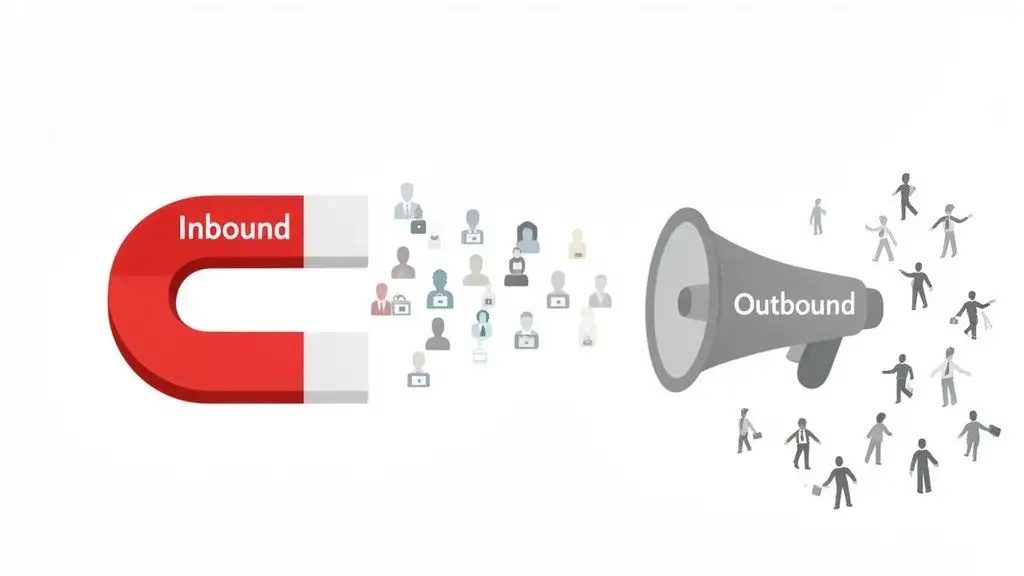
Seriously, when was the last time a cold call during dinner made you happy? I’m guessing never. That's the outbound experience in a nutshell: interrupting people and hoping for a lucky break. It’s like being that person at a party who corners you to talk about their crypto startup. You just want to escape.
Inbound is the polar opposite. It’s the art of being so ridiculously helpful that your ideal customers find you. You create killer content that solves their real-world problems, answers the questions keeping them up at night, and generally makes their lives easier.
Inbound marketing is about creating a welcome mat for your ideal customer. You're not breaking down their door; you're inviting them in by offering exactly what they're already searching for.
Picture this: a B2B software company drops an incredibly detailed guide on "How to Calculate ROI for New Tech Investments." A CFO, who happens to be frantically Googling that exact phrase, stumbles upon it. They get a ton of value, and just like that, the company is on their radar as a trusted expert. No awkward cold calls necessary. Of course, getting found on Google is a science in itself, which is where a solid strategy for B2B SEO for lead generation comes into play.
Why This Shift Matters More Than Ever
Let's be real: today's buyers are research fanatics. They've already done most of their homework long before they even think about talking to a salesperson. They hold all the cards, and they have zero hesitation hitting the "block" or "unsubscribe" button.
Inbound marketing respects this new reality. It meets buyers on their own terms, where they're already looking for answers. And the numbers don't lie. Inbound methods generate 54% more leads than old-school outbound tactics. Even better, they do it while costing 62% less per lead. When you nurture those leads properly, they turn into 50% more sales at a 33% lower cost. It’s an engine for sustainable growth that doesn’t require a nine-figure budget.
To really nail this down, let's look at the core differences side-by-side.
Inbound vs. Outbound Lead Generation: A Quick Showdown
This table cuts right to the chase, showing you exactly how the magnetic pull of inbound compares to the megaphone blast of outbound.
| Attribute | Inbound (The Magnet) | Outbound (The Megaphone) |
|---|---|---|
| Methodology | Pulls customers in with helpful content (blogs, SEO, webinars). | Pushes messages out to a broad audience (cold calls, TV ads). |
| Customer Focus | Solves specific problems for a targeted audience. | Interrupts the general public's day. |
| Lead Quality | High; leads are self-qualified and actively interested. | Low; leads are often unqualified and not looking to buy. |
| Cost Per Lead | Significantly lower over the long term. | Consistently high and requires a constant budget. |
| Long-Term Value | Builds brand equity and lasting digital assets. | Stops working the moment you stop paying. |
The takeaway is pretty clear. While outbound has its moments, inbound builds a lasting foundation for growth by turning your brand into a resource people genuinely want to engage with. It’s a marathon, not a sprint, but the payoff is huge.
Building Your Inbound Marketing Engine
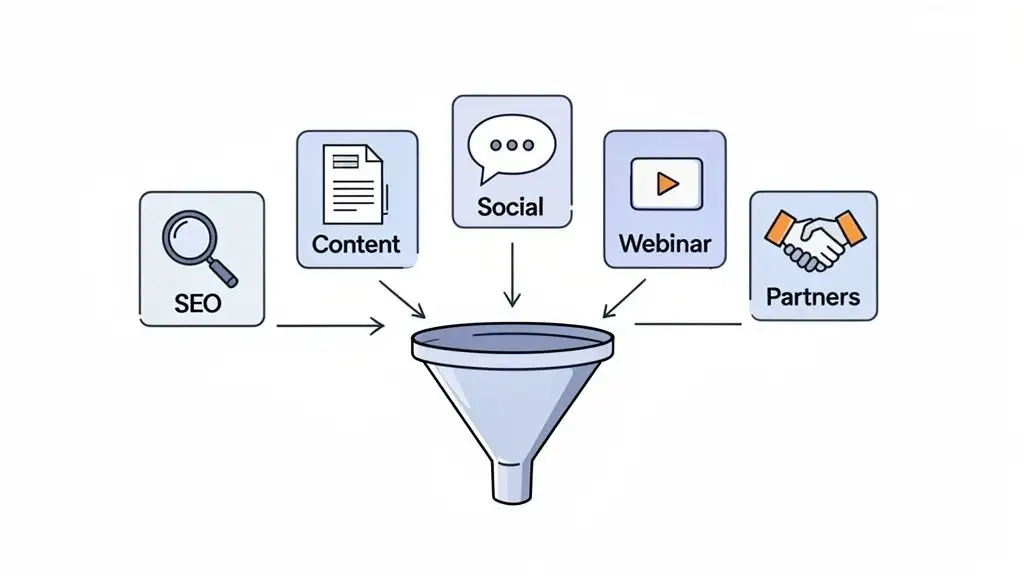
Alright, you’ve got your strategy sketched out. Now for the fun part: building the machine. Your inbound marketing engine is really just a handful of channels all pulling in the same direction to attract, engage, and ultimately win over your ideal customers.
Think of it like assembling the ultimate 90s mixtape for your perfect buyer. Each track, or channel in this case, sets a specific vibe and moves them closer to the grand finale: a conversation with your sales team.
Some channels are great for casting a wide net and making a big splash, while others are sharpshooters, designed for prospects who are already deep in the weeds of their research. The real magic happens when you orchestrate a symphony of content and distribution that makes you impossible for the right people to ignore.
Let's start assembling the core components of your inbound lead generation powerhouse.
Become Their Top Search Result with SEO
When a potential customer hits a wall, what’s their first move? They head straight to Google. They aren't dialing up sales reps; they're typing their frustrations into a search bar, hoping for an answer. Search Engine Optimization (SEO) is the art of making sure your website is that answer.
And no, this isn't about jamming keywords into a blog post like you’re trying to win a prize at the state fair. Modern SEO is all about getting inside your customer’s head. What are they really asking? What problem are they desperately trying to solve? When you create content that genuinely helps them, you earn Google’s trust and, far more importantly, your prospect's attention.
A killer SEO strategy means you show up at the exact moment your prospect realizes they have a problem you can solve. You're not an interruption; you're a revelation.
For example, a cybersecurity firm could publish a detailed guide titled, "Your Step-by-Step Plan to Fixing the Log4j Mess." By optimizing for a long-tail keyword like "how to fix log4j exploit," they attract security managers who are actively, and often frantically, searching for a solution. This instantly positions them as a helpful expert, not just another vendor trying to sell something.
Create Content That Actually Builds Trust
Content marketing is the high-octane fuel for your entire inbound engine. It’s how you prove you know your stuff and start building a relationship long before you ever ask for a meeting. We're not talking about churning out generic listicles here. We’re talking about creating assets so valuable your audience would happily pay for them, but you give them away for free.
Here are the workhorses of any solid B2B content strategy:
-
Blog Posts & Guides: These are your front-line soldiers, perfect for pulling in traffic from search and social media. They need to be insightful, practical, and nail a specific pain point.
-
Case Studies: Nothing screams "we get results" louder than social proof. A great case study tells a story: here's how we helped a customer just like you crush a specific goal. It’s the business equivalent of a movie trailer where you know the hero wins.
-
White Papers & Ebooks: When you need to tackle a complex topic, these long-form pieces establish you as a true authority. They make for perfect "gated" assets to capture leads who are willing to trade an email for your expertise.
Each piece of content should smoothly guide the reader on their journey. For a closer look at how this fits into the bigger picture, you can learn more about the B2B marketing funnel and see how different content serves each stage.
Engage Prospects with Webinars and Partnerships
While SEO and content are your foundation, a few other channels can seriously crank up your inbound lead generation. Webinars, for instance, are incredible for capturing an engaged audience for a full 45-60 minutes. It’s not uncommon for 20-40% of webinar attendees to turn into qualified leads. They offer a direct line to your experts and create a real sense of community and urgency.
Strategic partnerships are another secret weapon. Teaming up with a non-competing company in your space to co-host a webinar or co-author an ebook lets you tap into their audience. You instantly multiply your reach and borrow their credibility.
The data backs this multi-channel approach all day long. A whopping 90.7% of marketers use their websites for lead gen, with blogs right behind at 89.2%. On the social side, 89% of B2B pros are on LinkedIn looking for prospects. These aren't just "nice-to-haves"; they're non-negotiable for any modern inbound playbook. It all works together to create a powerful, self-sustaining engine.
Turning Website Visitors Into Qualified Leads
Getting a ton of traffic to your website feels great, but let's be honest, it's a vanity metric if nobody sticks around. Traffic without conversions is like throwing a massive party where everyone eats your food, enjoys the music, and then leaves without so much as a "thank you." Fun for the ego, but it doesn't lead to a second date or, in our case, a sales conversation.
This is where the magic of conversion really happens. It’s all about turning those anonymous window shoppers into actual, named leads who are raising their hands and showing interest. The whole process boils down to a simple, timeless exchange: you give them something incredibly valuable for free, and they give you their contact info in return.
Crafting a High-Converting Landing Page
Think of your landing page as the velvet rope to your exclusive offer. It has one job, and one job only: convince visitors that what you’re offering is worth handing over a few personal details. A landing page that tries to do too many things at once is destined to fail, like a movie with way too many confusing subplots.
A killer landing page has two best friends: a headline that hooks them and a call-to-action (CTA) that’s impossible to ignore. The headline needs to grab them by the collar and scream value. Ditch the vague promises. Instead of something generic like "Improve Your Business," get specific with "Double Your Email Open Rates with Our 5-Step Checklist." See the difference?
The CTA is that big, shiny button telling them exactly what to do next. "Download Now" or "Get Your Free Template" is far more powerful than a wimpy "Submit." Make it obvious. Make it compelling. And please, make it singular. Giving people too many choices is the fastest way to make sure they choose none of them. To really nail this, it helps to understand the patterns behind how to track website visitors and see what they actually care about.
Choosing Your Lead Magnet Wisely
A lead magnet is that irresistible resource you offer in exchange for an email address. The operative word here is valuable. It needs to be something your ideal customer is actively searching for, not just another boring PDF that will collect digital dust in their downloads folder.
The best lead magnets solve a mini-version of the larger problem your product solves.
-
Trying to attract CFOs? A downloadable "ROI Calculator for Logistics Software" is spot-on. It speaks their language (money) and addresses a core concern they have before making a big purchase.
-
Targeting marketing managers? An "Ultimate Content Calendar Template for B2B SaaS" is a practical tool they can start using today. It saves them a headache and immediately positions you as an expert.
-
Going after a technical audience? A deep-dive white paper on a complex industry challenge or a "Security Compliance Checklist" delivers the meaty, actionable insights they crave.
The perfect lead magnet is like a cheat code for your prospect's biggest work problem. It should offer a quick win and make them see you as a trusted guide.
The Psychology of Form Design
Finally, let’s talk about the form itself. This is the final hurdle, and it’s where so many companies stumble. Asking for twenty different pieces of information on a first interaction is the business equivalent of proposing on a first date. It’s too much, too soon, and just plain weird.
Every single field you add to your form creates friction and sends your conversion rate plummeting. Stick to the absolute must-haves. Often, a name and business email are all you need to kick things off.
Put yourself in their shoes. A long, intimidating form is an instant turn-off. Keep it short, sweet, and to the point. The goal is to make the exchange feel fair and effortless. To streamline this and engage visitors 24/7 without being pushy, a lead generation chatbot can be an incredibly effective tool. By putting these pieces together, you can finally turn all that party traffic into a pipeline of high-intent leads ready for a real conversation.
How to Score and Qualify Inbound Leads
Let's be honest: not all inbound leads are created equal. For every person ready to whip out the company credit card, you'll find a dozen just kicking the tires, hunting for a freebie, or who might have just taken a wrong turn on the internet.
If you treat every single one of them the same, you're not just wasting time. You're actively burning out your sales team and letting the truly golden opportunities slip right through your fingers.
This is where lead scoring and qualification come in. Think of it as being the bouncer for your sales pipeline. Your job is to separate the VIPs (the hot, ready-to-buy leads) from the folks who are just there for the free snacks. It's a system that transforms a messy jumble of contacts into a clean, prioritized, and actionable list for your sales reps.
Without a scoring system, your team is essentially playing a game of pipeline Minesweeper, clicking around and hoping they don't land on a dud. With a good scoring system, you're handing them a treasure map that shows exactly where the gold is buried.
Decoding Buyer Intent Signals
First things first, you have to learn how to spot intent signals. These are the digital breadcrumbs your prospects leave behind that practically scream, "Hey! I'm interested over here!" These actions are what separate the casual browsers from the serious buyers.
It's the difference between someone liking a movie trailer online and someone actually buying a ticket for opening night.
Some classic high-intent signals to look for:
-
They visit your pricing page multiple times. This is a huge tell. Nobody binge-watches a pricing page for fun. If they keep coming back, they’re genuinely weighing the cost.
-
They request a product demo. This is the B2B equivalent of a prospect sliding into your DMs. They've done some homework and now they want to see the real thing in action.
-
They download a bottom-of-funnel resource. When someone grabs a detailed case study or a competitor comparison guide, it’s a strong sign they’re deep in the decision-making process.
On the flip side, a contact who only downloads a top-of-funnel ebook or subscribes to your blog is probably just getting started. They're still valuable, but they aren’t ready for a sales call just yet.
Building a Practical Lead Scoring Model
Once you know which signals matter, you can build a scoring model. Don't overthink it. This is just a simple point system you create to assign value to different lead attributes and actions. It helps you quantify a lead's sales-readiness automatically, so you're not just guessing.
Here’s a simple, real-world example of what this could look like in practice:
| Attribute or Action | Points | Why It Matters |
|---|---|---|
| Title is Director or Higher | +10 | They likely have the authority to make a purchase. |
| Requested a Demo | +15 | This is one of the strongest signals of immediate buying intent. |
| Visited Pricing Page (3+ times) | +10 | They're working out the budget and are serious about buying. |
| Downloaded Case Study | +5 | They need proof and social validation that your solution works. |
| Using a Gmail/Yahoo Address | -5 | This often indicates a lower-quality lead, not a business user. |
A good lead scoring model isn't about some ridiculously complex algorithm; it's about common sense. It answers one simple question: "Based on who they are and what they've done, how likely is this person to buy from us right now?"
Modern platforms like Munch can put this entire process on autopilot. They track all these behavioral signals and cross-reference them with the firmographic data that defines your Ideal Customer Profile (ICP). This creates a dynamic, live score that tells your sales team exactly who to call first.
For a deeper dive into getting this right, check out these lead scoring best practices to really fine-tune your model. When you systematically identify and prioritize your best inbound leads, you ensure your sales team spends their precious time closing deals, not chasing ghosts.
Putting Your Inbound Strategy Into Action
A brilliant strategy scribbled on a whiteboard is a beautiful thing, but let's be honest, it doesn't pay the bills. The real magic happens when you turn that inbound lead generation plan into a well-oiled, revenue-generating machine. This is where the rubber meets the road, moving from theory to tangible results.
Let’s get practical. Picture this: a new inbound lead just signed up for your latest webinar. Awesome! You've got a name, an email, and maybe a company. But that’s just the opening act.
In a typical scenario, your sales rep would now spend the next hour digging through LinkedIn, trying to piece together who this person actually is. But when you operationalize your strategy, things look very different. A platform like Munch can jump in and instantly enrich that lead with verified contact info, company data, and other juicy details. It’s the difference between getting a name tag and getting their entire professional biography.
From Simple Lead to High-Priority Prospect
Getting the signup is just the first domino to fall. The next step is to figure out if they’re just kicking tires or have real buying intent. A truly smart system doesn’t just sit on the data it collects; it actively hunts for business triggers that scream, "Pay attention to this one!"
Let's go back to our webinar lead. Imagine Munch's AI is scanning public data and suddenly spots a massive buying signal: the lead’s company just closed a $30 million Series B funding round. This isn’t just a random factoid; it’s a game-changer. It tells you they’re flush with cash, have aggressive growth targets, and are probably on the hunt for tools to help them scale.
That’s how you turn a raw signal into a red-hot opportunity.
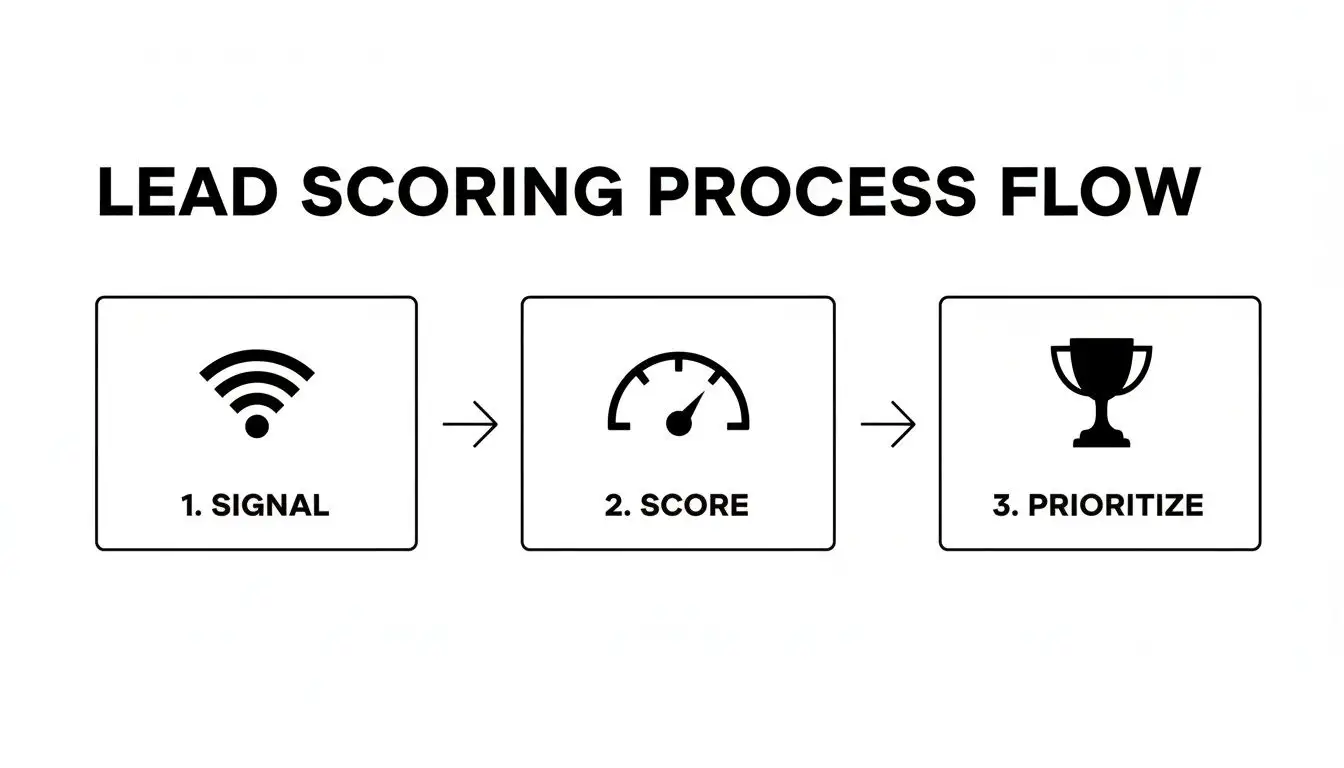
Moving from a signal to a score is what separates a reactive sales team from a proactive one, making sure your people are always focused on the leads most likely to close.
That single alert instantly transforms the lead from "some person who watched our webinar" to "a key contact at a freshly funded company that perfectly fits our ideal customer profile." Your sales rep gets an immediate notification, armed with context that would've taken them hours to find on their own. For more on this, check out our guide on automated lead generation to see how to put this system on autopilot.
Crafting Outreach That Actually Gets Replies
Now for the final, and most crucial, piece of the puzzle: the outreach. With all this context, your sales rep can finally ditch the soul-crushingly generic "Thanks for attending our webinar" email. We've all gotten them, and we all know they’re a one-way ticket to the trash folder.
Instead, they can craft something that’s impossible to ignore.
Subject: Quick thought on [Webinar Topic] & your Series B
"Hey [Lead Name],
Saw you attended our webinar on scaling customer support yesterday. Given that [Lead's Company] just announced its Series B funding, I bet you're planning to expand your team and need to maintain service quality without tripling headcount.
Our session covered how to automate ticket routing, which is something our clients like [Similar Company] found crucial right after their own funding rounds.
Worth a quick chat about how you're planning to handle the growth?"
See the difference? This email is pure relevance. It connects their known interest (the webinar) with their immediate business reality (the funding). It’s not a pitch; it's a conversation starter that proves you've done your homework and understand their world.
By putting your inbound strategy into action this way, you create a seamless flow from a simple inbound signal to a highly personalized sales conversation. You stop just collecting leads and start consistently opening doors to deals that actually drive revenue.
Common Questions About Inbound Lead Generation
You've made it this far, which means you're either buzzing with ideas about inbound lead generation or you have a few nagging questions. Let’s be real, it’s probably a bit of both. This is where we tackle the tough questions, the "but what about..." moments that keep marketers and sales leaders up at night.
Think of this as your straight-talk FAQ. No fluff, just direct answers to the most common head-scratchers about making inbound actually work.
How Long Does It Take for Inbound to Show Results?
Let's get this one out of the way first. Inbound marketing is not an instant gratification machine. It’s less like ordering a pizza and more like planting a garden. You have to prep the soil, plant the seeds, and water them consistently before you get to enjoy the harvest.
Think of it as building a killer reputation. It just doesn't happen overnight.
Generally, you can expect to see the first green shoots of traction within 3 to 6 months. This might look like a steady climb in organic traffic or a few leads trickling in from a blog post that finally starts to rank on Google.
But the real, predictable, "I can finally forecast this" lead flow? That usually starts building between 6 and 12 months. The good news is, once your inbound engine is humming, it keeps generating leads with far lower long-term costs. Unlike paid ads that vanish when you stop paying, your content works for you 24/7, even while you sleep.
What Are the Most Important Inbound Metrics to Track?
It's way too easy to get hypnotized by vanity metrics. Likes, shares, and page views feel good, but they don't pay the bills. When it comes to inbound, you need to track the numbers that connect directly to revenue. It’s like judging a movie by its box office returns, not its Rotten Tomatoes score.
Focus on the metrics that tell a complete story:
-
Website Traffic to Lead Conversion Rate: This is your foundational number. Of all the people stopping by your site, what percentage are actually raising their hand and becoming a lead?
-
Lead to MQL Rate: This tells you if you're attracting the right crowd. Are the leads you’re generating actually a good fit for what you sell?
-
MQL to SQL Rate: This shows how well marketing and sales are playing together. Are the leads marketing qualifies being accepted by sales as real opportunities?
Ultimately, the two metrics that reign supreme are Customer Acquisition Cost (CAC) and Customer Lifetime Value (LTV). A healthy inbound strategy consistently lowers your CAC while bringing in high-LTV customers. When you nail that combo, you’ll have a story your CFO will love. For a closer look, you can explore some of the most critical lead generation KPIs that really matter.
Can Inbound Work Without a Huge Budget?
Absolutely. In fact, that's one of its greatest superpowers. Think of it as the David vs. Goliath of marketing. You don't win by outspending the competition; you win by outsmarting and out-helping them.
The core of inbound lead generation isn't about the size of your wallet; it’s about the size of the value you provide. Your biggest initial investment is creativity and time, not cash.
While a big budget can certainly hit the accelerator, you can start small and be incredibly effective. Focus on owning a tiny niche. Write the single best, most detailed blog post on the internet about a very specific problem your ideal customer faces. Create a simple but insanely useful checklist they can't resist downloading.
Your expertise is your competitive advantage. Share it generously, and you’ll build an audience and a pipeline without needing a blank check.
How Does Inbound Fit with an Outbound Sales Strategy?
This is a classic question, but the answer is simple. They aren't rivals; they're the ultimate tag team, like Batman and Robin or Jay-Z and Beyoncé. They are so much more powerful together.
Inbound marketing acts as the air cover for your sales team. It fills the top of your funnel with warmer prospects who already know who you are and have shown clear interest. This makes your sales team's job infinitely easier.
Here’s how they work together in an "allbound" approach:
-
Inbound Signal: A prospect downloads your case study on a specific industry problem.
-
Outbound Action: Your sales rep gets an alert and follows up with a hyper-personalized email or LinkedIn message referencing that exact case study.
This strategy combines the scale of inbound with the precision of outbound. Your inbound efforts provide the intelligence and context, while your outbound team executes timely, relevant outreach to your most engaged prospects. It's truly the best of both worlds.
Ready to turn your inbound strategy into a predictable revenue machine? Munch is the sales intelligence platform that helps you find high-intent prospects, enrich their data, and launch personalized outreach that gets replies. Stop guessing and start closing. Get started with Munch today.