How To Find A Company Email Address: A Quick, Trusted Guide

By Mriganka Bhuyan
•Founder at Munch
Finding the right person's email can feel like a high-stakes scavenger hunt. You know the treasure is out there, but you’re stuck sifting through a mountain of digital clutter. The good news is that it's a game you can win. You can absolutely find a company email address; you just need the right playbook. We're talking about everything from simple website checks and clever Google tricks to smart guessing games and powerful tools that do the heavy lifting for you.
Let's turn that frustration into a reliable system.
So, Why Is This So Hard Anyway?
Look, you wouldn't be here if finding an email was as easy as ordering a pizza. We're up against digital gatekeepers, ancient "contact us" forms that lead to a black hole, and privacy walls that seem to get higher every year. It’s a maze, and it’s designed to keep salespeople and networkers out.
But here’s the thing: in the B2B world, a direct, verified email is still the gold standard. It cuts through the noise. It’s the difference between a personalized pitch that gets a reply and a generic LinkedIn message that gets ignored.
The grind is worth it because email is where real business gets done. I’m not just guessing here, the data is clear. A whopping 77% of B2B buyers prefer being contacted by email. That’s more than double any other channel. It’s not a fad; it’s how professionals communicate.
Verified Emails Are Your Golden Ticket
Sending a shot-in-the-dark email is a rookie mistake. An unverified address is a one-way ticket to a bounced message, and that’s bad news for your sender reputation. Seriously, every bounce is like a little red flag to email giants like Google and Microsoft. Too many, and they'll start sending your messages straight to the spam folder. (We've got a whole guide on this, explaining exactly what is a bounced email and why you need to avoid them like a dial-up modem.)
A verified email, though? That’s your green light. It confirms your message will actually land in their inbox, giving you a real chance to start a meaningful conversation.
What’s Coming Up in This Playbook
This is your no-fluff, hands-on guide. We're skipping the boring theory and jumping right into the street-smart tactics that I’ve seen work time and time again.
Here’s a sneak peek at the reliable strategies we’re about to unpack:
-
Become a Digital Detective: I’ll show you how to hunt down emails on company websites and use some slick Google search operator tricks.
-
Crack the Email Code: You'll learn how to spot and predict common email patterns, making you feel like Neo seeing the Matrix for the first time.
-
Bring in the Tech: We'll cover the best email finders and verification services that automate the grunt work for you.
-
Scale Like a Pro: We’ll look at how to go from finding one email to building entire, targeted prospect lists with powerful sales intelligence platforms.
For a deeper dive into even more techniques and tools, you’ll find this detailed article on how to find company email addresses to be an awesome resource. Now, let's get to it.
Your Manual Email Hunting Playbook
Alright, time to roll up our sleeves and do some good old-fashioned detective work. Before we unleash the high-tech gadgets and AI-powered tools, let's get back to basics. Sometimes, the email you’re looking for is hiding in plain sight, and mastering these manual techniques will make you surprisingly good at this without spending a single cent.
Think of it as the digital equivalent of shaking hands. It’s direct, a little old-school, but it gets the job done more often than you'd think.
The Obvious (But Often Overlooked) Hiding Spots
You would be absolutely shocked how often a prospect’s email is just sitting on their company website, patiently waiting for you. It’s like the end of The Sixth Sense where the clue was right there the whole time. Before you do anything else, give the company's website a thorough five-minute sweep.
Here’s your treasure map:
-
The "About Us" or "Team" Page: This is ground zero. A lot of companies, especially smaller outfits proud of their crew, list key people with their direct contact info right there.
-
Press Releases or the "News" Section: Dig up a recent press release. You'll often find a media contact (and their email) listed at the bottom. Boom. That gives you a confirmed email from the company, which is a massive clue for cracking their email pattern.
-
Author Bios on the Blog: If your prospect has ever penned a blog post for their company, their author bio is a potential goldmine. It might have their direct email or a link to a social profile with more breadcrumbs to follow.
This first pass isn't just about snagging the exact email; it's about intelligence gathering. Every little piece helps build the puzzle.
Unleash Your Inner Google Fu
When the website comes up dry, it’s time to show Google who’s boss. A standard search is for amateurs. We're going to use advanced search operators. They’re basically cheat codes that tell Google to skip the fluff and give you exactly what you’re looking for.
Let's say you're hunting for Jane Doe's email at AcmeCorp.com. Instead of just typing her name and hoping for the best, you get specific.
A few of my go-to operators:
-
site:acmecorp.com "Jane Doe" email: This tells Google to only search inside the acmecorp.com website for pages that mention "Jane Doe" and the word "email." It’s incredibly focused. -
"Jane Doe" email @acmecorp.com: This one searches the entire web for her name alongside her likely email domain. You can uncover mentions in interviews, conference speaker lists, or even personal blogs. -
"J.Doe" acmecorp.com: Sometimes you have to play the odds and guess the pattern. This operator hunts for common initial-based variations.
Pro Tip: Always, and I mean always, put names in quotation marks (like "Jane Doe"). This forces Google to search for that exact phrase. It's a tiny tweak that makes a world of difference in your results.
This flowchart pretty much sums up the decision-making process when you're on the hunt.
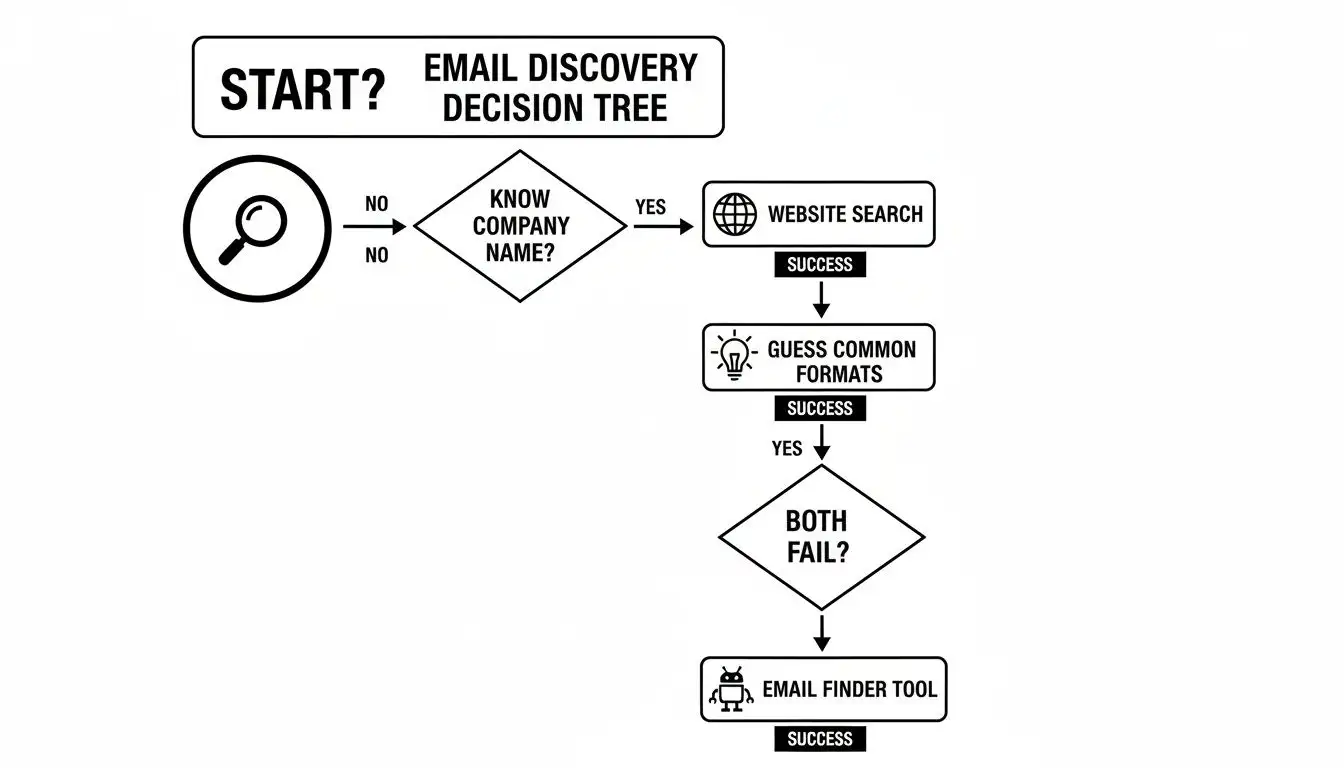
The big takeaway here is that manual checks are your first line of attack. You only escalate to more complex guesses or paid tools after you've exhausted the simple stuff.
Scour Social Media Profiles Like a Pro
Last stop: social media. I'm talking specifically about LinkedIn. It's the world's biggest professional networking party, and people often leave their contact info lying around. A direct email in a LinkedIn bio is rare, but it's not impossible.
Executives and founders, in particular, sometimes pop their email into their "About" section to seem more accessible. It’s a bit of a long shot, but it only takes a few seconds to check. While you're there, glance at their posts and comments. Have they shared a link to a personal project or a guest article on another site? Those are fresh leads to chase down.
A little persistence here can really pay off. For a deeper dive, our guide on how to search for employees on LinkedIn can give you an extra edge.
Mastering these manual methods is all about building your foundational skills. It takes a bit of grunt work, sure, but it builds great prospecting habits and costs nothing but your time. Once you've got these down, you'll be ready to move on to the more advanced stuff.
Put On Your Detective Hat and Spot the Pattern
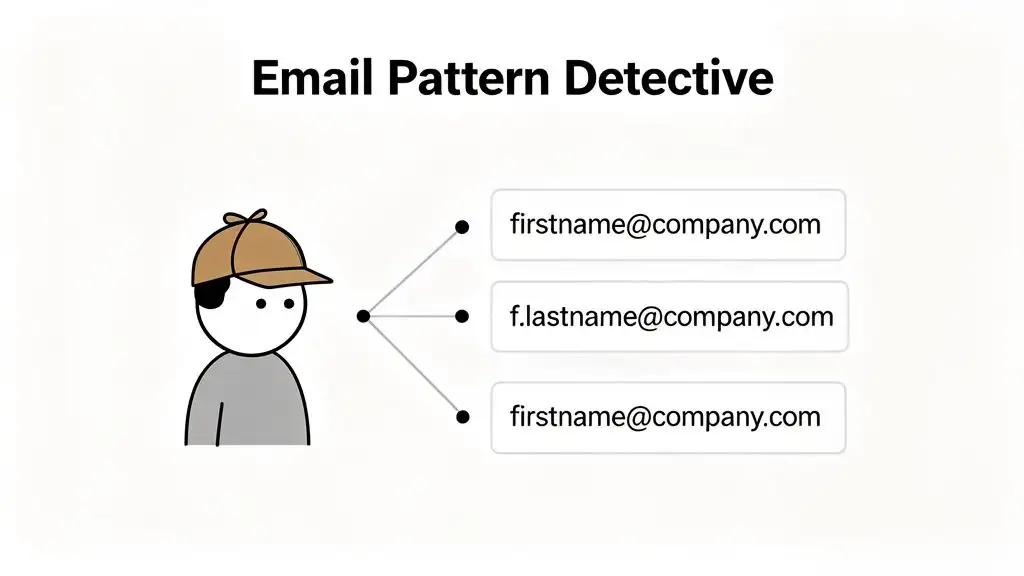
Ready to feel like a digital Sherlock Holmes? This next move is all about cracking the code behind a company's email structure. It’s less about a magnifying glass and more about simple logic, but the thrill of the hunt is just as real.
Most businesses aren't trying to hide. They crave consistency and operational sanity, which means their email addresses almost always follow a standard pattern. That predictable structure is the chink in the armor you're looking for.
If you can track down just one verified email address from your target company, you’ve basically found the Rosetta Stone. That single email reveals the blueprint, letting you reverse-engineer the address for almost anyone else on the team. It's a slick blend of deduction and old-school sleuthing.
First, You Need a Clue
Before you can start predicting patterns, you have to get your hands on a confirmed email address. Think of this as your anchor point, the first piece of the puzzle. Luckily, these initial clues are often hiding in plain sight.
Your mission is to find an email for anyone at the company. It doesn't have to be your prospect. A few goldmines for this are:
-
The Press or News Page: Hunt for a press release. Tucked away at the bottom, you'll almost always find a "Media Contact" with their full email. Bingo.
-
Blog Author Bios: Check out the company blog. The author's bio might list their email directly or link to a personal site where it's easily found.
-
General Inboxes: Even a generic
info@company.comorsales@company.comconfirms the domain you need to use for the second half of the address.
Once you have that first email, you're ready to start decoding the pattern they use for individual employees.
Decoding Common Email Permutations
With your clue in hand, it's time to form a hypothesis. Let's say you found a press release with a media contact named "John Appleseed," and his email is john.appleseed@megacorp.com.
The pattern is crystal clear: firstname.lastname@megacorp.com.
Now, if your real target is the VP of Sales, "Samantha Jones," you can make a highly educated guess that her email is samantha.jones@megacorp.com. You'd be amazed how often this simple logic pays off.
Here's a pro-level shortcut that feels like a cheat code. Once you have a few likely email options, pop open a new draft in Gmail. Type each guess into the "To" field, one by one. If a Google profile picture and full name suddenly appear for one of them, you’ve struck gold. It’s the digital equivalent of getting a knowing nod from across the room.
But what if the pattern isn't that straightforward? Companies have a handful of go-to formats they stick to.
A Field Guide to Email Patterns
Here are the most common structures you'll run into out in the wild. If you were trying to reach Walter White at Vamonos Pest Control (vamonospest.com), these are the permutations you'd want to test first:
| Pattern Style | Example Format |
|---|---|
| First Name | walter@vamonospest.com |
| First Name + Last Initial | walterw@vamonospest.com |
| First Initial + Last Name | wwhite@vamonospest.com |
| Full Name with a Dot | walter.white@vamonospest.com |
| Full Name with an Underscore | walter_white@vamonospest.com |
This methodical process of generating and testing possibilities is a cornerstone skill for any B2B seller. Just remember the final, critical step: always run your best guess through an email verification tool before clicking send. This protects your sender score and ensures your perfectly crafted message doesn't bounce into a digital black hole. Done right, this technique turns one tiny data point into the key that unlocks the entire org chart.
Using Email Finders and Verification Tools
Look, playing detective is fun, but let's be honest: you don't always have time to channel your inner Sherlock for every single prospect. When you need to find a company email address at scale and with a high degree of confidence, it’s time to bring in the big guns. Email finder and verification tools are your secret weapons for getting it done fast.
Think of these platforms as your personal army of research droids. They tirelessly scan the web, cross-reference massive databases, and run complex checks in the background. They do in seconds what would take you hours, turning a tedious slog into a simple click-and-copy operation.
How Do Email Finder Tools Work?
These platforms aren't just pulling data out of thin air. They operate by combining several smart techniques to triangulate the most likely email address for your target. It’s less magic and more of a powerful cocktail of data scraping, pattern analysis, and existing contact information.
Most top-tier finders use a multi-pronged attack:
-
Public Data Scraping: They crawl publicly available sources like company websites, press releases, and professional networking sites to find any mention of an email address.
-
Massive Databases: Many services maintain their own proprietary databases of business contacts, which they've built and scrubbed over years.
-
Pattern Inference: Just like we did manually, they analyze a company's known email pattern and apply it to generate a highly probable address for your specific prospect.
The result is an instant, data-backed guess that's often far more accurate than what you could produce on your own. This speed lets you build targeted lists quickly, moving from research to outreach in a fraction of the time.
Pro Tip: Use Munch to find work email addresses of your prospects and verify them.
Verification Isn’t Optional, It’s Essential
Finding a potential email address is only half the battle. Hitting "send" on an unverified email is like playing Russian roulette with your sender reputation. Every bounced email sends a negative signal to providers like Gmail and Outlook, jacking up the odds that your future messages land in the spam folder.
A high bounce rate is the sales equivalent of Blockbuster telling Netflix their idea will never work. It's a massive misstep that kills your credibility. Getting this right isn't just a "best practice"; it's fundamental to the long-term success of your outreach.
This is where verification tools step in. They perform a series of technical checks to determine if an email address is active and can receive mail before you ever press send.
The process usually involves a few key steps:
-
Syntax Check: The tool makes sure the address is formatted correctly (e.g.,
name@domain.com). Simple, but you'd be surprised how often this catches errors. -
Domain Check: It confirms the domain actually exists and is set up to receive email.
-
Server Ping: This is the magic trick. The tool communicates with the recipient's mail server to see if the specific user mailbox exists, all without actually sending an email.
This multi-step validation dramatically slashes your bounce rate, protecting your domain and ensuring your hard work doesn't go to waste. For a deeper dive, you can learn more about the technical side of how to verify email addresses in our dedicated guide.
What to Look For in an Email Verification Tool
Not all verification services are created equal. When choosing a tool, you're not just buying credits; you're investing in your deliverability. A good tool provides the peace of mind that your outreach will actually land where it's supposed to.
Here are the key features to look for:
| Feature | Why It Matters |
|---|---|
| High Accuracy Rate | Look for tools that promise 95%+ accuracy. Anything less introduces too much risk of bounces, defeating the whole purpose. |
| Real-Time Verification | Some tools check against stale, cached data. Real-time verification pings the server live, giving you the most current status of an inbox. |
| Integration Capabilities | The best tools plug right into your CRM or sales engagement platform, letting you verify emails automatically as you build lists. |
| Bulk Verification | If you're working with large lists, you need the ability to upload a CSV and get results for thousands of contacts at once. No one-by-one nonsense. |
Protecting your sender score is non-negotiable, and the right tool makes it a seamless part of your workflow. The investment is tiny compared to the potential damage of a blacklisted domain.
The ROI here is a no-brainer. Businesses spending just $100 or less per month on email marketing report an ROI of $21 or more for every dollar spent, making it one of the most effective channels out there. Email is a powerhouse, proving 40x more effective than social media for snagging new customers. With those kinds of returns on the line, ensuring your messages actually get delivered is everything. These email marketing statistics really drive home just how important a clean list is.
Time to Automate: From Finding Emails to Building a Pipeline
Alright, we’ve covered the manual grind and the clever workarounds for digging up a company email address. Now, let’s talk about graduating from digital detective to mission commander. This is where you stop chasing one email and start building a predictable, scalable sales pipeline.
Welcome to the world of sales intelligence platforms.
This isn't just about finding emails faster. It’s a completely different way of thinking about prospecting. The goal shifts from simply finding a contact to finding the right contact at the exact moment they’re most likely to buy. It’s about working smarter, not just harder.
Beyond Just Finding Emails
Sales intelligence tools pull lead discovery, data enrichment, and outreach into a single, smooth workflow. They kill the soul-crushing manual research that burns out reps and lets them get back to what they’re paid to do: talk to people and close deals.
Imagine a system that’s always scanning the web for buying signals, the digital breadcrumbs that tell you a company is ready to make a move. This could be anything from a fresh round of funding to a new exec joining the C-suite.
Here’s the basic playbook for these platforms:
-
They Monitor Buying Signals: These tools track job changes, funding announcements, new software adoption, and thousands of other triggers across millions of companies.
-
They Match Your Ideal Customer Profile (ICP): You feed the system your perfect customer (company size, industry, tech they use) and it filters out all the irrelevant noise.
-
They Deliver Hyper-Accurate Data: Once it finds a match, the platform instantly enriches the contact with a verified email boasting 95%+ accuracy, direct-dial phone numbers, and LinkedIn profiles.
This flips prospecting from a reactive guessing game into a proactive, data-driven strategy. To really get it, you need to understand what sales intelligence is for B2B growth. It's the engine that powers modern sales teams.
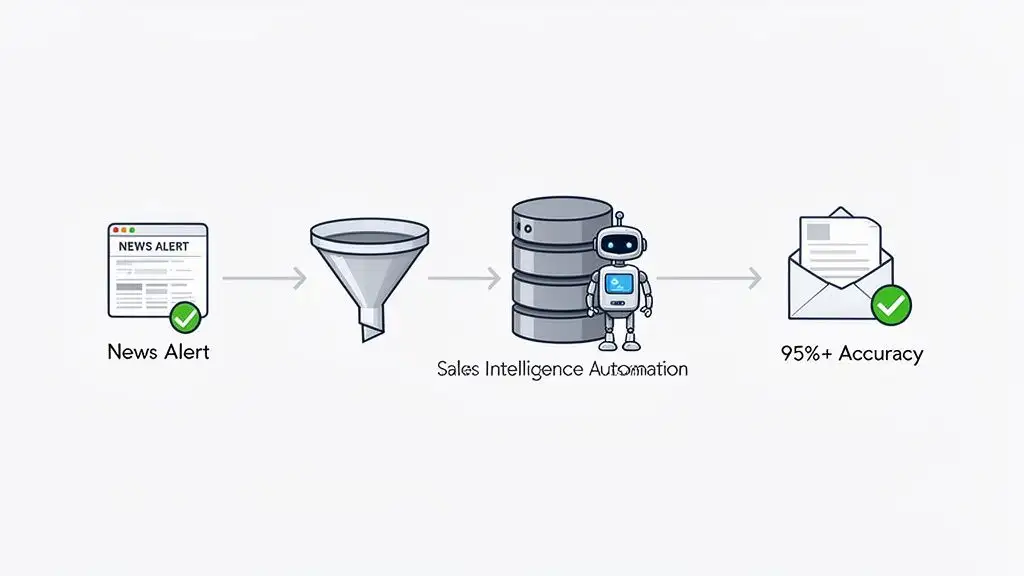
From a News Headline to Your Pipeline
Let’s make this real. Say you sell marketing automation software to mid-size tech companies. The old way would involve you manually scouring tech blogs all day, hoping to get lucky.
Here's how an intelligence platform automates that entire process:
-
The Trigger: An algorithm spots a news article: "InnovateTech Inc. just landed $20 million in Series B funding." It immediately flags this as a high-intent signal because you know that cash is about to be spent on growth tools.
-
The Match: The system checks InnovateTech against your ICP. Bam. They’re a 250-employee tech company, and its tech-stack data shows they aren't using a major competitor. Perfect fit.
-
The Target: It then identifies the new "VP of Growth," a role that’s a dead ringer for a key decision-maker for your product.
-
The Contact: Seconds later, you get a notification with her verified email address,
firstname.lastname@innovatetech.com, ready for you to hit "send."
What would've taken you hours of slogging is now done in minutes, if not seconds. That’s the magic of this approach.
Moving from manual hunting to automated discovery is like going from a paper map to a GPS that reroutes you in real-time based on traffic. One gets you there eventually; the other gets you there faster, smarter, and with a whole lot less road rage.
Why Automation Is the Final Boss of Prospecting
The real win here is time. Sales reps spend a shocking amount of their day not selling. They’re digging for data, updating CRMs, and doing admin work. Automation gives them that time back.
When you build a system that consistently surfaces high-intent leads with verified contact info, you create a predictable pipeline. You can forecast more accurately, your team hits quota more consistently, and you can scale without just throwing more people at the problem. For a deeper dive, check out our guide on automated lead generation, which takes these ideas even further.
Ultimately, this is the endgame. You stop looking for individual emails and start building a machine that delivers a steady stream of your ideal customers right to your doorstep.
Got Questions? We’ve Got Answers.
Alright, let's talk about the tricky stuff. Even with the best tools and a solid game plan, you're bound to run into a few head-scratchers when you're hunting for emails. Think of this as your field guide for those "what do I do now?" moments.
No theory, just straight talk from the trenches.
So, Is It Actually Legal To Email People I Find Online?
Yes, but you have to be smart about it. This isn't the Wild West. In the B2B world, sending a cold email is generally fine if you have what's called "legitimate interest" under rules like CAN-SPAM in the US.
But "legitimate interest" is the key phrase here. It means your message has to be genuinely relevant to the person's job. For example, don't pitch your SEO services to the head of HR; that's just spam. You’re knocking on a business door for a business reason, not trying to sell them a new set of kitchen knives.
And here’s the golden rule: you must give them an easy way to say "no thanks." An unsubscribe link is non-negotiable. If they opt-out, you honor it immediately. No exceptions.
Help! My Emails Keep Bouncing. What Gives?
First things first: stop sending to that list. A high bounce rate is a screaming red flag to email providers like Gmail and Outlook, and it's the fastest way to wreck your domain's reputation.
A bounce isn't just a failure; it's a message. You need to read it.
-
Hard Bounces: This is a dead end. The email address is fake, gone, or misspelled. It's a permanent failure. Your only move is to delete that contact from your list for good.
-
Soft Bounces: This is more of a temporary roadblock. Maybe their inbox is full or the company server is having a bad day. You can try again in a day or two, but if it bounces a second time, cut your losses and treat it like a hard bounce.
The real solution is to play defense. You absolutely have to verify every single email before you send that first message. For a deep dive into keeping your sender score healthy, check out our guide on how to improve email deliverability.
Whatever you do, never buy an email list. I know it's tempting. But it's a shortcut to disaster, packed with spam traps and dead addresses that will get you blacklisted. It's like buying a used car without checking under the hood; you're just buying someone else's problems.
How Do I Find a Founder's Email at a Super New Startup?
This is a fun one. New founders are often invisible to the big data-scraping tools. Their company might just be a simple landing page. But that's actually your advantage.
Early-stage founders want to be found. They live on LinkedIn, post constantly on X (formerly Twitter), and write guest articles for industry blogs. Check their social media bios first. You'd be surprised how often they put their email address right there for potential investors or partners.
Also, think simple. New startups rarely have complex email systems. They’re almost always using one of these two patterns:
-
firstname@newstartup.com -
firstname.lastname@newstartup.com
They're focused on building a product, not an elaborate email directory. A quick, educated guess followed by a spin through a verification tool will get you a valid email more often than not. Get in there before they have an army of gatekeepers.
Ready to stop hunting and start selling? Munch automates the entire process, using buying signals to find high-intent prospects and providing verified contact data with over 95% accuracy. Build a predictable pipeline and let our AI handle the personalized outreach. Get started with Munch today.