Prospecting LinkedIn: Your 2026 Guide to Prospecting LinkedIn

By Mriganka Bhuyan
•Founder at Munch
So, what do we actually mean by "prospecting on LinkedIn"? It’s way more than just firing off connection requests like they're going out of style and hoping for the best. It's a calculated game of finding the right people, connecting with them, and kicking off real conversations that can turn into actual business.
The whole point is to pinpoint the exact decision-makers who fit your ideal customer profile and then, you know, talk to them like a human.
Stop Scrolling and Start Prospecting on LinkedIn
Welcome to B2B sales in the 21st century. If you're still using LinkedIn like some dusty, digital Rolodex for collecting awkward endorsements, you’re leaving a mountain of cash on the table. Let's be real: it's the undisputed heavyweight champ of B2B lead gen. We're talking 80% of B2B leads coming straight from this platform.
Having a killer LinkedIn prospecting strategy isn't just a "nice-to-have" anymore; it's the core of any sales playbook that actually works. It's time to ditch the mindless scrolling and build a real system that fills your pipeline. Think of this as your Morpheus moment from The Matrix: we're about to see just how deep this rabbit hole goes.
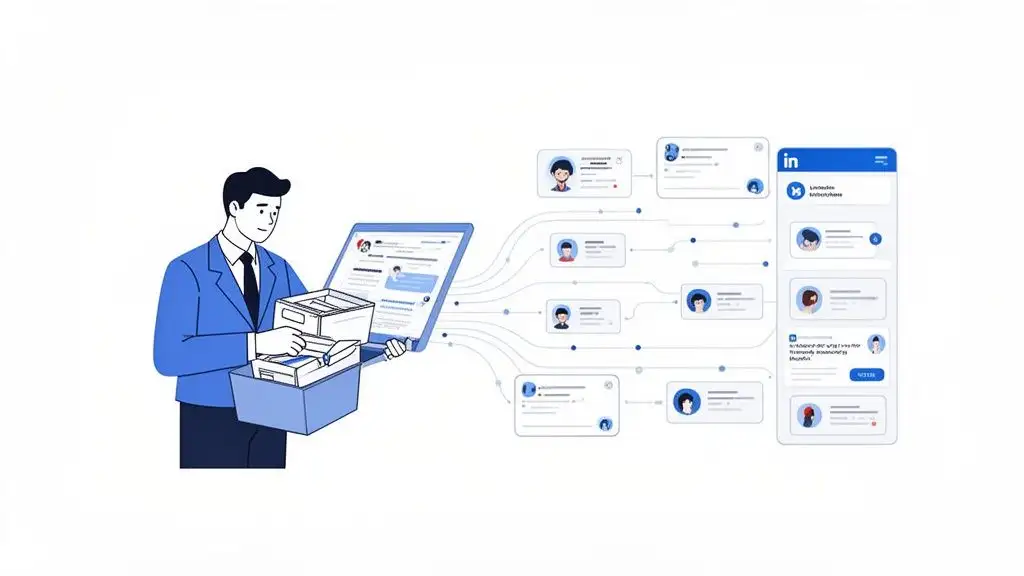
The Philosophy of Modern Prospecting
The core idea is refreshingly simple: stop being a product-pusher and start being a problem-solver. Your entire approach needs to be built on a foundation of relevance and genuine value.
-
Relevance Over Volume: It's better to send 10 hyper-personalized messages than to blast 100 generic templates. For example, instead of saying "I sell great software," you could say, "I saw your company just launched a new app for logistics, and I had an idea about how to reduce your customer onboarding friction." Quality smashes quantity every single time.
-
Value Before the Ask: Drop some insights, share a killer piece of content, or comment thoughtfully on their posts before you even think about pitching. Give, give, give, then ask.
-
Authenticity Wins: Your prospects have a finely tuned BS detector. They can spot a canned sales pitch from a mile away. Your genuine interest in their world is what will make you stand out.
This all starts with knowing how to build a personal brand on LinkedIn that doesn’t suck. A sharp, optimized profile is your digital storefront, building your credibility before you ever slide into someone’s DMs. For a closer look at the nuts and bolts, our guide on how to find connections on LinkedIn has more tactical goodies.
The reps who crush it on LinkedIn aren't the ones firing off the most messages. They’re the ones who make every single message count, turning a cold shoulder into a warm conversation.
Build Your Ideal Customer Profile
Before you even think about sending a single connection request, you have to know who you're hunting for. Firing off invites to everyone with a pulse is like trying to find Nemo by draining the entire ocean. It's a massive waste of time, and you'll probably just annoy a lot of fish.
A crystal-clear Ideal Customer Profile (ICP) is the bedrock of any LinkedIn prospecting that actually works. It's your compass, your treasure map... you get the idea. It's the difference between precision targeting and just making noise. It stops you from pouring hours into leads who were never, ever going to buy from you.
Go Way Beyond the Basics
Most sellers stop at the surface level. They'll target "Marketing Managers at tech companies with 50-200 employees." That's a starting point, I guess. But it's like saying your favorite movie is "one with actors in it." To actually break through, you have to get granular.
Let's pile on the details that really matter, the ones that signal genuine opportunity.
-
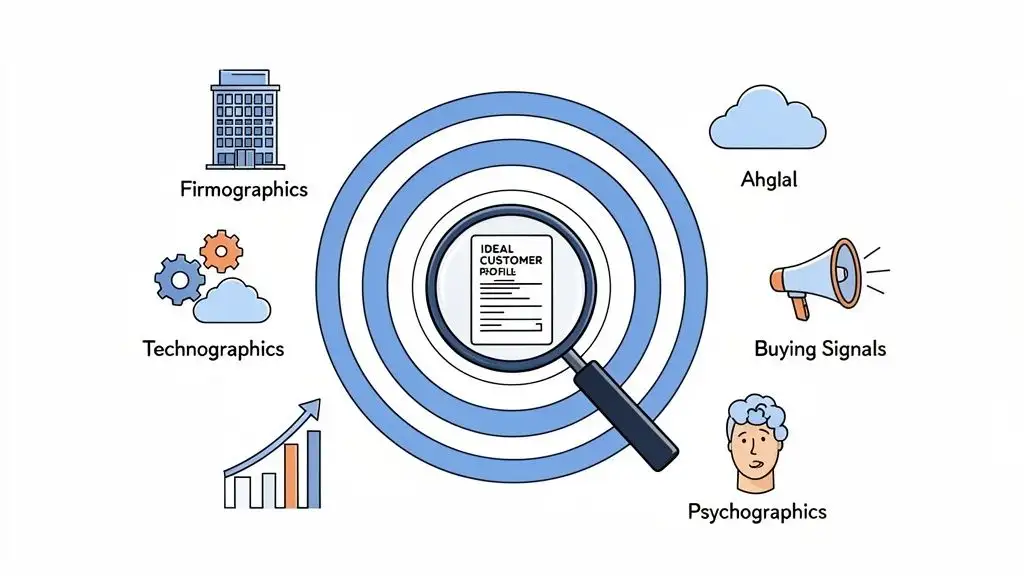
Firmographics: This is your foundation. Think industry (like FinTech or EdTech), company size (50-200 employees), and annual revenue ($10M-$50M). It’s the easy stuff.
-
Technographics: Now we're getting somewhere. What software are they already using? For instance, a company running on HubSpot and Salesforce has a completely different set of problems than one using a clunky, custom-built CRM.
-
Buying Signals: These are the giant, flashing "buy now" signs. Are they posting jobs for a new sales team? Did they just announce a Series B funding round? Did the CMO just rant on LinkedIn about "scaling lead generation"? Pure gold.
-
Psychographics: What keeps these people awake at night? For a VP of Sales, it’s probably high SDR turnover or a sales funnel that leaks like a sieve. Tapping into their specific pain is how you write a message that they actually read.
A killer ICP isn't just a boring checklist of attributes. It's a vivid story about a specific company facing a specific problem that you are uniquely built to solve. It transforms your prospecting from a shot in the dark into a surgical strike.
Let's Make This Real
So, how does this all come together in practice? Let's look at the difference between a lazy ICP and a powerful one.
The Weak ICP:
"SaaS companies in North America." (Yawn.)
The Strong ICP:
-
Industry: B2B SaaS, specifically in the MarTech space.
-
Company Size: 75-250 employees.
-
Buying Signal: Hired a new Head of Growth or VP of Marketing in the last 90 days.
-
Technographics: They're currently using Mailchimp for email marketing (which hints they might be outgrowing it and need better automation).
-
Pain Point: The marketing team is getting crushed trying to generate enough qualified leads for all the new sales reps they just hired.
See the difference? The first one is a wish. The second is a battle plan. With a strong ICP, you know exactly who to search for on LinkedIn, what their world looks like, and how to start a conversation that matters.
If you need a hand getting this organized, we've got a great ideal customer profile template you can use as a starting point.
How to Find and Qualify Leads on LinkedIn
Alright, you’ve done the hard work and built your Ideal Customer Profile. You know exactly who you're looking for, right down to the software they despise and the business problems that keep them up at night. Now for the fun part: the hunt. It’s time to turn that theory into a pipeline bursting with real, qualified leads.
This is where a tool like LinkedIn Sales Navigator becomes your secret weapon. It elevates your game from generic, hopeful searches to surgically precise strikes. Seriously, just typing "Marketing Director" into the main LinkedIn search bar is like shouting into a hurricane and hoping the right person hears you. We need to get way more specific.
Mastering Signal-Based Searches
The real magic isn't just in finding people with the right title; it's about finding people who are signaling they need help right now. These are the digital breadcrumbs that lead you straight to prospects actively searching for solutions, not just warming a seat.
Here are a few of my favorite high-intent filters to get you started:
-
Posted Content Keywords: This one is gold. Search for prospects who have recently posted using keywords tied to their biggest headaches. For example, a marketing director who just posted about "improving ROI" or "lead attribution" has practically invited you to start a conversation. It's the perfect, non-creepy opener.
-
Job Changes in the Last 90 Days: Pay close attention to this one. A new leader is 10 times more likely to make a purchasing decision. They’ve got a fresh budget, a mandate to shake things up, and they're eager to make an impact. This is your window of opportunity.
-
Company Headcount Growth: A company that’s hiring like crazy is a company with growing pains. Their old processes are probably cracking at the seams, and they desperately need new tools to scale effectively.
This approach completely changes the dynamic. Instead of a cold, "Hi, I sell stuff," your outreach becomes, "Hey, I saw your post on scaling your SDR team and wanted to share an idea." One is an annoying interruption; the other is the start of a relevant conversation.
The Rise of the AI Co-Pilot
Let's be real: artificial intelligence has completely changed the prospecting game on LinkedIn. By 2026, a whopping 81% of sales teams will be using AI-powered tools in their daily workflows. This isn't just a trend; it's a fundamental shift. Signal-targeted outreach, supercharged by AI, is getting teams around a 20% reply rate, absolutely crushing the pathetic 3% you see with generic, blasted-out messages.
Think of AI not as a replacement for a salesperson, but as the Jarvis to your Iron Man. It scans billions of data points for buying signals across the web and serves up the most promising opportunities on a silver platter, so you can focus on what you do best: building relationships.
A Modern Qualification Framework
Once you've found a list of promising prospects, you need a quick way to separate the contenders from the pretenders. Forget rigid, old-school frameworks like BANT that can feel like an interrogation. A much better, more fluid approach focuses on spotting genuine interest and a real, pressing need. Want to dig into this? You can learn more about how to qualify sales leads in our guide.
Crafting Messages People Actually Read
Let's be honest. Sending the default "I'd like to connect with you on LinkedIn" message is the professional equivalent of bringing a half-eaten bag of chips to a potluck. It screams zero effort. If you're just playing a numbers game, you're not prospecting on LinkedIn; you're just annoying people at scale.
To actually get replies, your message needs to hit like a perfectly timed movie quote. It has to be relevant, personal, and prove you've done at least a smidgen of homework. People are drowning in generic pitches, so a tiny spark of genuine connection is more than enough to stand out.
The Anatomy of a Non-Cringey Message
Your goal here is to start a conversation, not shove a contract in their face on the first date. Think of it less like a hard sales pitch and more like a friendly tap on the shoulder at a conference. It's all about finding some common ground and making them curious.
Here's a simple, battle-tested framework that works:
-
The Hook: Kick things off with a specific, genuine observation about them. This is your "I see you" moment.
-
The Bridge: Smoothly connect that observation to a problem you happen to solve. This is the "why I'm here" part.
-
The Value Prop: Briefly mention a killer result you delivered for a similar company.
-
The Ask: Wrap it up with a low-friction call to action, like asking a simple, easy-to-answer question.
So, instead of the soul-crushing "Hi John, I sell software," try something with a little more personality.
An Example That Actually Gets a Reply:
"Hi Sarah, I saw your post on the challenges of scaling your SDR team. That really hit close to home. We recently helped [Similar Company] cut their ramp time by 30% when they were facing the same hiring push. Curious if you're exploring any new training platforms this quarter?"
See the difference? This approach works because it’s about them. It shows you listened before you started talking, which is a rare and beautiful thing in the sales world. For more great ideas, check out our deep dive into crafting the perfect LinkedIn connection message.
Pro Tip: Use Munch AI to research your leads and craft outreach messages at scale!
Quality Over Quantity Is the New Law
The old "spray and pray" method of LinkedIn prospecting is officially dead. It was like trying to win an Oscar by auditioning for every single role, including the part of a tree. The data is crystal clear: a focused, high-quality approach is what actually drives results.
In fact, prioritizing quality has become the single most important trend in LinkedIn prospecting. Recent research shows that sales reps who send fewer than 25 connection requests per week are nearly twice as likely to hit a 40%+ acceptance rate compared to those who send more. With a solid connection rate falling between 30% and 45%, this is definitive proof that precision beats volume every single time.
To put this in perspective, let's look at the difference in outcomes between a targeted, low-volume approach and the classic high-volume 'spray and pray' method.
Low-Volume vs High-Volume Connection Strategy
| Metric | Low-Volume (<25 Requests/Week) | High-Volume (>26 Requests/Week) |
|---|---|---|
| Acceptance Rate | Often 40%+, sometimes even higher | Typically drops below 20% |
| Reply Rate | Significantly higher due to personalization | Very low, often single digits |
| Risk of Account Restriction | Minimal; activity looks natural | High; flagged as spammy behavior |
| Lead Quality | Higher; connects are with ideal prospects | Poor; connects are often irrelevant |
| Brand Perception | Positive; seen as thoughtful and relevant | Negative; seen as spammy and desperate |
The table really tells the whole story. A smaller, more strategic list not only gets you better results but also protects your reputation and your LinkedIn account. It's a no-brainer.
Following Up Without Being a Pest
Okay, so you sent a brilliant, personalized message and… crickets. It happens to the best of us. The key to the follow-up is to be persistent without turning into their personal stalker. Your goal is to add a little more value with each touchpoint, not just poke them with a digital stick.
-
Give It a Minute: Wait at least 3-4 business days before you pop back into their inbox. People are busy.
-
Switch Up Your Angle: Don't just copy-paste the same message. That’s lazy. Try a different approach. For instance, you could share a relevant article or comment on one of their recent posts to re-engage.
-
Know When to Fold 'Em: If you've sent 2-3 polite, value-driven follow-ups and are still getting the silent treatment, it's time to respectfully move on. There are plenty of other fish in the sea.
Remember, a great follow-up continues the story; it doesn't just repeat the first chapter over and over again.
Building a Multi-Channel Outreach Sequence
Relying solely on LinkedIn for prospecting is like trying to win Street Fighter by only knowing one special move. Sure, a well-timed Hadouken is cool, but you're going to get absolutely crushed by anyone who knows how to mix it up. The best prospectors orchestrate a smart, multi-channel sequence that combines LinkedIn touches with personalized emails to create a surround-sound effect.
This approach ensures you stay top-of-mind without being annoying. Instead of feeling like a cold interruption, your outreach starts to feel more like a helpful, persistent presence. You’re not just another random message; you’re the person who shows up in multiple relevant places with a consistent, valuable message.
An Effective 14-Day Sequence Blueprint
To your prospect, a great outreach sequence shouldn't feel like a sequence at all. It should feel like a series of natural, helpful touchpoints that build on each other. It’s less about a rigid script and more about a flexible rhythm.
Here’s a sample 14-day cadence you can riff on:
-
Day 1: The Silent Nod. Start with a simple LinkedIn profile view. It’s a subtle, no-pressure way to get on their radar. No message, no request, just a quiet "hello."
-
Day 2: The Thoughtful Handshake. Time to send that personalized connection request. Reference a recent post, a shared connection, or a company announcement you saw. Make it about them.
-
Day 4: The Channel Hop. Now, slide into their inbox with a high-value email that directly references your LinkedIn request. Something like, "Hey Jane, I just sent a connection request on LinkedIn after seeing your post about Q3 planning..."
-
Day 7: The Fan Moment. Pop back over to LinkedIn and genuinely engage with their content. A thoughtful comment on a post is far more powerful than a simple "like." Show you’re paying attention.
-
Day 10: The Value Drop. Follow up on that email thread with a relevant case study or a helpful resource that speaks directly to a pain point you've identified. No fluff, just value.
-
Day 14: The Final Question. Send one last, brief email or InMail. Ditch the pitch and just ask a simple, interest-based question.
This balanced approach seriously increases your chances of getting a response by meeting the prospect where they are, whether that’s their inbox or their LinkedIn feed. This little timeline breaks down the core flow of crafting each message.
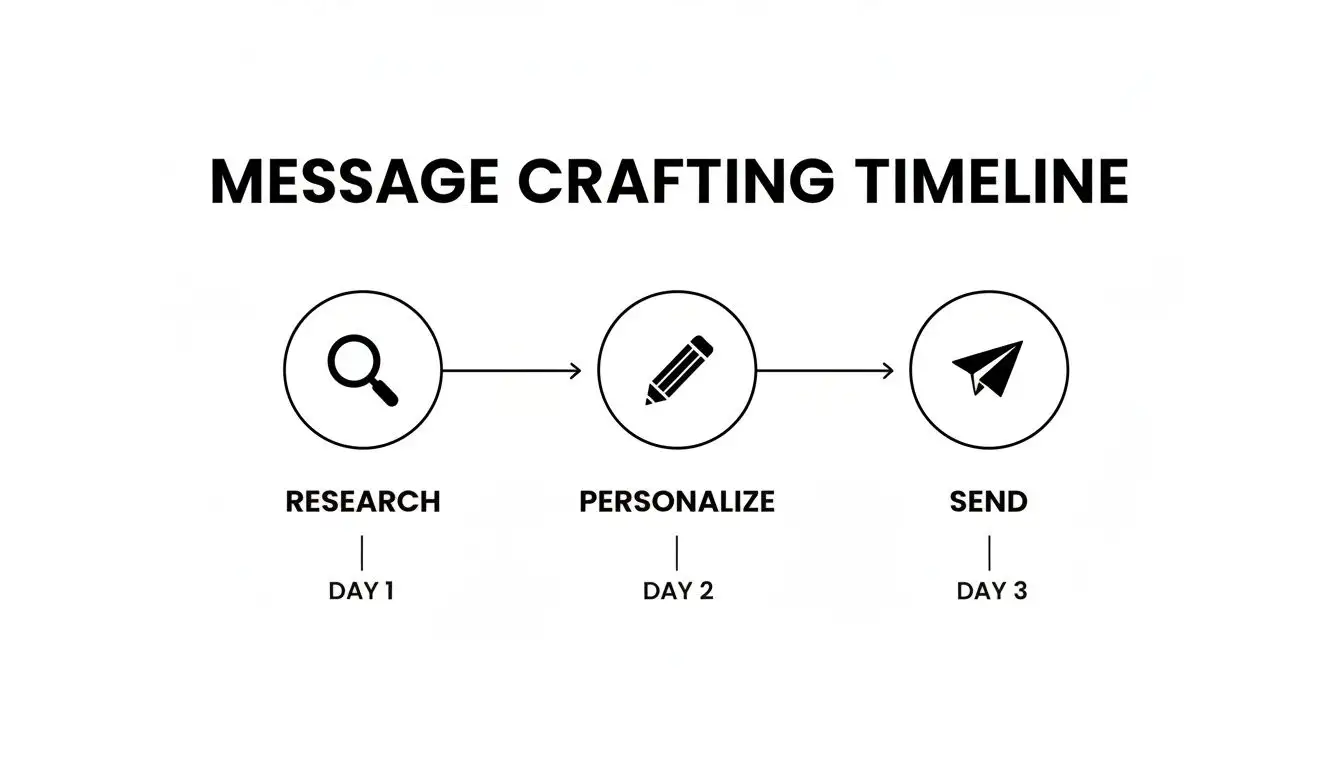
It hammers home the point that effective outreach is a process. You need to put in the time for research and personalization before you ever hit "send." If you really want to go deep on this, we've got more in our guide to sales cadence best practices.
The goal of a multi-channel sequence isn't to bombard your prospect from every angle. It's to create a cohesive narrative across platforms, making each touchpoint feel like a logical next step in a valuable conversation.
You Can't Improve What You Don't Measure
Let’s be honest: prospecting on LinkedIn without tracking your numbers is just a fancy way of being busy. It’s like trying to win a video game without ever looking at your health bar. You’re just mashing buttons and hoping for the best.
When you start tracking the right metrics, you turn your outreach from a hopeful art project into a repeatable, predictable science. Suddenly, you're building a sales pipeline you can actually count on.
This isn’t just a nice-to-have; it’s essential. LinkedIn has become the undisputed king of B2B lead generation, pulling in a staggering 75-85% of all social media leads in the B2B world. The platform is a whopping 277% more effective for lead gen than Facebook and Twitter combined, and its visitor-to-lead conversion rate is nearly three times higher. If you want a slice of that pie, you need to know what's working and what's falling flat.
Forget Vanity Metrics, These KPIs Pay the Bills
Stop obsessing over profile views. We're here to make money, not just get seen. For any serious prospecting effort on LinkedIn, these are the only numbers that truly matter.
-
Connection Acceptance Rate: This is your first big test. A low rate (anything under 30%) is a massive red flag. It’s screaming that either your targeting is way off or your connection note sounds like it was written by a 90s telemarketing robot.
-
Reply Rate (InMail & Email): They connected. Great! But are they actually talking back? This KPI tells you if your message is hitting the mark or getting sent straight to the digital graveyard.
-
Meetings Booked: This is it. The big one. This is the metric that proves the whole system works, from how you find people to the words you use to engage them. It’s the number that directly leads to closed deals.
A/B Testing: Your Secret Weapon for Better Results
Once you have your baseline numbers, it's time to start tinkering. The best way to do this is with simple A/B tests. Think of it as a head-to-head competition where you pit one approach against another to crown a clear winner.
This doesn't have to be complicated. You're just tweaking one small piece of your outreach to see what moves the needle on your KPIs.
The golden rule of A/B testing? Change only one thing at a time. If you rewrite the headline, the call to action, and the P.S. all at once, you’ll have no clue what actually made the difference.
Let's say you're testing your connection request on a batch of 100 similar prospects.
-
Version A (The Mutual Connection): "Hi Alex, noticed we're both connected to Sarah Jenkins. Her work at Acme Corp is fantastic. Since we're in the same world, I thought it made sense to connect."
-
Version B (The Company Signal): "Hi Alex, saw the news about your team's recent funding round, congrats! Been following your company's growth for a while and would love to connect."
Track the acceptance rate for both versions. Whichever one performs better becomes your new champion. Then, you pick a new variable to test. This constant cycle of testing, learning, and iterating is how you go from good to unstoppable.
Got Questions? We've Got Answers.
Even the best-laid plans hit a few bumps. Let's be honest, prospecting on LinkedIn can sometimes feel like trying to solve a Rubik's Cube in the dark. So, let's turn on the lights and tackle some of the most common head-scratchers that trip people up.
The Big One: How Many Connection Requests Should I Send?
Everyone wants to know the magic number. But the real answer isn't a number at all; it's a mindset. Quality will always crush quantity.
Think of it this way: blasting out 100 generic, copy-pasted requests a week is just noise. It’s like shouting into a void and hoping someone shouts back. The data doesn't lie. Reps who focus on sending fewer than 25 highly personalized requests each week are almost twice as likely to see a 40%+ acceptance rate.
Focus on a small, hyper-targeted batch each day. It's about making a real impression, not just playing a numbers game.
Seriously... Do I Have to Personalize Every Message?
Yes. Absolutely, unequivocally, yes. In an inbox flooded with robotic automation, a truly personal message stands out like a beacon.
Don't just take my word for it. Sales reps who always personalize their outreach are 4.5x more likely to achieve killer connection acceptance rates.
Your prospect's inbox is a VIP lounge with a very strict bouncer. Generic messages get left out in the cold. A little bit of genuine personalization? That's your all-access pass.
Is LinkedIn Sales Navigator Actually Worth the Money?
Look, if you're dipping your toes into LinkedIn prospecting, maybe you can get by without it. But if you're serious about building a pipeline here, Sales Nav isn't just a nice-to-have; it's a must-have.
Using the standard LinkedIn search is like trying to find a specific fish in the ocean with a snorkel. Sales Navigator is like having a deep-sea submarine with advanced sonar.
The real game-changer is the ability to filter for powerful buying signals. For example, you can find someone who just started a new role, a company that's hiring for a specific team, or people actively talking about a problem you solve. It helps you find prospects who are ready to buy, not just people who fit a title. It pays for itself in the time you save and the quality of leads you find.
Ready to put these ideas into action and build a pipeline that actually works? Munch is the sales intelligence platform that helps you find prospects showing real intent, enriches their data with 95%+ accuracy, and helps you craft the kind of outreach that actually gets a reply. Start finding your next customer today.