How to Qualify Sales Leads and Stop Wasting Time

By Mriganka Bhuyan
•Founder at Munch
To qualify sales leads the right way, you need a system, a repeatable process for separating the serious buyers from the casual browsers. It all comes down to defining who you’re selling to, applying a consistent qualification framework, and scoring leads based on how well they fit and what actions they take. This is how you stop wasting time and get your sales team focused on the deals that are actually going to close.
Why Your Sales Team Is Stuck Chasing Ghosts

Does your sales team feel like they’re constantly chasing leads that vanish into thin air? That’s what happens when you don't have a solid qualification process. The old "more is more" philosophy, treating every single form submission as a hot lead, is a recipe for burnout and missed quotas. It clogs the pipeline with a bunch of "maybes" that never turn into "yesses."
This endless chase isn't just frustrating; it's incredibly expensive. When you look at the data, the picture gets pretty bleak. Only a tiny 5% of salespeople believe the leads they get from marketing are top-notch. And just 25% of marketing-generated leads are actually ready for a sales conversation. When you consider that the average cost per lead hovers around $198.44, that's a lot of money going down the drain. For more on this, Outreach.io often shares some eye-opening stats about sales challenges.
The True Cost of Unqualified Leads
Chasing bad leads costs more than just cash. It slowly erodes team morale and productivity, kicking off a downward spiral that’s hard to escape.
-
Wasted Time and Resources: Every minute a rep spends on a prospect who was never going to buy is a minute stolen from a real opportunity.
-
Team Burnout: Hearing "no" all day from people who aren't a good fit is demoralizing. It leads to frustration, burnout, and good reps looking for the exit.
-
Inaccurate Forecasting: When your pipeline is stuffed with unqualified leads, your revenue forecasts are pure fiction. It creates a false sense of security that can lead to some very unpleasant surprises at the end of the quarter.
Shifting from Quantity to Quality
The fix is to stop thinking like a trawler and start thinking like a bouncer at an exclusive club. Your qualification process isn't about keeping people out; it's about making sure only the right people get in. By shifting your focus from the sheer number of leads to the quality of those leads, you build a much more predictable and effective sales machine.
Mastering how to qualify sales leads isn’t just another sales tactic. It’s the foundational strategy for building a predictable, scalable revenue engine. It turns selling from a game of chance into a calculated system for success.
This strategic filter gives your team permission to invest their energy where it actually matters, building relationships with prospects who are genuinely interested and a perfect fit for your solution. When you nail this down, you’ll see a real impact on everything from your sales cycle length to your win rates. It's a non-negotiable part of any successful outbound sales strategies.
Defining Your Ideal Customer Profile
Let’s be honest: selling to everyone is a recipe for disaster. It’s like trying to be friends with everyone on the first day of high school. It’s a classic rookie mistake that wastes time, burns out your team, and fills your pipeline with deals that were never going to close in the first place.
This is exactly why the first, most critical step in qualifying leads is nailing down your Ideal Customer Profile (ICP). Think of your ICP as the blueprint for your perfect customer, the kind of company that gets the most value from your solution and becomes a long-term partner. This profile isn't just a "nice to have"; it's the north star for your entire sales and marketing engine.
Moving Beyond Basic Firmographics
So many teams build a flimsy ICP based on surface-level data. Company size, industry, location... that's table stakes. Stopping there is like judging a book by its cover; you're missing the whole story.
A truly powerful ICP goes much, much deeper. You need to understand the context behind the company.
-
Pain Points: What real, nagging problems are keeping them up at night? Are they hemorrhaging cash on inefficient workflows? Losing market share to a nimbler competitor?
-
Business Goals: What are they actually trying to achieve? Are they chasing aggressive growth targets, trying to streamline operations, or desperate to improve customer retention? Your product needs to be a direct line to hitting those goals.
-
Tech Stack: What tools are already embedded in their daily operations? Knowing they use Slack versus, say, carrier pigeons, tells you a lot about their tech-savviness and potential integrations.
-
Organizational Structure: Who really calls the shots? Is there a key budget holder? Who will be your internal champion to push the deal forward?
And yes, we use our own platform - Munch, to enrich our leads with firmographic and technographic details as well as researching companies based on latest news, their blog posts or recent press releases.
Finding Clues in Your Current Customer Base
The absolute best place to start building your ICP is by looking in your own backyard. Your happiest, most successful customers are a goldmine of information. Pull a list of your top 10-20 accounts, the ones who renewed without a fuss, expanded their usage, and maybe even sent you a referral.
Your best customers aren't just your biggest fans; they are a treasure map leading you directly to your next best customers. Analyze their common traits to uncover the DNA of a perfect fit.
Now, play detective. What do these stellar customers have in common? Look for patterns in their revenue, employee count, industry, and the specific challenges you helped them overcome. This exercise takes your ICP from a theoretical guess to a data-driven, strategic weapon. For more on finding these lookalike accounts, check out our guide on outbound lead generation.
Once you have this detailed profile locked in, your team can spot a high-potential lead from a mile away. They can stop wasting precious time on dead-end conversations and focus their energy where it counts: on the accounts that look, act, and feel just like your best clients. That focus is the secret to a shorter sales cycle and a much higher win rate.
Choosing Your Qualification Framework
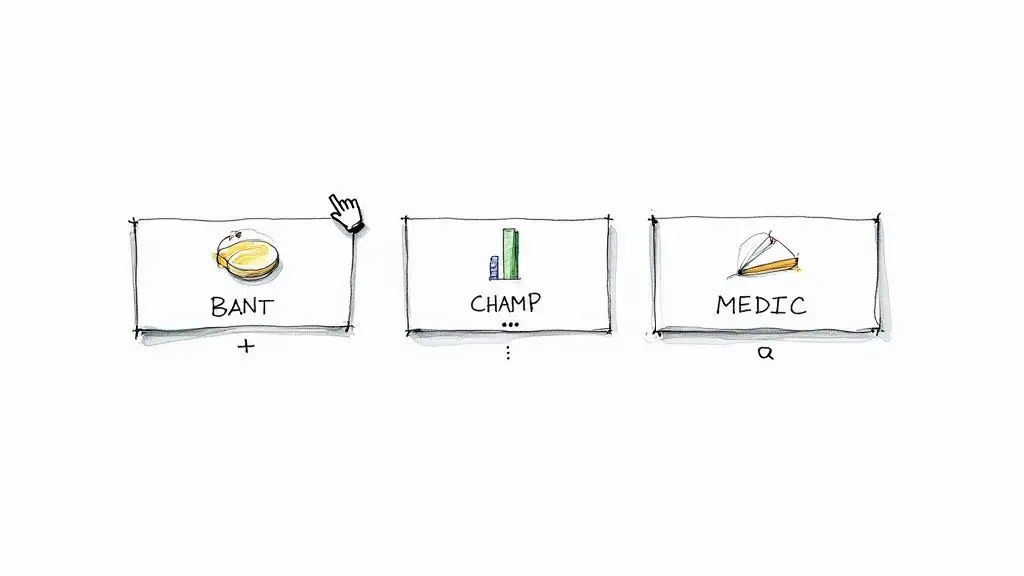
Once you’ve nailed down your Ideal Customer Profile, you need a repeatable way to have effective sales conversations. This is where qualification frameworks come in. Think of them as the operating system for your sales process, a structured approach to make sure you're asking the right questions, every single time.
You’ve probably heard the acronyms: BANT, CHAMP, MEDDIC. They sound like a random assortment of letters, but they represent powerful methods for separating the real opportunities from the time-wasters. The secret isn't picking the most complex or popular framework; it's about finding one that genuinely fits your sales cycle, your product, and your team's natural style.
Forcing your reps to use a framework that feels awkward or robotic is a recipe for disaster. It kills the natural flow of conversation and can make them sound like they're just checking boxes. The goal is to adopt a system that makes conversations more insightful, not less human.
The Classic BANT Framework
BANT is the OG of qualification, developed by IBM decades ago. It's simple, direct, and surprisingly potent, especially for transactional sales with shorter cycles. It’s the reliable sitcom of sales methodologies; it gets the job done without much fuss.
BANT breaks down the essentials:
-
Budget: Do they have the money to buy what you're selling?
-
Authority: Are you talking to the person who can actually sign the check?
-
Need: Is there a real business pain you can solve?
-
Timeline: How soon are they looking to make a decision?
This framework is brilliant for quick filtering. If a lead has no budget, isn't the decision-maker, and has a two-year timeline, you know not to sink hours into that call. The downside? Its rigidity. In modern B2B sales, a strong need often creates the budget, which BANT can sometimes miss.
More Modern Approaches: CHAMP and MEDDIC
As sales has shifted from a hard pitch to a more consultative partnership, the frameworks have evolved right along with it. These newer models go beyond BANT's gatekeeping to dig much deeper into the prospect's world.
CHAMP, for instance, flips BANT on its head by leading with Challenges. This approach starts from the premise that a significant business problem can create its own budget and urgency. It's a perfect fit for sales teams that lead with a problem-first, solution-second mindset.
A qualification framework isn’t a rigid script you follow word-for-word. It’s a compass. It just makes sure your conversations are always pointing toward the information that actually matters for moving a deal forward.
For teams navigating the choppy waters of high-value, complex enterprise deals, MEDDIC offers a far more detailed map. It covers everything from identifying the Economic Buyer to uncovering the Decision Criteria and, crucially, finding an internal Champion who will sell for you when you're not in the room. It’s a heavy-duty framework for long, multi-stakeholder sales cycles.
How to Choose the Right Framework
So, which one is for you? It all comes down to context. A startup with a high-velocity sales model would get bogged down by MEDDIC, while an enterprise team relying solely on BANT would be flying blind on a million-dollar deal.
To help you decide, let's break down the most common options and see how to qualify sales leads using each one.
Comparing Popular Lead Qualification Frameworks
Here’s a side-by-side comparison of BANT, CHAMP, and MEDDIC to help you choose the best fit for your sales process.
| Framework | What It Stands For | Best For | Key Advantage |
|---|---|---|---|
| BANT | Budget, Authority, Need, Timeline | Short sales cycles and transactional sales. | Simple and fast. Quickly disqualifies poor-fit leads. |
| CHAMP | Challenges, Authority, Money, Prioritization | Consultative sales where understanding pain is key. | Puts the customer's problem at the center of the conversation. |
| MEDDIC | Metrics, Economic Buyer, Decision Criteria, Decision Process, Identify Pain, Champion | Complex, high-value enterprise sales. | Extremely thorough, leaving no stone unturned in a major deal. |
The best part is, you don't have to choose just one. Many of the most successful sales organizations I've worked with create their own hybrid model, borrowing the elements that make the most sense for their market and customers.
Start with one, see how it feels in real conversations, and don't be afraid to tweak it. The right framework should feel less like a constraint and more like a natural extension of how your team already sells.
Building a Lead Scoring System That Works

Let's be honest: not all leads are created equal. You’ve got leads who are ready to sign a deal tomorrow, and then you have others who are just casually browsing while watching Netflix. So, how do you tell them apart? That’s where a solid lead scoring system comes in. It's your secret weapon for helping the sales team focus their energy on prospects who are actually ready to talk.
The whole system runs on points. We assign these points based on who a lead is (the information they give you) and what they do (the actions they take). By combining these two data sets, you get a dynamic score that automatically separates the genuinely interested from the merely curious.
Scoring Based on Fit and Behavior
Any scoring model worth its salt looks at two things: how well a lead matches your Ideal Customer Profile (ICP) and how engaged they are with your brand. Think of it as a video game, you get points for having the right character and for completing the right quests.
-
Fit (Firmographic & Demographic): This is all about the "who." How closely does this person or company mirror your perfect customer? You assign points for specific attributes that signal a great match.
-
High Score: A C-level executive in your target industry? That’s a big win (+20 points).
-
Medium Score: A director or manager still holds promise (+10 points).
-
Negative Score: Someone using a generic Gmail or Yahoo address? That might be a red flag (-10 points).
-
-
Behavior (Implicit Signals): Now we're looking at the "what." This side of the equation is about a lead's digital body language. Some actions scream "I'm ready to buy."
-
High Score: They requested a demo (+15 points) or keep coming back to your pricing page (+10 points).
-
Medium Score: Downloading a detailed case study is a good sign (+5 points).
-
Negative Score: Radio silence for 90 days? It's time to dock some points (-15 points).
-
The Rise of the Product-Qualified Lead
For SaaS companies, a new MVP has entered the game: the Product-Qualified Lead (PQL). These aren't just prospects; they're active users of your product, typically through a free trial or a freemium plan. Their actions inside your app are the purest buying signals you can get.
A PQL isn't just someone who might need your solution; they are someone actively using it to solve a problem. Tracking in-app milestones, like inviting team members or using a key feature, is the most direct way to measure buying intent.
This shift toward tracking behavior is a massive opportunity. It’s wild, but only 44% of companies are even using lead scoring right now. Yet, businesses that lean into marketing automation for nurturing see a staggering 451% increase in qualified leads. With PQLs becoming the preferred lead type for nearly half of all companies, it’s obvious that behavior is the new frontier of qualification. You can find more sales statistics that highlight the power of automation at Spotio.com.
When you combine fit and behavior, your lead scoring system transforms into an automated prioritization engine. It constantly surfaces the best opportunities, freeing your sales reps from the guesswork so they can focus on what they do best: building relationships and closing deals.
Asking Questions That Uncover Real Intent
A qualification framework gives you a map, but the real discovery happens in the conversation. This is where you separate a future champion from a dead-end deal. It’s the difference between sounding like a robotic telemarketer and acting like a trusted consultant.
Your goal isn't to just run through a checklist; it's to get the prospect talking about their world, their problems, and their goals. The best qualification calls feel less like an interrogation and more like a collaborative problem-solving session. You’re not there to just extract information, you're there to understand.
Ditch the Interrogation Script
Prospects can sniff out a scripted call a mile away. The moment they sense you're just reading off a list, their defenses go up, and the real conversation is over before it even starts.
Take the classic budget question: "Do you have a budget for this?" It’s a conversational dead end. More often than not, it gets you a vague, noncommittal answer because it feels transactional and intrusive.
Instead, try reframing it to be more consultative and less direct:
-
"When your team has tackled similar challenges in the past, what has the investment typically looked like?"
-
"What's the cost of not solving this problem over the next six months?"
See the difference? These questions don't demand a number; they ask for context. You’ve just shifted the dynamic from a transactional check-in to a strategic discussion about value, which is the core of how you truly qualify sales leads.
The best qualification questions don't feel like questions at all. They feel like the start of a story, prompting the prospect to explain their challenges, goals, and motivations in their own words.
Master the Art of Active Listening
Asking a great question is only half the battle. You have to actually listen to the answer. And I mean really listen, not just waiting for your turn to talk.
Active listening is about paying attention to what’s said, what’s not said, and how it’s said. It’s about picking up on the hesitation in their voice, the flash of enthusiasm when they mention a specific goal, or the recurring themes in their language.
-
Listen for the pain. When they mention a frustration, don't just nod and move on. Dig deeper. A simple, "Can you tell me more about that?" or "How does that specific issue affect your team's daily workflow?" can unlock a goldmine of information.
-
Listen for their vision of success. When they talk about goals, ask them how they'll know they've won. "What does a home run look like for you with this project?" This gets you straight to their most important KPIs.
This isn't just about gathering data; it's about building rapport. People want to feel heard. When you actively listen and reflect their challenges back to them, you build the trust needed to move a deal forward. The conversation shifts from you selling to them buying.
Automating and Scaling Your Qualification Process
Trying to manually qualify every lead is a recipe for burnout. It’s simply not scalable. If you want to grow, you have to bring in technology to do the heavy lifting. Automation is what turns your qualification strategy from a manual slog into a well-oiled machine.
The point isn’t to replace your sales team with bots. It’s about building a smart system that handles the repetitive, time-sucking tasks. This frees up your reps to do what humans do best: connect with people and close deals. Your CRM and other sales tools are about to become your best friends.
Putting Your Workflows on Autopilot
Modern CRMs and sales platforms are packed with powerful "if this, then that" automation rules. These rules are where your lead scoring model comes to life, creating a central nervous system for your entire qualification process. Get this right, and a high-potential lead will never fall through the cracks again.
Think of it like this:
-
Instant Lead Routing: A lead fills out a form and your scoring rules instantly give them a score of 75. Bam! An automation trigger can immediately assign that lead to the right rep and create a "follow up now" task in their queue. This speed is a game-changer when a prospect is actively looking for a solution.
-
Data Enrichment: A new inbound lead often comes with just a name and an email. Enrichment tools can automatically flesh out that profile in seconds, pulling in crucial data like company size, industry, location, and even their current tech stack. Your reps get the full story before they ever make a call. Munch does this very well with over 50+ data sources to enrich leads.
-
Automated Nurturing: What about those leads who look like a perfect fit but just aren't ready to talk? Instead of letting them go cold, automation can drop them into a targeted email sequence. You can nurture them with helpful content until their behavior shows they're warming up.
The big takeaway? Automation lets your team skip the checklist questions and jump straight to having meaningful, solution-focused discussions.
Automation ensures your qualification process runs 24/7 without getting tired or needing a coffee break. It applies your rules consistently, making sure every lead gets the right treatment at the right time, every single time.
Ultimately, automating your qualification process is about more than just speed. It's about creating a smarter, more seamless experience for everyone involved. You're arming your sales team with the right leads and all the context they need to have better conversations from the first hello.
For more deep dives and practical strategies, the content on the Munch blog is a great resource.
Your Lead Qualification Questions, Answered
As you start dialing in your qualification process, a few common questions always seem to surface. It's one thing to know the theory, but another to put it into practice. Let's tackle some of the most frequent head-scratchers I hear from sales teams.
What Are the Biggest Mistakes Teams Make?
The single biggest mistake is tunnel vision. Teams often get hung up on one single data point, like a job title or a single download, and use that to make a go/no-go decision. That’s like trying to predict the winner of a football game by looking at just one player.
Real qualification is about seeing the whole field. You have to weave together their company profile, their on-site behavior, and what they actually tell you in a conversation to get a clear picture.
Another classic blunder is setting your qualification rules in stone. What works today won't necessarily work in six months. Your market changes, your product evolves, and your best customers might look different over time. If your process is too rigid, you'll miss out.
How Often Should We Review Our Qualification Rules?
Think of your qualification process like a tune-up for your car. You should be popping the hood and checking things out at least twice a year.
Beyond a regular schedule, you need to watch for red flags.
The most obvious sign that something's off is when your "hot" leads start going cold. If your close rates for MQLs or high-scoring leads suddenly dip, that's your cue to immediately reassess your criteria.
Your business isn't static, and neither is your market. Your qualification model has to keep pace.
When Is It Time to Disqualify a Lead?
Pull the plug the moment you hit a non-negotiable dealbreaker. This isn't about being picky; it's about being efficient. A hard "no" on budget, a clear statement they don't have the problem you solve, or a company that’s a complete mismatch with your ICP, these are all valid reasons to disqualify and move on.
But here’s the key: "disqualified" shouldn't mean "gone forever." Don't just delete the contact. Instead, move them into a long-term nurture track. Circumstances change. Budgets get approved, priorities shift, and that "no for now" can easily become a "yes" a year down the road.
Ready to stop chasing ghosts and start engaging high-intent prospects? Munch unifies lead discovery, data enrichment, and AI-powered outreach into one seamless workflow, so your team can focus on what matters most: closing deals. Learn more and get started at https://usemunch.com.