Modern Outbound Sales Strategies That Convert

By Mriganka Bhuyan
•Founder at Munch
Outbound sales is all about proactively starting conversations with potential customers who haven't come knocking on your door first. Unlike inbound, where you wait for leads to find you, this is the art of hunting—actively reaching out through email, phone calls, and social media to create new opportunities from scratch.
Why Your Old Sales Playbook Is Failing
Let's be honest. The old "dial for dollars" and spray-and-pray email blasts are dead. Trying to win in today's market with those tactics is like showing up to a Formula 1 race with a horse and buggy. It just doesn't work anymore.
Buyers are smarter, more skeptical, and have zero patience for generic, tone-deaf outreach. A high-volume, impersonal approach doesn't just get you ignored; it gets you blocked, marked as spam, and actively hurts your brand's reputation. The game has fundamentally changed.
Moving from Volume to Value
Success in modern outbound isn't about how many calls you can make or emails you can send. It’s about making the right calls and sending the right emails to the right people. It’s a shift from brute force to surgical precision, like a sales ninja.
This new school of thought is built on a few core principles:
-
Hyper-Specific Targeting: Forget broad industry lists. We're talking about identifying companies that are showing real, timely signals of needing what you sell.
-
Deep Personalization: Your message needs to prove you've done your homework. Reference a prospect’s recent company announcement, a post they shared on LinkedIn, or a specific challenge you know they're facing.
-
Multi-Channel Engagement: Don't just live in the inbox. A smart outbound cadence weaves together email, LinkedIn touches, and phone calls into a cohesive story that builds familiarity and trust over time.
-
Data-Driven Optimization: Treat every part of your outreach as an experiment. You should be constantly testing subject lines, call-to-action phrasing, and even the time of day you reach out to see what truly works.
Thinking strategically before you ever hit "send" is the key. This simple framework breaks the entire process down into three essential actions.
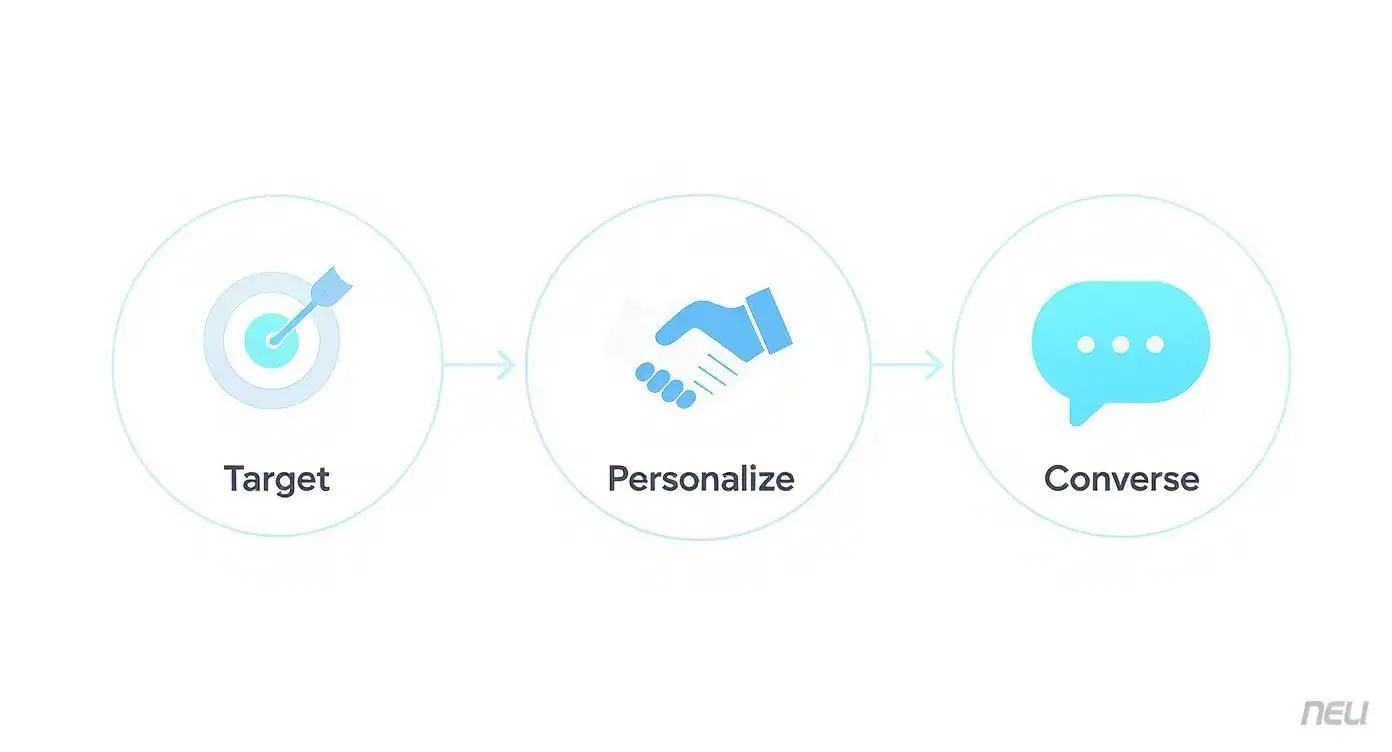
This isn't just a sequence of tasks; it's a flywheel. You identify the best-fit accounts, craft messages that actually resonate, and then focus on starting real conversations that lead to qualified opportunities.
The truth is, outbound isn't dead—lazy outbound is. The difference lies in replacing brute force with intelligence, research, and genuine curiosity about your prospect's world.
Don't let anyone tell you outbound is a thing of the past. It's still a powerhouse for driving revenue. Research consistently shows that outbound efforts are responsible for about 55% of all generated leads, easily beating inbound.
Yet, there's a huge disconnect. A staggering 52% of marketers admit they're unhappy with their outbound results, which points to a massive gap between effort and outcome. You can dig into these outbound sales findings to see the full picture. This guide is your tactical playbook for making sure your team is on the right side of that gap.
Defining Your Ideal Customer Profile
If you’re selling to everyone, you’re really selling to no one. It's the business equivalent of swiping right on every dating profile—sure, you'll get a lot of matches, but good luck finding "the one." Before you even think about writing an email or picking up the phone, you have to know exactly who you're targeting. This is where your Ideal Customer Profile (ICP) comes into play, and it’s the absolute bedrock of any outbound strategy that actually works.
A weak ICP is just a lazy list of industries and job titles. A powerful ICP, on the other hand, is a detailed blueprint of your perfect customer. It's less about who they could be and more about reverse-engineering who your best, most profitable, and happiest customers already are. Think of it as creating a "Most Wanted" poster for your sales team.
This isn’t just some stuffy business school exercise. Getting your ICP right means you focus your resources, personalize your messaging, and stop wasting precious time on leads who were never going to buy anyway. It’s the difference between being a sniper and firing a shotgun blindfolded.
Beyond Basic Demographics
To build an ICP that gives you a real edge, you have to dig much deeper than surface-level data. The profiles that drive serious pipeline are built on three pillars of information, giving you a 360-degree view of the account.
-
Firmographics: This is the basic stuff—the company's professional ID card. It covers industry, company size (both revenue and employee count), where they're located, and even their organizational structure. It's the foundation.
-
Technographics: This layer peels back the curtain on the technology a company uses. Knowing they’re on a competitor’s platform, use a complementary tool like Salesforce, or just invested in a specific marketing automation system can be a golden ticket for starting a relevant conversation.
-
Buying Signals: These are the game-changers, and they're often the most overlooked. Buying signals are timely events that scream, "We might be in the market for a solution like yours!" Think recent funding rounds, a new executive hire (like a VP of Sales), or a sudden surge in job postings for a specific department.
When you bring all three of these elements together, your ICP transforms from a static document into a dynamic targeting machine. You’re no longer just looking for "SaaS companies with 100-500 employees." You're hunting for "B2B SaaS companies with 100-500 employees, using HubSpot, that just hired a new Head of Demand Generation." Now that's a conversation you want to have.
From Profile to Priority Scoring
Okay, so you've defined your ICP. What now? The next move is to use it to score and prioritize your prospect list. Not all prospects who fit your ICP are created equal; some are way more ready to talk than others. A simple lead scoring model is your team's best friend for focusing their limited time on accounts with the highest chance of closing.
This model assigns points to prospects based on how well they match your ICP and the buying signals they're flashing. A company that ticks every firmographic box is good. A company that also just pulled in $20 million in Series B funding? That's great.
To make this tangible, here's a sample scoring model to get you started. It helps you prioritize prospects based on attributes that signal a strong fit.
ICP Scoring Framework Example
| Attribute Category | Specific Signal | Score (+/-) |
|---|---|---|
| Firmographics | Industry is a perfect match (e.g., B2B SaaS) | +20 |
| Firmographics | Company size is in the sweet spot (100-500 employees) | +15 |
| Technographics | Uses a direct competitor's software | +25 |
| Technographics | Uses a complementary technology (e.g., Salesforce) | +10 |
| Buying Signal | Just hired a new decision-maker (e.g., VP of Marketing) | +30 |
| Negative Signal | Currently in a hiring freeze | -20 |
By applying a simple framework like this, you create a clear pecking order for your team. Your reps can instantly see which accounts deserve their full attention right now and which should be put into a longer-term nurturing sequence.
An ICP without a scoring model is like a map without a compass. You know the general landscape, but you have no idea which direction to travel first.
This data-driven approach takes the guesswork out of prospecting. It ensures your team’s effort is always aimed at the most promising targets, making every single step of your outbound process more efficient and, ultimately, far more effective.
Building a High-Intent Prospect List
With a rock-solid Ideal Customer Profile in hand, you've essentially drafted the blueprints for your Death Star. Now for the fun part: finding your targets and making things happen. This is where so many outbound strategies fall flat, relying on stale, static lists that have all the life of a dial-up modem.
The mission isn't just to build a big list; it's to build a smart one. We're talking about a dynamic, high-intent group of prospects who are actively showing signs they need what you're selling right now. This shifts the game from vague identifiers to timely, actionable triggers.
Think of it like this: old-school prospecting is like randomly flipping through a phone book. Signal-based prospecting is like getting a push notification the second someone in your ICP tweets, "Does anyone know a good solution for [the exact problem you solve]?" One is a guessing game; the other is basically a cheat code.
Hunt for Signals, Not Just Titles
Static data like industry and employee count is just the starting point, not the finish line. The real magic kicks in when you layer on buying signals—real-world events that show a company is facing a challenge or is primed for a change. It's the difference between knowing a company's address and knowing their house is on fire.
Zeroing in on these signals turns your cold outreach into something much warmer. You’re no longer just some stranger interrupting their day; you’re a problem-solver showing up at the perfect moment.
Here are the kinds of signals you should be constantly scanning for:
-
Hiring Signals: See a company posting jobs for a dozen new sales reps? They're clearly scaling and will probably need sales enablement tools. A new VP of Marketing just started? You can bet they'll be reviewing their entire tech stack in the first 90 days.
-
Funding Events: When a company announces a fresh round of funding, that’s a massive green light. That capital is earmarked for growth, which almost always means investing in new software, services, and partners.
-
Technology Signals: Tools like Munch can give you a peek under the hood at what tech a company is using. Are they on a competitor's platform? Using a tool that integrates perfectly with yours? Did they just drop a piece of software you can replace? These are all powerful conversation starters.
-
Negative Keyword Signals: Keep an eye out for public mentions of pain points. News articles, press releases, or even customer reviews that talk about things like "integration issues," "scaling challenges," or "inefficient processes" are pure gold for an outbound rep.
This approach transforms your list from a static directory into a living, breathing ecosystem of opportunity. You're reaching out based on what they're doing, not just who they are.
The Unsexy but Crucial Job of Data Hygiene
Let’s be honest: data hygiene is the least glamorous part of sales. It's the flossing or tax-filing of our world—nobody gets excited about it, but ignoring it leads to disaster. A dirty list is the silent killer of even the most well-crafted outbound sales strategies.
High bounce rates from bad email addresses do more than just stop your messages from being delivered. They actively tank your domain's sending reputation, making it harder for any of your emails to land in the inbox. It’s a fast track to the spam folder, and good luck getting out of there.
A clean, verified prospect list isn't just a "nice to have"; it's the foundation of your entire outbound operation. Building on bad data is like trying to build a skyscraper on quicksand.
So, how do you keep things clean?
Your best bet is a multi-step verification process. Use platforms like Munch that offer waterfall enrichment, a technique that checks multiple data sources in order to pinpoint the most accurate, up-to-date contact info. The goal here is to hit 95% or higher email accuracy. That isn't some arbitrary number; it's the industry standard for maintaining a healthy sender score.
You should also make list cleaning a regular ritual, not a one-and-done task. People change jobs, companies get acquired, and emails go dark all the time. A quarterly scrub of your data is essential to prevent list decay and ensure your outreach engine is always running on premium fuel.
Weaving Together a Multi-Channel Outreach Sequence
You’ve done the hard work and built a pristine, high-intent prospect list. That's a huge win, but honestly, it's only half the battle. A brilliant list paired with a generic, single-channel outreach plan is like having a Ferrari stuck in a school zone—you have all this potential, but you’re not going anywhere fast.
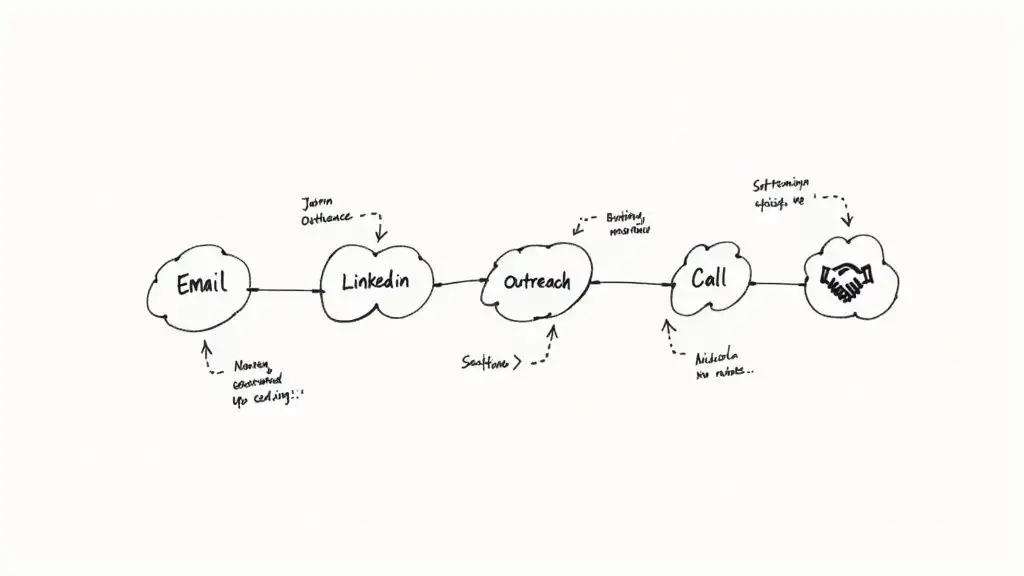
This is where you move beyond just sending emails and start designing an intelligent, multi-channel sequence. It’s about layering email, LinkedIn, and even phone calls to build a real conversation, not just to get a reply. A prospect might ignore your first email but then see your thoughtful comment on their LinkedIn post. That second touchpoint builds familiarity, making your next email feel less like a cold interruption and more like a follow-up from someone they vaguely recognize. This is the core of a modern outbound strategy.
The Anatomy of a High-Performing Sequence
Forget the old "spray and pray" model. A modern sequence is a carefully choreographed dance of touchpoints, each with a specific purpose. It’s not about blasting someone with eight emails in two weeks. It's about providing value at each step, building credibility, and staying top-of-mind without becoming a nuisance.
A balanced cadence respects the prospect’s time while strategically keeping the conversation moving forward. Here’s a breakdown of how the different channels play together:
-
Email: This is your workhorse. It’s where you deliver the detailed value props, share relevant case studies, and make direct asks (like booking a meeting). It’s the best place to be articulate about the problem you solve.
-
LinkedIn: Think of LinkedIn as your digital "warm-up" zone. Use it for lighter touches—a connection request, liking a prospect’s post, or commenting on something they shared. These small actions build name recognition before you ever land in their inbox.
-
Phone Calls: The phone is your tool for direct, human connection. It's most effective after you've "warmed up" the prospect with email and social touches. A call that references a previous interaction is ten times more effective than a truly cold call out of the blue.
By weaving these together, you create a surround-sound effect. Each touchpoint reinforces the others, making your outreach feel more considered and professional. It shows you’ve actually put thought into how and when you communicate.
Hyper-Personalization That Actually Scales
Let's be honest, "personalization" is a word that gets thrown around so much it’s almost lost its meaning. Simply using [First Name] and [Company Name] is the sales equivalent of a sad, limp handshake. It’s technically a greeting, but it leaves zero impression.
Real personalization shows you've done your homework. The secret to doing this at scale is to focus your research on just one or two highly relevant, timely details. This is where your signal-based prospect list really starts to pay off.
Don’t just personalize your message; personalize your timing. Reaching out with the right message is important, but reaching out at the right moment—just after a funding announcement or a new executive hire—is what cuts through the noise.
For example, instead of a generic opener, try one of these signal-based hooks:
-
For a new hire: "Hi Jane, congrats on the new role as VP of Marketing at Acme Corp! Typically, new leaders I speak with are focused on auditing their tech stack in the first 90 days."
-
For a funding round: "Hi Tom, saw the great news about your $30M Series B raise. With that kind of capital injection for growth, scaling your sales team efficiently must be a top priority."
These openers instantly prove you’re not just another bot sending a template. They show you understand the prospect's current context, making them dramatically more likely to read on. Platforms that offer AI-powered personalization, like Munch, can help generate these unique, context-aware messages for every prospect, saving your team hours of manual research.
Writing Copy That Gets Replies
Once you’ve earned their attention with a personalized opener, the rest of your message needs to deliver. Keep it short, focused, and about them—not you. Nobody cares about your company’s long history or your endless list of features. They only care about what you can do for them.
The chart below shows the basic concept behind A/B testing, a critical practice for optimizing your copy and overall sequence performance.
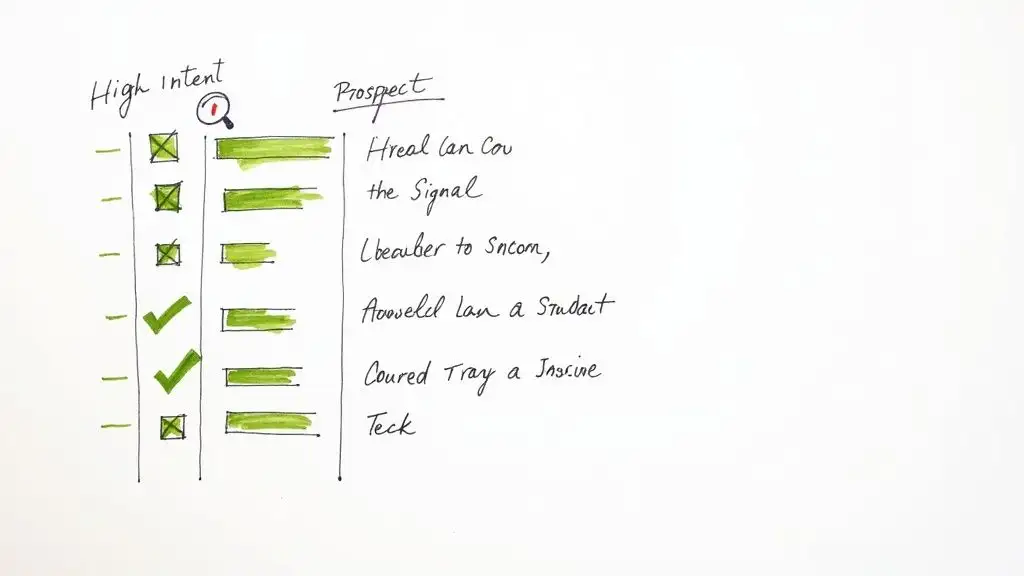
You should constantly be running small tests like this on your subject lines, calls-to-action, and email body copy. It's the only way to find out what truly resonates with your audience and stop guessing what works.
Measuring and Optimizing Your Performance
You simply can't improve what you don't measure. Flying blind with your outbound sales strategies is like trying to win a video game with the screen off—you're just mashing buttons and hoping for the best. To build a predictable revenue engine, you need to stop guessing and start analyzing.
This is where your outbound efforts transform from an art form into a data-driven science. By tracking the right key performance indicators (KPIs), you can spot problems early, double down on what’s working, and make small tweaks that lead to massive gains over time.
Identifying the Metrics That Truly Matter
It’s incredibly easy to get lost in a sea of vanity metrics. Sure, a high open rate feels good, but if it doesn't lead to replies or meetings, it’s just noise. A truly effective outbound strategy focuses on a handful of KPIs that track the entire journey, from that first touchpoint to a closed deal.
The world of outbound sales metrics requires tracking several key indicators to really dial in revenue and resource allocation. At its core, you have new business revenue as the ultimate goal and conversion rates at each stage of your funnel. Beyond that, metrics like sales cycle length give you a critical pulse on efficiency, while customer acquisition cost (CAC) is non-negotiable for understanding profitability.
These are the essential KPIs you should have on your dashboard:
-
Positive Reply Rate: This is your best leading indicator, period. It measures the percentage of prospects who respond with genuine interest, telling you if your messaging is actually resonating with your ICP.
-
Meeting Booked Rate: This is the big one for most sequences. This metric tracks how many of those positive replies turn into actual meetings on the calendar, connecting your outreach directly to your pipeline.
-
Sales Cycle Length: This shows you, on average, how long it takes to move a prospect from first contact to a closed deal. A shortening cycle is a powerful sign of increasing efficiency.
-
Customer Acquisition Cost (CAC): What’s the total cost of your sales and marketing efforts to land one new customer? Keeping a close eye on CAC ensures your outbound strategy stays profitable and sustainable.
By focusing on these metrics, you get a clear, unfiltered view of your campaign's health and can start making decisions based on reality, not assumptions.
The Power of Continuous A/B Testing
The best outbound teams I've ever seen treat their sequences not as fixed assets, but as living, breathing experiments. They are constantly running A/B tests to find small, incremental improvements that compound into significant results. This is where you swap your sales hat for a lab coat and get scientific.
The golden rule of A/B testing is simple: change only one variable at a time. If you test a new subject line and a new call-to-action in the same email, you'll have no idea which change actually moved the needle.
Don't aim for a single home run with one perfect sequence. Instead, focus on hitting a series of singles by continuously testing and optimizing small elements. Over time, those small wins add up to a championship-level performance.
Start by testing the high-impact elements where small changes can yield the biggest returns.
What to Test in Your Sequences
| Element | Variable A Example | Variable B Example | What It Impacts |
|---|---|---|---|
| Subject Line | "Idea for [Company Name]" | "Quick question, [First Name]" | Open Rate |
| Opening Line | "I saw your post on LinkedIn..." | "Congrats on the recent funding..." | Reply Rate |
| Call-to-Action | "Do you have 15 mins to connect?" | "Interested in learning more?" | Meeting Booked Rate |
| Send Time | Tuesday at 9:00 AM | Thursday at 2:00 PM | Open & Reply Rates |
Let each test run until you have a statistically significant sample size—usually, this means at least a few hundred sends per variant. Once you have a clear winner, make it the new control and move on to testing the next element. It's this methodical process that ensures your outbound engine is always finely tuned and operating at peak performance.
Your Top Outbound Sales Questions, Answered
Jumping into modern outbound sales can feel a bit overwhelming. You have all the right intentions, but making everything click into place often brings up a ton of questions. Think of this section as a conversation with a seasoned pro—I'm here to give you straight, practical answers to the most common sticking points I see sales teams run into.
Let's clear the air and get you executing with confidence.
How Long Should an Outbound Sales Sequence Be?
Everyone's looking for that magic number, but the truth is, there isn't one. The best sequence length isn't about hitting a specific number of days; it's about maintaining meaningful, value-first contact.
As a starting point, aim for a multi-channel sequence that spans 2-4 weeks and includes 8-12 intentional touchpoints. And I don't just mean eight generic emails. A great sequence is a well-choreographed mix of emails, LinkedIn interactions (think thoughtful comments, not just likes), and perfectly timed phone calls. We talk more about it here.
Each touchpoint needs to feel different and build on the last. For a complex, big-ticket enterprise deal, you might need to stretch that out to 6 weeks or even longer. On the flip side, if you're selling a simpler, higher-velocity product, a sharp, punchy 2-week sequence could be perfect.
The real objective isn't to hit an arbitrary number of touches. It’s to stay on their radar with helpful, relevant interactions until you get a clear "yes" or "no." If you see your engagement rates nosedive after touchpoint #7, that's your data telling you it's time to refine your approach.
What Is a Realistic Reply Rate for Cold Email?
This is probably the question I get asked the most, and my answer is always the same: "it depends." Industry benchmarks are fine for a ballpark idea, but obsessing over them is a rookie mistake.
Generally, you'll hear that a reply rate between 1% and 5% is standard for most cold outbound. But that number doesn't tell the whole story. I've seen top-tier teams with laser-focused lists and genuinely personalized messages pull in reply rates of 10% or even higher.
Instead of chasing someone else's numbers, focus on your own baseline and strive for consistent improvement. A 3% reply rate from your absolute dream customers is worth infinitely more than a 10% reply rate from unqualified leads who will waste your time. Quality always wins.
How Do I Personalize Outreach at Scale?
"Personalization at scale" sounds like a contradiction, I get it. But it's absolutely possible if you have the right process. The secret is to stop trying to personalize everything about every email. Instead, focus on one or two unique, highly relevant details that show you've done your homework.
Just using their name and company? That's the bare minimum these days. Real personalization comes from referencing something specific and timely.
Here’s how you can actually do it:
-
Find a Timely "Signal": This is your "why you, why now." Did their company just land a new round of funding? Did they hire a new VP of Sales? Did they post on LinkedIn about a specific challenge you can solve?
-
Find a Human Detail: This shows you see them as a person, not just a job title. Did they just speak on a podcast? Write a blog post you actually read? Share a strong opinion on something related to your field?
-
Weave It into a Smart Template: Build your templates with custom fields that force your reps to plug in this research.
For example: Hi [Name], I saw your recent post about [Specific Topic] and your point about [Specific Insight] really hit home. It reminded me of the work we're doing at [Your Company] to help leaders like you tackle [Problem].
This works because the research for each person only takes a few minutes, but the impact it has on your reply rate is massive.
Is Cold Calling Officially Dead?
Not even close. But the reports of its death have been greatly exaggerated for a reason: "dumb" cold calling is absolutely dead. Picking up the phone and hammering a random list with a generic, self-serving pitch is as effective as sending a fax.
But a strategic phone call as one step in a multi-channel sequence? That's not just alive—it's thriving.
Think of it as a "warm" call. Before you dial, your prospect should have already seen your name in their inbox or on their LinkedIn feed. Now when you call, you have instant context. You can open with, "Hi [Name], I'm following up on the email I sent yesterday about [Topic]." That one sentence immediately separates you from the 99% of truly cold calls they get.
The goal of that first call isn't to pitch. It's to see if there's a real problem, build a little rapport, and book the actual meeting. Used this way, the phone is one of the most powerful tools you have.
Ready to stop guessing and start building a high-intent prospect list that fuels your entire strategy? Munch is the sales intelligence platform that unifies lead discovery, data enrichment, and AI-powered personalization into a single, seamless workflow. Find prospects showing real buying signals and launch outreach that actually gets replies. Start finding your next customers with Munch.