The 12 Best B2B Lead Generation Tools for Unstoppable Growth in 2026

By Mriganka Bhuyan
•Founder at Munch
Building a B2B pipeline can feel like a slow jam from another era. You know the leads are out there, but finding them is a grind of manual research, bad data, and outreach that gets ignored. It's the modern sales equivalent of trying to make a mixtape on a dual cassette deck: slow, frustrating, and the final product might just get eaten by the machine. If your CRM looks more like a ghost town than a bustling marketplace, it’s time to upgrade your tech stack from dial-up to fiber optic.
This isn't just another listicle. It’s your definitive guide to the 12 best B2B lead generation tools that will stop you from manually scraping websites and start you on the path to a full pipeline. We’re going to dissect each platform, showing you exactly how they help with prospecting, data enrichment, and crafting outreach that doesn't immediately get marked as spam. Think of it as a cheat sheet for building a revenue engine that actually works.
We will provide a detailed breakdown for each tool and honest assessments of their strengths and weaknesses. Forget generic feature lists. We're diving into specific use cases for SDRs, startups, and enterprise teams, so you can pinpoint the exact solution for your needs. We'll even cover integration notes for your CRM and sales sequences. By the end of this guide, you will have a clear, actionable plan to choose the right tools, fill your pipeline with qualified leads, and finally, change the sad R&B soundtrack of your sales floor.
1. Munch
Munch is an all-in-one sales intelligence and outbound platform designed to collapse the entire B2B lead generation workflow into a single, unified system. It replaces the usual Frankenstein's monster of separate tools for prospecting, data enrichment, and outreach, making it a standout choice for teams that want to move faster without sacrificing quality. Instead of juggling CSVs and multiple subscriptions, Munch integrates real-time intent signal monitoring, waterfall data enrichment, and AI-powered personalization into one seamless process.
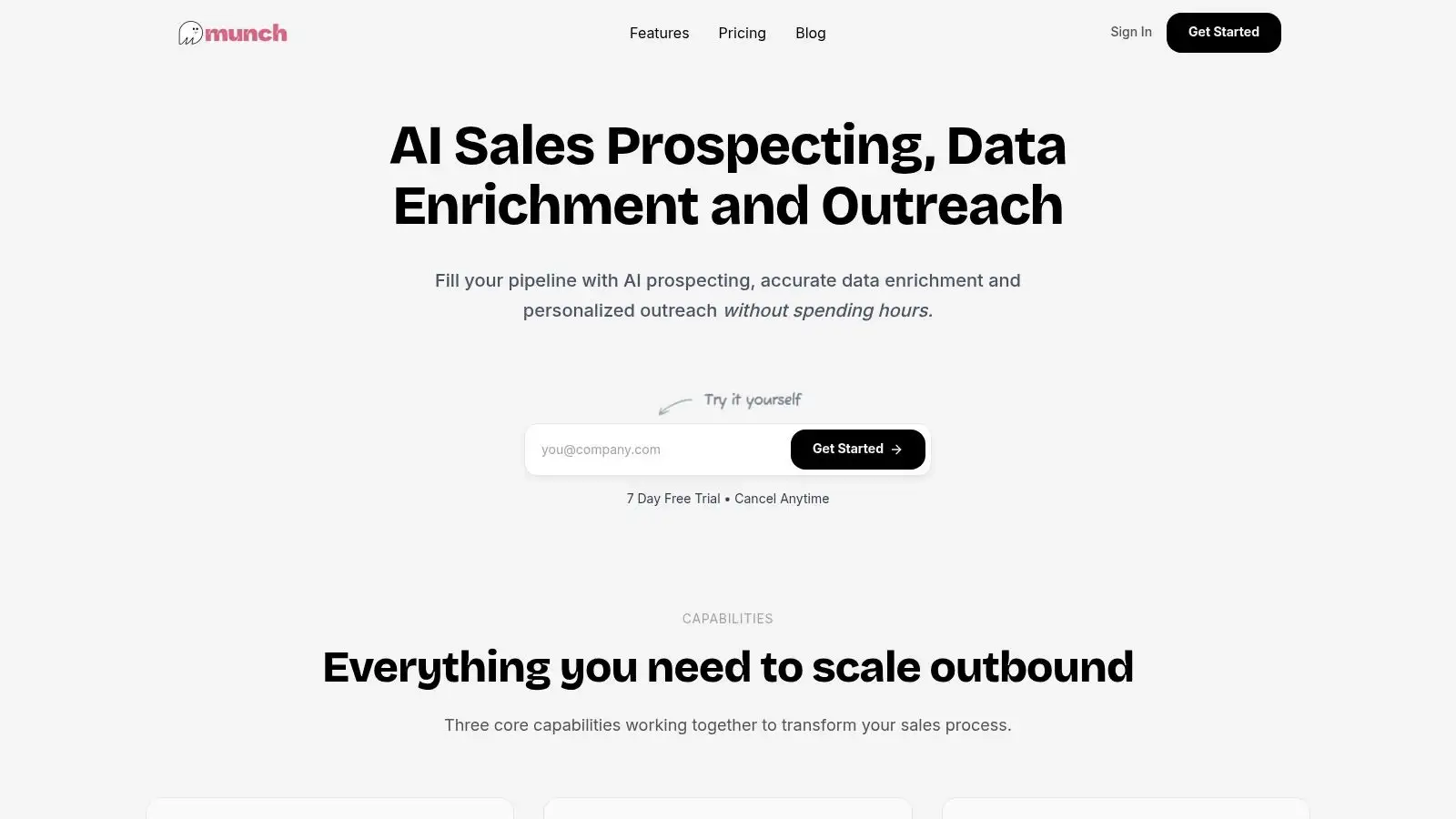
The platform continuously scans over 50 verified sources for critical buying signals like job changes, recent funding rounds, and technology adoption. This allows SDRs to find high-intent prospects who are actively looking for solutions, rather than just blasting cold emails into the void. This intent-driven approach is what makes Munch one of the more powerful b2b lead generation tools available today.
Key Strengths & Use Cases
Munch's core advantage is its unified workflow. The platform’s waterfall enrichment process is particularly effective, checking multiple premium data providers to verify contact details and boasting a 95%+ email accuracy rate. This significantly reduces bounce rates and saves hours of manual verification, letting sales reps focus on selling, not data entry.
“Munch’s biggest win is consolidating what used to be three or four different tools into one. You find your leads, enrich them, and write hyper-personalized outreach without ever leaving the platform. It's the productivity hack your sales team has been praying for.”
The AI personalization engine drafts context-aware outreach for each prospect, referencing their specific intent signals. This moves beyond basic {{first_name}} tokens to craft genuinely relevant messages that get replies.
-
Best For: Startups and SMBs looking to build a scalable outbound engine without the high cost and complexity of an enterprise-level tech stack.
-
Also Great For: BDR and SDR teams aiming to triple their pipeline by focusing on high-intent leads and automating personalized outreach.
Pricing, Limitations, and Final Verdict
Munch offers a transparent, scalable pricing model that makes it accessible for teams of all sizes.
| Plan | Monthly Price | Key Features |
|---|---|---|
| Basic | $49 | Core prospecting, enrichment, and AI outreach |
| Pro | $99 | Increased credits, more advanced features |
| Advanced | $249 | High-volume credits, priority support, account manager |
For ambitious sales teams ready to streamline their outbound efforts and cut down on tool costs, Munch offers a powerful, cost-effective, and highly efficient solution.
Website: https://www.usemunch.com
2. LinkedIn Sales Navigator
Let's be real, if B2B sales had a mothership, it would be LinkedIn. Sales Navigator is the platform’s high-octane upgrade, turning the world’s largest professional network into your personal prospecting playground. It's less like fishing with a single line and more like deploying an entire fleet with sonar. This tool is purpose-built for SDRs and BDRs who need to slice and dice a billion-plus member database to find their exact ideal customer, right down to their favorite business buzzword (probably).
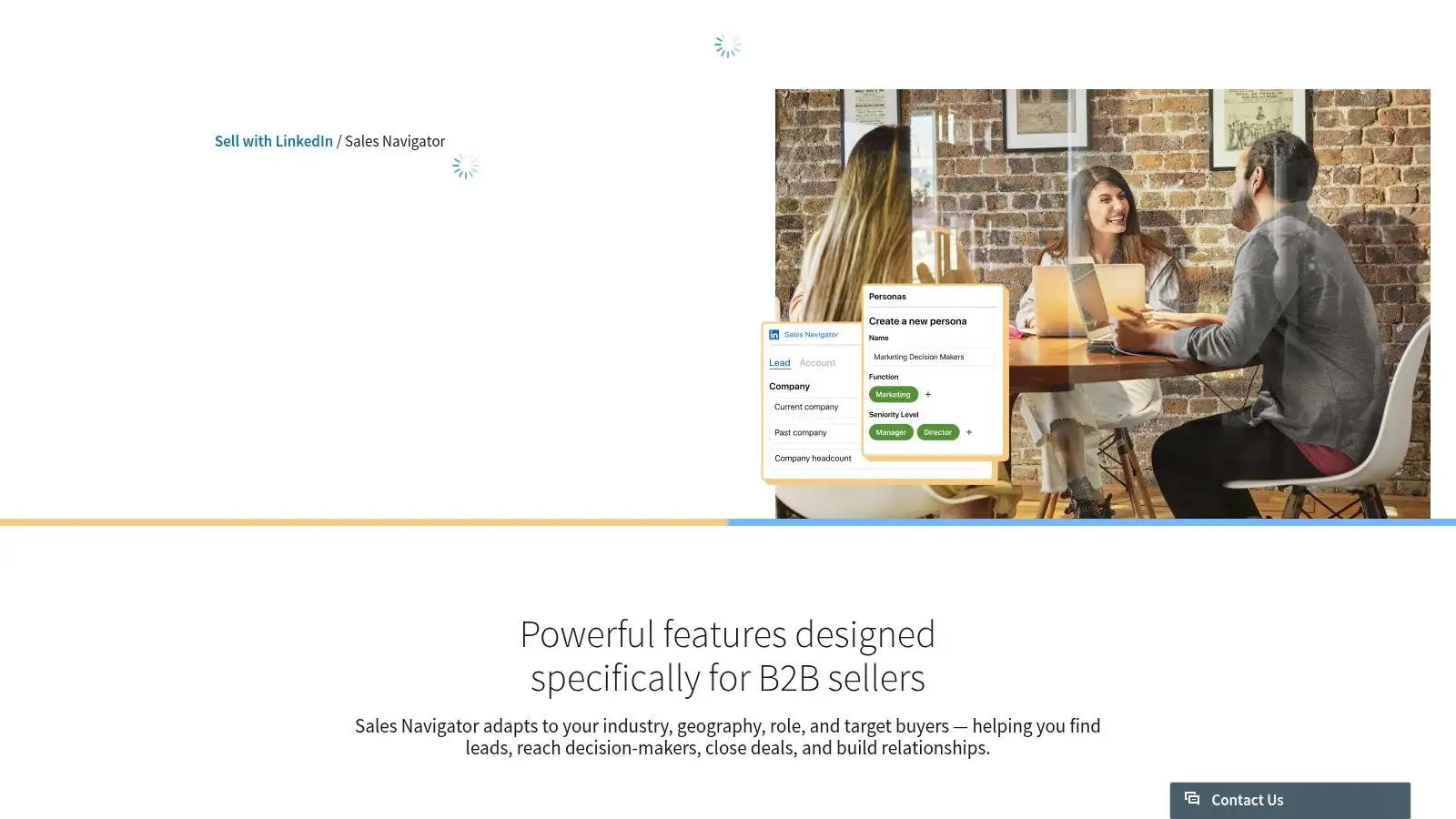
What makes Sales Nav a non-negotiable part of the B2B lead generation tools stack is its first-party data advantage. You get access to incredibly timely and relevant trigger events. Think of it as your sales spidey-sense: you'll know instantly when a key prospect changes jobs, their company is mentioned in the news, or they post about a specific challenge. This isn't just data; it's a perfectly timed conversation starter.
Key Features & Use Cases
-
Best For: SDRs, BDRs, and Account Executives who need direct access to decision-makers and timely buying signals. Startups and enterprise teams alike will find value, though higher tiers are built for larger, collaborative sales orgs.
-
Advanced Search & Filtering: With over 50 filters, you can pinpoint prospects by seniority, company size, recent job changes, and more. For example, you can target VPs of Marketing at SaaS companies in California with 50-200 employees that recently hired a new CMO.
-
Saved Searches & Alerts: Automate your prospecting by saving complex searches and getting notified when new leads match your criteria.
-
InMail Credits: Directly message anyone on LinkedIn, even if you aren't connected. Be warned: use them wisely, as the limits can feel a bit restrictive.
-
TeamLink: This feature is pure gold. It surfaces warm introduction paths by showing you which of your colleagues are connected to a target prospect.
Pricing & Limitations
Pricing isn't plastered on the homepage, requiring you to engage with their sales process for higher-tier plans like Advanced Plus. The entry-level "Core" plan starts around $99/month per user, but crucial features like CRM integrations (Salesforce, HubSpot, etc.) are gated behind the more expensive "Advanced" and "Advanced Plus" tiers. The main drawback is that while you have the keys to the kingdom, your InMail credits are finite, which can throttle high-volume outreach strategies. For a deeper dive, explore our guide to prospecting on LinkedIn.
Website: https://business.linkedin.com/sales-solutions/sales-navigator
3. ZoomInfo SalesOS
What sets ZoomInfo apart is its ambition to unify prospecting, enrichment, and intent data under one roof. It tells you which companies are researching topics related to your product, identifies anonymous visitors on your site, and then gives you the direct dials and emails to reach the right people within those accounts.
Key Features & Use Cases
-
Best For: Enterprise and mid-market sales teams, especially in the US, that need a high volume of accurate contact data and integrated GTM intelligence. Operations teams love its data governance and enrichment capabilities.
-
Massive B2B Database: Access millions of verified contacts and company profiles with deep filtering, including department, management level, and specific technologies used (technographics).
-
Buyer Intent & WebSights: Identify which companies are actively searching for your solution across the web and see which of those accounts are visiting your website, even if they don't fill out a form. These signals are crucial for effective lead scoring strategies.
-
Workflow Automation: Build lists and push them directly into integrated sales engagement platforms like Outreach or Salesloft, streamlining the handoff from prospecting to outreach.
Pricing & Limitations
ZoomInfo’s pricing is famously opaque and tailored to your organization, meaning you won’t find a price tag on their website. Contracts are typically annual and represent a significant investment, often placing it out of reach for smaller startups. The primary drawback, apart from the cost, is that while the data is vast, some users report variable data quality, especially outside of North America. Be prepared for a persistent sales process; they are very good at what they do.
Website: https://www.zoominfo.com/
4. Apollo.io
Apollo bundles a massive contact database with sequencing and a dialer, making it a powerful all-in-one hub for prospecting and engagement.
What makes Apollo a staple in the B2B lead generation tools lineup is its sheer utility and value, especially for startups and mid-market teams. The Chrome extension is particularly slick, letting you pull contact data directly from LinkedIn profiles and drop prospects into your pipeline.
However there have been many posts online about the quality of informatino via Apollo.
Key Features & Use Cases
-
Best For: Startups and SMBs looking for an all-in-one prospecting and outreach solution. It's a favorite among SDR teams who need both a data source and the tools to act on it immediately.
-
Contact Database & Enrichment: Access a huge database to build prospect lists from scratch or enrich your existing CRM records with verified emails and direct-dial phone numbers..
-
AI Writing & Research: Leverage AI to generate personalized emails and get quick summaries on your target accounts, saving you valuable prep time.
Pricing & Limitations
Paid plans start at a very accessible price point, around $49/user/month for the "Basic" plan. However, the platform operates on a credit-based system for exporting contacts and sending emails, so high-volume teams will likely need to purchase additional credits or upgrade to higher-tier plans like "Professional" or "Organization." The main limitation is that while it does many things well, a dedicated, best-in-class tool for any single function (like a standalone sales dialer or sequencer) may offer deeper functionality.
Website: https://www.apollo.io/pricing
5. 6sense Sales Intelligence
It’s a sales intelligence platform that goes beyond simple contact data, layering on predictive AI to tell you which accounts are in-market and ready to engage right now.
It tries to identify "dark funnel" prospects, and connects them to real accounts. Instead of guessing, your team gets a prioritized list of accounts showing strong buying signals, such as researching your competitors or specific keywords. It's like having a cheat code for your entire account-based marketing strategy.
Key Features & Use Cases
-
Best For: Account-based sales teams, enterprise BDRs, and marketers who want to prioritize high-intent accounts and align their outreach efforts.
-
Predictive AI & Intent Signals: Combines fit and intent scores to surface accounts most likely to buy. It analyzes technographics, psychographics, job postings, and third-party intent data.
-
Sales Copilot: Acts as a prioritization engine, guiding reps on which contacts and accounts to focus on for the highest impact.
-
CRM/SEP Integrations: Pushes its rich data and insights directly into your existing workflows within Salesforce, HubSpot, Outreach, and Salesloft.
Pricing & Limitations
6sense offers a free tier that lets you test-drive some of its core functionality, which is a great way to see the magic happen. For the full suite of predictive features, higher contact credit volumes, and deeper integrations, you’ll need to move to their paid plans. Pricing is not publicly listed, requiring a conversation with their sales team. The primary drawback is that for a very small startup or solo founder, the platform’s powerful account-based capabilities might be more firepower than is necessary.
Website: https://6sense.com/platform/sales/pricing/
6. Cognism
If your sales team lives and breathes on the phone, Cognism is the tool that turns cold calling from a game of chance into a precision sport. This isn't just another contact database; it's a sales intelligence platform obsessed with one thing: getting you a direct line to a real person. Its main superpower is its phone-verified mobile numbers, or "Diamond Data," which basically means they have people checking the numbers so your SDRs don't have to listen to another "this number is no longer in service" recording.
What makes Cognism a top-tier B2B lead generation tool, especially for teams dialing into Europe, is its commitment to compliance. It’s built with GDPR and CCPA in mind, with extensive Do-Not-Call list scrubbing. This focus provides a safety net, allowing your team to prospect aggressively without accidentally wandering into a regulatory minefield. It’s less about just finding data and more about finding the right, compliant data you can actually use.
Key Features & Use Cases
-
Best For: Outbound sales teams with a heavy focus on cold calling, particularly those targeting prospects in the US and Europe who need accurate mobile numbers and strict compliance.
-
Diamond Data®: Premium, phone-verified mobile numbers designed to significantly boost connect rates for dialing teams. Includes a "Diamonds-on-Demand" service for targeted verification.
-
Global Data Coverage: Extensive database including firmographics, technographics, sales trigger events, and Bombora-powered intent data.
-
Browser Extension: Capture contacts directly from LinkedIn and corporate websites, then push them straight into your CRM or sales engagement platform.
-
Compliance Engine: Automatically screens against DNC lists and adheres to global data privacy regulations, reducing risk for your organization.
Pricing & Limitations
Cognism keeps its pricing under wraps, requiring a conversation with their sales team. It's generally geared towards multi-seat packages, so it might not be the most accessible for a solo user or a very small team. The biggest value comes from its unrestricted data views and exports (within a fair use policy), which is a huge plus compared to credit-based models. However, the premium price point means you need a team ready to leverage its core strength: dialing verified numbers at scale.
Website: https://www.cognism.com/
7. Lusha
If you’ve ever felt like finding a prospect’s direct dial is harder than finding a quiet spot in a WeWork, Lusha is the tool for you. It’s a lean, mean, contact-finding machine built on a simple premise: click a button, get a phone number or email, and get on with your day.
Key Features & Use Cases
-
Best For: SMBs, startups, and individual sales reps who need a fast, simple, and affordable way to find direct contact information for outreach.
-
Simple Credit Model: A transparent system where you use credits to unlock emails and phone numbers. It’s easy to predict costs and scale usage.
-
Browser Extension: The Chrome extension is the star of the show, allowing for one-click contact discovery directly on LinkedIn profiles and company websites.
-
CRM Integrations: Pushes contact data directly into major platforms like Salesforce and HubSpot, reducing manual data entry and speeding up your workflow.
Pricing & Limitations
Lusha’s pricing is built around its credit model. The free plan offers a handful of credits per month, while paid plans like "Pro" (starting at $36/user/month) and "Premium" ($59/user/month) offer larger credit bundles and more features. The main limitation is the credit cost difference: direct dials and mobile numbers cost significantly more credits than emails. This can make Lusha expensive for teams focused heavily on cold calling, forcing you to be more selective with your unlocks.
Website: https://www.lusha.com/pricing/
8. LeadIQ
LeadIQ is the prospecting tool for reps who live in their web browser and treat LinkedIn like their second home. Instead of flipping between tabs like a stressed-out day trader, LeadIQ lets you capture prospect data with a single click right where you find it. It's built for speed, turning the manual drudgery of finding and verifying contact info into a smooth, integrated workflow that feels less like a chore and more like a high-score game for your CRM.
What makes LeadIQ a standout among b2b lead generation tools is its laser focus on the SDR’s real-world process. It doesn't try to be an all-in-one platform; it aims to be the absolute best at capturing verified contact info and syncing it seamlessly. The platform’s "Signals" feature also adds a layer of intelligence, alerting you to job changes or company news so your outreach is timely, not just another cold email landing in the void.
Key Features & Use Cases
-
Best For: SDRs and BDRs who spend significant time prospecting on LinkedIn and company websites and need a fast way to build lists and push them into their sales engagement tools.
-
Chrome Extension: Capture prospects with one click from LinkedIn profiles, Sales Navigator, and corporate websites, pulling in verified emails and mobile numbers.
-
AI-Powered Personalization: The Scribe AI feature helps you draft personalized outreach messages based on prospect data, saving you from staring at a blank screen.
-
CRM & SEP Sync: Offers deep integrations, allowing you to sync captured leads directly to Salesforce, HubSpot, Outreach, and Salesloft without manual data entry.
-
Job Change Signals: Get timely alerts when your prospects or past customers move to a new company, creating perfect warm outreach opportunities.
Pricing & Limitations
Paid plans like "Starter" and "Pro" are priced per user, with costs scaling based on the volume of email and mobile credits needed. The main limitation is that credits for mobile numbers are typically more "expensive" than email credits, requiring teams to strategically plan their usage. Additionally, while its core data is strong, coverage for contacts outside major markets like North America and Europe can vary by industry.
Website: https://leadiq.com/pricing
9. Hunter.io
It’s a clean, no-nonsense tool that does one thing exceptionally well: finding and verifying professional email addresses. Hunter cuts through the noise of complex, all-in-one platforms to deliver the data you need for your cold outreach, ensuring your carefully crafted messages don't just bounce into the digital abyss. It's the digital equivalent of a bloodhound for email addresses.
What makes Hunter a staple in many B2B lead generation tools arsenals is its simplicity and reliability. The platform’s confidence scores and robust verification system protect your sender reputation, which is critical for long-term outbound success. Instead of bundling dozens of features you’ll never use, it focuses on providing accurate contact data and a simple outreach tool to get your campaigns started quickly and effectively.
Key Features & Use Cases
-
Best For: Startups, SMBs, and sales teams that need a straightforward, affordable way to build and verify email lists for cold outreach. It's also great for marketers and recruiters.
-
Domain Search: Enter a company domain like
apple.comand get a list of all publicly available email addresses associated with it, complete with confidence scores. -
Email Finder & Verifier: Find a specific person's email with just their name and company, or upload a bulk list to scrub it for invalid addresses.
-
API & Integrations: Connects with popular CRMs and sales tools like Salesforce, HubSpot, and Zapier to automate your lead-building workflow.
Pricing & Limitations
It offers a free plan with 25 searches and 50 verifications per month, which is perfect for testing the waters. Paid plans start at around $49/month for the "Starter" tier, scaling up based on the number of searches and verifications you need. The main limitation is its singular focus on email; you won't find phone numbers, direct dials, or deep buying intent signals here. It's a specialist, not a generalist. For a deeper look at email-finding strategies, you can learn more about finding business emails.
Website: https://hunter.io/pricing
10. Clearbit (by HubSpot)
Now part of the HubSpot family, Clearbit specializes in data enrichment, acting as a real-time private investigator for your inbound leads.
Key Features & Use Cases
-
Best For: Marketing and RevOps teams deeply embedded in the HubSpot ecosystem who want to improve lead scoring, routing, and conversion rates with high-quality data.
-
Data Enrichment: Automatically enriches new leads in your CRM with firmographic and technographic data, ensuring your team has full context from the start.
-
HubSpot Integration: As a HubSpot product, its integration is becoming increasingly seamless, making it a natural fit for users of the platform.
Pricing & Limitations
Clearbit operates on a sales-led, usage-based pricing model, so you won’t find a pricing page with neat little boxes. You'll need to talk to their sales team to get a quote tailored to your contact volume and feature needs. The primary limitation is its ecosystem gravity; while it integrates with other platforms, the best value and tightest alignment are undoubtedly for companies already using HubSpot. For a closer look at identifying anonymous visitors, discover more about how to track website visitors.
Website: https://clearbit.com/
11. G2 – Lead Generation category
Think of G2 not as a single tool, but as the bustling grand central station for all B2B lead generation tools. It's the ultimate reality check, a buyer review marketplace where you can see what actual users think before you commit your budget. Instead of relying on a vendor's slick marketing pitch, you get crowdsourced ratings, unfiltered feedback, and side-by-side comparisons that help you cut through the noise and find the right fit for your team.
Navigating G2 is like having thousands of sales ops peers whispering their best and worst tech experiences in your ear. The platform brilliantly categorizes everything from lead capture and intelligence to data mining, complete with filterable grids. You can quickly see who the top players are, discover rising stars, and, most importantly, read recent, unvarnished reviews that tell you what it’s really like to use a product day-to-day.
Key Features & Use Cases
-
Best For: Sales and RevOps leaders tasked with evaluating and purchasing new software. It’s also invaluable for SDRs and BDRs who want to understand the competitive landscape or find alternatives to their current tools.
-
Crowdsourced Ratings & Reviews: Access a massive database of peer reviews, allowing you to filter by company size, role, and industry to find feedback relevant to your specific situation.
-
Side-by-Side Comparisons: Pit tools against each other feature-for-feature to see how they stack up on everything from usability to customer support.
-
Category Grids & Shortlists: Quickly identify market leaders, high performers, and niche solutions within specific sub-categories like lead scoring or visitor identification.
Pricing & Limitations
G2 is free for buyers to use. The business model relies on vendors paying for enhanced profiles, analytics, and lead generation features on the platform. The main limitation is that you have to be a savvy consumer. Vendor marketing can influence a product's positioning, and some reviews might be incentivized. Always cross-reference the information on G2 with the vendor’s official website and, if possible, get a demo before making a final decision. You can see some great examples of tools in action to get a better feel.
Website: https://www.g2.com/categories/lead-generation
12. Salesforce AppExchange
If Salesforce is the Death Star of CRMs, then the AppExchange is its fully stocked armory. This isn't a single tool; it's a bustling marketplace where thousands of apps compete for your attention, all promising to supercharge your Salesforce instance. For teams already living and breathing in Salesforce, this is the ultimate convenience store for b2b lead generation tools, offering everything from data enrichment to lead routing without ever leaving your native environment.
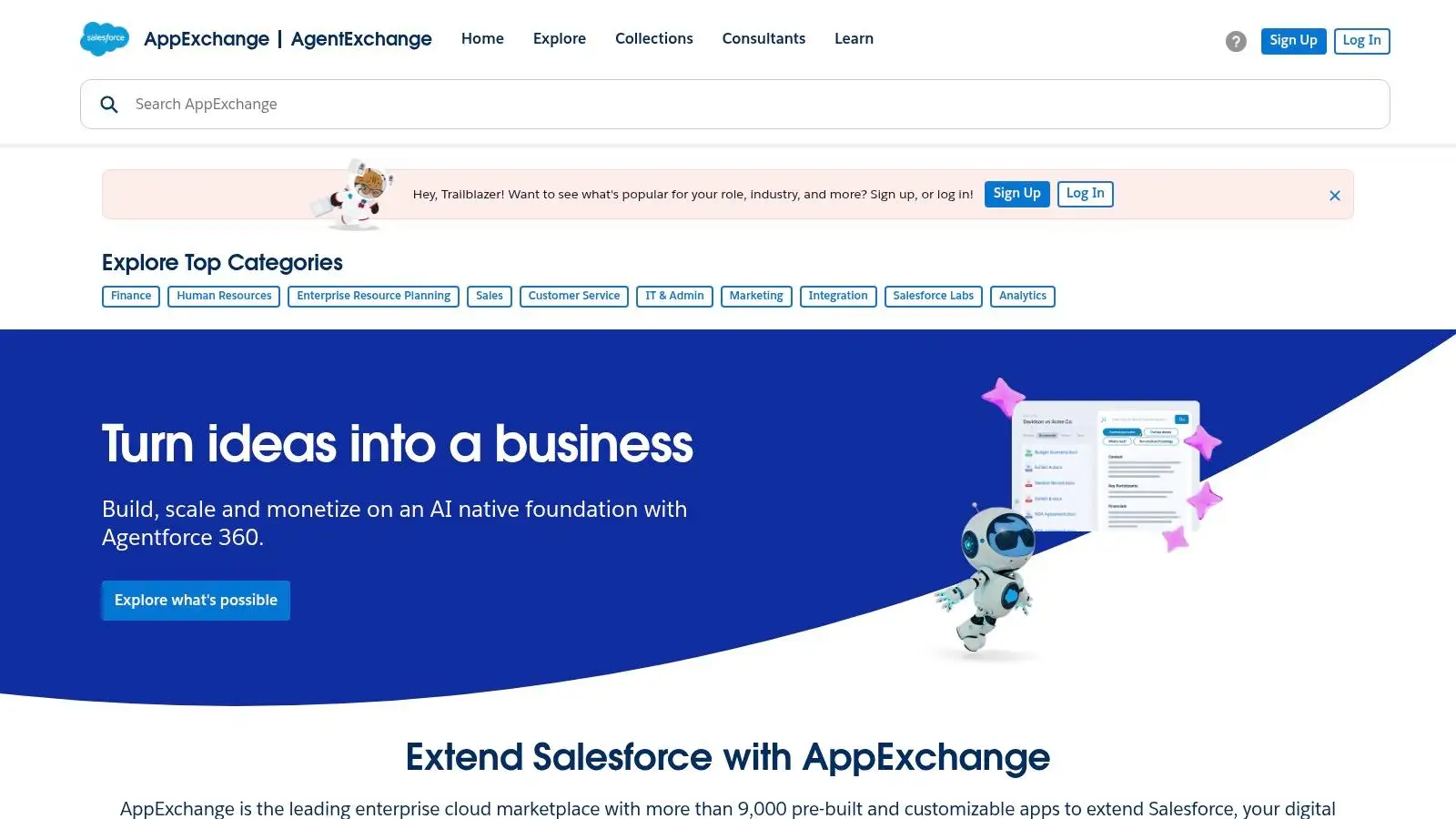
The AppExchange’s real power is its built-in trust factor. Every app is vetted for security and compatibility, so you can avoid the integration nightmare of trying to connect a random third-party tool. Think of it as the Apple App Store for your sales stack: curated, reviewed, and built to plug directly into your daily workflow, making it an essential resource for any serious Salesforce-powered sales team.
Key Features & Use Cases
-
Best For: Salesforce-centric RevOps and sales teams who need to find, vet, and install fully integrated lead generation apps without complex custom development.
-
Curated Collections: Discover apps grouped by function, like "Apps to Provide Better Data to your Sales Teams," which cuts down on endless searching.
-
Vetted & Reviewed Listings: Each listing includes compatibility details, user reviews, and release dates, providing a clear picture before you commit.
-
Direct Install & Free Trials: Many apps can be installed directly into your Salesforce environment for a free trial with just a few clicks.
-
Ecosystem Coverage: Find dedicated solutions for nearly any lead gen need, including data enrichment (ZoomInfo, Clearbit), lead routing (LeanData), and territory management.
Pricing & Limitations
Pricing is the wild west here. Since it’s a marketplace, costs are set by individual vendors and vary wildly. Many listings are quote-based, so be prepared for a few sales calls. The primary limitation is its ecosystem lock-in; the AppExchange is a paradise for Salesforce users but offers little to no value if your team runs on a different CRM. It’s an exclusive club, and the price of admission is a Salesforce license.
Website: https://appexchange.salesforce.com/
Top 12 B2B Lead Generation Tools: Feature Comparison
| Product | Core Capabilities ✨ | Quality ★ | Target 👥 | Price / Value 💰 |
|---|---|---|---|---|
| Munch 🏆 | Lead discovery, waterfall enrichment, AI personalization; 100+ intent sources; 95%+ email accuracy | ★★★★★ | 👥 Ambitious B2B SDR/AE teams, SMB–mid-market | 💰 From $49/mo, cost-effective (replaces multi-tool stack) |
| LinkedIn Sales Navigator | 1B+ profiles, 50+ filters, saved searches, InMail, job-change signals | ★★★★ | 👥 SDRs & reps focused on LinkedIn outreach | 💰 Tiered (some enterprise features gated) |
| ZoomInfo SalesOS | Large contact/company DB, intent & WebSights, enrichment, automation | ★★★★ | 👥 Enterprise GTM teams needing broad coverage | 💰 Quote-based, often expensive (annual contracts) |
| Apollo.io | Contact DB & enrichment, sequencing, dialer, A/B testing | ★★★★ | 👥 Startups & mid-market teams wanting all-in-one outreach | 💰 Budget-friendly base; credit model for heavy users |
| 6sense Sales Intelligence | Predictive AI fit/intent, technographics, web visitor ID | ★★★★ | 👥 ABM and intent-led account teams | 💰 Usage-based tiers; free/basic trial available |
| Cognism | Phone-verified mobile numbers, compliance (DNC/GDPR), firmographics | ★★★★ | 👥 Call-heavy SDR teams and regulated orgs | 💰 Sales-led pricing; best value with multi-seat contracts |
| Lusha | Credit-based email/phone unlocks, Chrome ext, free tier credits | ★★★☆ | 👥 SMBs needing quick email/phone discovery | 💰 Transparent credit pricing; free tier available |
| LeadIQ | One-click prospect capture (Chrome), verified contacts, CRM syncs | ★★★★ | 👥 SDRs capturing prospects while browsing LinkedIn/sites | 💰 Freemium & credit tiers; configurable plans |
| Hunter.io | Email finder, verifier, outreach campaigns, API access | ★★★★ | 👥 Email-first outreach teams & deliverability-focused users | 💰 Clear, affordable credit plans (generous annual credits) |
| Clearbit (by HubSpot) | Real-time enrichment, Reveal for anonymous visitors, 100+ attributes | ★★★★ | 👥 HubSpot-centric stacks & lead routing teams | 💰 Sales-led, usage-based; best for HubSpot users |
| G2 – Lead Gen category | Crowdsourced reviews, shortlists, category comparisons | ★★★★ | 👥 Buyers researching and shortlisting tools | 💰 Free to use (vendor listings may be promoted) |
| Salesforce AppExchange | Curated lead-gen apps, trials, direct Salesforce installs | ★★★★ | 👥 Salesforce-first orgs needing vetted integrations | 💰 Varies by vendor; many quote-based listings |
Choosing Your Player: How to Pick the Right Tool Without Buyer's Remorse
Alright, we’ve just navigated a labyrinth of B2B lead generation tools that would make even Theseus need a GPS. From all-in-one powerhouses to specialized sharpshooters, the options are staggering. It's like standing in front of a giant vending machine where every snack promises to solve world hunger, or at least, your pipeline problems. So, how do you choose your champion without suffering from the dreaded buyer's remorse that hits you three months and a few thousand dollars later?
The truth is, there's no single "best" tool, just like there's no single "best" character in Street Fighter. The right choice depends entirely on your team's fighting style, your budget, and the specific boss you're trying to defeat, whether that's an empty pipeline, inaccurate data, or abysmal reply rates.
Recapping the Key Players
Let's do a quick highlight reel. If you're an enterprise titan with a bottomless budget and a team that already speaks fluent Salesforce, giants like ZoomInfo or 6sense offer unparalleled data depth and ecosystem integration. They're the heavyweights, built for organizations that need massive scale and predictive analytics to stay ahead.
For teams who basically live on LinkedIn, Sales Navigator isn't just a tool; it's a mandatory utility, like Wi-Fi or coffee. It's the ultimate social prospecting playground. Meanwhile, tools like Munch have carved out a space as the scrappy, high-value contenders, offering a fantastic blend of data and outreach features that punch well above their price point, making them darlings of the startup and SMB world.
Your Action Plan: The Three-Step Litmus Test
Feeling overwhelmed? Don't be. Choosing from this list of b2b lead generation tools is a strategic decision, not a coin flip. Here’s a simple framework to guide you from analysis paralysis to confident action.
-
Identify Your Arch-Nemesis: What is the single biggest bottleneck in your lead gen process right now? Is it finding contacts (Prospecting)? Is it outdated phone numbers and emails (Enrichment)? Or is it crafting messages that don't get immediately archived (Outreach)? Be brutally honest. Don't buy a Ferrari if your problem is navigating a tight city alley. Pinpoint the primary pain, and let that guide your search. For instance, if your CRM is a graveyard of bad data, a tool focused on enrichment like Clearbit is your priority. If you have no leads at all, a prospecting-first platform is the answer.
-
Map to Your Workflow, Not the Other Way Around: The slickest tool on the market is useless if it forces your team to adopt a clunky, unnatural process. A great tool should feel like a superpower, not a chore. Does it integrate seamlessly with your CRM? Can your SDRs get up and running in an afternoon, or will they need a PhD in its user manual? Always prioritize tools that augment your existing flow. If your team is already running a lean, multi-channel outreach, a unified platform that combines prospecting and sequencing will be a game-changer.
-
Run the Free Trial Gauntlet: You wouldn't buy a car without a test drive, so don't commit to a software subscription without putting it through its paces. Most tools we've covered offer a free trial or a freemium plan. Use it. Get your hands dirty. Pull a list, verify some contacts, and run a micro-campaign. See how the data quality actually holds up and if the user interface makes you want to celebrate or throw your laptop out the window.
Ultimately, the goal isn't to find a tool that does everything; it's to find the tool that does what you need exceptionally well. Your mission is to build a sales tech stack that works for you, not the other way around. Choose wisely, integrate thoughtfully, and get back to what you do best: building relationships and closing deals.
Ready to stop duct-taping multiple tools together and finally streamline your entire B2B lead generation process? Munch is the all-in-one platform that combines intent-based prospecting, best-in-class data enrichment, and AI-powered outreach into a single, intuitive workflow. See for yourself how top-performing sales teams are saving time and crushing quota by visiting Munch.