Automatic Lead Generation - The Ultimate Sales Playbook

By Mriganka Bhuyan
•Founder at Munch
Traditional prospecting sucks! It's a soul crushing grind. It’s like trying to find a needle in a haystack, except the haystack is the size of the internet, and you’re sifting through it with a pair of tweezers. It’s tedious, repetitive, and often, a massive waste of your sales team's talent.
Automatic lead generation is the antidote to that grind. It's a system that intelligently finds, qualifies, and hands over sales-ready leads to your team, all without them having to lift a finger for the grunt work. Think of it as replacing the tweezers with a powerful, intelligent magnet.
What Is Automatic Lead Generation
Imagine you're trying to find your ideal customer at a giant music festival. The old way? You'd wander aimlessly through the crowd for hours, shouting their name, hoping for a lucky break.
Automatic lead generation is like having an all-access backstage pass, a GPS tracker locked onto your perfect buyer, and a personal introduction from the band's manager. It’s a smarter system that does the heavy lifting for you.
Instead of your sales team spending their days endlessly scrolling through LinkedIn or scraping websites for scraps of information, an automated system works around the clock. It’s always listening for buying signals, pinpointing prospects who are a perfect match for your ideal customer profile (ICP), and then serving them up on a silver platter, complete with verified contact info and a ready-made conversation starter.
This isn't just about saving a few hours here and there. It's about fundamentally changing how you sell.
The Old Grind Versus The Smart Machine
The difference between the old manual way and the new automated approach is night and day. It’s like comparing a dusty old flip phone to the latest smartphone. Sure, they can both make calls, but one of them gives you the power to do a thousand other things faster, smarter, and with way less effort.
This is exactly why so many B2B teams are making the switch. The numbers don't lie: a whopping 80% of marketing automation users see an increase in the number of leads they generate. And it gets better. Companies that nail their automation strategy see 77% higher lead conversion rates. That's huge, especially when you consider that a staggering 80% of new leads never convert without consistent follow-up.
To really see the contrast, let's put them side-by-side.
Manual Prospecting vs Automatic Lead Generation
Here’s a quick look at how the old, manual slog stacks up against a modern, automated engine. It's a clear win for working smarter, not harder.
| Aspect | Manual Prospecting (The Old Grind) | Automatic Lead Generation (The Smart Machine) |
|---|---|---|
| Speed | Painfully slow. Reps burn hours on research for just a few contacts. | Blazing fast. The system finds and qualifies hundreds of leads in minutes. |
| Accuracy | Prone to human error. Data gets stale fast, leading to high bounce rates. | Laser-focused. Uses multiple data sources and verification for clean, reliable info. |
| Timing | Reactive and always late. You find out about opportunities after they've passed. | Proactive and real-time. It catches buying signals the second they happen. |
| Scalability | Limited by headcount. Getting more leads means hiring more people. Period. | Nearly infinite. You can scale your outreach without bloating your payroll. |
It's clear which approach gives your team the advantage to not just compete, but dominate.
The goal of automatic lead generation isn't to replace your sales team. It's to empower them by removing the tedious work that burns them out, allowing them to focus on high-value conversations that actually drive revenue.
By making this shift, you're moving from a system of brute force to one of precision and intelligence. We dive deeper into this in our complete guide on what sales automation is and how it all connects. This is how your team stops chasing dead ends and starts having meaningful conversations with people who are actually ready to buy.
The Core Components Of A Sales Automation Engine
Building a killer automatic lead generation system is a bit like assembling a high-performance engine. You can't just throw a bunch of parts together and hope for the best. Every component has to fit perfectly and work in sync with the others to generate real power.
But this isn't some black box filled with confusing tech. It's actually a super logical flow of six core parts working together. Think of them as the sequential stages of a rocket launch: each one firing at the right time to get you into orbit.
Here’s a quick visual of the overall journey, from spotting a potential customer to actually talking to them.
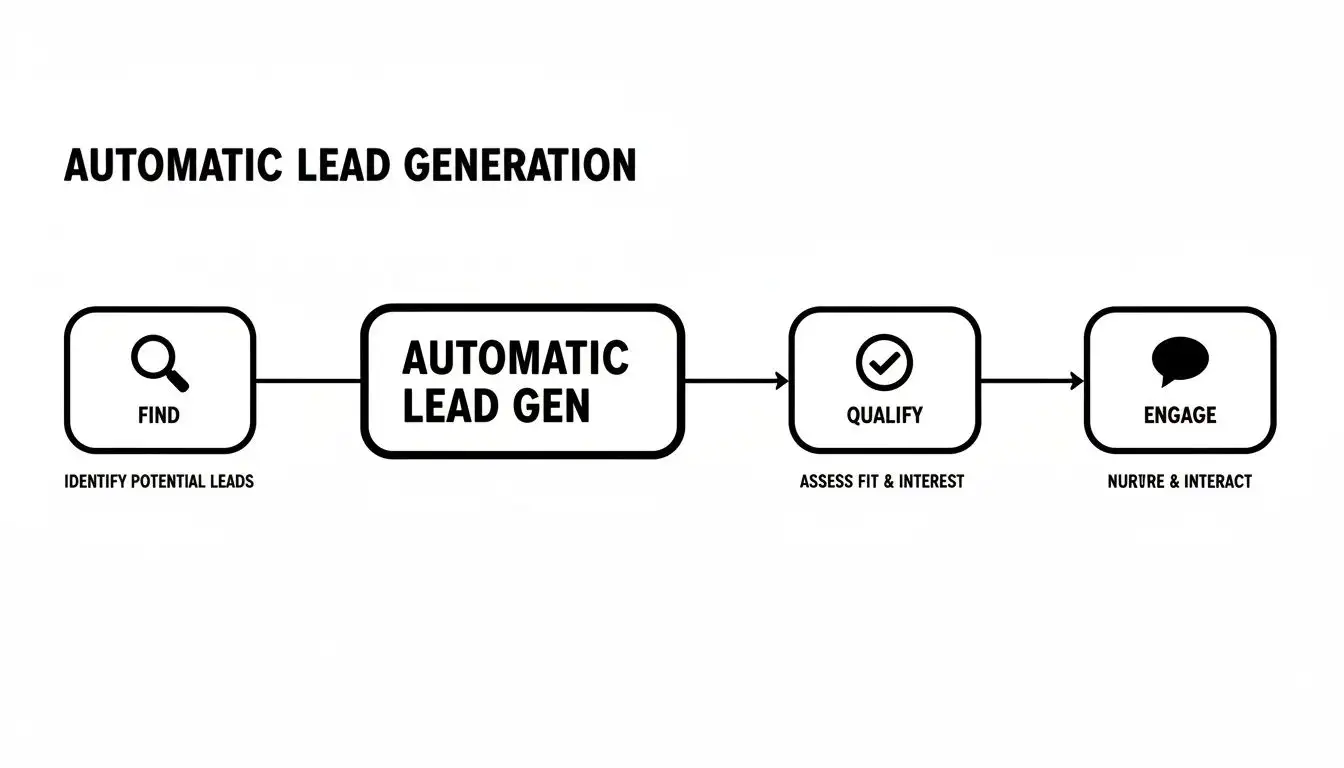
This breaks it down nicely: find the right people, make sure they’re a good fit, and then start a real conversation. The six components we're about to dive into are what make this entire flow hum.
1. Signal Sources: Your "Buy Now" Radar
First up, you have signal sources. These are your digital eyes and ears, constantly scanning the market for buying indicators. Think of them as a radar system for B2B sales, pinging every time a company makes a move that screams, "We might need what you sell!"
A signal isn't just noise; it’s a specific event that points to a potential need.
-
Job Changes: A target company just hired a new VP of Sales. That's a classic sign they're about to shake things up and might be open to new tools.
-
Funding Events: A startup in your wheelhouse just announced a $20 million Series A. Ka-ching! That’s fresh cash they're looking to spend on growth.
-
Technology Adoption: You see a company on your dream-client list just installed a software that pairs perfectly with yours. This tells you they're actively building out their tech stack.
These signals are the high-octane fuel for your entire lead gen engine. Without them, you’re just flying blind.
2. Matching: Separating The Gold From The Gravel
Once you have a firehose of signals, the next step is matching. This is where your Ideal Customer Profile (ICP) acts as a high-powered filter. It’s like being a talent scout who knows exactly what to look for and can spot a future superstar in a crowd of thousands.
The system takes a raw signal, like "Company ABC is hiring 20 new engineers," and instantly checks it against your ICP. Does Company ABC match your target industry, size, and location? If it's a "yes," you’ve got a match. This step is crucial for making sure your team only chases prospects with the highest chance of closing.
3. Enrichment: Getting The Right Phone Number
A matched company is a great start, but it's just a name. You need to know who to talk to and how to reach them. That's where enrichment comes in. Think of it as your team’s personal private investigator, instantly digging up the direct contact info for the key decision-makers.
Enrichment is all about taking a matched company and finding verified contact details for the right people. The best platforms use a "waterfall" method, checking multiple data providers one after another until they hit gold, ensuring an accuracy rate of over 95%.
This is the part that saves your SDRs from the soul-crushing drudgery of hunting for emails and phone numbers. It turns a company name into a real, live contact, ready for outreach.
4. Personalization: Making The First "Hello" Count
Okay, you've got the signal, the perfect company, and the right contact. Now it’s time for personalization. This is the magic that turns a cold, generic email into a warm introduction that actually gets a reply. One-size-fits-all messages are the fastest way to get your emails sent straight to the trash bin.
AI-powered personalization analyzes the original signal and the prospect's profile to help you craft a message that feels like you did your homework.
Instead of a tired old "Hi, I sell stuff," the AI can help you draft something like: "Hey [Name], I saw on LinkedIn that you're hiring 20 new engineers at [Company]. Congrats on the growth! Scaling dev teams usually creates headaches around [pain point]. We actually help with that."
See the difference? That's how you start a real conversation. For a deeper look at how all these pieces fit together, our guide on the sales automation process covers the whole playbook.
Pro Tip: Use Munch to not only build a highly targetted prospect list, but also to enrich their data and craft personalized outreach messages.
5. & 6. Sequencing and Measurement: Your Automated Playbook
Last but not least, we have sequencing and measurement. Sequencing is your automated outreach campaign: a perfectly timed series of emails and LinkedIn touches that keeps you on their radar without being annoying. Measurement is your dashboard, showing you exactly what’s working by tracking reply rates, meetings booked, and other key metrics.
These final two steps close the loop, turning your automatic lead generation system from a concept into a predictable, revenue-generating machine.
How To Spot Buying Signals Before Your Competitors
In sales, timing isn't just everything; it's the only thing. Showing up a week after your competitor inked a deal is like arriving at the party after the lights come on. You missed all the action. This is where an automatic lead generation system hands you a massive, almost unfair, advantage.
It's like giving your sales team a sixth sense for spotting buying signals: those digital breadcrumbs prospects leave behind that practically scream, "I'm ready to spend some money!" You stop guessing and start acting on real, up-to-the-minute intelligence.
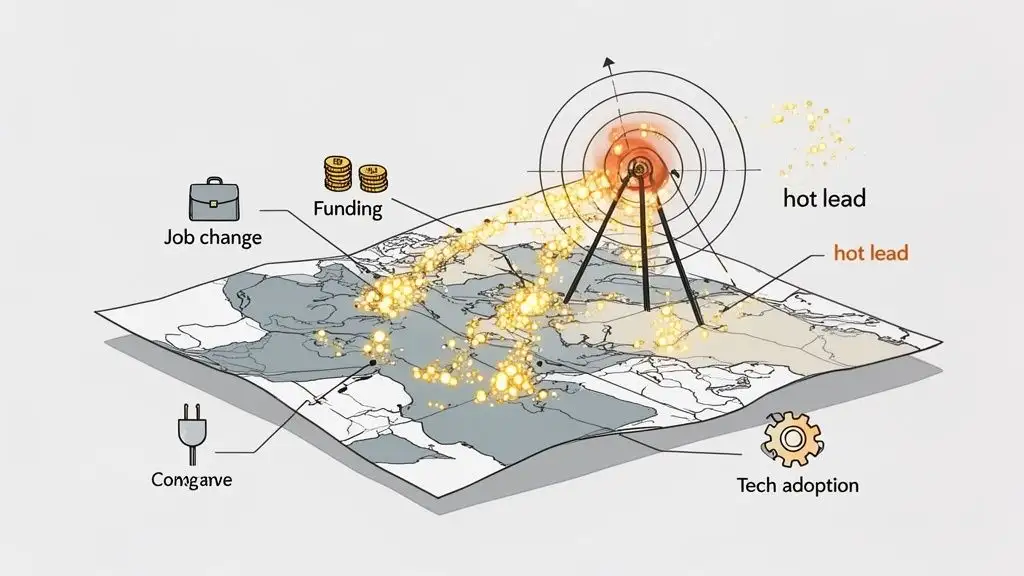
This isn't a small tweak to your process; it’s a complete strategic overhaul. In the B2B world, companies using AI-powered tools are seeing a 50% increase in sales-ready leads and are chopping their customer acquisition costs by up to 60%. By scanning verified sources for these signals, you can instantly match opportunities to your ideal customer profile. To see just how big the impact is, you can explore lead generation statistics and trends driven by AI.
The Big Three Buying Signals
You could track a hundred different signals, but a few are the true heavyweights. Think of these as the flashing neon signs that point directly to an open window of opportunity. Let's dig into the most important ones.
-
Job Changes: A new executive just walked in the door, especially a big gun like a VP of Sales or a new CMO. They’ve been hired to make things happen, and they usually arrive with a fresh budget and an itchy trigger finger. For instance, a new VP is 3x more likely to buy new tools within their first 90 days. A good system flags this change the second their LinkedIn profile updates.
-
Funding Events: Ka-ching! A target company just announced a massive Series B funding round. What does that tell you? They're sitting on a pile of cash with investors breathing down their necks to grow, and grow fast. This is a five-alarm fire of a buying signal, screaming new projects, bigger teams, and a huge appetite for tools that can deliver results.
-
Technology Adoption: Let's say your product is the perfect dance partner for Salesforce. An automated platform can ping you the very moment a target account installs it. Suddenly, your outreach isn't a cold call; it's a super-relevant conversation about helping them get the most out of their brand-new investment.
Turning Signals Into Action
Spotting the smoke is great, but putting out the fire is what closes deals. This is exactly where a platform like Munch connects the dots. It’s constantly scanning over 100 verified sources, from company websites and news articles to social platforms and tech directories, looking for these triggers.
It's a bit like this: your competitors are stuck relying on Google Alerts that might hit their inbox a week late. Meanwhile, your system is feeding you a live, real-time ticker tape of high-intent prospects, complete with the exact reason you need to call them right now.
This entire process gives your SDRs an incredible head start. Forget digging through stale spreadsheets. They get a curated list of fresh opportunities, each one sparked by a real, timely event.
For instance, Munch can spot that a target company just brought on a new Head of Marketing. It doesn't just toss a name over the fence; it finds their verified email and helps you cook up a personalized message congratulating them on the new gig. You've just turned a cold data point into a warm, human conversation.
This proactive approach is a game-changer, and we dive deeper into similar strategies in our guide to SaaS lead generation. It’s all about being the first one through the door, armed with the perfect conversation starter, before your competition even realizes the door was unlocked.
Turning A Raw Signal Into A Sales-Ready Lead
Spotting a buying signal is a great first step, but a raw signal alone is like hearing your favorite 90s rock band is reuniting for a tour. It’s exciting, but it’s not a ticket. You still need the tour dates, the venue, and most importantly, how to get backstage. This is where an automatic lead generation platform turns that faint whisper of interest into a front-row, sales-ready opportunity.
It’s really a two-part process that transforms a simple data point into an actual conversation. First comes data enrichment, which finds the "who" and "where." Then comes AI personalization, which figures out "what" to say.
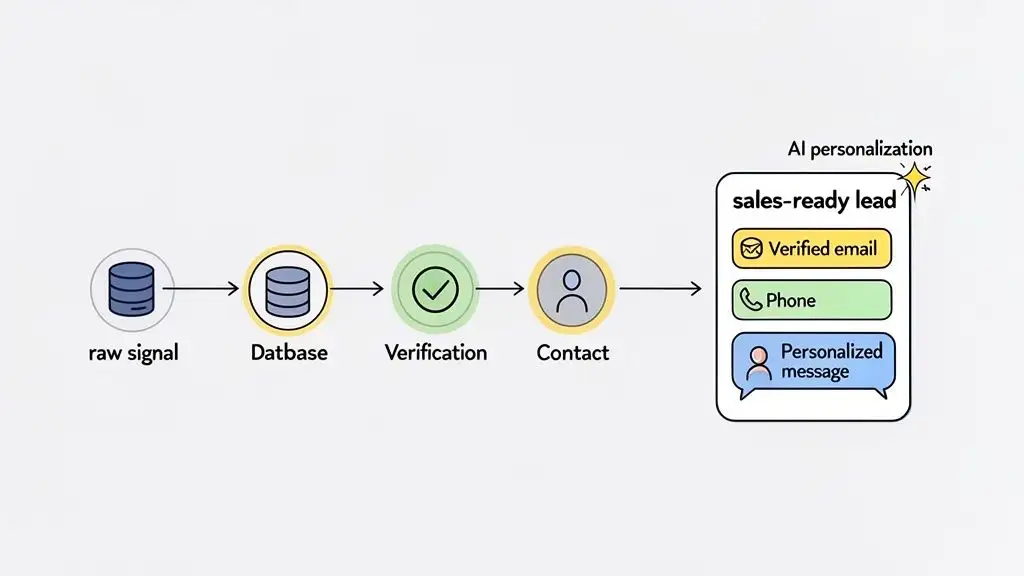
This one-two punch is what separates a modern sales engine from a clunky, manual process. It’s the difference between sending a generic fan letter and getting a personal reply from the band’s manager.
From Signal To Contact With Waterfall Enrichment
A raw signal, like a "New VP of Sales Hired" alert, is basically useless without contact information. The old way to solve this was to send your SDRs on a digital scavenger hunt across LinkedIn and Google, a task about as fun as trying to untangle a drawer full of old headphones. It’s slow, tedious, and often yields outdated information.
Modern platforms automate this with a process called waterfall enrichment.
Think of it as having a team of elite private investigators. The system takes the signal and first checks its primary data source for a verified email and phone number. If it comes up empty, it doesn't just give up. It automatically cascades to a second data provider, then a third, and so on, until it strikes gold.
This multi-layered verification process is why platforms like Munch can deliver contact data with over 95% email accuracy. It’s a relentless approach that ensures your team isn't wasting time on bounced emails and disconnected phone numbers.
The result? Your SDR gets a complete profile delivered in seconds:
-
Verified email address: The direct line to their inbox.
-
Direct-dial phone number: No more getting stuck at the gatekeeper.
-
Company details: Firmographics like size, industry, and revenue.
This single step eliminates hours of soul-crushing manual research per day, freeing your team to focus on what they do best: selling. To get a better handle on this, you can explore our detailed guide on the essentials of lead enrichment.
AI Personalization That Actually Sounds Human
Once you have the right contact, the next challenge is crafting an outreach message that doesn't sound like it was written by a robot from a bad sci-fi movie. This is where AI personalization steps in, and it's a quantum leap beyond simply inserting a {first_name} token into a tired template.
Modern AI doesn't just see a name and a company. It analyzes the entire context:
-
The Original Signal: It knows why you're reaching out. Was it a funding announcement? A new executive hire? A technology installation?
-
The Prospect's Profile: It scans their LinkedIn profile for their title, responsibilities, and recent activity.
-
Company Information: It looks at the company’s industry, recent news, and overall mission.
The AI then synthesizes all this information to draft a unique, context-aware message that sounds genuinely human. It’s the difference between a generic "Hope you're having a great week!" and a razor-sharp "Congrats on the new VP of Marketing role at Acme Corp! Scaling a marketing team after a Series B can be tough, especially when it comes to X."
This approach is changing the game for sales pipelines. Marketing automation is proven to generate 451% more qualified leads, and the personalization component is a huge reason why. When you combine discovery from over 100 sources with high-accuracy data and AI-driven messaging, you create a powerful system where 77% of marketers see a boost in lead conversions.
This intelligent automation turns a cold data point into a warm conversation starter that actually gets replies.
Your Roadmap to Automated Lead Generation
Alright, you’ve seen the engine’s blueprints and how it turns a faint signal into a hot lead. Now, it’s time to roll up your sleeves. This is your practical, no-fluff guide to launching your very own automatic lead generation system.
Think of this as the IKEA manual for building a predictable sales pipeline, only with way fewer confusing diagrams and zero leftover screws. We’re going to break this down into four simple phases.
Phase 1: Define Your Ideal Customer Profile
Before you even think about automating a single email, you have to know exactly who you’re hunting for. Your Ideal Customer Profile (ICP) is your North Star. It's the detailed blueprint of the perfect company that gets massive value from what you sell and, in turn, provides massive value back to you.
Without a laser-focused ICP, you're just boiling the ocean. It’s like a movie director trying to make a film for everyone and ending up with something nobody really loves. Don't be that director. Get specific.
Your ICP needs to go way beyond the basics. Define it with surgical precision:
-
Industry: Which specific verticals do you absolutely crush it in? For example, "B2B SaaS with a focus on fintech."
-
Company Size: What's the sweet spot for employee count or annual revenue? Be specific, like "50-250 employees or $10M-$50M ARR."
-
Geography: Where are your best customers located? Maybe it's "North America and Western Europe."
-
Tech Stack: What other tools do they use that scream "perfect fit"? For instance, "Companies using Salesforce Marketing Cloud and Marketo."
A well-defined ICP is the cornerstone of any successful automatic lead generation strategy. A broad ICP is like trying to be friends with everyone at a huge party: you'll shake a lot of hands but make zero real connections.
Phase 2: Configure Your Signal Triggers
With your ICP locked and loaded, it’s time to tell your system what to look for. This is where you set up your signal triggers: the digital tripwires that go off when a company matching your ICP shows they might be ready to buy.
This isn’t about tracking every little thing. It's about zeroing in on the high-impact signals that consistently lead to closed deals for your business.
That’s not just a lead; it's a golden opportunity served on a silver platter. You’ve officially switched from fishing with a giant net to spearfishing with pinpoint accuracy.
Phase 3: Build Your First Automated Sequence
Okay, you now have a steady stream of high-intent leads flowing in. The next move is to engage them without sounding like a robot. This is where you build your first automated outreach sequence, which is just a fancy way of saying a series of pre-planned messages sent across different channels.
A solid starter sequence usually blends emails and LinkedIn touches over a couple of weeks. The golden rule here is to add value with every message, not just clog their inbox.
-
Touch 1 (Day 1): Fire off a hyper-personalized email that directly references the signal. "Saw you just raised a $15M Series A. Huge congrats!"
-
Touch 2 (Day 3): Send a LinkedIn connection request with a short, non-salesy note.
-
Touch 3 (Day 5): Follow up via email with something genuinely useful, like a case study from a company just like theirs.
-
Touch 4 (Day 8): Like or comment on one of their recent LinkedIn posts to pop back up on their radar.
Make sure you set up A/B tests right out of the gate. Test different subject lines, calls-to-action, and messaging angles to see what lands. This is how you turn a good sequence into a meeting-booking machine.
Phase 4: Measure, Iterate, and Scale
Your first campaign is live. Pop the champagne! But don't get too comfortable, the real work is just beginning. This final phase is a continuous loop of measuring, tweaking, and scaling what works. You need to become completely obsessed with the data.
Forget vanity metrics. Focus on the numbers that actually put money in the bank.
Key Metrics to Track:
-
Reply Rate: Are people actually hitting "reply"? This is your #1 indicator of whether your message is hitting the mark.
-
Positive Reply Rate: How many replies are genuinely interested versus those politely (or not-so-politely) telling you to get lost?
-
Meetings Booked: This is the big one. How many qualified meetings is your system actually generating?
-
Conversion Rate: Of those booked meetings, how many are converting into real, qualified pipeline opportunities?
Use this data to refine everything: your ICP, your signal triggers, and your messaging. Once you find a formula that's consistently delivering, that’s your cue to pour gas on the fire and scale it to the moon.
Frequently Asked Questions
Alright, let's get into the nitty-gritty. You've got questions about automatic lead generation, and I've got answers. Think of this as the part of the movie where the mentor finally spills all the secrets.
How Is This Different From Buying A Lead List?
Ah, the classic lead list. Buying a list is like getting a phone book from 1998. It's a static, dusty document filled with people who have zero idea who you are or why you're calling them during dinner. It's the sales equivalent of showing up to a party you weren't invited to. Just plain awkward.
Automatic lead generation is the polar opposite. It’s a living, breathing system that finds prospects who are waving their hands in the air, showing real buying signals right now. Instead of a cold, stale list, you get a fresh, curated feed of people who are actually a great fit for what you sell.
It's the difference between cold calling strangers out of the blue and getting a warm introduction from a mutual friend who just said, "You two need to talk." One gets you a dial tone; the other gets you a meeting.
The whole game here is about timing and relevance, making sure every single person on your list has a darn good reason to be there.
Will Automation Make My Outreach Sound Robotic?
This is a totally fair question, mostly because old-school automation earned its terrible reputation. We all know the type: the "Hi {first_name}" emails that feel hollow and lazy. That era is over. It’s like a pop star from 2002 trying to make a comeback without changing their sound. It just doesn't fly anymore.
Today's AI-powered platforms are built to create genuinely personalized messages, and do it at scale. The AI acts like your personal research assistant, digging into a prospect's LinkedIn, their company's latest funding announcement, or the specific signal that put them on your radar.
It then drafts a unique message that often sounds more human than most manual emails because it's grounded in real, timely facts. Automation handles the grunt work, freeing you up to add your unique flair and build a real connection.
How Much Technical Skill Is Needed To Set This Up?
You really don't need a computer science degree or a data scientist on speed dial. Modern platforms are designed for sales pros, not engineers. The interfaces are clean and simple, usually with straightforward filters and dropdown menus to get you rolling.
Honestly, if you can create a filter in your Gmail or put together a fire playlist on Spotify, you've got all the technical chops you need.
All the complicated stuff like the data sourcing, the enrichment, and the AI magic happens behind the scenes. You get to focus on the fun part: strategy. You can have your first campaign up, running, and pulling in leads in less than an hour.
What Kind Of ROI Can I Realistically Expect?
The return on investment with automatic lead generation is a one-two punch of efficiency and effectiveness.
-
Efficiency Gains: Your reps get back dozens of hours every single week that they used to waste on soul-crushing manual research. That time goes right back into what they do best: running demos and closing deals.
-
Effectiveness Gains: Your team starts talking to better leads at the exact right moment. This sends reply rates and booked meetings through the roof. It's not uncommon for teams using these systems to see a 50% increase in sales-ready leads.
With most platforms, booking just one or two extra meetings a month delivers a fantastic ROI. But the real prize isn't just more leads; it's building a predictable, scalable pipeline. That's priceless. A big part of that is knowing which leads to prioritize, and that's where a smart approach becomes crucial. You can learn more about lead scoring to see how that fits into the puzzle.
Ready to ditch the manual grind and build a sales pipeline that actually works? Munch brings lead discovery, enrichment, and AI-powered personalization together in one seamless workflow. Signup today and see how you can generate sales-ready leads on autopilot.