How to Generate B2B Leads: A Modern Playbook

By Mriganka Bhuyan
•Founder at Munch
Tired of an empty sales pipeline? I get it. Learning how to generate B2B leads these days isn't about casting a wide net; it’s more like fishing with a laser-guided spear. It's time to finally ditch the old 'spray and pray' tactics that feel about as effective as trying to sell a Blockbuster membership in 2024.
Your New Playbook For B2B Lead Generation
If your sales efforts feel like you're just shouting into the void, consider this guide your megaphone. The game of generating a steady stream of qualified prospects has fundamentally changed. This isn't about abstract theory. It's about a precise, actionable system.
We're going to build a playbook designed to predictably fill your calendar with meetings. That means:
-
Finding prospects who are practically waving a flag that says, "I'm ready to buy."
-
Engaging them with outreach so personal it feels like a DM from an old friend.
-
Building a repeatable system that delivers consistent results, month after month.
Think of it as the difference between a random cold call and showing up with your prospect's favorite coffee order. It's about being strategic, relevant, and timely. You're not just another email in their crowded inbox; you are the welcome solution to a problem they're actively trying to solve.
The Core Process Distilled
When you boil it all down, the entire B2B lead generation process simplifies into three core phases: finding the right people, engaging them in a meaningful way, and qualifying their actual interest.
The goal isn't just to find any lead. It's to find the right lead at the right time. This shift from quantity to quality is what separates the top-performing sales teams from everyone else.
This diagram breaks down the simple but powerful flow of modern lead generation.
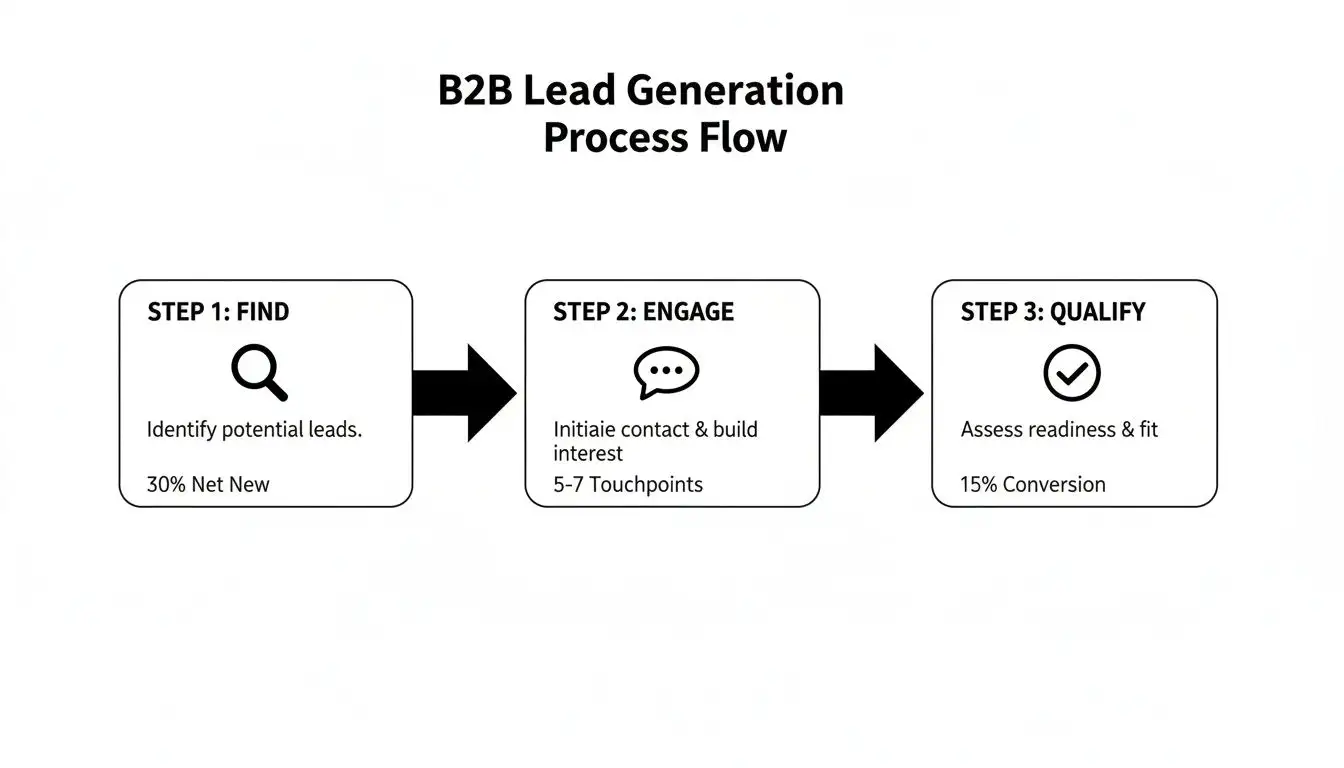
Each stage builds directly on the last, creating a streamlined path from a stranger to a genuine sales opportunity. In the rest of this guide, we'll dive deep into executing each of these steps, turning high-level strategy into specific actions that drive real revenue. Let's get to it.
Find High-Intent Prospects Before Your Competitors Do
The best leads? They're the ones already hunting for a solution just like yours. The real trick, though, is finding them before they get buried under a mountain of emails from your competition. Generating quality B2B leads isn't about casting a wide net; it's about becoming a digital detective, sniffing out the buying signals that scream "opportunity!"
Forget about mindlessly scrolling through generic company lists. That's a surefire way to waste time. We're going to focus on tracking specific triggers that tell you a company is primed and ready to open its wallet.
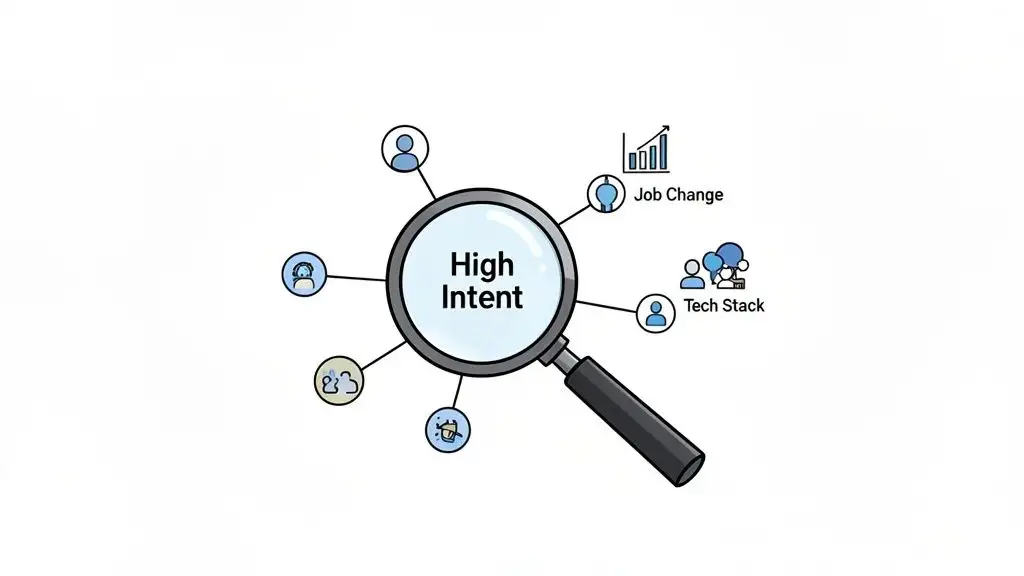
This whole approach is less "needle in a haystack" and more like knowing exactly where to find a specific person in a crowd because you know their habits. It's all about precision, not just sheer volume.
First, Nail Your Ideal Customer Profile
Before you can spot a dream prospect from a mile away, you need to know exactly what they look like. Your Ideal Customer Profile (ICP) is your North Star here. It’s a super-specific breakdown of the company type that gets the most bang for their buck from your product and, in turn, gives you the most value back.
Don't be vague. Go way beyond basic firmographics like industry and employee count. You need to get granular.
-
Technographics: What marketing automation platform are they on? What about their CRM? For example, if you sell a tool that integrates seamlessly with Salesforce, your ICP should specify "uses Salesforce CRM." This detail alone can reveal killer integration opportunities and some serious pain points you can solve.
-
Company Structure: Do your best customers have a dedicated sales ops team? Or maybe they all have at least five BDRs? These details matter.
-
Growth Stage: Are you looking for a scrappy Series B startup that just landed $20 million in funding, or a massive enterprise that’s pushing into a new market?
Your ICP is basically a cheat code. It filters out all the noise, letting you zero in on accounts that are actually likely to close. It saves you from chasing after prospects who were never going to buy in the first place.
Once you have this profile locked down, you can start looking for the real magic: buying signals.
Hunt for High-Intent Buying Signals
Buying signals are just what they sound like: actions that show a company is either in a buying cycle right now or is about to be. Think of them as flares in the dark. These triggers are what turn a cold, generic name on a list into a warm, timely opportunity.
A new VP of Sales probably means a new budget and a fresh look at the tool stack. A big funding announcement means new projects are kicking off and they urgently need solutions to handle that growth. Even seeing a company post a job for a "Demand Generation Manager" tells you exactly what's on their mind.
Here are a few high-impact signals I always track:
-
Job Changes: When a new exec comes on board, they’re often expected to make waves within their first 90 days. They bring new ideas, new budgets, and are way more open to hearing from new vendors.
-
Funding Announcements: Fresh cash has to go somewhere. Companies that just closed a round are actively shopping for tools and services to pour fuel on their growth fire.
-
Negative Competitor Mentions: See someone complaining about your competitor on LinkedIn or G2? That’s not just a gripe; it’s a wide-open invitation to start a conversation.
-
Technology Adoption: If a company just installed a tool that works well with yours, they might need you to complete their stack. On the flip side, if they signed on with a competitor 6-12 months ago, they could be unhappy and looking for an exit when that contract is up.
To give you a better idea, here’s a quick breakdown of common signals and what they really mean for your sales efforts.
High Intent Buying Signals And What They Mean
| Buying Signal | What It Means For Sales | Example Action |
|---|---|---|
| New Executive Hire | The new leader is likely reviewing their budget and tech stack within the first 90 days. | Reach out with a congratulatory message and offer insights relevant to their new role. |
| Recent Funding Round | The company has cash to spend on growth initiatives and scaling operations. | Target them with a solution-focused pitch that aligns with their expansion goals. |
| Hiring for Key Roles | Job postings for roles like "Salesforce Admin" or "Head of Marketing" reveal strategic priorities. | Personalize your outreach by referencing the new role and how you can help that team succeed. |
| Negative Competitor Review | The prospect is actively unhappy and potentially looking for a replacement. | Offer a direct comparison and highlight how you solve the specific pain points they mentioned. |
| Website Visit from Target Account | A company you're targeting is already researching your solution. They're a warm lead. | Add them to a high-priority outreach sequence and reference a piece of content they viewed. |
These signals are your bread and butter. Each one is a clue that now is the right time to reach out.
Another incredibly powerful, yet often overlooked, signal is when a target account visits your own website. Knowing how to track website visitors gives you a direct line of sight into who's already checking you out. This isn't just some random company; it's a qualified account showing genuine interest.
When you start layering these buying signals over your sharp, well-defined ICP, you create a hyper-targeted list of prospects. These aren't just companies that fit the bill; they are companies waving a flag that says they need help right now. This is the absolute foundation of a predictable lead gen machine.
Turn Raw Contacts into Qualified Goldmines
Alright, so you've got a list of prospects who are showing all the right signs. Fantastic. But a name and a company? That’s just the starting line. Showing up with that little information is like trying to make friends at a party by just shouting your name. To actually build a connection, you need to know who you're talking to.
This is where we turn that basic contact info into a rich, detailed profile. It’s the secret sauce for real, genuine personalization.
Sure, this step helps you avoid bounced emails, which is great. But the real win is getting a deep understanding of your prospect's world. This lets you qualify them properly and stop wasting precious time on people who can't, or won't, buy.
From Names on a List to Actionable Intel
Data enrichment is all about taking the raw data you have and layering on crucial information. Think of it as building a sales dossier, not for some spy thriller, but to close more deals.
The whole point is to answer some critical questions before you even think about hitting "send" on that first email.
-
What's their actual job title and where do they sit in the food chain?
-
How big is the company? What kind of revenue are we talking about?
-
What tools are they already using (their technographics)?
-
Can I get a verified, direct-dial phone number?
Answering these questions helps you paint a complete picture. It's how you go from chasing lukewarm leads to engaging genuinely qualified prospects.
Master the Waterfall Enrichment Method
Here’s a trick that separates the amateurs from the pros: waterfall enrichment. It sounds fancy, but it's dead simple. Instead of relying on one data provider, you check multiple sources in a sequence until you strike gold.
It’s like asking for a restaurant recommendation. If your first friend is no help, you ask the next, and the next, until someone gives you a killer suggestion.
This method is king because no single database has all the answers. One tool might be incredible for enterprise tech stacks, while another is the best at digging up direct-dial numbers for startups. By chaining them together, your data accuracy goes through the roof.
Your goal should be 95% or higher email accuracy. A high bounce rate isn't just an email problem; it’s a symptom of a shaky foundation in your entire lead generation process.
Using a waterfall approach gives you clean, reliable data, setting every single outreach campaign up for success right from the get-go.
Pro Tip: Use Munch to not only build your prospect list, but also use it to enrich your leads and generate personalized outreach messages.
Qualify Like a Pro with Firmographics and Technographics
Once your data is fleshed out, qualification becomes a breeze. You can now slice and dice your prospect list to make sure every person you contact is a bullseye fit.
Firmographic data, things like company size, industry, and revenue, helps you confirm they fit your Ideal Customer Profile. If you only work with companies over 500 employees, you can instantly filter out the rest. No more wasted effort.
But technographic data is where the magic really happens. Knowing a company uses a specific CRM, a marketing automation tool, or even one of your direct competitors’ products gives you a massive advantage.
For instance, you sell a project management tool that has a killer integration with HubSpot. You find a prospect who is a heavy HubSpot user. Boom. Your opening line is practically written for you. This isn't a cold call anymore; it’s a relevant, strategic conversation starter. This level of insight is also key to implementing effective lead scoring best practices, helping you focus on the hottest leads first.
By enriching and qualifying leads with this kind of precision, you’re done with guesswork. You’re making smart, data-driven decisions that point your sales team exactly where they’ll have the biggest impact. You're not just showing up to the right party; you're bringing their favorite, hard-to-find vinyl record as a gift.
Crafting Outreach That Actually Gets Replies
Let’s be honest. Nobody likes getting a generic, copy-pasted email. It’s the digital equivalent of junk mail: instantly forgettable and slightly annoying. To actually start conversations and generate B2B leads, your outreach needs to hit differently.
This is where all that grunt work you did finding buying signals and enriching data finally pays off. You're no longer a stranger shouting into the void. Instead, you're a helpful expert showing up at the perfect moment with a perfect solution. The goal is to make every message feel like a thoughtful suggestion from a smart colleague, not a sales pitch from a stranger.
Think of it like this: Michael Scott's sales technique in The Office was… memorable, for sure. We're aiming for something a little less cringey and a whole lot more effective.
Connect Their Signal to Your Solution
The secret sauce of any great outreach message is a straight line connecting their recent activity to the value you provide. You’re not just saying, "Hey, buy my stuff." You’re saying, "I saw you did X, and I have a way to make Y happen because of it."
This simple tweak immediately shows you’ve done your homework. It frames your product not as some random tool, but as the logical next step for them.
-
For a funding announcement: "Congrats on the $30M Series B! Scaling your sales team is a huge priority now, and our platform helps new reps onboard 40% faster by automating their lead research."
-
For a new executive hire: "Saw that you just joined as the new VP of Marketing. Typically, new leaders in your role are looking to quickly prove ROI. Our tool provides the analytics to show exactly which channels are driving revenue in your first 90 days."
-
For a negative competitor mention: "Noticed your post on LinkedIn about struggling with [Competitor]'s slow support. We built our service with a dedicated success manager for every account to avoid that exact issue."
See the pattern? Each message connects a specific, real-world event directly to a tangible outcome your product delivers.
Your prospect doesn't care about your product's features. They care about their problems. Your job is to translate your features into solutions for their very specific, very current problems.
This simple shift changes the entire dynamic of the conversation from a sales pitch to a strategic discussion.
Master the Art of the Subject Line
Your subject line has one job: get the email opened. That's it. Forget the clever wordplay or clickbait nonsense. In B2B, clarity and relevance win every single time.
A great subject line is basically a tiny, compressed version of your email's core value. It has to be specific and intriguing enough to make them pause their endless inbox scroll.
Bad Subject Lines:
-
Quick Question
-
Touching Base
-
[Your Company Name] <> [Their Company Name]
Good Subject Lines:
-
Idea for scaling your new BDR team
-
Congrats on the new role, [Name]
-
Question about your [Competitor] experience
The good ones work because they're hyper-relevant, using the exact buying signals you already found. For a deeper dive, check out our guide packed with powerful cold email examples that convert.
Leverage LinkedIn for a Warmer Approach
Email is a beast, but don't sleep on LinkedIn. The platform is the undisputed king of the B2B landscape. Research shows a staggering 80% of all B2B leads from social media come directly from LinkedIn. It gets better: 89% of B2B marketers use it for lead gen, with many saying it's twice as effective as the next best channel. This is the place to be. You can find more stats on this at Salesgenie.
A LinkedIn connection request or InMail can feel way less formal and more conversational than a cold email, especially when you do it right.
Example LinkedIn Connection Request Note:
"Hi [Name], saw the news about your Series B—congrats! I've worked with a few other SaaS companies like [Similar Customer] to help them ramp up their outbound efforts post-funding. Thought it would be great to connect and follow your growth."
This note is short, sweet, and congratulatory. It provides relevant social proof without being pushy and is a low-friction way to get on their radar before you follow up. By crafting personalized, relevant outreach across both email and LinkedIn, you’re not just generating leads; you’re starting valuable conversations.
Weave Your Outreach Across Multiple Channels for Maximum Impact
Ever tried to win a basketball game with just one shot? Probably not. So why are you doing that with your outreach? Firing off a single email and crossing your fingers is a recipe for an empty pipeline. In today's B2B world, you have to show up where your prospects actually live and work.
This isn't about spamming people into submission. It’s about being strategically persistent. Think of it like the marketing for The Blair Witch Project back in the day: it was everywhere, building a story and making itself impossible to ignore. That’s the kind of vibe we're going for with a killer outreach sequence.
Building Your Multi-Channel Playbook
A multi-channel sequence is just a fancy term for a planned series of pokes and prods across different platforms, usually email and LinkedIn. The goal is to stay on their radar over a couple of weeks without driving them crazy. The real magic happens when you mix automated touches with genuinely personal, manual actions.
Here’s a simple, effective structure I’ve seen work time and time again:
-
Day 1: Kick things off with a personalized email. Tie it directly to a buying signal you uncovered. Later that day, pop over and view their LinkedIn profile. It’s a quiet nod that says, "I've done my homework."
-
Day 3: Send a LinkedIn connection request. Keep the note short and sweet; no pitching! Just mention a shared interest, a recent post of theirs, or a mutual connection.
-
Day 5: Circle back with a follow-up email that actually adds value. Maybe you link them to a case study that mirrors their industry, or you record a quick Loom video explaining a point you made earlier.
-
Day 8: Did they accept your request? Awesome. Now go engage with one of their LinkedIn posts. A thoughtful comment can work wonders and shows you’re paying attention.
-
Day 10: Time for another follow-up email. This one can be a bit more direct, asking for a quick chat to dig into a specific goal you think you can help them crush.
This rhythm builds familiarity. Each step is a small nudge, not a hard shove. Getting this flow right is crucial. To really nail it, you need to understand the cadence of great outreach. You can get a much deeper look into structuring these touchpoints by exploring some proven sales cadence best practices.
The Fine Art of the Follow-Up
Let’s be real: most deals are born in the follow-up. It's rare for a prospect to bite on the first email. Most meaningful conversations don't even start until the fourth or fifth touchpoint. But there’s a razor-thin line between being persistent and just being a pest.
Your follow-up emails should never be the dreaded, "Just bumping this to the top of your inbox." Each message has to bring something new to the table.
The goal of a follow-up isn't just to remind them you exist. It's to give them another reason to care. Each message should be a new, compelling micro-pitch that builds on the last.
For instance, your second email could tackle a different pain point. Your third might share a surprising stat about their industry. This proves you’re not just a robot blasting templates; you're actively thinking about their world.
Always Be Testing
Your sequence is never "done." What crushes it with one audience might be a total dud with another. This is where A/B testing goes from a nice-to-have to your absolute best friend. It’s the difference between guessing and knowing.
You should be in a constant state of testing and tweaking every part of your sequence.
-
Subject Lines: Pit a benefit-focused subject line against one that asks a provocative question.
-
Calls to Action (CTAs): See what performs better: a "hard" ask like, "Got 15 minutes next week?" or a "soft" ask like, "Is this a priority for you right now?"
-
Messaging Angles: Try leading with a pain point in one version and a juicy success story in another.
Keep a close eye on your open rates, reply rates, and of course, meetings booked for each version. This data-driven approach is how you turn lead generation from a game of chance into a predictable, scalable machine.
Measure Your Wins and Build a repeatable Playbook
You can't get better at something if you're flying blind. Trying to scale a sales process without looking at the data is like playing darts in a dark room. You might hit the board eventually, but it's pure luck. The final piece of this puzzle is turning your hard-fought wins into a repeatable, predictable machine that churns out quality leads.
This is where you channel your inner sports analyst. It’s the Moneyball moment for your sales game, where you let the numbers tell you which plays are scoring touchdowns and which ones are fumbling on the one-yard line. You don't need a crazy-complex dashboard, just a solid handle on a few key stats that reveal what's really happening.
The Metrics That Actually Move the Needle
Let's cut through the noise. Vanity metrics are for rookies. We're zeroing in on the numbers that directly lead to conversations and, ultimately, closed deals.
-
Open Rates: Are your subject lines even getting a look? A low open rate (anything dipping below 40%) is a giant red flag. It’s your first signal that you need to start A/B testing your subject lines, like, yesterday.
-
Reply Rates: This is the real gut check. A high open rate with a low reply rate means your foot is in the door, but your pitch is falling flat. Your core message simply isn't connecting.
-
Meetings Booked: Bingo. This is the whole point of the exercise, isn't it? It’s the clearest sign that your targeting, your personalization, and your messaging are all singing in harmony.
-
Deals Closed: And this is the grand finale. Tracing a closed deal all the way back to the initial outreach sequence is how you calculate the true ROI of your work. It also helps you refine everything at the top of your process. See how all this connects in our deep dive on the B2B marketing funnel.
When you look at this data, you start getting answers to the real questions. Did that quirky subject line with the emoji actually outperform the super-direct one? Is the LinkedIn-first sequence landing more meetings than the email-only approach? The answers aren't just interesting. They're your blueprint for scaling up.
Found a subject line that’s a consistent winner? A call-to-action that gets replies every time? Don't just high-five your screen. Systematize it. Turn that lightning in a bottle into a template the whole team can lean on.
Turning Solo Wins into a Team-Wide Playbook
Once you've struck gold and figured out what works, it’s time to make it repeatable for everyone. This is how you go from a single sales rep having a knockout month to the entire team blowing past their quotas quarter after quarter.
Build out a shared library of your greatest hits: proven email templates, killer LinkedIn connection requests, and entire multi-channel sequences that have delivered the goods.
Be sure to document the why behind each one. This isn't just a collection of text; it's a strategic arsenal. For example, have a "Post-Funding Announcement" sequence ready to go the moment a target company's big news hits the press.
This isn't about stifling creativity or turning your reps into robots. It’s the exact opposite. You're giving them a battle-tested foundation to build upon. This frees them from the grunt work of starting from scratch and lets them pour their energy into a little extra personalization and building genuine connections. And that's how you stop chasing leads and start building a system that brings them right to your door.
Got Questions? We've Got Answers.
Every great strategy comes with a few "what ifs" and "how to's." Let's tackle some of the most common questions that pop up when teams start building their B2B lead gen machine.
"Okay, But How Long Until This Actually Works?"
I get it. You're putting in the work and you want to see the payoff. While you're not going to build a revenue empire overnight, you'll see promising signs faster than you think.
Within the first 1-2 weeks of launching a solid outreach sequence, you should start seeing positive open and reply rates. These are your early indicators that your targeting and messaging are on point. Think of it as smoke before the fire.
Actually booking your first qualified meetings? Give it about 2-4 weeks. This gives your prospects time to marinate on your messages and for you to build a sliver of rapport across a few touchpoints. If you're talking about building a truly predictable, scalable pipeline that hums along on its own? That's a quarter-long project. It requires consistency, testing, and a whole lot of fine-tuning.
"What’s the Real Difference Between a 'Lead' and a 'Prospect'?"
Ah, the classic debate. This gets confused all the time, but the distinction is crucial.
Think of it this way:
-
A lead is just a name on a list. They might have downloaded an ebook or attended a webinar. They're a Marketing Qualified Lead (MQL): interesting, but not yet vetted for a real sales conversation.
-
A prospect is a lead that's been properly qualified. Your team has done the research, confirmed they match your Ideal Customer Profile, and, most importantly, spotted signs of genuine buying intent. This is your Sales Qualified Lead (SQL), and they're the ones who deserve your time and personalized attention.
This whole playbook is designed to skip the fluff and go straight for high-quality prospects, not just build a bigger list of names.
A prospect has a problem you can solve and the means to solve it. A lead is just a name and an email address until proven otherwise.
"Seriously, How Much Personalization Is Enough?"
Let's be real: you don't have time to write a custom novel for every single person you contact. The goal here is strategic personalization, not creepy over-the-top research.
I live by the 80/20 rule on this one. About 80% of your message can be a proven, high-performing template. The other 20% is where the magic happens. That's your hyper-personalized hook based on one specific, relevant data point.
This is exactly why finding those buying signals is so important. That little 20% can be a single, powerful sentence that mentions:
-
Their recent promotion on LinkedIn.
-
A major company funding announcement.
-
A post they shared or commented on.
It’s that one detail that cuts through the noise and makes them think, "Okay, this person did their homework." It’s less about flattery and more about showing you understand their world.
Ready to stop guessing and start building a predictable pipeline of qualified leads? Munch is your all-in-one platform for finding high-intent prospects, enriching their data, and launching personalized outreach that actually gets replies. Signup on Munch today and see how it works.